Question types

Linear Equations in Two Variables question types

420 questions across 8 question groups — pick any mix to generate a Maths paper with step-by-step answer keys.

420
Questions
8
Question groups
5
Question types
Sample Questions

Linear Equations in Two Variables questions

One sample from each question group in this chapter. Select any group above to see the full set with answer keys.

If the system of equations has infinitely many solutions, then : $2x + 3y = 7(a + b)x + (2a - b)y = 21$
  • A
    $a = 1, b = 5$
  • $a = 5, b = 1$
  • C
    $a = -1, b = 5$
  • D
    $a = 5, b = -1$

Answer: B.

View full solution
The sum of the digits of a two digit number is 9. if 27 is added to it, the digits of the number get reversed. The number is:
  • A
    25.
  • B
    72.
  • C
    63.
  • 36.

Answer: D.

View full solution
If am ≠ bl, then the system of equations $ax + by = clx + my = nax + by = clx + my = n.$
  • Has a unique solution.
  • B
    Has no solution.
  • C
    Has infinitely many solutions.
  • D
    May or may not have a solution.

Answer: A.

View full solution
If 2x - 3y = 7 and (a + b)x - (a + b - 3)y = 4a + b represent coincident lines, then a and b satisfy the equation:
  • A
    a + 5b = 0
  • B
    5a + b = 0
  • a - 5b = 0
  • D
    5a - b = 0

Answer: C.

View full solution
Statement-1 (A) : The area of the trapezium formed by the lines $3 x+4 y-12=0$ and $3 x+4 y=6$ is $\frac{9}{2}$ square units.
Statement-2 (R): The system of equations $a_1 x+b_1 y+c_1=0$ and $a_2 x+b_2 y+c_2=0$ is inconsistent, if $\frac{a_1}{a_2}=\frac{b_1}{b_2}=\frac{c_1}{c_2}$.
  • A
    Statement-1 and Statement-2 are True; Statement-2 is a correct explanation for Statement-1.
  • B
    Statement-1 and Statement-2 are True; Statement-2 is not a correct explanation for Statement-1.
  • C
    Statement-1 is True, Statement-2 is False.
  • D
    Statement-1 is False, Statement-2 is True.
View full solution
Statement-1 (A): The system of equations $2 x+y+9=0$ and $x+3 y+7=0$ is consistent having unique solution.
Statement-2 (R): The system of equations $a x+b y+c=0$ and $p x+q y+r=0$ is always consistent with unique solution, if $a q \neq b p$.
  • Statement-1 and Statement-2 are True; Statement-2 is a correct explanation for Statement-1.
  • B
    Statement-1 and Statement-2 are True; Statement-2 is not a correct explanation for Statement-1.
  • C
    Statement-1 is True, Statement-2 is False.
  • D
    Statement-1 is False, Statement-2 is True.

Answer: A.

View full solution
Statement-1 (A): The system of linear equations $2 x+3 y=7$ and $k x+\frac{9}{2} y=12$ have no solution, if $k=3$.
Statement -2(R) : The system of linear equations $a_1 x+b_1 y+c_1=0$ and $a_2 x+b_2 y+c_2=0$ have no solution, if $\frac{a_1}{a_2}=\frac{b_1}{b_2}$.
  • A
    Statement-1 and Statement-2 are True; Statement-2 is a correct explanation for Statement-1.
  • B
    Statement-1 and Statement-2 are True; Statement-2 is not a correct explanation for Statement-1.
  • Statement-1 is True, Statement-2 is False.
  • D
    Statement-1 is False, Statement-2 is True.

Answer: C.

View full solution
Statement-1 $(A)$ : The system of linear equations $9 x+3 y+12=0$ and $18 x+6 y+24=0$ have infinitely many solutions.
Statement-2 $(R)$ : The system of linear equations $a_1 x+b_1 y+c_1=0$ and $a_2 x+b_2 y+c_2=0$ have infinitely many solutions, if $\frac{a_1}{a_2}=\frac{b_1}{b_2}=\frac{c_1}{c_2}$.
  • Statement-1 and Statement-2 are True; Statement-2 is a correct explanation for Statement-1.
  • B
    Statement-1 and Statement-2 are True; Statement-2 is not a correct explanation for Statement-1.
  • C
    Statement-1 is True, Statement-2 is False.
  • D
    Statement-1 is False, Statement-2 is True.

Answer: A.

View full solution
Statement-1 (A): If the system of equations $3 x+6 y=10$ and $2 x-k y+5=0$ is inconsistent, then $k=-4$.
Statement-2 $(R)$ : The system of equations $a_1 x+b_1 y+c_1=0$ and $a_2 x+b_2 y+c_2=0$ is inconsistent iff $\frac{a_1}{a_2}=\frac{b_1}{b_2}=\frac{c_1}{c_2}$.
  • A
    Statement-1 is true, Statement-2 is true; Statement-2 is a correct explanation for Statement-1.
  • B
    Statement-1 is true, Statement-2 is true; Statement- 2 is not a correct explanation for Statement-1.
  • Statement-1 is true, Statement-2 is false.
  • D
    Statement-1 is false, Statement-2 is true.

Answer: C.

View full solution
Which value(s) of $\lambda,$ do the pair of linear equations $\lambda\text{x}+\text{y}=\lambda^2$ and $\text{x}+\lambda\text{y}=1$have:
Infinitely many solutions?
View full solution
On comparing the ratios $\frac{\text{a}_1}{\text{a}_2},\frac{\text{b}_1}{\text{b}_2}$ and $\frac{\text{c}_1}{\text{c}_2},$ and without drawing them, find out whether the lines representing the following pairs of linear equations intersect at a point, are parallel or coincide.
$5x - 4y + 8 = 0$
$7x + 6y - 9 = 0$
View full solution
Which value(s) of $\lambda,$ do the pair of linear equations $\lambda\text{x}+\text{y}=\lambda^2$ and $\text{x}+\lambda\text{y}=1$have:
a unique solutions?
View full solution
On comparing the ratios $\frac{\text{a}_1}{\text{a}_2},\frac{\text{b}_1}{\text{b}_2}$ and $\frac{\text{c}_1}{\text{c}_2},$ and without drawing them, find out whether the lines representing the following pairs of linear equations intersect at a point, are parallel or coincide.
$6x - 3y + 10 = 0$
$2x - y + 9 = 0$
View full solution
On comparing the ratios $\frac{\text{a}_1}{\text{a}_2},\frac{\text{b}_1}{\text{b}_2}$ and $\frac{\text{c}_1}{\text{c}_2},$ and without drawing them, find out whether the lines representing the following pairs of linear equations intersect at a point, are parallel or coincide.
$9x + 3y + 12 = 0$
$18x + 6y + 24 = 0$
View full solution
Q 283 Marks Question3 Marks
Ten years ago, a father was twelve times as old as his son and ten years hence, he will be twice as old as his son will be then. Find their present ages.
View full solution
Q 293 Marks Question3 Marks
Meena went to a bank to withdraw Rs. 2000. She asked the cashier to give her Rs. 50 and Rs. 100 notes only. Meena got 25 notes in all. Find how many notes Rs. 50 and Rs 100 she received.
View full solution
Q 303 Marks Question3 Marks
The cost of 4 pens and 4 pencil boxes is ₹ 100. Three times the cost of a pen is ₹ 15 more than the cost of a pencil box. Form the pair of linear equations for the above situation. Find the cost of a pen and pencil box.
View full solution
Solve the following systems of equations:
$\frac{\text{xy}}{\text{x}+\text{y}}=\frac{6}{5}$
$\frac{\text{xy}}{\text{y}-\text{x}}=6$ where $\text{x}+\text{y}\neq0,\text{y}-\text{x}\neq0.$
View full solution
In the following system of equation determine whether the system has a unique solution, no solution or infinitely many solutions. In case there is a unique solution, find it:
$x - 2y = 8$
$5x - 10y = 10$
View full solution
Find the value of k for which each of the following system of equations have infinitely many solutions:
$2x + 3y = k$
$(k - 1)x + (k + 2)y = 3k$
View full solution
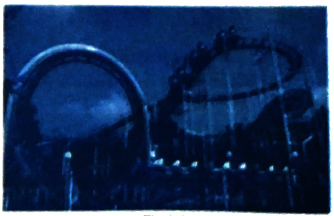
Essel World is one of India's largest amusement parks that offers a diverse range of thrilling des, water attractions and entertainment options for visitors of all ages. The park is known for its iconic -Vater Kingdom" section, making it a popular destination for family outings and fun-filled adventure. The ket charges for the park are ₹ 150 per child and ₹ 250 per adult.
Image
On a day, the cashier of the park found that 300 tickets were sold and an amount of ₹$ 55,000$ was collected. Based on the above, answer the following questions:
(i) If the number of children visited be $x$ and the number of adults visited be $y$, then write the given situation algebraically.
(ii) (a) How many children visited the amusement park that day?
OR
(b) How many adults visited the amusement park that day?
(iii) How much amount will be collected if 250 children and 100 adults visit the amusement park?
View full solution
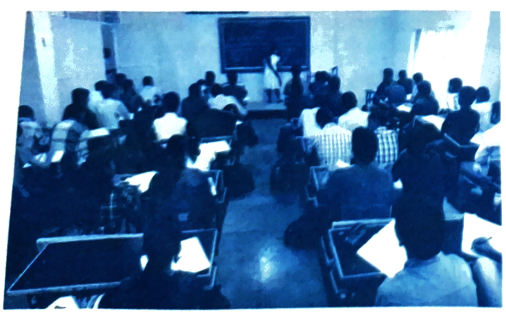
A coaching institute of Mathematics conducts classes in two batches I and 11 and fees for rich and poor children are different. In batch I, there are 20 poor and 5 rich children, whereas in batch II, there are 5 poor and 25 rich children. The total monthly collection of fees from batch I is ₹9,000 and from batch II is ₹ 26,000 . Assume that each poor child pays ₹ $x$ per month and each rich child pays ₹ y per month.
Image
Based on the aborv information, ansuyy the followents puestions:
(i) Represent the information given ahorv in terms of $x$ and $y$.
(ii) Find the monthly for puid by a poor child.
(iii) Find the difference in the monthly fov paid ty a poor child and a rikh chill.
(iv) If there are 10 poor and 20 rich children in Mutch 11 , what is the tolat mowhly collectious of fwa fome batch 11 .
View full solution
It is common that governments revise travel fares from time to time based on various factors such as inflation (a general increase in prices and fall in the purchasing value of money) on different types of vehicles like auto rickshaws, taxis, radio cabs etc. The auto charges in a city comprise of a fixed charge together with the charge for the distance covered. Study the following situations:
Image

Name of the CityDistance travelled (km)( Amount paid (₹))
City A1075
15110
City B891
14145
(i) If the fixed charges of autorickshaw be ₹ $x$ and the running charges be ₹ $y$ per km, the pair of linoar equations representing the travel in city $A$ is
(a) $x+10 y=75, x+5 y=145$
(b) $x+10 y=75, x+15 y=110$
(c) $x+8 y=91, x+14 y=145$
(d) $x+8 y=145, x+14 y=91$
(ii) If the fixed charges of autorikshaw be ₹$ x$ and the running charges be ₹$ y$ per km, the pair of linoar equations representing the travel in City $B$ is
(a) $x+10 y=75, x+5 y=145$
(b) $x+10 y=75, x+15 y=110$
(c) $x+8 y=91, x+14 y=145$
(d) $x+8 y=145, x+14 y=91$
(iii) The amount paid by a person travelling 100 km in city $A$ is
(a) ₹ 310 $\qquad$ (b) ₹ 510 $\qquad$ (c) ₹ 705 $\qquad$ (d) ₹ 710
(iv) The amount paid by a person travelling 60 km in city $B$ is
(a) ₹ 370 $\qquad$ (b) ₹ 578 $\qquad$ (c) ₹ 559 $\qquad$ (d) ₹ 610
View full solution
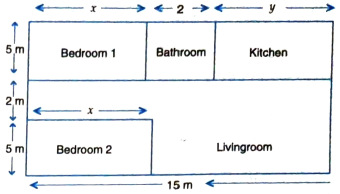
Ravish is planning to buy a house whose layout is given below. The design and the measurement has been made such that areas of two bedrooms and kitchen together is $95 m^2$.
Image
(i) The pair of linear equations in two variables describing this situation is
(a) $2 x+y=19, x+y=13$
(b) $x+2 y=19, x+y=13$
(c) $2 x+y=13, x+y=13$
(d) $2 x+y=13, x+y=19$
(ii) The perimeter and area of the house are respectively
(a) $54 m, 180 m^2$
(b) $180 m, 54 m^2$
(c) $27 m, 90 m^2$
(d) $108 m, 180 m^2$
(iii) The value of $x y$ is
(a) 42 $\qquad$ (b) 48 $\qquad$ (c) 49 $\qquad$ (d) 13
(iv) The value of $x-y$ is
(a) 13 $\qquad$ (b) 1 $\qquad$ (c) -1 $\qquad$ (d) .42
View full solution
A test consists of 'True' or 'False' questions. One mark awarded for every correct answer while $\frac{1}{4}$ mark is deducted for every wrong answer. A student knew answers to some of the questions. Rest of the questions he attempted by guessing. He answered 120 questions and scored 95 marks.
(i) If answer to all questions he attempted by guessing were wrong, then the number of questions he answered correctly is
(a) 24 $\qquad$ (b) 96 $\qquad$ (c) 100 $\qquad$ (d) 90
(ii) The number of questions he guessed, is
(a) 20 $\qquad$ (b) 96 $\qquad$ (c) 20 $\qquad$ (d) 90
(iii) If answers to all questions he attempted by guessing were wrong and answered 80 correctly, then how many marks he got?
(a) 40 $\qquad$ (b) 45 $\qquad$ (c) 70 $\qquad$ (d) 35
(iv) If answer to all questions he attempted by guessing were wrong, then the number of questions answered correctly to score 95 marks is
(a) 100 $\qquad$ (b) 105 $\qquad$ (c) 90 $\qquad$ (d) 95
View full solution

Generate a Linear Equations in Two Variables paper free

Pick question groups from the list above, set marks and difficulty, and export a branded PDF with step-by-step answer keys. First 3 chapters free — no signup.

Download App