Questions

3 Marks Question

🎯

Test yourself on this topic

8 questions · timed · auto-graded

Question 13 Marks
One card is drawn from a well-shuffled deck of 52 cards. Find the probability of getting
i. a king of red colour
ii. a face card
iii. a red face card
iv. the jack of hearts
v. a spade
vi. the queen of diamonds
View full question & answer
Question 23 Marks
Prove that: $\frac{\cos ^3 \theta+\sin ^3 \theta}{\cos \theta+\sin \theta}+\frac{\cos ^3 \theta-\sin ^3 \theta}{\cos \theta-\sin \theta}=2$.
Answer
LHS $=\frac{\cos ^3 \theta+\sin ^3 \theta}{\cos \theta+\sin \theta}+\frac{\cos ^3 \theta-\sin ^3 \theta}{\cos \theta-\sin \theta}$
$=\frac{(\cos \theta+\sin \theta)\left(\cos ^2 \theta+\sin ^2 \theta-\sin \theta \cos \theta\right)}{(\cos \theta+\sin \theta)}+\frac{(\cos \theta-\sin \theta)\left(\cos ^2 \theta+\sin ^2 \theta+\sin \theta \cos \theta\right)}{(\cos \theta-\sin \theta)}$
$=(1-\sin \theta \cos \theta)+(1+\sin \theta \cos \theta)$
$=1+1-\sin \theta \cos \theta+\sin \theta \cos \theta$
$=2=$ RHS
View full question & answer
Question 33 Marks
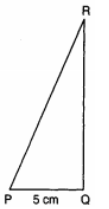
In $\triangle P Q R$, right angled at Q, PR + QR = 25 cm and PQ = 5 cm. Determine the values of sinP, cosP and tanP.
Answer

Image
In $\triangle P Q R$, by Pythagoras theorem
$PR ^2= PQ ^2+ QR ^2$
$\Rightarrow(25-Q R)^2=5^2+Q R^2[\because P R+Q R=25 cm \Rightarrow P R=25- QR ]$
$625-50 QR + QR ^2=25+ QR ^2$
$\Rightarrow 600-50 Q R=0$
$\Rightarrow Q R=\frac{600}{50}=12 cm$
Now, PR + QR = 25 cm
$\Rightarrow PR =25- QR =25-12=13 cm$
Hence, sin P = $\frac{Q R}{P R}=\frac{12}{13}, \cos P=\frac{P Q}{P R}=\frac{5}{13}$ and, $\tan P=\frac{Q R}{P Q}=\frac{12}{5}$
View full question & answer
Question 43 Marks
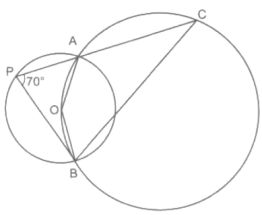
In a given figure, two circles intersect at A and B. The centre of the smaller circle is O and it lies on the circumference of the larger circle. If $\angle APB =70^{\circ}$, find $\angle ACB$.
Image
Answer
Consider the smaller circle whose centre is given as O.
The angle subtended by an arc at the centre of the circle is double the angle subtended by the arc in the remaining part of the circle.
Image
Therefore,we have,
$\angle AOB =2 \angle APB$
$=2\left(70^{\circ}\right)$
$\angle AOB =140^{\circ}$
Now consider the larger circle and the points A,C, B and O along its circumference. AOBC from a cycle quadrilateral. In a cyclic quadrilateral , the opposite angles are supplementary, meaning that the opposite angles add up to $180^{\circ}$.
$\angle AOB +\angle ACB =180^{\circ}$
$\angle ACB =180^{\circ}-\angle AOB$
$=180^{\circ}-140^{\circ}$
$\angle ACB =40^{\circ}$
Therefore, the measure of angle ACB is $40^{\circ}$.


View full question & answer
Question 53 Marks
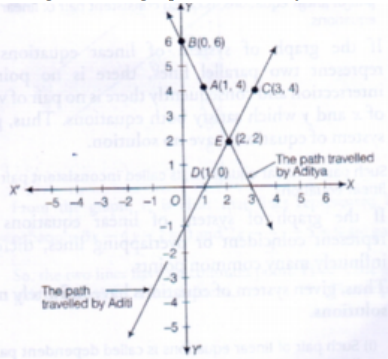
Aditya is walking along the line joining points (1,4) and (0,6). Aditi is walking along the line joining points (3,4) and (1,0). Represent the graph and find the point where both cross each other
Answer
Let the given points be A(1,4) , B(0,6) , C(3,4) and D(1,0).
On plotting points A and B and joining them, we get the path travelled by Aditya. Similarly, on plotting points C and D and joining them, we get path travelled by Aditi.
Image
It is clear from the graph that both of them cross each other at point E(2,2).
View full question & answer
Question 63 Marks
Solve the pair of linear equations $\sqrt{2} x-\sqrt{3} y=0$ and $\sqrt{3} x-\sqrt{8} y=0$ by substitution method.
Answer
The given equations are
$\sqrt{2} x-\sqrt{3} y=0$...........(i)
$\sqrt{3} x-\sqrt{8} y=0$...........(ii)
From equation (i), we obtain:
$x=\frac{\sqrt{3} y}{\sqrt{2}}$...(iii)
Substituting this value in equation (ii), we obtain:
$\sqrt{3}\left(\frac{\sqrt{3} y}{\sqrt{2}}\right)-\sqrt{8} y=0$
$\frac{3 y}{\sqrt{2}}-2 \sqrt{2} y=0$
$y\left(\frac{3}{\sqrt{2}}-2 \sqrt{2}\right)=0$
$y=0$
Substituting the value of y in equation (iii), we obtain:
x = 0
$\therefore x=0, y=0$
Hence the solution of given equation is (0,0).
View full question & answer
Question 73 Marks
If $\alpha, \beta$ are zeroes of the quadratic polynomial $x^2+9 x+20$, form a quadratic polynomial whose zeroes are ($\alpha+$1 and $(\beta+1)$.
Answer
$\because \alpha$ and $\beta$ are zeroes of given polynomial
So, $x^2+9 x+20=0$
$x^2+4 x+5 x+20=0$
$x(x+4)+5(x+4)=0$
$(x+5)(x+4)=0$
$x=-5$ and $x=-4$
$\therefore \alpha=-5$ and $\beta=-4$
Now, $\alpha$ + 1 = -4 and $\beta$ + 1 = -3
So, product of zeroes= (-4) $ \times$ (-3) = 12
Sum of zeroes = -7
Now polynomial $=x^2-$ (sum of zeroes) $x+$ (product of zeroes)
Polynomial $=x^2+7 x+12$
View full question & answer
Question 83 Marks
Prove that $\sqrt{5}$ is irrational.
Answer
Let us prove $\sqrt{5}$ irrational by contradiction.
Let us suppose that $\sqrt{5}$ is rational. It means that we have co-prime integers a and b $(b \neq 0)$
Such that $\sqrt{5}=\frac{a}{b}$
$\Rightarrow b \sqrt{5}=a$
Squaring both sides, we get
$\Rightarrow 5 b^2=a^2$ ... (1)
It means that 5 is factor of $a^2$
Hence, 5 is also factor of a by Theorem. ... (2)
If, 5 is factor of a , it means that we can write a = 5c for some integer c .
Substituting value of a in (1) ,
$5 b^2=25 c^2$
$\Rightarrow b^2=5 c^2$
It means that 5 is factor of $b ^2$
Hence, 5 is also factor of b by Theorem. ... (3)
From (2) and (3) , we can say that 5 is factor of both a and b .
But, a and b are co-prime .
Therefore, our assumption was wrong. $\sqrt{5}$ cannot be rational. Hence, it is irrational.
View full question & answer
3 Marks Question - Maths STD 10 Questions - Vidyadip