Questions

5 Marks Questions

🎯

Test yourself on this topic

6 questions · timed · auto-graded

Question 15 Marks
The following data gives the distribution of total monthly household expenditure of 200 families of a village. Find the modal monthly expenditure of the families. Also, find the mean monthly expenditure:
Expenditure (in ₹)Frequency
1000-150024
1500-200040
2000-250033
2500-300028
3000-350030
3500-400022
4000-450016
4500-50007
Answer
We may observe from the given data that maximum class frequency is 40 belonging to 1500 - 2000 interval.
Class size (h) = 500
Mode = $1+\frac{f-f_1}{2 f-f_1-f_2} \times h$
Lower limit $(l)$ of modal class = 1500
Frequency (f) of modal class = 40
Frequency $\left( f _1\right)$ of class preceding modal class = 24
Frequency $\left( f _2\right)$ of class succeeding modal class = 33
mode = $1500+\frac{40-24}{2 \times 40-24-33} \times 500$
$=1500+\frac{16}{80-57} \times 500$
= 1500 + 347.826
= 1847.826 ≈ 1847.83
Expenditure (in ₹.)Number of families $f _{ i }$$x _{ i }$$d_i=x_i-2750$$u _{ i }$$u _{ i } f _{ i }$
1000-1500241250-1500-3-72
1500-2000401750-1000-2-80
2000-2500332250-500-1-33
2500-3000282750=a000
3000-3500303250500130
3500-40002237501000244
4000-45001642501500348
4500-5000747502000428
$\Sigma f_i=200$ $\Sigma f_i d_i=-35$
Mean $\bar{x}=a+\frac{\Sigma f_i d_i}{\Sigma f_i} \times h$
$\bar{x}=2750+\frac{-35}{200} \times 500$
$\bar{x}=2750-87.5$
$\bar{x}=2662.5$
View full question & answer
Question 25 Marks
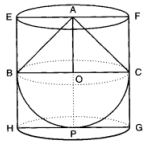
A solid toy is in the form of a hemisphere surmounted by a right circular cone. Height of the cone is 2 cm and the diameter of the base is 4 cm. If a right circular cylinder circumscribes the solid. Find how much more space it will cover.
Answer
Let BPC be the hemisphere and ABC be the cone mounted on the base of the hemisphere. Let EFGH be the right circular cylinder circumscribing the given toy.
Image
We have,
Given radius of cone, cylinder and hemisphere (r) = $\frac{4}{2}=2 cm$
Height of cone (l) = 2 cm
Height of cylinder (h) = 4 cm
Now, Volume of the right circular cylinder = $\pi r ^2 h=\pi \times 2^2 \times 4 cm^3=16 \pi cm^3$
Volume of the solid toy = $\left\{\frac{2}{3} \pi \times 2^3+\frac{1}{3} \pi \times 2^2 \times 2\right\} cm ^3=8 \pi cm^3$
$\therefore$ Required space = Volume of the right circular cylinder - Volume of the toy
$=16 \pi cm^3-8 \pi cm^3=8 \pi cm^3$.
Hence, the right circular cylinder covers $8 \pi cm^3$ more space than the solid toy.
So, remaining volume of cylinder when toy is inserted in it = $8 \pi cm^3$
View full question & answer
Question 35 Marks
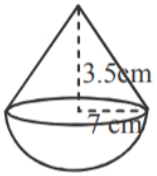
A solid is in the shape of a hemisphere surmounted by a cone. If the radius of hemisphere and base radius of cone is 7 cm and height of cone is 3.5 cm, find the volume of the solid. (Take $\pi=\frac{22}{7}$ )
Answer
Volume of solid = $\frac{1}{3} \times \frac{22}{7} \times(7)^2 \times 3.5+\frac{2}{3} \times \frac{22}{7} \times(7)^3$
$=\frac{22}{7} \times(7)^2 \times\left[\frac{3.5}{3}+\frac{2}{3} \times 7\right]$
$=898 \frac{1}{3}$ or $898.33 cm^3$
Image
View full question & answer
Question 45 Marks
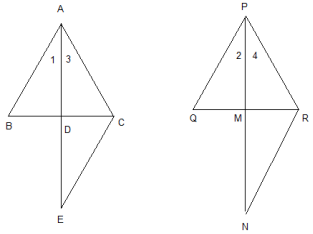
Sides AB and AC and median AD of a triangle ABC are respectively proportional to sides PQ and PR and median PM of another triangle PQR. Show that $\triangle A B C \sim \triangle P Q R$.
Answer

Image
Given : In $\triangle A B C$ and $\triangle P Q R$ The AD and PM are their medians,
such that $\frac{A B}{P Q}=\frac{A D}{P M}=\frac{A C}{P R}$
To prove : $\triangle A B C \sim \triangle P Q R$
Construction : Produce AD to E such that AD = DE and produce PM to N such that PM = MN. Join CE and RN.
Proof : In $\triangle A B D$ and $\triangle E D C$
AD = DE
$\angle A D B=\angle E D C$ (vertically opposite angles)
BD = DC(as AD is a median)
$\therefore \quad \triangle A B D \equiv \triangle E D C$ (By SAS congruency)
or, AB = CE (By CPCT)
Similarly, PQ = RN
$\frac{A B}{P Q}=\frac{A D}{P M}=\frac{A C}{P R}$ (Given)
or, $\frac{C E}{R N}=\frac{2 A D}{2 P M}=\frac{A C}{P R}$
or $\frac{C E}{R N}=\frac{A E}{P N}=\frac{A C}{P R}$
So $\triangle A C E \sim \triangle P R N$
$\angle 3=\angle 4$
Similarly $\angle 1=\angle 2$
$\angle 1+\angle 3=\angle 2+\angle 4$
So $\angle A=\angle P$ and
$\frac{A B}{P Q}=\frac{A C}{P R}$ (given)
Hence $\triangle A B C \sim \triangle P Q R$
View full question & answer
Question 55 Marks
The sum of squares of two consecutive multiples of 7 is 637. Find the multiples.
Answer
According to the question, let the consecutive multiples of 7 be 7x and 7x +7
$(7 x)^2+(7 x+7)^2=637$
or, $49 x^2+49 x^2+49+98 x=637$
or, $98 x^2+98 x-588=0$
or, $x^2+x-6=0$
or, $(x+3)(x-2)=0$
or, $x=-3,2$
Rejecting the value, x=2
Thus,the required multiples are, 14 and 21.
View full question & answer
Question 65 Marks
Solve for x:$\left(\frac{2 x}{x-5}\right)^2+5\left(\frac{2 x}{x-5}\right)-24=0, x \neq 5$
Answer
We have given,
$\left(\frac{2 x}{x-5}\right)^2+5\left(\frac{2 x}{x-5}\right)-24=0$
Let $\frac{2 x}{(x-5)}$ be $y$
$\therefore \quad u^2+5 u-24=0$
Now factorise,
$y^2+8 y-3 y-24=0$
$y(y+8)-3(y+8)=0$
$(y+8)(y-3)=0$
$y=3,-8$
Putting y=3
$\frac{2 x}{x-5}=3$
2x = -8x + 40
10x = 40
x = 4
Hence, x is 15 , 4
View full question & answer
5 Marks Questions - Maths STD 10 Questions - Vidyadip