Questions

M.C.Q (1 Marks)

🎯

Test yourself on this topic

18 questions · timed · auto-graded

MCQ 11 Mark
The distribution below gives the marks obtained by 80 students on a test:
MarksLess than 10Less than 20Less than 30Less than 40Less than 50Less than 60
Number of Students31227577580
The modal class of this distribution is:
  • 30 - 40
  • B
    20 - 30
  • C
    50 - 60
  • D
    $10 - 20$
Answer
Correct option: A.
30 - 40
(a) 30-40
Explanation: 30 - 40
View full question & answer
MCQ 21 Mark
3 rotten eggs are mixed with 12 good ones. One egg is chosen at random. The probability of choosing a rotten egg is
  • A
    $\frac{1}{15}$
  • B
    $\frac{4}{5}$
  • $\frac{1}{5}$
  • D
    $\frac{2}{5}$
Answer
Correct option: C.
$\frac{1}{5}$
(c) $\frac{1}{5}$
Explanation: Number of possible outcomes $=3$
Number of Total outcomes $=15$
$\therefore$ Required Probability $=\frac{3}{15}=\frac{1}{5}$
View full question & answer
MCQ 31 Mark
A die is thrown once. The probability of getting an even number is
  • A
    $\frac{1}{3}$
  • B
    $\frac{5}{6}$
  • C
    $\frac{1}{6}$
  • $\frac{1}{2}$
Answer
Correct option: D.
$\frac{1}{2}$
(d) $\frac{1}{2}$
Explanation: Number of all possible outcomes $=6$.
Even numbers are 2,4, 6. Their number is 3 .
$\therefore P$ (getting an even number) $=\frac{3}{6}=\frac{1}{2}$
View full question & answer
MCQ 41 Mark
A pendulum swings through an angle of $30^{\circ}$ and describes an arc $8.8 \ cm$ in length. Find the length of the pendulum.
  • A
    $8.8 \ cm$
  • B
    $17 \ cm$
  • C
    $15.8 \ cm$
  • $16.8 \ cm$
Answer
Correct option: D.
$16.8 \ cm$
Length of the pendulum $=$ Radius of a sector of the circle
Arc length $=8.8$
$\frac{\theta}{360}(2 \pi r)=8.8$
$\frac{30}{360} \times 2 \times \frac{22}{7} \times r=8.8$
$r=16.8 \ cm$
View full question & answer
MCQ 51 Mark
In a circle of radius $14 \ cm$ , an arc subtends an angle of $120^{\circ}$ at the centre. If $\sqrt{3}=1.73$ then the area of the segment of the circle is
  • A
    $124.63 \ cm^2$
  • B
    $130.57 \ cm^2$
  • $120.56 \ cm^2$
  • D
    $118.24 \ cm^2$
Answer
Correct option: C.
$120.56 \ cm^2$
 $ar($ segment $)=\left(\frac{\pi r^2 \theta}{360}-r^2 \sin \frac{\theta}{2} \cos \frac{\theta}{2}\right)$
$=\left(\frac{22}{7} \times 14 \times 14 \times \frac{120}{360}\right)-\left(14 \times 14 \times \sin 60^{\circ} \cos 60^{\circ}\right)$
$=\left(\frac{616}{3}-\frac{\sqrt{3}}{2} \times \frac{1}{2} \times 14 \times 14\right) \ cm^2$
$=(205.33-49 \times 1.73) \ cm^2$
$=(205.33-84.77) \ cm^2$
$=120.56 \ cm^2$
View full question & answer
MCQ 71 Mark
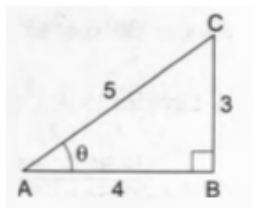
If $\cos \theta=\frac{4}{5}$ then $\tan \theta=?$
  • $\frac{3}{4}$
  • B
    $\frac{5}{3}$
  • C
    $\frac{4}{3}$
  • D
    $\frac{3}{5}$
Answer
Correct option: A.
$\frac{3}{4}$
$\cos \theta=\frac{4}{5}=\frac{A B}{A C}$
$\therefore B C^2=A C^2-A B^2$
$=25-16$
$=9$
$\Rightarrow B C=3$
$\therefore \tan \theta=\frac{B C}{A B}=\frac{3}{4}$

Image
View full question & answer
MCQ 81 Mark
$1+\frac{\cot ^2 \alpha}{1+\operatorname{cosec} \alpha}=$
  • A
    $\sin \alpha$
  • B
    $\sec \alpha$
  • $\operatorname{cosec} \alpha$
  • D
    $\tan \alpha$
Answer
Correct option: C.
$\operatorname{cosec} \alpha$
$=1+\frac{\cot ^2 \alpha}{1+\operatorname{cosec} \alpha}$
$=1+\frac{\operatorname{cosec}^2 \alpha-1}{1+\operatorname{cosec\alpha }}$
$=1+\frac{(\operatorname{cosec} \alpha-1)(\operatorname{cosec} \alpha+1)}{1+\operatorname{cosec} \alpha}$
$=1+\operatorname{cosec} \alpha-1$
$=\operatorname{cosec} \alpha$
View full question & answer
MCQ 91 Mark
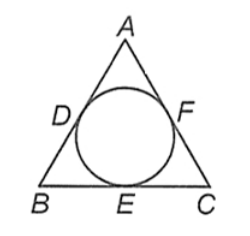
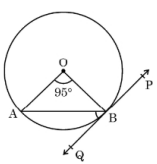
A circle inscribed in $\triangle \text{ABC}$ having $AB =10 \ cm, BC =12 \ cm, CA =28 \ cm$ touching sides at $\text{D, E, F} ($respectively$)$. Then $\text{AD + BE + CF} = ........$​​​​​​​
Image
  • A
    $22 \ cm$
  • $25 \ cm$
  • C
    $18 \ cm$
  • D
    $20 \ cm$
Answer
Correct option: B.
$25 \ cm$
Image
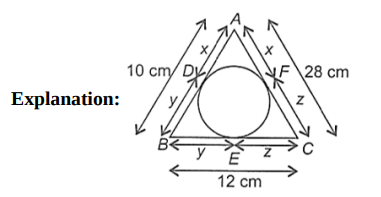
$x+y=10 \ cm \ldots \text { (i) }$
$y+z=12 \ cm \ldots \text { (ii) }$
$x+z=28 \ cm \ldots \text { (iii) }$
Adding $(i), (ii)$ and $(iii),$ we get
$2(x+y+z)=50$
$\Rightarrow x+y+z=25 \ cm$
View full question & answer
MCQ 111 Mark
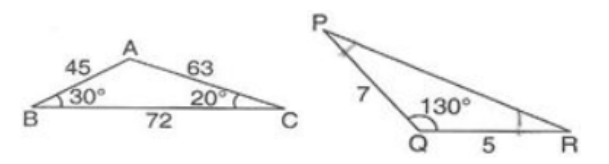
In the figures find the measures of $\angle P$ and $\angle R$
Image
  • $20^{\circ}, 30^{\circ}$
  • B
    $50^{\circ}, 40^{\circ}$.
  • C
    $30^{\circ}, 20^{\circ}$.
  • D
    $40^{\circ}, 50^{\circ}$.
Answer
Correct option: A.
$20^{\circ}, 30^{\circ}$
Explanation :
In triangle $\text{ABC} , \angle A +\angle B +\angle C =180^{\circ}$
$\Rightarrow \angle A+30^{\circ}+20^{\circ}=180^{\circ}$
$\Rightarrow \angle A=130^{\circ}$
In triangle $\text{ABC}$ and $\text{QRP}, \frac{A B}{Q R}=\frac{A C}{P Q}$
$\Rightarrow \frac{45}{5}=\frac{63}{7} \Rightarrow \frac{9}{1}=\frac{9}{1}$
Since sides of triangles $\text{ABC}$ and $\text{QRP}$ are proportional, and included angles are equal,
therefore by $\text{SAS}$ similarity criteria,
$\triangle ABC \sim \Delta QRP$
$\angle A=\angle Q, \angle B=\angle R, \angle C=\angle P$
$\Rightarrow \angle P=20^{\circ}, \angle R=30^{\circ}$
View full question & answer
MCQ 121 Mark
In what ratio, does x-axis divide the line segment joining the points A(3, 6) and B(-12, -3)?
  • $ 2 : 1$
  • B
    $1 : 2$
  • C
    $4 : 1$
  • D
    $1 : 4$
Answer
Correct option: A.
$ 2 : 1$
(a) $2: 1$
Explanation: $2: 1$
View full question & answer
MCQ 131 Mark
$\text{ABCD}$ is a rectangle whose three vertices are $B (4,0), C (4,3)$ and $D (0,3).$ The length of one of its diagonals is
  • $5$
  • B
    $3$
  • C
    $4$
  • D
    $25$
Answer
Correct option: A.
$5$
Three vertices of a rectangle $\text{ABCD}$ are $B (4,0), C (4,3)$ and $D (0,3)$ length of one of its diagonals
$BD=\sqrt{(4-0)^2+(0-3)^2}$
$=\sqrt{4^2+3^2}$
$=\sqrt{16+9}$
$=\sqrt{25}$
$=5$
View full question & answer
MCQ 141 Mark
What is the common difference of an $AP$ in which $a _{18}- a _{14}=32$ ?
  • A
    $-8$
  • B
    $4$
  • C
    $-4$
  • $8$
Answer
Correct option: D.
$8$
$a _{18}- a _{14}=32$
$(18-14) d =32$
$\Rightarrow 4 d=32$
$\Rightarrow d=8$
View full question & answer
MCQ 151 Mark
In the Maths Olympiad of 2020 at Animal Planet, two representatives from the donkey’s side, while solving a
quadratic equation, committed the following mistakes.
i. One of them made a mistake in the constant term and got the roots as 5 and 9.
ii. Another one committed an error in the coefficient of x and he got the roots as 12 and 4.
But in the meantime, they realised that they are wrong and they managed to get it right jointly. Find the quadratic equation.
  • A
    $2 x^2+7 x-24=0$
  • B
    $x^2+4 x+14=0$
  • C
    $3 x^2-17 x+52=0$
  • $x^2-14 x+48=0$
Answer
Correct option: D.
$x^2-14 x+48=0$
(d) $x^2-14 x+48=0$
Explanation: For $1^{\text {st }}$ one,
Let the equation be $x ^2+ ax + b =0$
Since roots are 5 and 9
$\therefore a=-14 \text { and } b=45$
For $2^{\text {nd }}$ one,
Let the equation be $x ^2+ px + q =0$
Since roots are 12 and 4.
$\therefore p=-16 \text { and } q=48$
Now, according to the question, b and p both are wrong.
Therefore, the correct equation would be
$x^2-14 x+48=0$
View full question & answer
MCQ 161 Mark
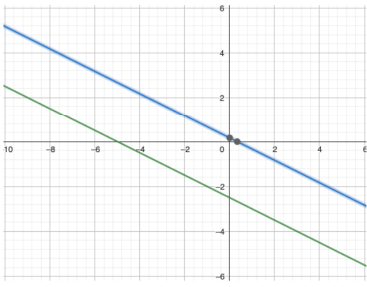
The pair of equations $x+2 y+5=0$ and $-3 x-6 y+1=0$ have
Image
  • A
    a unique solution
  • B
    infinitely many solutions
  • no solution
  • D
    exactly two solutions
Answer
Correct option: C.
no solution
Given, equations are
$x+2 y+5=0,$ and
$-3 x-6 y+1=0$
Comparing the equations with general form:
$a_1 x+b_1 y+c_1=0$
$a_2 x+b_2 y+c_2=0$
Here, $a_1=1, b_1=2, c_1=5$
And $a_2=-3, b_2=-6, c_2=1$
Taking the ratio of coefficients to compare
$\frac{a_1}{a_2}=\frac{-1}{3}, \frac{b_1}{b_2}=\frac{-1}{3}, \frac{c_1}{c_2}=\frac{5}{1}$
So $\frac{a_1}{a_2}=\frac{b_1}{b_2} \neq \frac{c_1}{c_2}$
This represents a pair of parallel lines.
Hence, the pair of equations has no solution.
View full question & answer
MCQ 171 Mark
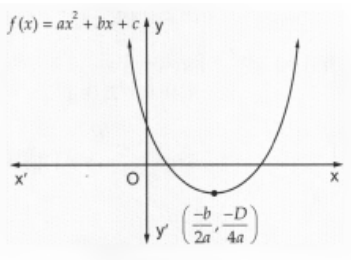
Figure show the graph of the polynomial $f(x)=a x^2+b x+c$ for which
Image
  • a > 0, b < 0 and c > 0
  • B
    a < 0, b < 0 and c < 0
  • C
    a < 0, b > 0 and c > 0
  • D
    a > 0, b > 0 and c < 0
Answer
Correct option: A.
a > 0, b < 0 and c > 0
(a) a $>0$, b $<0$ and c $>0$
Explanation: Clearly, $f(x)=a x^2+b x+c$ represent a parabola opening upwards.
Therefore, $a>0$
The vertex of the parabola is in the fourth quadrant, therefore $b <0$
$y=a x^2+b x+c$ cuts Y axis at P which lies on OY .
Putting $x =0$ in $y=a x^2+b x+c$, we get $y = c$.
So the coordinates of P is $(0, c )$.
Clearly, P lies on OY.$\Rightarrow c >0$
Hence, $a>0, b<0$ and $c>0$
View full question & answer
MCQ 181 Mark
(HCF × LCM) for the numbers 30 and 70 is:
  • A
    21
  • B
    70
  • 2100
  • D
    210
Answer
Correct option: C.
2100
(c) 2100
Explanation: As we know HCF $\times$ LCM $=$ Product of the Numbers
Hence HCF $\times \operatorname{LCM}(30,70)=30 \times 70=2100$
View full question & answer
M.C.Q (1 Marks) - Maths STD 10 Questions - Vidyadip