Questions

5 Marks Questions

🎯

Test yourself on this topic

6 questions · timed · auto-graded

Question 15 Marks
Let there be an $A.P.$ with first term $'a\ ',$ common difference $'d\ '.$ If $a_n$ denotes its $n^{\text {th }}$ term and $S_n$ the sum of first $n$ terms, find. $n$ and $S _{ n } ,$ if $a =5, d=3$ and $a _{ n }=50.$
Answer
Given,
First term$(a) = 5$
Common difference $(d)=3$
and, term $\left(a_n\right)=50$
$\Rightarrow a+(n-1) d=50$
$\Rightarrow 5+(n-1)(3)=50$
$\Rightarrow 5+3 n-3=50$
$\Rightarrow 3 n=50-5+3$
$\Rightarrow 3 n=48$
$\Rightarrow n=\frac{48}{3}=16$
Therefore, $S _{ n }=\frac{n}{2}\left[a+a_n\right]$
$=\frac{16}{2}[5+50]$
$=8 \times 55$
$=440$
View full question & answer
Question 25 Marks
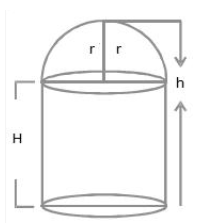
A building is in the form of a cylinder surmounted by a hemispherical dome. The base diameter of the dome is equal to $\frac{2}{3}$ of the total height of the building. Find the height of the building, if it contains $67 \frac{1}{21} m^3$ of air.
Answer

Image
Let the radius of the hemispherical dome be $r$ and the total height of the building be $h$.
Since, the base diameter of the dome is equal to $\frac{2}{3}$ of the total height
$2 r=\frac{2}{3} h$
$\Rightarrow r=\frac{h}{3}$
Let H be the height of the cylindrical position.
$\Rightarrow H=h-r=h-\frac{h}{3}=\frac{2 h}{3}$
Volume of air inside the building $=$ Volume of air inside the dome $+$ Volume of air inside the cylinder
$\Rightarrow 67 \frac{1}{21}=\frac{2}{3} \pi r^3+\pi r^2 H$
$\Rightarrow \frac{1408}{21}=\pi r^2\left(\frac{2}{3} r+H\right)$
$\Rightarrow \frac{1408}{21}=\frac{22}{7} \times\left(\frac{h}{3}\right)^2\left(\frac{2}{3} \times \frac{h}{3}+\frac{2 h}{3}\right)$
$\Rightarrow \frac{1408 \times 7}{22 \times 21}=\frac{h^2}{9} \times\left(\frac{2 h}{9}+\frac{2 h}{3}\right)$
$\Rightarrow \frac{64}{3}=\frac{h^2}{9} \times\left(\frac{8 h}{9}\right)$
$\Rightarrow \frac{64 \times 9 \times 9}{3 \times 8}=h^3$
$\Rightarrow h^3=8 \times 27$
$\Rightarrow h=6$
Thus, the height of the building is $6 m $.
View full question & answer
Question 35 Marks
A hemispherical depression is cut out from one face of a cubical wooden block such that the diameter $l$ of the hemisphere is equal to the edge of the cube. Determine the surface area of the remaining solid.
Answer
According to the question, a hemispherical depression is cut from one face of the cubical block such that the diameter $l$ of the emmisphere is equal to the edge of the cube.
Let the radius of hemisphere $=r$
$\therefore r=\frac{l}{2}$
Now, the required surface area $=$ Surface area of cubical block $-$ Area of base of hemisphere $+$ Curved surface area of hemisphere.
$=6(\text { side })^2-\pi r^2+2 \pi r^2$
$=6 l^2-\pi\left(\frac{l}{2}\right)^2+2 \pi\left(\frac{l}{2}\right)^2$
$=6 l^2-\frac{\pi l^2}{4}+\frac{\pi}{2} l^2$
$=6 l^2+\frac{\pi l^2}{4}$
Surface area $=\frac{1}{4}(24+\pi) l^2$ units.
$=\frac{1}{4}\left(24+\frac{22}{7}\right) l^2$
View full question & answer
Question 45 Marks
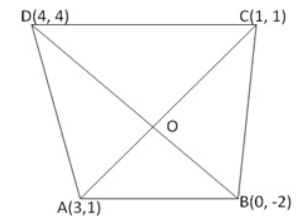
Show that the points $A(3,1), B(0,-2), C(1,1)$ and $D(4,4)$ are the vertices of a parallelogram $A B C D$.
Answer
Let A(3, 1) B(0, - 2) C(1,1) and D(4, 4) be the vertices of quadrilateral
Join AC, BD. AC and BD, intersect other at the point O.

Image
We know that the diagonals of a parallelogram bisect each other
Therefore, O is midpoint of AC as well as that of BD
Now midpoint of AC is $\left(\frac{3+1}{2}, \frac{1+1}{2}\right)$ ie., $(2,1)$
And midpoint of BD is $\left(\frac{0+4}{2}, \frac{-2+4}{2}\right)$ ie., $(2,1)$
Mid point of AC is the same as midpoint of BD
Hence, A, B, C, D, are the vertices of a parallelogram ABCD
View full question & answer
Question 55 Marks
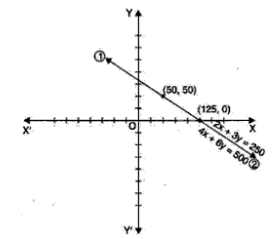
Sangeeta went to a book$-$seller's shop and purchased $2$ textbook of $IX$ Mathematics and $3$ textbook of $X$ mathematics for $Rs.250.$ Her friend Meenu also bought $4$ textbooks of $IX$ Mathematics and $6$ textbooks of $X$ maths of same kind for $Rs.500.$ Represents this situation algebraically and graphically.
Answer
Let the cost of a $IX$ Maths textbook be $Rs.x$ and the cost of a $X$ Maths textbook be $Rs.y.$
Then the algebraic representation is given by the following equations
$2x + 3y = 250 ...(1)$
and $4x + 6y = 500 ...(2)$
To represent these equations graphically, we find two
solutions for each equation.
These solution are given below:
For equations $(1) 2 x+3 y=250$
$\Rightarrow y=\frac{250-2 x}{3}$
Table $1$ of solutions
$X$ $50$ $125$
$y$ $50$ $0$
For equation $(2)$
$4 x+6 y=500$
$\Rightarrow 6 y=500-4 x$
$\Rightarrow y=\frac{500-4 x}{6}$
Table $2$ of solutions
$X$ $50$ $125$
$y$ $50$ $0$
We plot these points on a graph paper, we find that both the lines coincide.
This is so, because, both the equations are equivalent,
i.e., one can be derived from the other.
Image
View full question & answer
Question 65 Marks
A person invested some amount at the rate of $12 \%$ simple interest and the remaining at $10 \%$. He received yearly interest of $₹ 130$ but if he had interchanged the amount invested, he would have received $₹ 4$ more as the interest. How much money did he invest at different rates?
Answer
Suppose that he invested $₹x$ at the rate of $12 \%$ simple interest and $₹y $ at the rate $10 \%$ simple interest.
Then, according to the question, $\frac{12 x}{100}+\frac{10 y}{100}=130$
$\Rightarrow 12 x+10 y=13000\ldots \ldots \text{Dividing throughout by 2}$
$\Rightarrow 6 x+5 y=6500 \ldots \ldots \text{(1)}$
and, $\frac{12 y}{100}+\frac{10 x}{100}=134$
$\Rightarrow 12 y+10 x=13400$
$\Rightarrow 6 y+5 x=6700\ldots \ldots \text{Dividing throughout by 2}$
$\Rightarrow 5 x+6 y=6700\ldots \ldots(2)$
Dividing throughout by $2$ Multiplying equation $(1)$ by $6$ and equation $(2)$ by $5 ,$ we get
$36 x+30 y=39000 \ldots \ldots(3)$
$25 x+30 y=33500\ldots \ldots \text{(4)}$
$\Rightarrow$ subtracting $(3)$ and $(4)$ we get $x=500$
Substituting this value of $x$ in equation $(1), $ we get $6(500)+5 y=6500$
$\Rightarrow 3000+5 y=6500$
$\Rightarrow 5 y=6500-3000$
$\Rightarrow 5 y=3500$
$\Rightarrow y=\frac{3500}{5}=700$
So, the solution of the equation $(1)$ and $(2)$ is $x=500$ and $y=700$
Hence, he invested $₹ 500$ at the rate of $12 \%$ simple interest and $₹ 700$ at the rate of $10 \%$ simple interest. verification.
Substituting $x=500, y=700$,
We find that both the equation $(1)$ and $(2)$ are satisfied as shown below:
$6 x+5 y=6(500)+5(700)=3000+3500=6500$
$5 x+6 y=5(500)+6(700)=2500+4200=6700$
This verifies the solution.
View full question & answer
5 Marks Questions - Maths STD 10 Questions - Vidyadip