Questions

2 Marks Questions

🎯

Test yourself on this topic

7 questions · timed · auto-graded

Question 12 Marks
If a $\cos \theta+ b \sin \theta= m$ and $a \sin \theta- b \cos \theta= n$, prove that $a ^2+ b ^2= m ^2+ n ^2$
Answer
Given,
$\text { R.H.S }=m^2+n^2$
$=(a \cos \theta+b \sin \theta)^2+(a \sin \theta-b \cos \theta)^2$
${[\sin c e, m=a \cos \theta+b \sin \theta \text { and } n=a \sin \theta-b \cos \theta]}$
$=\left(a^2 \cos ^2 \theta+b^2 \sin ^2 \theta+2 a b \cos \theta \sin \theta\right)$
$+\left(a^2 \sin ^2 \theta+b^2 \cos ^2 \theta-2 a b \sin \theta \cos \theta\right)$
$=a^2\left(\because\left(\cos ^2 \theta+\sin ^2 \theta\right)+b^2\left(\sin ^2 \theta+\cos ^2 \theta\right)\right.$
$=a^2+b^2= \text{L.H.S} \left[\because b^2 \pm 2 a b\right]$
therefore, $m^2+n^2=a^2+b^2$
Hence proved.
View full question & answer
Question 22 Marks
What is the diameter of a circle whose area is equal to the sum of the areas of two circles of diameters $10 \ cm$ and $24 \ cm.$
Answer
Let the radius of the large circle be $R .$
Then, we have
Area of large circle of radius $R =$ Area of a circle of radius $5 \ cm+$ Area of a circle of radius $12 \ cm$
$\Rightarrow \pi R^2=\left(\pi \times 5^2+\pi \times 12^2\right)$
$\Rightarrow \pi R^2=(25 \pi+144 \pi)$
$\Rightarrow \pi R^2=169 \pi$
$\Rightarrow R^2=169$
$\Rightarrow R=13 \ cm$
$\Rightarrow \text { Diameter }=2 R$
$=26 \ cm$
View full question & answer
Question 32 Marks
Find the area of a quadrant of a circle whose circumference is $22 \ cm.$
Answer
Let the radius of the circle be $r \ cm .$
Then, circumference of the circle $=2 \pi rcm$
According to the question,
$2 \pi r=22$
$\Rightarrow 2 \times \frac{22}{7} \times r=22$
$\Rightarrow r=\frac{22 \times 7}{2 \times 22} $
$\Rightarrow r=\frac{7}{2} \ cm$
For a quadrant of a circle,
$\text { Area }=\frac{1}{4} \pi r^2$
$=\frac{1}{4} \times \frac{22}{7} \times\left(\frac{7}{2}\right)^2$
$=\frac{1}{4} \times \frac{22}{7} \times \frac{7}{2} \times \frac{7}{2}$
$=\frac{77}{8} \ cm^2$
View full question & answer
Question 42 Marks
Find the value of : $\sin 30^{\circ} \cdot \cos 60^{\circ}+\cos 30^{\circ} \cdot \sin 60^{\circ}$. Is it equal to $\sin 90^{\circ}$ or $\cos 90^{\circ}$ ?
Answer
$\sin 30^{\circ} \cdot \cos 60^{\circ}+\cos 30^{\circ} \cdot \sin 60^{\circ}$
$=\frac{1}{2} \times \frac{1}{2}+\frac{\sqrt{3}}{2} \times \frac{\sqrt{3}}{2}$
$=\frac{1}{4}+\frac{3}{4}=\frac{1+3}{4}$
$=\frac{4}{4}$
$=1=\sin 90^{\circ}$
$=\cos 90^{\circ}$
View full question & answer
Question 52 Marks
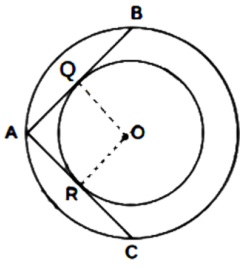
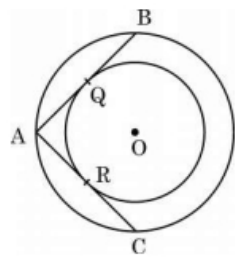
In Fig., there are two concentric circles with centre $O$. If $\text{ARC}$ and $\text{AQB}$ are tangents to the smaller circle from the point A lying on the larger circle, find the length of $AC$, if $AQ = 5 cm.$
Image
Answer
Here, $AC$ and $AB$ are the tangents from external point $A$ to the smaller circle.

Image
$\therefore AC=AB$
Now, $A B$ is the chord of bigger circle and $O Q$ is the perpendicular bisector of chord $A B$.
$\therefore A Q=Q B$
$\text { or, } A B=2 A Q$
$\text { or, } A B=2(5)=10 \ cm \ldots[\because \text { Given } A Q=5 \ cm]$
$\text { or, } A C=10 \ cm$
View full question & answer
Question 62 Marks
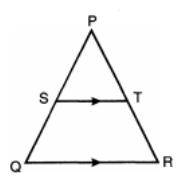
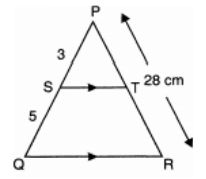
In the given figure, in a triangle $PQR , ST \| QR$ and $\frac{P S}{S Q}=\frac{3}{5}, PR =28 cm$, find $PT .$
Image
Answer
According to the question,

Image
$ ST \| QR$
$\therefore \frac{P S}{P Q}=\frac{P T}{P R}( By BPT )$
$\text { Given, } \frac{P S}{S Q}=\frac{3}{5} \text { and } PR =28 \ cm$
$PQ =3+5=8$
$\text { or, } \frac{P S}{P Q}=\frac{P T}{P R}$
$\text { or, } \frac{3}{8}=\frac{P T}{28}$
$\therefore P T=\frac{3 \times 28}{8}=10.5 \ cm$
View full question & answer
Question 72 Marks
Find H.C.F. and L.C.M. of 56 and 112 by prime factorisation method.
Answer
Using the factor tree we have,
$56=2^3 \times 7$ and $112=2^4 \times 7$
Hence HCF is $2^3 \times 7=56$
and LCM is $2^4 \times 7=112$
View full question & answer
2 Marks Questions - Maths STD 10 Questions - Vidyadip