Questions

5 Marks Questions

🎯

Test yourself on this topic

6 questions · timed · auto-graded

Question 15 Marks
The median of the following data is $525.$ Find the values of $x$ and $y,$ if the total frequency is $100.$
Class interval Frequency
$0-100$ $2$
$100-200$ $5$
$200-300$ $x$
$300-400$ $12$
$400-500$ $17$
$500-600$ $20$
$600-700$ $y$
$700-800$ $9$
$800-900$ $7$
$900-1000$ $4$
Answer
Class intervals Frequency $(f)$ Cumulative frequency $(cf/F)$
$0-100$ $2$ $2$
$100-200$ $5$ $7$
$200-300$ $x$ $7 + x$
$300-400$ $12$ $19 + x$
$400-500$ $17$ $36 + x$
$500-600$ $20$ $56 + x$
$600-700$ $y$ $56 + x + y$
$700-800$ $9$ $65 + x + y$
$800-900$ $7$ $72 + x + y$
$900-1000$ $4$ $76 + x + y$
    Total $= 76 + x + y$
We have,
$ N =\Sigma f_i=100$
$\Rightarrow 76+ x + y =100$
$\Rightarrow x + y =24$
It is given that the median is $525.$
Clearly, it lies in the class $500 - 600$
$\therefore l=500, h=100, f=20, F=36+x$ and $N=100$
Now, Median $=1+\frac{\frac{N}{2}-F}{f} \times h$
$\Rightarrow 525=500+\frac{50-(36+x)}{20} \times 100$
$\Rightarrow 525-500=(14-x) 5$
$\Rightarrow 25=70-5 x$
$\Rightarrow 5 x=45$
$\Rightarrow x=9$
Putting $x = 9$ in $x + y = 24,$
we get $y = 15$
Hence, $x = 9$ and $y = 15$
View full question & answer
Question 25 Marks
A cylindrical tub of radius $12 \ cm$ contains water to a depth of $20 \ cm.$ A spherical ball is dropped into the tub and the level of the water is raised by $6.75 \ cm.$ Find the radius of the ball.
Answer
According to question it is given that
Radius of cylindrical tub $= 12 \ cm$
Depth of cylindrical tub $= 20 \ cm$
Let us suppose that $(r)$ be the radius of spherical ball
Again it is given that level of water is raised by $6.75 \ cm$
Now, according to the question,
Volume of spherical ball $=$ Volume of water rise in cylindrical tub
$\Rightarrow \frac{4}{3} \pi r^3=\pi(12)^2 \times 6.75$
$\Rightarrow \frac{4}{3} r^2=12 \times 12 \times 6.75$
$\Rightarrow r^3=\frac{12 \times 12 \times 6.75 \times 3}{4}$
$\Rightarrow r^3=729$
$\Rightarrow r=\sqrt[3]{729}=9 \ cm$
Therefore, Radius of the ball $= 9 \ cm$
View full question & answer
Question 35 Marks
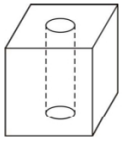
In Figure, from a solid cube of side $7 \ cm,$ a cylinder of radius $2.1 \ cm$ and height $7 \ cm$ is scooped out. Find the total surface area of the remaining solid.
Image
Answer
We have; A Cube, Cube's $\frac{\text { length }}{\text { Edge }}, a =7 \ cm$
A Cylinder: Cylinder's Radius, $r = 2.1 \ cm$ or $r = \frac{21}{10} \ cm$
Cylinder's Height, $h = 7 \ cm$
$\because$ A cylinder is scooped out from a cube,
$\therefore  \text{TSA}$ of the resulting cuboid:
$=\text{TSA}$ of whole Cube $-2 \times ($Area of upper circle or Area of lower circle$)+ \text{CSA}$ of the scooped out Cylinder
$=6 a ^2+2 \pi rh -2 \times\left(\pi r ^2\right)$
$=6 \times(7)^2+2 \times(22 \div 7 \times 2.1 \times 7)-2 \times\left[22 \div 7 \times(2.1)^2\right]$
$=6 \times 49+(44 \div 7 \times 14.7)-(44 \div 7 \times 4.41)$
$=294+92.4-27.72$
$=294+64.68$
$=358.68 \ cm^2$
Hence, the total surface area of the remaining solid is $358.68 \ cm ^2$
View full question & answer
Question 45 Marks
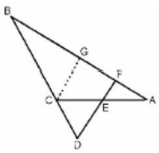
In the given figure, a $\angle A E F=\angle A F E$ and $E$ is the mid $-$ point of $CA$ . Prove that $\frac{B D}{C D}=\frac{B F}{C E}$
Image
Answer
Given, $\angle A E F=\angle A F E$ and E is the mid $-$ point of $CA$ .
To prove, $\frac{B D}{C D}=\frac{B F}{C E}$
Construction Draw a line $CG$ parallel to $DF\  (C G \| D F)$
Image
Proof : $\angle A E F=\angle A F E$ and $E$ is the mid $-$ point of $CA$
$\therefore C E=A E=\frac{A C}{2} \ldots (i)$
In $\triangle B D F, C G \| D F$
By Basic proportionality theorem,
$\frac{B D}{C D}=\frac{B F}{G F}...(ii)$
$\text { In } \triangle A F E \text {, }$
$\angle A E F=\angle A F E \ [\because$  given$]$
$\Rightarrow A F=A E\ [\because$ Since, sides opposite to equal angles are equal $]$
$\Rightarrow A F=A E=C E \ [\because$ From Eq $(i) ] \ldots (iii)$
In $\triangle A C G, E$ is the midpoint of AC and $E F \| C G,$
$\therefore F G=A F\ [\because A E=C E] \ldots (iv)$
From Eq $(ii),$ Eq $(iii)$ and Eq $(iv),$
$\frac{B D}{C D}=\frac{B F}{G F}$
$\frac{B D}{C D}=\frac{B F}{C E}\ [\because G F=A F=C E]$
Hence proved.
View full question & answer
Question 55 Marks
A motor boat whose speed is $18 \ km/h$ in still water takes $1$ hour more to go $24 \ km$ upstream, than to return to the same point. Find the speed of the stream and total time of the journey.
Answer
Given:-
Speed of boat $=18 \ km/hr$
Distance $= 24 \ km$
Let $x$ be the speed of stream.
Let $t_1$ and $t_2$ be the time for upstream and downstream As we know that,
speed $=\frac{\text { distance }}{\text { time }}$
$\Rightarrow$ time $=\frac{\text { distance }}{\text { speed }}$
For upstream, Speed $= (18 - x) \ km/hr$
Distance $=24 \ km$
Time $= t _1$
Therefore,
$t_1=\frac{24}{18-x}$
For downstream,
Speed $= (18 + x) \ km/hr$
Distance $= 24 \ km$
Time $= t _2$
Therefore,
$t_2=\frac{24}{18+x}$
Now according to the question
$ t _1= t _2+1$
$\frac{24}{18-x}=\frac{24}{18+x}+1$
$\Rightarrow \frac{1}{18-x}-\frac{1}{18+x}=\frac{1}{24}$
$\Rightarrow \frac{(18+x)-(18-x)}{(18-x)(18+x)}=\frac{1}{24}$
$\Rightarrow 48 x =(18- x )(18+ x )$
$\Rightarrow 48 x =324+18 x -18 x - x ^2$
$\Rightarrow x ^2+48 x -324=0$
$\Rightarrow x ^2+54 x -6 x -324=0$
$\Rightarrow x ( x +54)-6( x +54)=0$
$\Rightarrow( x +54)( x -6)=0$
$\Rightarrow x =-54$ or $x =6$
Since speed cannot be negative.
$\Rightarrow x \neq-54$
$\therefore x=6$
Thus the speed of stream is $6 \ km/hr.$
Total time of Journey = $t_1+t_2$
$=\frac{24}{18-x}+\frac{24}{18+x}$
$=\frac{24}{12}+\frac{24}{24}$
$=2+1$
$=3\ hrs $
View full question & answer
Question 65 Marks
A train takes $2$ hours less for a journey of $300 \ km$ if its speed is increased by $5 \ km/hr$ from its usual speed. Find the usual speed of the train.
Answer
Let the usual speed of train be $x \ km/hr$
$\frac{300}{x}-\frac{300}{x+5}=2$
$300 (x+5 - x) = 2x(x+5)$
$150(5)=x^2+5 x$
$750=x^2+5 x$
 or, $x^2+5 x-750=0$
 or, $x^2+30 x-25 x-750=0$
 or, $(x+30)(x-25)=0$
 or, $x=-30$ or $x=25$
Since, speed cannot be negative.
$\therefore x \neq-30, x=25 \ km / hr$
$\therefore$ Speed of train $=25 \ km / hr$
View full question & answer