Questions

5 Marks Questions

🎯

Test yourself on this topic

6 questions · timed · auto-graded

Question 15 Marks
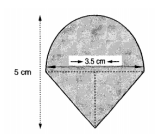
Rasheed got a playing top $($lattu$)$ as his birthday present, which surprisingly had no colour on it. He wanted to colour it with his crayons. The top is shaped like a cone surmounted by a hemisphere. The entire top is $5 \ cm$ in height and the diameter of the top is $3.5 \ cm$ . Find the area he has to colour. $($Take $\pi=\frac{22}{7} )$.
Image
Answer
Surface area to colour $=$ surface area of hemisphere $+$ curved surface area of cone
Diameter of hemisphere $=3.5 \ cm$
So radius of hemispherical portion of the lattu $= r =\frac{3.5}{2} \ cm=1.75$
$r =$ Radius of the concial portion $=\frac{3.5}{2}=1.75$
Height of the conical portion $=$ height of top $-$ radius of hemisphere $=5-1.75=3.25 \ cm$
Let $I$ be the slant height of the conical part.
Then,
$l^2=h^2+r^2$
$l^2=(3.25)^2+(1.75)^2$
$\Rightarrow l^2=10.5625+3.0625$
$\Rightarrow l^2=13.625$
$\Rightarrow l=\sqrt{13.625}$
$\Rightarrow l=3.69$
Let $S$ be the total surface area of the top.
Then,
$S=2 \pi r^2+\pi r l$
$\Rightarrow S=\pi r(2 r+l)$
$\Rightarrow S=\frac{22}{7} \times 1.75(2 \times 1.75+3.7)$
$\quad=5.5(3.5+3.7)$
$=5.5(7.2)$
$=39.6 \ cm^2$
View full question & answer
Question 25 Marks
If the roots of the quadratic equation $(x-a)(x-b)+(x-b)(x-c)+(x-c)(x-a)=0$ are equal. Then show that $a=b$ $=c$
Answer
Given,
$(x-a)(x-b)+(x-b)(x-c)+(x-c)(x-a)=0$
$\Rightarrow x^2-a x-b x+a b+x^2-b x-c x+b c+x^2-c x-a x+a c=0$
$\Rightarrow 3 x^2-2 a x-2 b x-2 c x+a b+b c+c a=0$
For equal roots $B^2-4 A C=0$
or, $\{-2(a+b+c)\}^2=4 \times 3(a b+b c+c a)$
or, $4(a+b+c)^2-12(a b+b c+c a)=0$
or, $a^2+b^2+c^2+2 a b+2 b c+2 a c-3 a b-3 b c-3 a c=0$
or, $\frac{1}{2}\left[2 a^2+2 b^2+2 c^2-2 a b-2 a c-2 b c\right]=0$
or, $\frac{1}{2}\left[\left(a^2+b^2-2 a b\right)+\left(b^2+c^2-2 b c\right)+\left(c^2+a^2-2 a c\right)\right]=0$
or, $(a-b)^2+(b-c)^2+(c-a)^2=0$ if $a \neq b \neq c$
Since $(a-b)^2>0,(b-c)^2>0(c-a)^2>0$
Hence, $(a-b)^2=0$
$\Rightarrow a=b$
$(a-c)^2=0$
$\Rightarrow b=c$
$(c-a)^2=0$
$\Rightarrow c=a$
$\therefore a=b=c$
Hence Proved.
View full question & answer
Question 35 Marks
Find the missing frequencies in the following distribution, if the sum of the frequencies is $120$ and the mean is $50.$
Class $0-20$ $20-40$ $40-60$ $60-80$ $80-100$
Frequency $17$ $f_1$ $32$ $f_2$ $19$
Answer
$\text{Class Interval}$ $\text{Frequency} f_i$ $\text{Mid-value} x_i$ $f_i x_i$
$0-20$ $17$ $10$ $170$
$20-40$ $f_1$ $30$ $30f_1$
$40-60$ $32$ $50$ $1600$
$60-80$ $f_2$ $70$ $70f_2$
$80-100$ $19$ $90$ $1710$
  $\sum f_i=68+f_1+f_2=120$   $\sum f_i x_i=3480+30 f_1+70 f_2$
given
Mean $=\frac{\sum f_i x_i}{\sum f_i}$
$\Rightarrow 50=\frac{3480+30 f_1+70 f_2}{120}$
$\Rightarrow 6000=3480+30 f_1+70 f_2$
$\Rightarrow 30 f_1+70 f_2=252 \ldots \text { (i) }$
Also, $68+f_1+f_2=120$
$\Rightarrow f_1=52-f_2$
Substituing in $(i),$ we have
$3\left(52-f_2\right)+7 f_2=252$
$\Rightarrow 4 f_2=96$
$\Rightarrow f_2=-24$
$\Rightarrow f_1=52-24=28$
Hence$, f_1=28$ and $f_2=24$
View full question & answer
Question 45 Marks
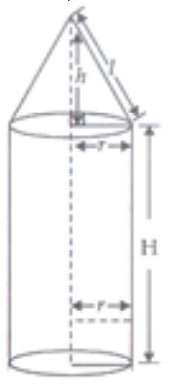
A rocket is in the form of a right circular cylinder closed at the lower end and surmounted by a cone with the same radius as that of cylinder. The diameter and height of cylinder are $6 \ cm$ and $12 \ cm ,$ respectively. If the slant height of the conical portion is $5 \ cm,$ then find the total surface area and volume of rocket. $($Use $\pi=3.14)$
Answer
Cylinder Cone
$r =\frac{6}{2}=3 cm$ $r = 3 \ cm$
$H = 12 \ cm$ $l = 5 \ cm$
For cone,
$\therefore l^2=r^2+h^2+ $ or $h^2=l^2-r^2$
$h^2=5^2-3^2=25-9=16$
$\Rightarrow h=\sqrt{16}=4 \ cm$

Image

Now, volume of rocket $=$ Volume of cylinder $+$ Volume of cone
$=\pi r^2 H+\frac{1}{3} \pi r^2 h=\pi r^2\left[H+\frac{1}{3} h\right]$
$=3.14 \times 3 \times 3\left[12+\frac{1}{3} \times 4\right]$
$=3.14 \times 9\left[\frac{40}{3}\right]=3.14 \times 3 \times 40$
$=376.8 \ cm^3$
$\therefore$ Volume of Rocket $=376.8 \ cm^3$
Total surface area of rocket $=$ Curved surface area of cylinder $+$ Curved surface area of cone $+$ Area of base of cylinder $[$As it is closed $($Given$)]$
$=2 \pi r H+\pi rl+\pi r^2=\pi r[2 H+l+r]$
$=3.14 \times 3[2 \times 12+5+3]$
$=3.14 \times 3 \times 32$
$=301.44 \ cm^2$
Hence, the surface area of rocket is $301.44 \ cm^2$.
View full question & answer
Question 55 Marks
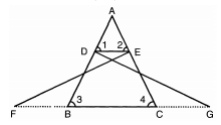
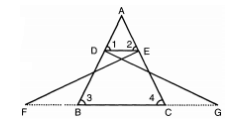
In the following figure, $\triangle \text{FEC} \cong \triangle \text{GBD}$ and $\angle 1=\angle 2$ Prove that $\triangle \text{ADE} \cong \triangle \text{ABC}$.
Image
Answer
Image
$\because \triangle \text{FEC} \cong \triangle \text{GBD}$
or, $EC = BD\ldots\ldots(i)$
It is given that $\angle 1=\angle 2$
or, $\text{AE = AD} (\because$ Isosceles triangle property$)...(ii)$
From ,eqns. $(i)$ and $(ii),$
$\frac{A E}{E C}=\frac{A D}{D B}$
or, $DE |\mid BC$, ( $\because$ converse of $\text{B.PT})$
or, $\angle 1=\angle 3$ and $\angle 2=\angle 4$ ( $\because$ Corresponding angles)
Thus in $\triangle \text{ADE}$ and $\triangle \text{ABC}$,
$\angle A=\angle A$
$\angle 1=\angle 3$
$\angle 2=\angle 4$
$\triangle \text{ADE} \sim \triangle \text{ABC}(\because \text{AAA}$ criterion of similarity$)$
$\triangle \text{ADE} \sim \triangle \text{ABC}$ Hence proved
View full question & answer
Question 65 Marks
A train travels at a certain average speed for a distance of $360 \ km$. It would have taken $48$ minutes less to travel the same distance if its speed was $5 \ \text{km/hour}$ more. Find the original speed of the train.
Answer
Given that a train travelling at a uniform speed for $360 \ km$
Let the original speed of the train be $x \ km / hr$
Time taken $=\frac{\text { Distance }}{\text { Speed }}=\frac{360}{x}$
Time taken at increased speed $=\frac{360}{x+5}$ hours.
According to the question
$\frac{360}{x}-\frac{360}{x+5}=\frac{48}{60}$
$360\left[\frac{1}{x}-\frac{1}{x+5}\right]=\frac{4}{5}$
or $, \frac{360(x+5-x)}{x^2+5 x}=\frac{4}{5}$
or $, \frac{1800}{x^2+5 x}=\frac{4}{5}$
$\Rightarrow x^2+5 x-2250=0$
$\Rightarrow x^2+(50-45) x-2250=0$
$\Rightarrow x^2+50 x-45 x-2250=0$
$\Rightarrow (x+50)(x-45)=0$
Either $x =-50$ or $x =45$
As speed cannot be negative
$\therefore$ Original speed of train $=45 \ km / hr$.
View full question & answer