Question 14 Marks
Read the text carefully and answer the questions:
Skysails is the genre of engineering science that uses extensive utilization of wind energy to move a vessel in the seawater.
The 'Skysails' technology allows the towing kite to gain a height of anything between $100$ metres $- 300$ metres.
The sailing kite is made in such a way that it can be raised to its proper elevation and then brought back with the help of a 'telescopic mast' that enables the kite to be raised properly and effectively.
Based on the following figure related to sky sailing, answer the following questions:
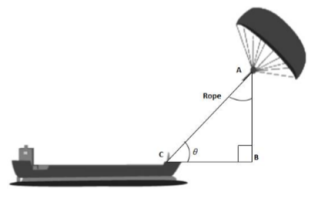
$(a)$ In the given figure, if $\sin \theta=\cos \left(\theta-30^{\circ}\right)$, where $\theta$ and $\theta-30^{\circ}$ are acute angles, then find the value of $\theta$.
$(b)$ What should be the length of the rope of the kite sail in order to pull the ship at the angle $\theta$ $($calculated above$)$ and be at a vertical height of $200 m$ ?
OR
What should be the length of the rope of the kite sail in order to pull the ship at the angle $\theta \ ($calculated above$)$ and be at a vertical height of $150 m$ ?
$(c)$ In the given figure, if $\sin \theta=\cos \left(3 \theta-30^{\circ}\right),$ where $\theta$ and $3 \theta-30^{\circ}$ are acute angles, then find the value of $\theta$.
Skysails is the genre of engineering science that uses extensive utilization of wind energy to move a vessel in the seawater.
The 'Skysails' technology allows the towing kite to gain a height of anything between $100$ metres $- 300$ metres.
The sailing kite is made in such a way that it can be raised to its proper elevation and then brought back with the help of a 'telescopic mast' that enables the kite to be raised properly and effectively.
Based on the following figure related to sky sailing, answer the following questions:
$(a)$ In the given figure, if $\sin \theta=\cos \left(\theta-30^{\circ}\right)$, where $\theta$ and $\theta-30^{\circ}$ are acute angles, then find the value of $\theta$.
$(b)$ What should be the length of the rope of the kite sail in order to pull the ship at the angle $\theta$ $($calculated above$)$ and be at a vertical height of $200 m$ ?
OR
What should be the length of the rope of the kite sail in order to pull the ship at the angle $\theta \ ($calculated above$)$ and be at a vertical height of $150 m$ ?
$(c)$ In the given figure, if $\sin \theta=\cos \left(3 \theta-30^{\circ}\right),$ where $\theta$ and $3 \theta-30^{\circ}$ are acute angles, then find the value of $\theta$.
Answer
View full question & answer→Read the text carefully and answer the questions:
Skysails is the genre of engineering science that uses extensive utilization of wind energy to move a vessel in the seawater.
The 'Skysails' technology allows the towing kite to gain a height of anything between $100$ metres $- 300$ metres.
The sailing kite is made in such a way that it can be raised to its proper elevation and then brought back with the help of a 'telescopic mast' that enables the kite to be raised properly and effectively.
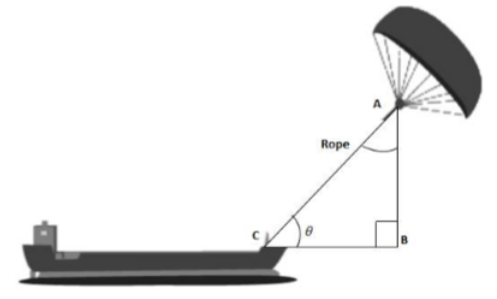
Based on the following figure related to sky sailing, answer the following questions:
$ (i)\sin \theta=\cos \left(\theta-30^{\circ}\right)$
$ \cos \left(90^{\circ}-\theta\right)=\cos \left(\theta-30^{\circ}\right)$
$\Rightarrow 90^{\circ}-\theta=\theta-30^{\circ}$
$\Rightarrow \theta=60^{\circ}$
$(ii) \frac{A B}{A C}=\sin 60^{\circ}$
$\therefore$ Length of rope, $AC =\frac{A B}{\sin 60^{\circ}}$
$=\frac{200}{\frac{\sqrt{3}}{2}}=\frac{200 \times 2}{\sqrt{3}}=230.94 m$
OR
$\frac{A B}{A C}=\sin 30^{\circ}$
$\therefore $ Length of rope $, AC =\frac{A B}{\sin 30^{\circ}}$
$=\frac{150}{\frac{1}{2}}=150 \times 2=300 m$
$\text { (iii) } \sin \theta=\cos \left(3 \theta-30^{\circ}\right)$
$ \cos \left(90^{\circ}-\theta\right)=\cos \left(3 \theta-30^{\circ}\right)$
$\Rightarrow 90^{\circ}-\theta=3 \theta-30^{\circ} $
$\Rightarrow \theta=30^{\circ}$
Skysails is the genre of engineering science that uses extensive utilization of wind energy to move a vessel in the seawater.
The 'Skysails' technology allows the towing kite to gain a height of anything between $100$ metres $- 300$ metres.
The sailing kite is made in such a way that it can be raised to its proper elevation and then brought back with the help of a 'telescopic mast' that enables the kite to be raised properly and effectively.
Based on the following figure related to sky sailing, answer the following questions:
$ (i)\sin \theta=\cos \left(\theta-30^{\circ}\right)$
$ \cos \left(90^{\circ}-\theta\right)=\cos \left(\theta-30^{\circ}\right)$
$\Rightarrow 90^{\circ}-\theta=\theta-30^{\circ}$
$\Rightarrow \theta=60^{\circ}$
$(ii) \frac{A B}{A C}=\sin 60^{\circ}$
$\therefore$ Length of rope, $AC =\frac{A B}{\sin 60^{\circ}}$
$=\frac{200}{\frac{\sqrt{3}}{2}}=\frac{200 \times 2}{\sqrt{3}}=230.94 m$
OR
$\frac{A B}{A C}=\sin 30^{\circ}$
$\therefore $ Length of rope $, AC =\frac{A B}{\sin 30^{\circ}}$
$=\frac{150}{\frac{1}{2}}=150 \times 2=300 m$
$\text { (iii) } \sin \theta=\cos \left(3 \theta-30^{\circ}\right)$
$ \cos \left(90^{\circ}-\theta\right)=\cos \left(3 \theta-30^{\circ}\right)$
$\Rightarrow 90^{\circ}-\theta=3 \theta-30^{\circ} $
$\Rightarrow \theta=30^{\circ}$