Questions

5 Marks Questions

🎯

Test yourself on this topic

6 questions · timed · auto-graded

Question 15 Marks
Find the mode, median and mean for the following data:
Marks Obtained $25-35$ $35-45$ $45-55$ $55-65$ $65-75$ $75-85$
Number of students $7$ $31$ $33$ $17$ $11$ $1$
Answer
Table
$\text{Class}$ $\text{Frequency}$ $\text{Mid value} x_i$ $f_ix_i$ $\text{Cumulative frequency}$
$25-35$ $7$ $30$ $210$ $7$
$35-45$ $31$ $40$ $1240$ $38$
$45-55$ $33$ $50$ $1650$ $71$
$55-65$ $17$ $60$ $1020$ $88$
$65-75$ $11$ $70$ $770$ $99$
$75-85$ $1$ $80$ $80$ $100$
  $N = 100$   $\sum f_ix_i = 4970$  

$i.$ Mean
$\frac{\sum f_i x_i}{\sum f_i}=\frac{4970}{100}=49.70$
$ii. N =100, \frac{N}{2}=50$ Median Class is $45 - 55$
$l=45, h=10, N=100, c=38, f=33$
$\therefore \text { Median }=l+h\left(\frac{\frac{N}{2}-c}{f}\right)$
$=45+\left\{10 \times \frac{50-38}{33}\right\}$
$=45+3.64=48.64$
$iii.$ we know that, Mode $=3\  \times$ median $-2 \ \times$ mean
$=3 \times 48.64-2 \times 49.70$
$=145.92-99.4=46.52$
View full question & answer
Question 25 Marks
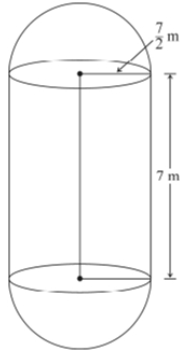
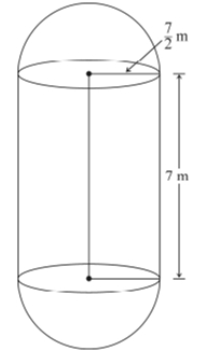
The boilers are used in thermal power plants to store water and then used to produce steam. One such boiler consists of a cylindrical part in middle and two hemispherical parts at its both ends. Length of the cylindrical part is $7 \ m$ and radius of cylindrical part is $\frac{7}{2}m$.
Find the total surface area and the volume of the boiler. Also, find the ratio of the volume of cylindrical part to the volume of one hemispherical part.
Image
Answer
Give that,
Image
Length of cylindrical part $=7 m$
Radius of cylindrical part $=\frac{7}{2} m$
Total surface area of figure $=2 \pi rh +2\left(2 \pi r ^2\right)$
$=2 \pi\left[\frac{7}{2} \times 7+2 \times\left(\frac{7}{2}\right)^2\right]$
$=308 m^2$
Volume of boiler $=$ Volume of cylindrical part $+$ Volume of two hemispherical parts
$=\pi r^2 h+\left(\frac{4}{3}\right) \pi r^3$
$=\pi\left(\frac{7}{2}\right)^2 \times(7)+\left(\frac{4}{3}\right) \pi\left(\frac{7}{2}\right)^3$
$=269.5+179.66$
$=449.167 m^3$
Required ratio $=\frac{\text { Volume of cylindrical part }}{\text { Volume of one hemispherical part }}$
$=\frac{269.5}{89.83}$
$=3$
View full question & answer
Question 35 Marks
A spherical glass vessel has a cylindrical neck $8 \ cm$ long and $1 \ cm$ in radius. The radius of the spherical part is $9 \ cm.$ Find the amount of water $($in litres$)$ it can hold, when filled completely.
Answer
The volume of the spherical vessel is
calculated by the given formula
$V=\frac{4}{3} \pi \times r^3$
Now,
$V=\frac{4}{3} \times \frac{22}{7} \times 9 \times 9 \times 9$
$V=3,054.85 \ cm^3$
The volume of the cylinder neck is calculated by the given formula.
$V=\pi \times R^2 \times h$
Now,
$V=\frac{22}{7} \times 1 \times 1 \times 8$
$V=25.14 \ cm^3$
The total volume of the vessel is equal to the volume of the spherical shell and the volume of its cylindrical neck.
$3054.85+25.14=3,080 \ cm^3$
The total volume of the vessel is $3,080 \ cm^3$.
As we know,
$1L=1000 \ cm^3$
$\frac{3080}{1000}=3.080 L$
Thus, the amount of water $($in litres$)$ it can hold is $3.080 L .$
View full question & answer
Question 45 Marks
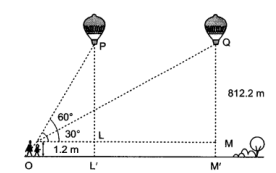
A $1.2 \ m$ tall girl spots a balloon moving with the wind in a horizontal line at a height of $88.2\ m$ from the ground.The angle of elevation of the balloon from the eyes of the girl at any instant is $60^{\circ}$. After some time, the angle of elevation reduces to $30^{\circ}$. Find the distance travelled by the balloon during the interval.
Answer
Let $P$ be the position of the balloon when its angle of elevation from the eyes of the girl is $60^{\circ}$ and $Q$ be the position when angle of elevation is $30^{\circ}$.
In $\triangle O L P$, we have
Image
$\tan 60^{\circ}=\frac{P L}{O L}$
$\Rightarrow \sqrt{3}=\frac{P L^{\prime}-L L^{\prime}}{O L}=\frac{88.2-1.2}{O L}$
$\Rightarrow \sqrt{3}=\frac{87}{O L}$
$\Rightarrow O L=\frac{87}{\sqrt{3}}$
In $\triangle O M Q$, we have
$\tan 30^{\circ}=\frac{Q M}{O M}$
$=\frac{Q M^{\prime}-M M^{\prime}}{O M}$
$\Rightarrow \frac{1}{\sqrt{3}}=\frac{88.2-1.2}{O M}$
$\Rightarrow \frac{1}{\sqrt{3}}=\frac{87}{O M}$
$\Rightarrow O M=87 \times \sqrt{3}$
$\therefore$ Distance travelled by the balloon
$= PQ = LM = OM - OL$
$=\left(87 \times \sqrt{3}-\frac{87}{\sqrt{3}}\right) m$
$=87 \times\left(\sqrt{3}-\frac{1}{\sqrt{3}}\right) m$
$=\frac{87 \times 2}{\sqrt{3}} m$
$=\frac{174}{\sqrt{3}} m$
$=\frac{174}{3} \sqrt{3} m$
$=58 \sqrt{3} m$
View full question & answer
Question 55 Marks
A train travels at a certain average speed for a distance $63 \ km$ and then travels a distance of $72 \ km$ at an average speed of $6 \ km / hr$ more than the original speed. If it takes $3$ hours to complete total journey, what is its original average speed?
Answer
Let the original average speed of the train be $x \ km / hr$.
Time taken to cover $63 \ km=\frac{63}{x}$ hours
Time taken to cover $72 \ km$ when the speed is increased by $6 \ km / hr =\frac{72}{x+6}$ hours
By the question,we have,
$\frac{63}{x}+\frac{72}{x+6}=3$
$\Rightarrow \frac{21}{x}+\frac{24}{x+6}=1$
$\Rightarrow \frac{21 x+126+24 x}{x^2+6 x}=1$
$\Rightarrow 45 x+126=x^2+6 x$
$\Rightarrow x^2-39 x-126=0$
$\Rightarrow x^2-42 x+3 x-126=0$
$\Rightarrow x(x-42)+3(x-42)=0$
$\Rightarrow(x-42)(x+3)=0$
$\Rightarrow x-42=0$ or $x+3=0$
$\Rightarrow x=42$ or $x=-3$
Since the speed cannot be negative, $x \neq-3$.
Thus, the original average speed of the train is $42 \ km / hr$.
View full question & answer
Question 65 Marks
The difference of two numbers is $5$ and the difference of their reciprocals is $\frac{1}{10}$. Find the numbers.
Answer
Let the first number be $x$
$\therefore \text { Second number } {=} x+5$
Now according to the question
$\frac{1}{x}-\frac{1}{x+5}=\frac{1}{10}$
$\Rightarrow \frac{x+5-x}{x(x+5)}=\frac{1}{10}$
$\Rightarrow 50=x^2+5 x$
$\Rightarrow x^2+5 x-50=0$
$\Rightarrow x^2+10 x-5 x-50=0$
$\Rightarrow x(x+10)-5(x+10)=0$
$\Rightarrow \quad(x+10)(x-5)=0$
$x=5,-10 \text { rejected }$
The numbers $=5$ and $10 .$
 
View full question & answer
5 Marks Questions - Maths STD 10 Questions - Vidyadip