Questions

Case study (4 Marks)

🎯

Test yourself on this topic

3 questions · timed · auto-graded

Question 14 Marks
Answer
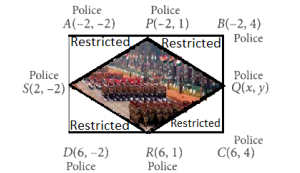
i. $Q(x, y)$ is mid-point of $B(-2,4)$ and $C(6,4)$
$
\therefore(x, y)=\left(\frac{-2+6}{2}, \frac{4+4}{2}\right)=\left(\frac{4}{2}, \frac{8}{2}\right)=(2,4)
$
ii. Since PQRS is a rhombus, therefore, $PQ = QR = RS = PS$.
$
\therefore PQ=\sqrt{(-2-2)^2+(1-4)^2}=\sqrt{16+9}=\sqrt{25}=5 \text { units }
$
Thus, length of each side of PQRS is 5 units.
iii. Length of route PQRS $=4$ PQ
$
=4 \times 5=20 \text { units }
$
OR
Length of $CD =4+2=6$ units and length of $AD =6+2=8$ units
$\therefore$ Length of route ABCD - 2(6 +8$)=28$ units+
View full question & answer
Question 24 Marks
Read the following text carefully and answer the questions that follow:
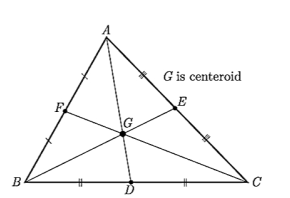
The centroid is the centre point of the object. It is also defined as the point of intersection of all the three medians. The median is a line that joins the midpoint of a side and the opposite vertex of the triangle. The centroid of the triangle separates the median in the ratio of $2: 1$. It can be found by taking the average of $x$ coordinate points and $y-$ coordinate points of all the vertices of the triangle. See the figure given below
Image
Here $D, E$ and $F$ are mid points of sides $BC , AC$ and $AB$ in same order. $G$ is centroid, the centroid divides the median in the ratio $2: 1$ with the larger part towards the vertex. Thus $AG : GD =2: 1$
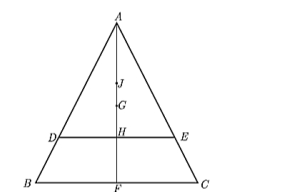
On the basis of above information read the question below. If $G$ is Centroid of $\triangle A B C$ with height $h$ and $J$ is Centroid of $\triangle ADE$. Line $DE$ parallel to $BC ,$ cuts the $\triangle ABC$ at a height $\frac{h}{4}$ from $BC . HF =\frac{h}{4}$
Image
$i$. What is the length of $AH$ ? 
$ii$. What is the distance of point $A$ from point $G$ ? 
$iii$. What is the distance of point $A$ from point $J$ ?
OR
What is the distance $GJ$?
Answer
$i.$
$\therefore AF=h \ ($Given$)$
$\therefore AF=AH+HF$
$h=AH+\frac{h}{4}$
$AH=h-\frac{h}{4}$
$AH=\frac{3 h}{4}$
$ii.$
$\because AF=h \ ($Given$)$
$\therefore AG=\frac{2}{3} AF$
$\because$ centroid divide the median in $2: 1$
$iii . AH =\frac{3 h}{4}$
$J$ is centroid of $\triangle ADE$
$AJ : JH =2: 1$
$\text { let } AJ=2 x$ and $ JH=x$
$2 x+x=\frac{3 h}{4}$
$x=\frac{h}{4}$
$AJ=2 \times \frac{h}{4}=\frac{h}{2}$
$AG=AJ+GJ$
$=\frac{h}{2}+\frac{h}{6}$
$=\frac{2 h}{3}$
But $AJ =\frac{h}{2} \times \frac{2}{3}$
$AJ=\frac{3}{4} AG$
OR
$GJ=AG-AJ$
$=AG-\frac{3}{4} AG$
$GJ=\frac{1}{4} AG$
View full question & answer
Question 34 Marks
Read the following text carefully and answer the questions that follow: A coaching institute of Mathematics conducts classes in two batches $I$ and $II$ and fees for rich and poor children are different. In batch $I,$ there are $20$ poor and $5$ rich children, whereas in batch $II,$ there are $5$ poor and $25$ rich children. The total monthly collection of fees from batch $I $ is $₹ 9000$ and from batch II is $₹ 26,000$ . Assume that each poor child pays $₹ x$ per month and each rich child pays $₹ y$ per month.
Image
$i$. Represent the information given above in terms $x$ and $y$ .
$ii$. Find the monthly fee paid by a poor child.
$iii$. Find the difference in the monthly fee paid by a poor child and a rich child.
OR
If there are $10$ poor and $20$ rich children in batch $II,$ what is the total monthly collection of fees from batch II?
Answer
$i.$ Since, each poor child pays $₹ x$
and each rich child pays $₹ y$
$\therefore$ In batch $I, 20$ poor and $5$ rich children pays $₹ 9000$ can be represented as $20 x+5 y=9000$
and in batch $II, 5$ poor and $25$ rich children pays $₹ 26,000$ can be represented as $5 x+25 y=26,000$
$ii$. As we have $20 x+5 y=9,000 \ldots (i)$
and $5 x+25 y=26,000$
or $x+5 y=5,200 \ldots...(ii)$
On subtracting $(ii)$ from $(i),$ we get
$19 x=3,800$
$\Rightarrow x=200$
$\therefore$ Monthly fee paid by a poor child $= ₹ 200$
$iii$. As we have,
$20 x+5 y=9000 \ldots \text { (i) }$
and $ 5 x+25 y=26000$
$x+5 y=5200 \ldots \text { (ii) }$
On subtracting equation $(ii)$ from $(i),$ we have
$19 x=3800$
$x=\frac{3800}{19}$
$=200$
Put the value of $x$ in equation $(ii),$ we get
$200+5 y=5200$
$5 y=5200-200$
$y=1000$
$\therefore y-x=1000-200$
$=800$
Hence, difference in the monthly fee paid by a poor child and a rich child is $₹ 800 .$
OR
Total monthly fee $=10 x +20 y$
$=10(200)+20(1,000)$
$=2,000+20,000$
$=\text { ₹ } 22,000$
View full question & answer
Case study (4 Marks) - Maths STD 10 Questions - Vidyadip