Questions

5 Marks Questions

🎯

Test yourself on this topic

6 questions · timed · auto-graded

Question 15 Marks
In Figure, from a solid cube of side 7 cm , a cylinder of radius 2.1 cm and height 7 cm is scooped out. Find the total surface area of the remaining solid.
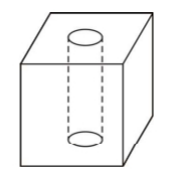
Image
Answer
We have;
A Cube,
Cube's $\frac{\text { length }}{\text { Edge }}, a =7 cm$
A Cylinder:
Cylinder's Radius, $r =2.1 cm$ or $r =\frac{21}{10} cm$
Cylinder's Height, $h =7 cm$
$\because$ A cylinder is scooped out from a cube,
$\therefore$ TSA of the resulting cuboid:
$=$ TSA of whole Cube $-2 \times$ (Area of upper circle or Area of lower circle) + CSA of the scooped out Cylinder $=6 a^2+2 \pi r h-2 \times\left(\pi r^2\right)$
$=6 \times(7)^2+2 \times(22 \div 7 \times 2.1 \times 7)-2 \times\left[22 \div 7 \times(2.1)^2\right]$
$=6 \times 49+(44 \div 7 \times 14.7)-(44 \div 7 \times 4.41)$
$=294+92.4-27.72$
$=294+64.68$
$=358.68 cm^2$
Hence, the total surface area of the remaining solid is $358.68 cm^2$
View full question & answer
Question 25 Marks
The sum of ages of a father and his son is $45$ years. Five years ago, the product of their ages $($in years$)$ was $124 $. Determine their present ages.
Answer
Let the present age of father be $x$ years.
Son's present age $=(45-x)$ years.
Five years ago:
Father's age $=(x-5)$ years
Son's age $=(45-x-5)$ years $=(40-x)$ years.
According to question,
$\therefore(x-5)(40-x)=124$
$\Rightarrow 40 x-x^2-200+5 x=124$
$\Rightarrow x^2-45 x+324=0$
Spilting the middle term,
$\Rightarrow x^2-36 x-9 x+324=0$
$\Rightarrow x(x-36)-9(x-36)=0$
$\Rightarrow(x-9)(x-36)=0$
$\Rightarrow x=9,$ or $36$
We can't take father age as $9$ years
So, $x=36$, we have
Father's present age $=36$ years
Son's present age $=9$ years
Hence, Father's present age $=36$ years and Son's present age $=9$ years.
View full question & answer
Question 35 Marks
The median of the following data is $16.$ Find the missing frequencies $a$ and $b$ if the total of frequencies is $70$
Class $0 - 5$ $5 - 10$ $10 - 15$ $15 - 20$ $20 - 25$ $25 - 30$ $30 - 35$ $35 - 40$
Frequency $12$ $a$ $12$ $15$ $b$ $6$ $6$ $4$
Answer
Let the missing frequencies are $a$ and $b.$
Class Interval Frequency $f_i$ Cumulative frequency
$0 - 5$ $12$ $12$
$5 - 10$ $a$ $12 + a$
$10 - 15$ $12$ $24 + a$
$15 - 20$ $15$ $39 + a$
$20 - 25$ $b$ $39 + a + b$
$25 - 30$ $6$ $45 + a + b$
$30 - 35$ $6$ $51 + a + b$
$35 - 40$ $4$ $55 + a + b = 70$
Then, $55+ a + b =70$
$a+b=15\ldots(1)$
Median is $16 , $which lies in 1$5 - 20$
So$,$ The median class is $15-20$
Therefore$, l =15, h=5, N=70, f =15$ and $cf =24+ a$
Median is $16 ,$ which lies in the class $15-20$. Hence$,$ median class is $15-20$.
$\therefore l=15, h=5, f=15, c . f .=24+a$
Now$,$ Median $=l+\left\{h \times \frac{\left(\frac{N}{2}-c f\right)}{f}\right\}$
$\therefore 16=15+\left\{5 \times \frac{(35-24-a)}{15}\right\}$
$\Rightarrow 16=15+\left\{\frac{11-a}{3}\right\}$
$\Rightarrow 1=\frac{11-a}{3}$
$\Rightarrow 3=11-a$
$\Rightarrow a=8$
Now$, 55+a+b=70$
$\Rightarrow 55+8+b=70$
$\Rightarrow 63+b=70$
$\Rightarrow b=7$
Hence$,$ the missing frequencies are $a =8$ and $b =7$.
View full question & answer
Question 45 Marks
A well, whose diameter is $7 m ,$ has been dug $22.5 m$ deep and the earth dugout is used to form an embankment around it. If the height of the embankment is $1.5 m$ , find the width of the embankment.
Answer
According to question
Diameterdiameter of the well $=7 m$
Radius of the well $( r )=\frac{7}{2} m=3.5 m$ and, height of the well $( h )=22.5 m$
$\therefore$ Volume of the earth dugout $=\pi \times(3.5)^2 \times 22.5 m^3=\pi \times \frac{7}{2} \times \frac{7}{2} \times \frac{45}{2} m^3$
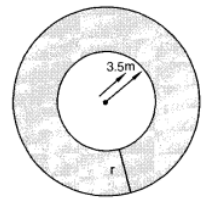
Let the width of the embankment be $r$ metres.
Clearly, embankment forms a cylindrical shell whose inner and outer radii are $3.5 m$ and $( r +3.5) m$ respectively and height $1.5 m .$
$\therefore$ Volume of the embankment $=$ Area of ring at top $\times$ height of the embankment
$=\pi\left\{(r+3.5)^2-(3.5)^2\right\} \times 1.5 m^3=\pi(r+7) r \times \frac{3}{2} m^3$
But, Volume of the embankment $=$ Volume of the well
Image
$\Rightarrow \pi r(r+7) \times \frac{3}{2}=\pi \times \frac{7}{2} \times \frac{7}{2} \times \frac{45}{2}$
$\Rightarrow r(r+7)=\frac{49}{4} \times 15$
$\Rightarrow 4 r^2+28 r=735$
$\Rightarrow 4 r^2+28 r-735=0$
$4 r^2+70 x-42 x-735=0$
$\Rightarrow 2 r(2 r+35)-21(2 r+35)=0$
$\Rightarrow(2 r+35)(2 r-21)=0$
$\Rightarrow 2 r+35=0$ or $2 r-21=0$
$\Rightarrow r=\frac{-35}{2}$ or $x=\frac{21}{2}$
$\frac{-35}{2}$ is negative, hence neglect this value
$\Rightarrow x=\frac{21}{2}=10.5 m$
Hence, the width of the embankment is $10.5 m$
View full question & answer
Question 55 Marks
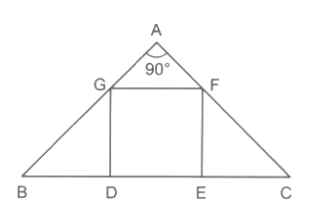
In the given figure, $\text{DEFG}$ is a square and $\angle B A C=90^{\circ}$. Prove that
$i. \triangle A G F \sim \triangle D B G$
$ii. \triangle A G F \sim \triangle E F C$
$iii. \triangle D B G \sim \triangle E F C$
$iv. D E^2=B D \times E C$
Image
Answer
Given $A \triangle A B C$ in which $\angle B A C=90^{\circ}$ and $\text{DEFG}$ is a square.
Proof
$i$. In $\triangle A G F$ and $\triangle D B G$, we have
$\angle G A F=\angle B D G=90^{\circ}$
$\angle A G F=\angle D B G \ [$corresponidng angles$]$
$\text { [ } \because G F \| B C \ $ and $AB$ is the transversal$]$
$\therefore \triangle A G F \sim \triangle D B G$
$ii$. In $\triangle A G F$ and $\triangle E F C$, we have
$\angle F A G=\angle C E F=90^{\circ}$
$\angle G F A=\angle F C E \ [$corresponding angles$]$
$[\because G F \| B C $ and $AC$ is the transversal$]$
$\therefore \triangle A G F \sim \triangle E F C$
$iii$. $\triangle D B G \sim \triangle A G F$ and $\triangle A G F \sim \triangle E F C$
$\Rightarrow \triangle D B G \sim \triangle E F C$
$iv. \triangle D B G \sim \triangle E F C$
$\Rightarrow \frac{B D}{F E}=\frac{D G}{E C}$
$\Rightarrow \frac{B D}{D E}=\frac{D E}{E C} \quad[\because DG=DE \text { and } FE=DE) .$
Hence, $D E^2=B D \times E C$.
View full question & answer
Question 65 Marks
Find the value of $m$ for which the quadratic equation $(m+1) y^2-6(m+1) y+3(m+9)=0, m \neq-1$ has equal roots. Hence find the roots of the equation.
Answer
In equation $(m+1) y^2-6(m+1) y+3(m+9)=0$
$A=m+1, B=-6(m+1), C=3(m+9)$
For equal roots, $D=B^2-4 A C=0$
$36(m+1)^2-4(m+1) \times 3(m+9)=0$
$\Rightarrow 3\left(m^2+2 m+1\right)-(m+1)(m+9)=0$
$\Rightarrow 2 m^2-4 m-6=0$
$\Rightarrow m^2-2 m-3=0$
$\Rightarrow m^2-3 m+m-3=0$
$\Rightarrow m(m-3)+1(m-3)=0$
$\Rightarrow(m-3)(m+1)=0$
$\therefore m=-1,3$
Neglecting $m \neq-1$
$\therefore m=3$
$\therefore$ the equation becomes $4 y^2-24 y+36=0$
$\Rightarrow y^2-6 y+9=0$
$\Rightarrow(y-3)(y-3)=0$
$\Rightarrow(y-3)=0$ and $(y-3)=0$
$\therefore \text { roots are } y=3,3$
View full question & answer
5 Marks Questions - Maths STD 10 Questions - Vidyadip