Questions

5 Marks Questions

🎯

Test yourself on this topic

6 questions · timed · auto-graded

Question 15 Marks
The median of the following data is $525.$ Find the values of $x$ and $y,$ if the total frequency is $100.$
Class interval Frequency
$0-100$ $2$
$100-200$ $5$
$200-300$ $X$
$300-400$ $12$
$400-500$ $17$
$500-600$ $20$
$600-700$ $y$
$700-800$ $9$
$800-900$ $7$
$900-1000$ $4$
Answer
Class intervals Frequency $(f)$ Cumulative frequency $(cf / F)$
$0-100$ $2$ $2$
$100-200$ $5$ $7$
$200-300$ $X$ $7 + x$
$300-400$ $12$ $19 + x$
$400-500$ $17$ $36 + x$
$500-600$ $20$ $56 + x$
$600-700$ $y$ $56 + x + y$
$700-800$ $9$ $65 + x + y$
$800-900$ $7$ $72 + x + y$
$900-1000$ $4$ $76 + x + y$
    Total $76 + x + y$
We have,
$N=\Sigma f_i=100$
$\Rightarrow 76+x+y=100$
$\Rightarrow x+y=24$
It is given that the median is $525 .$
Clearly, it lies in the class $500-600$
$\therefore l=500, h=100, f=20, F=36+x \text { and } N=100$
Now, Median $=1+\frac{\frac{N}{2}-F}{f} \times h$
$\Rightarrow 525=500+\frac{50-(36+x)}{20} \times 100$
$\Rightarrow 525-500=(14-x) 5$
$\Rightarrow 25=70-5 x$
$\Rightarrow 5 x=45$
$\Rightarrow x=9$
Putting $x=9$ in $x+y=24$, we get $y=15$
Hence, $x=9$ and $y=15$
View full question & answer
Question 25 Marks
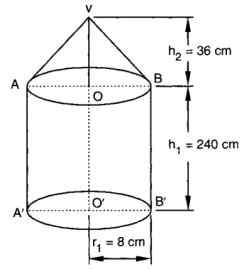
An iron pillar has some part in the form of a right circular cylinder and remaining in the form of a right circular cone.The radius of the base of each of cone and cylinder is $8 \ cm.$ The cylindrical part is $240 \ cm$ high and the conical part is $36 \ cm$ high. Find the weight of the pillar if one cubic $\ cm$ of iron weighs $7.8$ grams.
Answer
Let us suppose that $r_1 \ cm$ and $r_2 \ cm$ denote the radii of the base of the cylinder and cone respectively. Then$, r_1 = r_2 = 8 \ cm$
Let us suppose that $h_1$ and $h_2 \ cm$ be the heights of the cylinder and the cone respectively. Then,
Image
$h_1=240 \ cm$  and $h_2=36 \ cm$
$\therefore$ Volume of the cylinder $=\pi r_1^2 h_1 \ cm^3$
$=(\pi \times 8 \times 8 \times 240) \ cm^3$
$=(\pi \times 64 \times 240) \ cm^3$
Now$,$ Volume of the cone $=\frac{1}{3} \pi r_2^2 h_2 \ cm^3$
$=\left(\frac{1}{3} \pi \times 8 \times 8 \times 36\right) \ cm^3$
$=\left(\frac{1}{3} \pi \times 64 \times 36\right) \ cm^3$
$\therefore$ Total volume of the iron $=$ Volume of the cylinder $+$ Volume of the cone
$=\left(\pi \times 64 \times 240+\frac{1}{3} \pi \times 64 \times 36\right) \ cm^3$
$=\pi \times 64 \times(240+12) \ cm^3$
$=\frac{22}{7} \times 64 \times 252 \ cm^3=22 \times 64 \times 36 \ cm^3$
Total weight of the pillar $=$ Volume $\times$ Weight per $cm ^3$
$=(22 \times 64 \times 36) \times 7.8 gms$
$=395366.4\  gms=395.3664 \ kg$
View full question & answer
Question 35 Marks
Two cubes each of volume $125 \ cm^3$ are joined end to end. Find the volume and the surface area of the resulting $[5]$ cuboid.
Answer
Volume of one cube $=125 \ cm^3$
$\therefore$ side of the cube $=5 \ cm$
Volume of the resulting cuboid $=$ volume of $2$ cubes $=250 \ cm^3$
$\therefore$ Length of new cuboid $5+5=10 \ cm$
Breadth of new cuboid $=5 \ cm$
Height of new cuboid $=5 \ cm$
Surface area of the resulting cuboid $=2( lb + bh + hl )$
$=2(10 \times 5+5 \times 5+5 \times 10)$
$=250 \ cm^2$
View full question & answer
Question 45 Marks
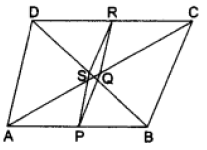
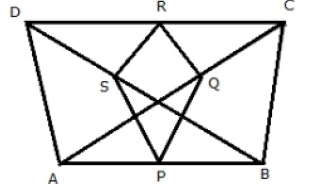
$A B C D$ is a quadrilateral in which $A D=B C$. If $P, Q, R, S$ be the midpoints of $A B, A C, C D$ and $B D$ respectively, show that PQRS is a rhombus.
Image
View full question & answer
Question 55 Marks
If the equation $\left(1+m^2\right) x^2+2 m c x+\left(c^2-a^2\right)=0$ has equal roots, prove that $c^2=a^2\left(1+m^2\right)$
Answer
Here roots are equal,
$
\therefore D=B^2-4 A C=0
$
Here, $A=1+m^2, B=2 m c, C=\left(c^2-a^2\right)$
$
\therefore(2 m c)^2-4\left(1+m^2\right)\left(c^2-a^2\right)=0
$
or, $4 m^2 c^2-4\left(1+m^2\right)\left(c^2-a^2\right)=0$
or, $m^2 c^2-\left(c^2-a^2+m^2 c^2-m^2 n^2\right)=0$
or, $m^2 c^2-c^2+a^2-m^2 c^2+m^2 a^2=0$
or, $-c^2+a^2+m^2 a^2=0$
or, $c^2=a^2\left(1+m^2\right)$
Hence Proved.
View full question & answer
Question 65 Marks
Two pipes running together can fill a tank in $11 \frac{1}{9}$ minutes. If one pipe takes 5 minutes more than the other to fill the tank, find the time in which each pipe would fill the tank separately.
Answer
Let time taken by pipe $A$ be $x$ minutes, and time taken by pipe $B$ be $x+5$ minutes.
In one minute pipe A will fill $\frac{1}{x}$ tank
In one minute pipe $B$ will fill $\frac{1}{x+5}$ tank
pipes A + B will fill in one minute $=\frac{1}{x}+\frac{1}{x+5}$ tank
Now according to the question.
$
\frac{1}{x}+\frac{1}{x+5}=\frac{9}{100}
$
or, $\frac{x+5+x}{x(x+5)}=\frac{9}{100}$
or, $100(2 x+5)=9 x(x+5)$
or, $200 x+500=9 x^2+45 x$
or, $9 x^2-155 x-500=0$
or, $9 x^2-180 x+25 x-500=0$
or, $9 x ( x -20)+25( x -20)=0$
or, $( x -20)(9 x +25)=0$
or, $x=20, \frac{-25}{9}$
rejecting negative value, $x=20$ minutes
and $x+5=25$ minutes
Hence pipe A will fill the tank in 20 minutes and pipe B will fill it in 25 minutes.
View full question & answer
5 Marks Questions - Maths STD 10 Questions - Vidyadip