Questions

5 Marks Questions

🎯

Test yourself on this topic

6 questions · timed · auto-graded

Question 15 Marks
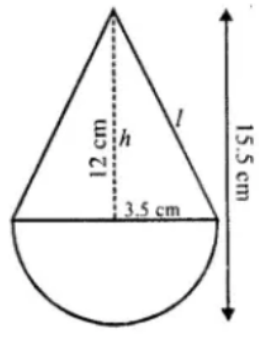
A toy is in the form of a cone mounted on a hemisphere of radius $3.5 \ cm .$ The total height of the toy is $15.5 \ cm ;$ find the total surface area and volume of the toy.
Answer
The Radius of the toy $( r )=3.5 \ cm$
Total height of the toy $=15.5 \ cm$
$\therefore$ Height of the conical part is $=15.5-3.5=12 \ cm$
Slant height of the conical part $(l)$
$=\sqrt{r^2+h^2}=\sqrt{(3.5)^2+(12)^2}$
$=\sqrt{12.25+144}$
$=\sqrt{156.25}$
$=12.5 \ cm$
Image
$i.$ Now total surface area of the toy $=$ curved surface area of conical part $+$ curved surface area of hemipherical part
$=\pi r l+2 \pi r^2=\pi r(l+2 r)$
$=\frac{22}{7} \times 3.5(12.5+2 \times 3.5) \ cm^2$
$=11(12.5+7)=11 \times 19.5 \ cm^2$
$=214.5 \ cm^2$
$ii.$ Volume of the toy $=\frac{1}{3} \pi r^2 h+\frac{2}{3} \pi r^3$
$=\frac{1}{3} \pi r^2(h+2 r)$
$=\frac{1}{3} \times \frac{22}{7}(3.5)^2(12+2 \times 3.5) \ cm^3$
$=\frac{1}{3} \times \frac{22}{7} \times 12.25(12+7) \ cm^3$
$=\frac{22}{3} \times 1.75 \times 19 \ cm^3$
$=\frac{731.5}{3}$
$=243.83 \ cm^3$
View full question & answer
Question 25 Marks
A train travels at a certain average speed for a distance of $54 \ km$ and then travels a distance of $63 \ km$ at an average speed of $6 \ km/h$ more than the first speed. If it takes $3$ hours to complete the total journey, what was its first average speed?
Answer
Let the speed of the train be $x \ km / hr$ for first $54 \ km$ and for next $63 \ km$ , speed is $(x+6) \ km / hr$.
According to the question
$\frac{54}{x}+\frac{63}{x+6}=3$
$\frac{54(x+6)+63 x}{x(x+6)}=3$
or, $54 x +324+63 x =3 x ( x +6)$
or, $117 x+324=3 x^2+18 x$
or, $3 x^2-99 x-324=0$
or, $x^2-33 x-108=0$
or, $x^2-36 x+3 x-108=0$
or, $x ( x -36)+3( x -36)=0$
$(x-36)(x+3)=0$
$x=36$
$x=-3$ rejected.
$($as speed is never negative$)$
Hence First speed of train $=36 \ km / h$
View full question & answer
Question 35 Marks
The monthly income of $100$ families are given as below:
Income in $($in $₹.)$ Number of families
$0-5000$ $8$
$5000-10000$ $26$
$10000-15000$ $41$
$15000-20000$ $16$
$20000-25000$ $3$
$25000-30000$ $3$
$30000-35000$ $2$
$35000-40000$ $1$
Calculate the modal income.
Answer
class $10000-15000$ has the maximum frequency,
so it is the modal class.
$\therefore l =10000, h=5000, f =41, f _1=26$ and $f _2=16$
$\text { Mode }= l +\frac{f-f_1}{2 f-f_1-f_2} \times h$
$=10000+\frac{41-26}{2(41)-26-16} \times 5000$
$=10000+\frac{15}{40} \times 5000$
$=10000+1875$
$=11875$
View full question & answer
Question 45 Marks
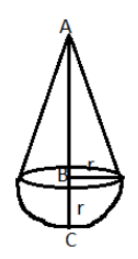
A solid is in the shape of a right$-$circular cone surmounted on a hemisphere, the radius of each of them is being $3.5 \ cm$ and the total height of solid is $9.5 \ cm.$ Find the volume of the solid.
Answer
Image
From the given figure,
Height $( AB )$ of the cone $= AC - BC ($Radius of the hemisphere$)$
Thus, height of the cone $=$ Total height $-$ Radius of the hemisphere
$=9.5-3.5$
$=6 \ cm$
Volume of the solid $=$ Volume of the cone $+$ Volume of the hemisphere
$=\left(\frac{1}{3} \pi r^2 h\right)+\left(\frac{2}{3} \pi r^3\right)$
$=\frac{1}{3} \pi r^2(h+2 r)$
$=\frac{1}{3} \times \frac{22}{7} \times 3.5 \times 3.5(6+2 \times 3.5)$
$=\frac{1}{3} \times \frac{22}{7} \times 3.5 \times 3.5 \times 13$
$=166.83 \ cm^3$
Thus, total volume of the solid is $166.83 \ cm^3$.
View full question & answer
Question 55 Marks
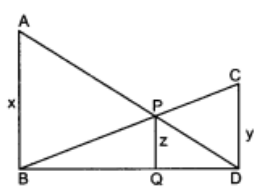
In figure $AB \| PQ \| CD , AB = x$ units, $CD = y$ units and $PQ = z$ units, prove that $\frac{1}{x}+\frac{1}{y}=\frac{1}{z}$
Image
Answer
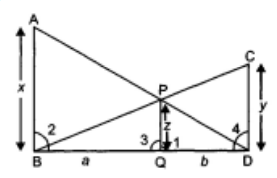
Let $BQ = a$ units, $DQ = b$ units
Image
$\because PQ \| AB \therefore \angle 1=\angle 2,$
and $\angle A D B=\angle P D Q$
$\therefore \triangle ADB \sim \triangle PDQ$
Similarly $\triangle B C D \sim \triangle B P Q$
$\because \triangle A D B \sim \triangle P D Q$
$\therefore \frac{AB}{PQ}=\frac{BD}{DQ}$
$\frac{x}{z}= \frac{a+b}{b}$
$\frac{x}{z} =\frac{a}{b}+1 $
$\Rightarrow \frac{x}{z}-1=\frac{a}{b}\ldots(i)$
Also, $\triangle B C D \sim \triangle B P Q$
$\therefore \frac{BD}{BQ}=\frac{CD}{PQ} $
$\Rightarrow \frac{a+b}{a}=\frac{y}{z}$
$1+\frac{b}{a}=\frac{y}{z} $
$\Rightarrow \frac{b}{a}=\frac{y}{z}-1$
$\Rightarrow \frac{b}{a}=\frac{y-z}{z} $
$\Rightarrow \frac{a}{b}=\frac{z}{y-z}\ldots(ii)$
From $(i)$ and $(ii)$
$\frac{x}{z}-1=\frac{z}{y-z} $
$\Rightarrow \frac{x}{z}=\frac{z}{y-z}+1$
$\frac{x}{z}=\frac{z+y-z}{y-z}$
$\frac{x}{z}=\frac{y}{y-z} $
$\Rightarrow \frac{z}{x}=\frac{y-z}{y}$
$\frac{z}{x}=1-\frac{z}{y}$
$z\left(\frac{1}{x}\right)=z\left(\frac{1}{z}-\frac{1}{y}\right) $
$\Rightarrow \frac{1}{x}=\frac{1}{z}-\frac{1}{y}$
$\Rightarrow \frac{1}{x}+\frac{1}{y}=\frac{1}{z}$
Hence proved 
View full question & answer
Question 65 Marks
A shopkeeper buys a number of books for $Rs.1200.$ If he had bought $10$ more books for the same amount, each book would have cost him $Rs.20$ less. Find how many books did he buy?
Answer
Let number of books the shopkeeper buys $=x$
Price of each book $= Rs. \frac{1200}{x}$
cost of each book when $x +10$ books are bought $= RS.\frac{1200}{x+10}$
According to given question,
$\frac{1200}{x}-\frac{1200}{x+10}=20$
$1200\left(\frac{1}{x}-\frac{1}{x+10}\right)=20$
$\left(\frac{1}{x}-\frac{1}{x+10}\right)=\frac{20}{1200}$
$\frac{(x+10-x}{x(x+10)}=\frac{1}{60}$
$x+10-x=\frac{x^2+10 x}{60}$
$600=x^2+10 x$
$x^2+10 x-600=0$
Here, it is quadratic equation
$x^2+30 x-20 x-600=0$
$x(x+30)-20(x+30)=0$
$(x+30)(x-20)=0$
either
$(x+30)=0$ or $(x-20)=0$
$x=-30$ or $x=20$
$x=-30$, is not possible because the number of books can't be negative.
so, number of books $=x=20.$
View full question & answer