Questions

2 Marks Questions

🎯

Test yourself on this topic

7 questions · timed · auto-graded

Question 12 Marks
What is the angle subtended at the centre of a circle of radius $6 \ cm$ by an arc of length $6 \ \pi cm$ ?
Answer
$ l =6 \pi, r =6 \ cm$
$l=\frac{\theta \pi r}{180^{\circ}}$
$\Rightarrow 6 \pi=\frac{\theta \times \pi \times 6}{180^{\circ}}$
$\Rightarrow \theta=180^{\circ}$
View full question & answer
Question 22 Marks
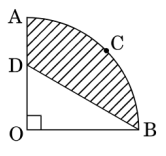
In Figure, OACB is a quadrant of a circle with centre O and radius 7 cm . If $OD =3 cm$, then find the area of the shaded region.
Image
Answer
Area of quadrant $=\frac{1}{4} \pi(7)^2=\frac{49}{4} \pi cm^2$
Area of triangle $=\frac{1}{2} \times 7 \times 3=\frac{21}{2} cm^2$
Area of shaded region $=\frac{49}{4} \pi-\frac{21}{2}$
$
=\frac{7}{2}\left(\frac{7}{2} \pi-3\right) cm^2 \text { or } 28 cm^2
$
View full question & answer
Question 32 Marks
If $\tan (A+B)=\sqrt{3}$ and $\tan (A-B)=1,0^{\circ}<(A+B)<90^{\circ}$ and $A>B$ then find $A$ and $B$.
Answer
$\tan (A+B)=\sqrt{3}$
$\tan (A+B)=\tan 60^{\circ}$
$A+B=60^{\circ} \ldots . . \text { (i) }$
$\tan (A-B)=1$
$\tan (A-B)=\tan 45^{\circ}$
$A-B=45^{\circ} \ldots \ldots . . . \text { (ii) }$
Solving $(i)$ and $(ii),$ we get
$A=(52.5)^{\circ}  $ and $ B=(7.5)^{\circ} \text {. }$
Hence, $A =(52.5)^{\circ}$ and $B =(7.5)^{\circ}$.
View full question & answer
Question 42 Marks
If $\sin \theta+\cos \theta=\sqrt{3}$, then find the value of $\sin \theta \cdot \cos \theta$.
Answer
$\sin \theta+\cos \theta=\sqrt{3}$
squaring both sides
$\sin ^2 \theta+\cos ^2 \theta+2 \sin \theta \cos \theta=3$
$\Rightarrow 1+2 \sin \theta \cos \theta=3$
$\Rightarrow \sin \theta \cos \theta=1$
View full question & answer
Question 52 Marks
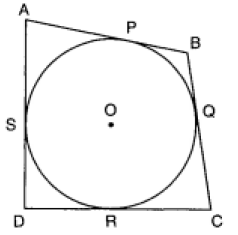
A circle touches all the four sides of a quadrilateral $\text{ABCD}$. Prove that $A B+C D=B C+D A$.
Answer

Image
Since tangents drawn from an exterior point to a circle are equal in length.
$AP=AS\ [$ From $ A] \ldots \text { (i) }$
$BP=BQ \ [$ From $B] \ldots \text { (ii) }$
$CR=CQ\ [$ From $C] \ldots \text { (iii) }$
and$, DR = DS\ [$From $D] ...(iv)$
Adding $(i), (ii), (iii)$ and $(iv),$ we get
$AP+BP+CR+DR$
$=AS+BQ+CQ+DS$
$\Rightarrow(AP+BP)+(CR+DR)$
$=(AS+DS)+(BQ+CQ)$
$\Rightarrow AB+CD=AD+BC$
Hence, $AB + CD = BC + DA$
View full question & answer
Question 62 Marks
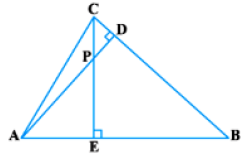
In the figure, altitudes AD and CE of $\triangle ABC$ intersect each other at the point P . Show that: $\triangle A E P \sim \triangle A D B$:
Image
Answer
In $\triangle AEP$ and $\triangle ADB$, we have
$AEP =\angle ADB$ $\qquad$ (1) [Each equal to $90^0$ ]
$\angle EAP =\angle DAB$ $\qquad$ (2) [Common angle]
In view of (1) and (2),
$\triangle AEP \sim \triangle ADB [ AA$ similarity criterion]
View full question & answer
Question 72 Marks
Find the greatest number which divides $85$ and $72$ leaving remainder $1$ and $2$ respectively.
Answer
We have to find the greatest number which divides $85$ and $72$ leaving remainder $1$ and $2$ respectively.
Let assume that $x$ be the greatest number which divides $85$ and $72$ leaving remainder $1$ and $2$ respectively.
So, it means
$x$ divides $85-1=84$
and
$x$ divides $72-2=70$
So, from this we concluded that
$=x$ divides $84$ and $70$
$=x=\operatorname{HCF}(84,70)$
Now, to find $\operatorname{HCF}(84,70)$, we use method of prime factorization.
Prime factors of $84=2 \times 2 \times 3 \times 7$
Prime factors of $70=2 \times 5 \times 7$
So, $=\operatorname{HCF}(84,70)=2 \times 7=14$
$=x=14$
Hence, $14$ is the greatest number which divides $85$ and $72$ leaving remainder $1$ and $2$ respectively.
View full question & answer
2 Marks Questions - Maths STD 10 Questions - Vidyadip