Questions

3 Marks Question

🎯

Test yourself on this topic

8 questions · timed · auto-graded

Question 13 Marks
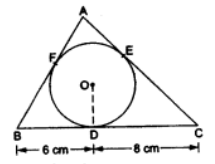
A triangle $\text{ABC}$ is drawn to circumscribe a circle of radius $4 \ cm$ such that the segments $BD$ and $DC$ into which $BC$ is divided by the point of contact $D$ are of lengths $6 \ cm$ and $8 \ cm$ respectively. Find the lengths of the sides $AB$ and $AC.$​​​​​​​
Image
Answer
Image
We know that the lengths of tangents drawn from an exterior point to a circle are equal.
$A E=A F=x \ cm,$
$B D=B F=6 \ cm, C D=C E=8 \ cm .$
$\text { so, } AB=AF+BF=(x+6) \ cm,$
$BC=BD+CD=14 \ cm,$
$AC=CE+AE=(x+8) \ cm .$
$\text { Perimeter, } 2 s=AB+BC+AC$
$=[(x+6)+14+(x+8)] \ cm$
$=(2 x+28) \ cm$
$\Rightarrow s=(x+14) \ cm .$
$\therefore \operatorname{ar}(\Delta A B C)=\sqrt{s(s-A B)(s-B C)(s-A C)}$
$=\sqrt{(x+14)\{(x+14)-(x+6)\}\{(x+14)-14\}\{(x+14)-(x+8)\}} \ cm^2$
$\left.=\sqrt{48 x(x+14)} \ cm^2 \ldots i\right)$
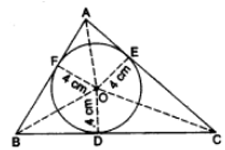
Join $OE$ and $OF$ and also $OA, OB$ and $OC.$
$\therefore \operatorname{ar}(\Delta A B C)$
$=\operatorname{ar}(\triangle O A B)+\operatorname{ar}(\triangle O B C)+\operatorname{ar}(\triangle O C A)$
$=\left(\frac{1}{2} \times A B \times O F\right)+\left(\frac{1}{2} \times B C \times O D\right)+\left(\frac{1}{2} \times A C \times O E\right)$
$=\left[\frac{1}{2} \times(x+6) \times 4\right]+\left[\frac{1}{2} \times 14 \times 4\right]+\left[\frac{1}{2} \times(x+8) \times 4\right]$
$=2[(x+6)+14+(x+8)]$
$=4(x+14) \ cm^2 \ldots \text { (ii) }$
From $(i)$ and $(ii),$ we get
$\sqrt{48 x(x+14)}=4(x+14)$
$\Rightarrow 48 x(x+14)=16(x+14)^2$
$\Rightarrow 48 x=16(x+14)$
$\Rightarrow x=\frac{16 \times 14}{32}=7$
$\therefore A B=(x+6) \ cm$
$=(7+6) \ cm$
$=13 \ cm$
and
$A C=(x+8) \ cm$
$=(7+8) \ cm$
$=15 \ cm$
View full question & answer
Question 23 Marks
Solve: $x^2+5 x-\left(a^2+a-6\right)=0$
Answer
$\text { Given, } x^2+5 x-\left(a^2+a-6\right)=0$
$\text { splitting } a^2+a-6$
$\Rightarrow x^2+5 x-\left(a^2+3 a-2 a-6\right)=0$
$\Rightarrow x^2+5 x-[a(a+3)-2(a+3)]=0$
$\Rightarrow x^2+5 x-(a+3)(a-2)=0$
Now splitting the middle term
$\Rightarrow x^2+(a+3) x-(a-2) x-(a+3)(a-2)=0$
$\Rightarrow x[x+(a+3)]-(a-2)[x+(a+3)]=0$
$\Rightarrow[x+(a+3)][x-(a-2)]=0$
$\Rightarrow x+(a+3)=0 \text { or } x-(a-2)=0$
Therefore, $x=-(a+3)$ or $(a-2)$
View full question & answer
Question 33 Marks
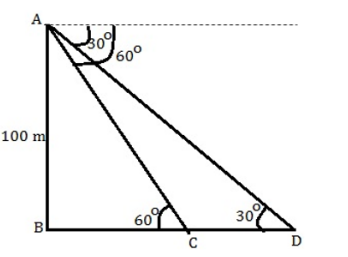
As observed from the top of a light-house, $100 m$  high above sea level, the angle of depression of a ship, sailing directly towards it, changes from $30^{\circ}$ to $60^{\circ}$. Determine the distance travelled by the ship during the period of observation. $($ Use $\sqrt{3}=1.732)$
Answer
Image
Height of the tower $=100 m$
Let $BC = x$ and $BD = y$
Consider the $\triangle A B C$,
$\frac{AB}{BC}=\tan 60^{\circ}$
$\Rightarrow \frac{100}{x}=\sqrt{3}$
$\Rightarrow x=\frac{100}{\sqrt{3}} m$
Consider the $\triangle A B D$,
$\frac{AB}{BD}=\tan 30^{\circ}$
$\frac{1}{\sqrt{3}}=\frac{100}{y}$
$y=100 \sqrt{3}$
We know that,
$B D=B C+C D$
$y=x+C D$
$C D=y-x$
$=100 \sqrt{3}-\frac{100}{\sqrt{3}}$
$=\frac{200}{\sqrt{3}} m$
$=\frac{200 \sqrt{3}}{3} m$
$=115.466 m$
View full question & answer
Question 43 Marks
Prove the identity: $\frac{(1+\cot A+\tan A)(\sin A-\cos A)}{\sec ^3 A-\operatorname{cosec}^3 A}=\sin ^2 A \cos ^2 A$
Answer
We have,
$\text { LHS }=\frac{\left(1+\frac{\cos A}{\sin A}+\frac{\sin A}{\cos A}\right)(\sin A-\cos A)}{\left(\frac{1}{\cos ^3 A}-\frac{1}{\sin ^3 A}\right)}$
$\Rightarrow \text { LHS }=\frac{\left(1+\frac{\cos ^2 A+\sin ^2 A}{\sin A \cos A}\right)(\sin A-\cos A)}{\left(\frac{\sin ^3 A-\cos ^3 A}{\sin ^3 A \cos ^3 A}\right)}$
$\Rightarrow \ce{LHS}=\frac{\left(1+\frac{1}{\sin A \cos A}\right)\left(\sin ^3 A-\cos A\right) \sin ^3 A \cos ^3 A}{\left(\sin ^3 A-\cos ^3 A\right)}$
$\Rightarrow \ce{LHS}=\frac{(\sin A \cos A+1)\left(\sin ^2 A-\cos ^2\right) \sin ^2 A \cos ^2 A}{(\sin A-\cos A)\left(\sin ^2 A+\cos ^2 A+\sin ^2 A \cos ^2 A\right)}$
$\left[\because a^3-b^3=(a-b)\left(a^2+b^2+ab\right)\right]$
$\Rightarrow \ce{LHS}=\frac{(\sin A \cos A+1) \sin ^2 A \cos ^2 A}{(1+\sin A \cos A)}$
$=\sin ^2 A \cos ^2 A=\text { RHS }$
View full question & answer
Question 53 Marks
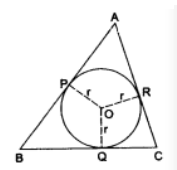
In the given figure, the sides $AB , BC$ and $CA$ of a triangle $ABC$ touch a circle with center $O$ and radius $r$ at $P , Q$ and R respectively. Prove that.
$a. AB + CQ = AC + BQ$
$b.$ area $(\Delta A B C)=\frac{1}{2}$ (perimeter of $\left.\Delta A B C\right) \times r$.
Image
Answer
We know that the lengths of tangents from an exterior point to a circle are equal.
$AP = AR , \ldots (i) [$tangents from $A ]$
$B P=B Q, \ldots (ii) [$tangents from $B]$
$CQ = CR . \ldots (iii) [$tangents from $C ]$
$a. A B+C Q=A P+B P+C Q$
$=A R+B Q+C R[\text { using (i), (ii) and (iii) }]$
$=(A R+C R)+B Q=A C+B Q$
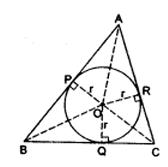
$b.$ Join $\text{OA, OB}$ and $OC.$
$\text { Area }(\triangle A B C)=\text { area }(\triangle O A B)$
$\text { + area }(\Delta O B C)$
$\text { + area }(\triangle O C A)$
$=\left(\frac{1}{2} \times A B \times O P\right)$
$+\left(\frac{1}{2} \times B C \times O Q\right)$
$\left.+\left(\frac{1}{2} \times C A \times O R\right)\right)$
$=\left(\frac{1}{2} \times A B \times r\right)+\left(\frac{1}{2} \times B C \times r\right)+\left(\frac{1}{2} \times C A \times r\right)$
$=\frac{1}{2}(A B+B C+C A) \times r$
$=\frac{1}{2}(\text { perimeter of } \Delta A B C) \times r$
Image
View full question & answer
Question 63 Marks
Nine times the side of one square exceeds a perimeter of a second square by one metre and six times the area of the second square exceeds twenty$-$nine times the area of the first by one square metre, Find the side of each square.
Answer
Assume side of one square $= x m$ and side of other square $= y m$,
then we have $9 x=4 y+1$
$\Rightarrow \frac{9 x-1}{4}=y\ldots\ldots(i)$
According to given situation we have,
$6 y^2=29 x^2+1$
$\Rightarrow 6\left(\frac{9 x-1}{4}\right)^2=29 x^2+1$
$\Rightarrow \frac{3\left(81 x^2-18 x+1\right)}{8}=29 x^2+1$
$\Rightarrow 243 x^2-54 x+3=232 x^2+8$
$\Rightarrow 11 x^2-54 x-5=0$
Factorize above quadratic equation we get
$\Rightarrow(x-5)(11 x+1)=0$
$\Rightarrow x=5$ or $x=\frac{-1}{11} ($ negative value is rejected $)$
$\therefore x=5 m$
When $x=5$, then $y=\frac{9 \times 5-1}{4}=11 m ($From $(i))$
Hence sides of the square are $5 m$ and $11 m .$
View full question & answer
Question 73 Marks
A point $P$ divides the line segment joining the points $A (3,-5)$ and $B (-4,8)$ such that $\frac{A P}{P B}=\frac{k}{1}$. If $P$ lies on the line $x+y=0$, then find the value of $k$.
Answer
Given points are $A (3,-5)$ and $B (-4,8)$.
$P$ divides $AB$ in the ratio $k : 1$
Using the section formula, we have:
Coordinate of point $P$ are $\left\{\left(\frac{-4 k+3}{k+1}\right)\left(\frac{8 k-5}{k+1}\right)\right\}$
Now it is given, that $P$ lies on the line $x+y=0$
Therefore,
$\frac{-4 k+3}{k+1}+\frac{8 k-5}{k+1}=0$
$\Rightarrow-4 k+3+8 k-5=0$
$\Rightarrow 4 k-2=0$
$\Rightarrow k=\frac{2}{4}$
$\Rightarrow k=\frac{1}{2}$
Thus, the value of $k$ is $1 / 2$.
View full question & answer
Question 83 Marks
Three sets of English, Hindi and Mathematics books have to be stacked in such a way that all the books are stored topic wise and the height of each stack is the same. The number of English books is 96, the number of Hindi books is 240 and the number of Mathematics books is 336. Assuming that the books are of the same thickness, determine the number of stacks of English, Hindi and Mathematics books.
Answer
In order to arrange the books as required, we have to find the largest number that divides 96,240 and 336 exactly. Clearly, such a number is their HCF.
We have,
$96=2^5 \times 3,240=2^4 \times 3 \times 5 \text { and } 336=2^4 \times 3 \times 7$
$\therefore$ HCF of 96, 240 and 336 is $2^4 \times 3=48$
So, there must be 48 books in each stack.
$\therefore$ Number of stacks of English books $=\frac{96}{48}=2$
Number of stacks of Hindi books $=\frac{240}{48}=5$
Number of stacks of Mathematics books $=\frac{336}{48}=7$
View full question & answer
3 Marks Question - Maths STD 10 Questions - Vidyadip