Questions

5 Marks Questions

🎯

Test yourself on this topic

6 questions · timed · auto-graded

Question 15 Marks
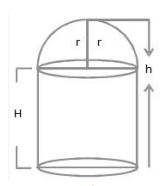
A building is in the form of a cylinder surmounted by a hemispherical dome. The base diameter of the dome is equal to $\frac{2}{3}$ of the total height of the building. Find the height of the building, if it contains $67 \frac{1}{21} m^3$ of air.
Answer
Image

Let the radius of the hemispherical dome be $r$ and the total height of the building be $h$.
Since, the base diameter of the dome is equal to $\frac{2}{3}$ of the total height
$2 r=\frac{2}{3} h$
$\Rightarrow r=\frac{h}{3}$
Let $H$ be the height of the cylindrical position.
$\Rightarrow H=h-r=h-\frac{h}{3}=\frac{2 h}{3}$
Volume of air inside the building $=$ Volume of air inside the dome $+$ Volume of air inside the cylinder
$\Rightarrow 67 \frac{1}{21}=\frac{2}{3} \pi r^3+\pi r^2 H$
$\Rightarrow \frac{1408}{21}=\pi r^2\left(\frac{2}{3} r+H\right)$
$\Rightarrow \frac{1408}{21}=\frac{22}{7} \times\left(\frac{h}{3}\right)^2\left(\frac{2}{3} \times \frac{h}{3}+\frac{2 h}{3}\right)$
$\Rightarrow \frac{1408 \times 7}{22 \times 21}=\frac{h^2}{9} \times\left(\frac{2 h}{9}+\frac{2 h}{3}\right)$
$\Rightarrow \frac{64}{3}=\frac{h^2}{9} \times\left(\frac{8 h}{9}\right)$
$\Rightarrow \frac{64 \times 9 \times 9}{3 \times 8}=h^3$
$\Rightarrow h^3=8 \times 27$
$\Rightarrow h=6$
Thus, the height of the building is $6 m .$
View full question & answer
Question 25 Marks
A train covered a certain distance at a uniform speed. If it were $6 \ km/h$ faster, it would have taken $4$ hours less than the scheduled time. And, if the train were slower by $6 \ km/h,$ it would have taken $6$ hours more than the scheduled time. Find the length of the journey.
Answer
Let the actual speed of the train be $x \ km / hr$ and the actual time taken be $y$ hours.
Then, Distance covered $=( xy ) \ km \ldots (i) \ [\because$ Distance $=$ Speed $\times$ Time $]$
If the speed is increased by $6 \ km / hr,$
then time of journey is reduced by $4$ hours
i.e., when speed is $(x+6) \ km / hr,$ time of journey is $(y-4)$ hours.
$\therefore $ Distance covered $=(x+6)(y-4)$
$\Rightarrow x y=(x+6)(y-4)\ [$Using $(i)]$
$\Rightarrow-4 x+6 y-24=0$
$\Rightarrow-2 \cdot x+3 y-12=0 \ldots \text { (ii) }$
When the speed is reduced by $6 \ km / hr$, then the time of journey is increased by $6$ hours
i.e., when speed is $( x -6) \ km / hr,$ time of journey is $(y+6)$ hours.
$\therefore $ Distance covered $=(x-6)(y+6)$
$\Rightarrow xy=(x-6)(y+6) \ [$Using $(i)]$
$\Rightarrow 6 x-6 y-36=0$
$\Rightarrow x-y-6=0 \ldots \text { (iii) }$
Thus, we obtain the following system of equations:
$-2 x+3 y-12=0$
$x-y-6=0$
By using cross $-$ multiplication, we have,
$\frac{x}{3 \times-6-(-1) \times-12}$
$=\frac{-y}{-2 \times-6-1 \times-12}$
$=\frac{1}{-2 \times-1-1 \times 3}$
$\Rightarrow \frac{x}{-30}=\frac{-y}{24}=\frac{1}{-1}$
$\Rightarrow x=30$ and $y=24$
Putting the values of $x$ and $y$ in equation $(i),$ we obtain
Distance $=(30 \times 24) \ km =720 \ km$.
Hence, the length of the journey is $720 \ km .$
View full question & answer
Question 35 Marks
If the sum of the first $p$ terms of an $A.P.$ is $q$ and the sum of the first $q$ terms is $p$; then show that the sum of the first $(p+q)$ terms is $\{-(p+q)\}$.
Answer
It is given that, Sum of first $p$ terms of an $A P=q$
and Sum of the first $q$ terms the same $A P=p$
Let us take the first term as a and the common difference d Therefore, the sum $S _{ n }=\frac{n}{2}[2 a+(n-1) d]$
$q=\frac{p}{2}[2 a+(p-1) d]$
$p=\frac{q}{2}[2 a+(q-1) d]$
Subtracting the sum of the $q$ terms from the sum of $p$ terms we get
$q-p=\left[\frac{p}{2}(2 a+(p-1) d]-\frac{q}{2}[2 a+(q-1) d]\right.$
$q-p=a(p-q)+\frac{d}{2}\left(p^2-p-q^2+q\right)$
After solving the equation we get
$d=-\frac{2(p+q)}{p q}$
Now with $d =-\frac{2(p+q)}{p q}$, the first term of the series is a and the number of terms is $( p + q )$
$S_{n}=\frac{n}{2}[2 a+(n-1) d]$
$Sp+q=\frac{p+q}{2}[2 a+(p+q-1) d]=\frac{p+q}{p q}(-p q)$
Therefore, the sum is $-(p+q)$.
View full question & answer
Question 45 Marks
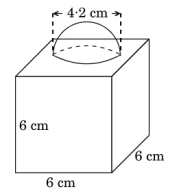
In Figure, a decorative block is shown which is made of two solids, a cube and a hemisphere. The base of the block is a cube with edge $6 \ cm$ and the hemisphere fixed on the top has a diameter of $4.2 \ cm .$ Find
a. the total surface area of the block.
b. the volume of the block formed. $($Take $\pi=\frac{22}{7}$ )
Image
Answer
$a.$ Total surface area of block
$= \text{TSA}$ of cube $+ \text{CSA}$ of hemisphere $-$ Base area of hemisphere
$=6 a^2+2 \pi r^2-\pi r^2$
$=6 a^2+\pi r^2$
$=\left(6 \times 6{ }^2+\frac{22}{7} \times 2.1 \times 2.1\right) \ cm^2$
$=(216+13.86) \ cm^2$
$=229.86 \ cm^2$
$b.$ Volume of block
$=6^3+\frac{2}{3} \times \frac{22}{7} \times(2.1)^3$
$=(216+19.40) \ cm^3$
$=235.40 \ cm^3$
View full question & answer
Question 55 Marks
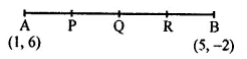
Points $P, Q$ and $R$ in order are dividing a line segment joining $A(1, 6)$ and $B(5, -2)$ in four equal parts. Find the coordinates of $P, Q$ and $R$
Answer
Points $P, Q$ and $R$ in order divide a line segment joining the points $A(1, 6)$ and $B(5, -2)$ in $4$ equal parts.
Image
$P$ divides $AB$ in the ratio of 4 Let coordinates of $P$ be $(x, y),$ then
$x=\frac{m x_2+n x_1}{m+n}=\frac{1 \times 5+3 \times 1}{1+3}$
$=\frac{5+3}{4}=\frac{8}{4}=2$
$y=\frac{m y_2+n y_1}{m+n}=\frac{1 \times(-2)+3 \times 6}{1+3}$
$=\frac{-2+18}{4}=\frac{16}{4}=4$
$\therefore$ Coordinates of  $P$ are $(2,4)$
Similarly,
$Q$ divides $AB$ in $2: 2$ or $1: 1$ and $Q$ is midpoint of $AB$.
$\therefore$ Coordinates of $Q$ will be
$\left(\frac{1+5}{2}, \frac{6-2}{2}\right)$ or $\left(\frac{6}{2}, \frac{4}{2}\right)$ or $(3,2)$
and $R$ divides $A B$ in the ratio of $3: 1$
Coordinates of $R$ will be
$\left(\frac{3 \times 5+1 \times 1}{3+1}, \frac{3 \times(-2)+1 \times 6}{3+1}\right)$
or $\left(\frac{15+1}{4}, \frac{-6+6}{4}\right)$ or $\left(\frac{16}{4}, \frac{0}{4}\right)$ or $(4,0)$
View full question & answer
Question 65 Marks
A leading library has a fixed charge for the first three days and an additional charge for each day thereafter Sarika paid $₹ 27$ for a book kept for seven days, while Sury paid $₹ 21$ for the book she kept for five days, find the fixed charge and the charge for each extra day
Answer
Let the fixed charge be $Rs. x$ and additional charge by $Rs. y$. According to question,
$x+(7-3) y=27$
or $x+4 y=27 \ldots .(i)$
and $x+(5-3) y=21$
$x+2 y=21 \ldots \text { (ii) }$
On substracting $(i)$ and $(ii),$ we get
$2 y=6$
$y=3$
putting $y$ in $(i),$
$x+4(3)=27$
$x=15$
$\therefore x=\text { Rs. } 15$ and $y=\text { Rs. } 3$
$\therefore$ Fixed charge $= Rs. 15$
$\therefore$ Charge for each extra day $= Rs. 3$
View full question & answer
5 Marks Questions - Maths STD 10 Questions - Vidyadip