Question 14 Marks
Read the following text carefully and answer the questions that follow:
Two poles, $30$ feet and $50$ feet tall, are $40$ feet apart and perpendicular to the ground. The poles are supported by wires attached from the top of each pole to the bottom of the other, as in the figure. $A$ coupling is placed at $C$ where the two wires cross.
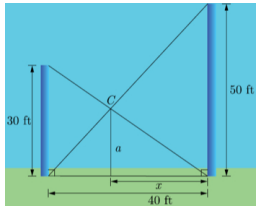
$i$. What is the horizontal distance from $C$ to the taller pole? $(1)$
$ii$. How high above the ground is the coupling? $(1)$
$iii.$ How far down the wire from the smaller pole is the coupling? $(2)$
OR
Find the length of line joining the top of the two poles. $(2)$
Two poles, $30$ feet and $50$ feet tall, are $40$ feet apart and perpendicular to the ground. The poles are supported by wires attached from the top of each pole to the bottom of the other, as in the figure. $A$ coupling is placed at $C$ where the two wires cross.
$i$. What is the horizontal distance from $C$ to the taller pole? $(1)$
$ii$. How high above the ground is the coupling? $(1)$
$iii.$ How far down the wire from the smaller pole is the coupling? $(2)$
OR
Find the length of line joining the top of the two poles. $(2)$
Answer
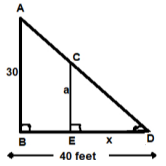
$\triangle ABD \sim \triangle CED \text { (by AA criteria) }$
$\frac{30}{a}=\frac{40}{x}$
$\frac{x}{a}=\frac{40}{30}$
$a =\frac{30}{40} x$
$\text { Again }$
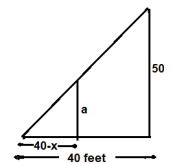
$\frac{40-x}{40}=\frac{a}{50}$
$\frac{40-x}{40}=\frac{30 \times x}{40 \times 50}$
$8000-200 x =120 x$
$8000=320 x$
$\therefore x=25 \text { feet }$
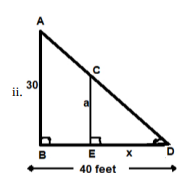
$\frac{x}{40}=\frac{a}{30}$
$\frac{25}{40}=\frac{a}{30}$
$\frac{25 \times 30}{40}=a$
$\frac{75}{4}= a$
$a =18.75 \text { feet }$
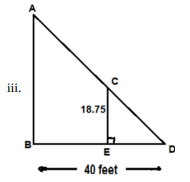
$AD=\sqrt{30^2+40^2}$
$=\sqrt{900+1600}$
$=\sqrt{2500}$
$AD=50 \text { feet }$
In $\triangle C E D$
$CD=\sqrt{18.75^2+25^2}$
$=\sqrt{976.5625}$
$=31.25 \text { feet }$
$AC=AD-CD$
$=50-31.25$
$=18.75 \text { feet }$
OR
$\sqrt{40^2+20^2}$
$=\sqrt{1600+400}$
$=\sqrt{2000}$
$=20 \sqrt{5} \text { feet }$
View full question & answer→$\triangle ABD \sim \triangle CED \text { (by AA criteria) }$
$\frac{30}{a}=\frac{40}{x}$
$\frac{x}{a}=\frac{40}{30}$
$a =\frac{30}{40} x$
$\text { Again }$
$\frac{40-x}{40}=\frac{a}{50}$
$\frac{40-x}{40}=\frac{30 \times x}{40 \times 50}$
$8000-200 x =120 x$
$8000=320 x$
$\therefore x=25 \text { feet }$
$\frac{x}{40}=\frac{a}{30}$
$\frac{25}{40}=\frac{a}{30}$
$\frac{25 \times 30}{40}=a$
$\frac{75}{4}= a$
$a =18.75 \text { feet }$
$AD=\sqrt{30^2+40^2}$
$=\sqrt{900+1600}$
$=\sqrt{2500}$
$AD=50 \text { feet }$
In $\triangle C E D$
$CD=\sqrt{18.75^2+25^2}$
$=\sqrt{976.5625}$
$=31.25 \text { feet }$
$AC=AD-CD$
$=50-31.25$
$=18.75 \text { feet }$
OR
$\sqrt{40^2+20^2}$
$=\sqrt{1600+400}$
$=\sqrt{2000}$
$=20 \sqrt{5} \text { feet }$