Questions

M.C.Q (1 Marks)

🎯

Test yourself on this topic

18 questions · timed · auto-graded

MCQ 11 Mark
In the formula $\bar{x}=a+\frac{\sum f_i d_i}{\sum f_i}$ for finding the mean of grouped data $d_i^{\prime} s$ are deviations from $a$ of
  • A
    upper limits of the classes
  • B
    lower limits of the classes
  • mid points of the classes
  • D
    frequencies of the class marks
Answer
Correct option: C.
mid points of the classes
(c) mid points of the classes
Explanation : We know that, $d _{ i }= x _{ i }- a$
Where,
$x _{ i }$ are data or class mark and "a" is the assumed mean
i.e. $d_i$ are the deviations of observations from assumed mean.
View full question & answer
MCQ 21 Mark
Cards marked with numbers 1, 2, 3, ..., 25 are placed in a box and mixed thoroughly and one card is drawn at random from the box. The probability that the number on the card is a multiple of 3 or 5 is
  • A
    $\frac{8}{25}$
  • $\frac{12}{25}$
  • C
    $\frac{4}{25}$
  • D
    $\frac{1}{5}$
Answer
Correct option: B.
$\frac{12}{25}$
(b) $\frac{12}{25}$
Explanation : Number of multiples of 3 = 8 ( 3  6  9  12  15  18  21  24)
Number of multiples of 5 = 5 ( 5  10  15  20  25)
Number of possible outcomes (multiples of 3 or 5)
= 12 ( 3,5,6,9,10,12,15,18,20,21,24,25 )
Number of Total outcomes = 25
$\therefore$ Required Probability  $=\frac{12}{25}$
View full question & answer
MCQ 31 Mark
What is the probability that a leap year has 52 Mondays?
  • $\frac{5}{7}$
  • B
    $\frac{6}{7}$
  • C
    $\frac{2}{7}$
  • D
    $\frac{4}{7}$
Answer
Correct option: A.
$\frac{5}{7}$
(a) $\frac{5}{7}$
Explanation : No. of days in a leap year $=366$
No. of Mondays $=52$
Extra days $=366-52 \times 7$
$=366-364=2$
$\therefore$ Remaining days in the week $=7-2=5$
$\therefore$ Probability of being 52 Mondays in the leap year $=\frac{5}{7}$
View full question & answer
MCQ 41 Mark
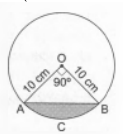
A chord of a circle of radius $10 \ cm$ subtends a right angle at the centre. The area of the minor segments $($given, $\pi$
$=3.14)$ is
  • A
    $32.5 \ cm^2$
  • B
    $34.5 \ cm^2$
  • C
    $30.5 \ cm^2$
  • $28.5 \ cm^2$
Answer
Correct option: D.
$28.5 \ cm^2$
$\operatorname{ar}($ minor segment A C B A $)=\operatorname{ar}($ sector O A C B O) $-\operatorname{ar}(\Delta O A B)$
$=\left(\frac{\pi r^2 \theta}{360}-\frac{1}{2} \times r \times r\right)$
Image
$=\left(\frac{3.14 \times 10 \times 10 \times 90}{360}-\frac{1}{2} \times 10 \times 10\right) \ cm ^2$
$=(78.5-50) \ cm ^2=28.5 \ cm^2$
View full question & answer
MCQ 51 Mark
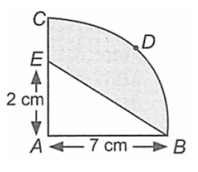
In the figure, $\text{ABDCA}$ represents a quadrant of a circle of radius $7 \ cm$ a with centre A. Find the area of the shaded portion.
Image
  • A
    $14 \ cm^2$
  • $31.5 \ cm^2$
  • C
    $24.5 \ cm^2$
  • D
    $38.5 \ cm^2$
Answer
Correct option: B.
$31.5 \ cm^2$
$\text { Explanation: Area of quadrant }=\frac{1}{4} \pi r^2$
$=\frac{1}{4} \times \frac{22}{7} \times(7)^2=\frac{77}{2} \ cm^2=38.5 \ cm^2$
Area of $\triangle BAE =\frac{1}{2} \times$ base $\times$ height
$=\frac{1}{2} \times AB \times AE=\frac{1}{2} \times 7 \times 2=7 \ cm^2$
Hence, area of the shaded portion $=$ Area of the quadrant $A B D C A ~-$ Area of $\triangle B A E$
$=(38.5-7) \ cm^2=31.5 \ cm^2$
View full question & answer
MCQ 61 Mark
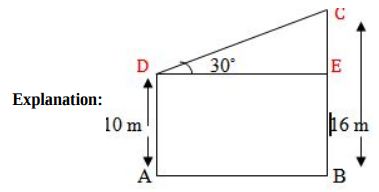
The tops of two poles of height 16 m and 10 m are connected by a wire. If the wire makes an angle of $30^{\circ}$ with the horizontal, then the length of the wire is
  • 12 m
  • B
    $10 \sqrt{3} m$
  • C
    16 m
  • D
    10 m
Answer
Correct option: A.
12 m
(a) 12 m
Image
Given: Two poles $BC =16 m$ and $AD =10 m$
And $\angle CDE =30^{\circ}$
To find: Length of wire $CD =x$
$\therefore$ In triangle CDE,
$\sin 30^{\circ}=\frac{ CE }{ CD }$
$\Rightarrow \frac{1}{2}=\frac{ BC - BE }{ CD }$
$\Rightarrow \frac{1}{2}=\frac{16-10}{x}$
$\Rightarrow \frac{1}{2}=\frac{6}{x}$
$\Rightarrow x=12 m$
Therefore, the length of the wire is 12 m .
View full question & answer
MCQ 71 Mark
The ratio of $\text{HCF}$ to $\text{LCM}$ of the least composite number and the least prime number is:
  • A
    $1: 1$
  • B
    $2: 1$
  • $1: 2$
  • D
    $1: 3$
Answer
Correct option: C.
$1: 2$
Least composite number is $4$ and the least prime number is $2 .$
$\operatorname{LCM}(4,2)=4$
$\operatorname{HCF}(4,2)=2$
The ratio of $\text{HCF}$ to $\text{LCM}=2: 4$ or $1: 2$.
View full question & answer
MCQ 81 Mark
If $\sec \theta+\tan \theta= p$, then the value of $\sin \theta$ is
  • A
    $\frac{1-p^2}{p^2+1}$
  • $\frac{p^2-1}{p^2+1}$
  • C
    $\frac{1+p^2}{p^2-1}$
  • D
    $\frac{p^2+1}{p^2-1}$
Answer
Correct option: B.
$\frac{p^2-1}{p^2+1}$
Given: $\sec \theta+\tan \theta= p$
$\Rightarrow \frac{1}{\cos \theta}+\frac{\sin \theta}{\cos \theta}=p$
$\Rightarrow \frac{1+\sin \theta}{\cos \theta}=p$
Squaring both sides, we get
$\Rightarrow \frac{(1+\sin \theta)^2}{\cos ^2 \theta}=p^2$
$\Rightarrow \frac{(1+\sin \theta)^2}{1-\sin \theta}=p^2$
$\Rightarrow \frac{(1+\sin \theta)^2}{(1+\sin \theta)(1-\sin \theta)}=p^2$
$\Rightarrow \frac{1+\sin \theta}{1-\sin \theta}=p^2$
$\Rightarrow 1+\sin \theta=p^2(1-\sin \theta)$
$\Rightarrow 1+\sin \theta=p^2-p^2 \sin \theta$
$\Rightarrow \sin \theta+p^2 \sin \theta=p^2-1$
$\Rightarrow \sin \theta\left(1+p^2\right)=p^2-1$
$\Rightarrow \sin \theta=\frac{p^2-1}{p^2+1}$
View full question & answer
MCQ 91 Mark
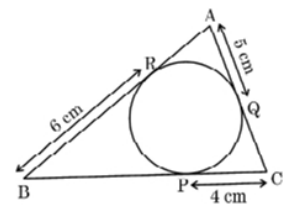
In the given figure, the perimeter of $\triangle \text{ABC}$ is:
Image
  • A
    $15 \ cm$
  • $30 \ cm$
  • C
    $60 \ cm$
  • D
    $45 \ cm$
Answer
Correct option: B.
$30 \ cm$
$\ce{AQ = AR =}4$
Similarly,
$\ce{PC=CQ}=5$
Similarly,
$\ce{BP=BR}=6$
Perimeter $= \ce{AB + BC + CA}$
Perimeter $= \ce{AR + RB + BP + PC + CQ + QA}$
$=4+6+6+5+5+4$
$=30 \ cm$
View full question & answer
MCQ 101 Mark
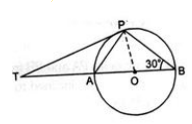
In the given figure, $\text{BOA}$ is a diameter of a circle and the tangent at a point $P$ meets $BA$ extended at $T$ . If $\angle PBO =30^{\circ},$ then $\angle PTA$ is equals to:
Image
  • A
    $20^{\circ}$
  • $30^{\circ}$
  • C
    $40^{\circ}$
  • D
    $60^{\circ}$
Answer
Correct option: B.
$30^{\circ}$
In triangle $\text{POB} , OP = OB \ [$Radii of the same circle$]$
$\Rightarrow \angle BPO=\angle PBO$
$=30^{\circ} \ [$Opposite angles of equal sides are equal$]$
Also $\angle APB =90^{\circ}$
[Angle in semicircle]
$\therefore \angle OPA =90^{\circ}-30^{\circ}=60^{\circ}$
In triangle $POA , OP = OA \ [$Radii of the same circle$]$
$\Rightarrow \angle OPA =\angle OAP =60^{\circ} \ [$Opposite angles of equal sides are equal$]$
Now, $OP \perp TP,$ then $\angle OPT =90^{\circ}$
$\therefore \angle APT=90^{\circ}-60^{\circ}=30^{\circ}$
Also $, \angle BAP+\angle PAT=180^{\circ}$
$\Rightarrow 60^{\circ}+\angle PAT=180^{\circ}$
$\Rightarrow \angle PAT=120^{\circ}$
Now, in triangle $\text{APT}, \angle PTA +\angle APT +\angle PAT =180^{\circ}$
$\Rightarrow \angle PTA+30^{\circ}+120^{\circ}=180^{\circ}$
$\Rightarrow \angle PTA=30^{\circ}$
View full question & answer
MCQ 111 Mark
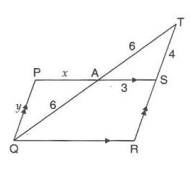
In the given figure if $\ce{PS\|QR}$ and $\ce{PQ\|SR}$ and $\ce{AT = AQ = 6, AS = 3, TS = 4,}$ then
Image
  • A
    $x = 2, y = 3.$
  • B
    $x = 1, y = 2.$
  • $x = 3, y = 4.$
  • D
    $x = 4, y = 5.$
Answer
Correct option: C.
$x = 3, y = 4.$
In triangles $\text{APQ}$ and $\text{ATS,}$ $\angle \text{PAQ} =\angle \text{TAS}$
$[$Vertically opposite angles$] \angle \text{PQA} =\angle \text{ATS}[$ Alternate angles$]$
$\therefore \Delta \text{APQ} \sim \Delta \text{AST[AA}$ similarity $]$
$\therefore \frac{AQ}{AT}=\frac{AP}{AS}$
$\Rightarrow \frac{6}{6}=\frac{x}{3}$
$\Rightarrow x=\frac{6 \times 3}{6}=3$
And $\frac{AQ}{AT}=\frac{PQ}{ST}$
$\Rightarrow \frac{6}{6}=\frac{y}{4}$
$\Rightarrow y=\frac{4 \times 6}{6}=4$
Therefore, $x=3, y=4$
View full question & answer
MCQ 121 Mark
The zeroes of the polynomial $p(x)=x^2+4 x+3$ are given by:
  • A
    $-1,3$
  • B
    $1,-3$
  • C
    $1,3$
  • $-1,-3$
Answer
Correct option: D.
$-1,-3$
Given, $P( x )= x ^2+4 x +3$
$=x^2+3 x+x+3$
$=x(x+3)+1(x+3)$
$=(x+1)(x+3)$
For zeroes of polynominal $(P(x)=0$
$(x+1)(x+3)=0$
$x=-1,-3$
View full question & answer
MCQ 131 Mark
A circle drawn with origin as the centre passes through $\left(\frac{13}{2}, 0\right)$. The point which does not lie in the interior of the circle is
  • A
    $\frac{-3}{4}, 1$
  • B
    $2, \frac{7}{3}$
  • C
    $5, \frac{-1}{2}$
  • $\left(-6, \frac{5}{2}\right)$
Answer
Correct option: D.
$\left(-6, \frac{5}{2}\right)$
Distance between $(0,0)$ and $\left(-6, \frac{5}{2}\right)$
$d=\sqrt{(-6-0)^2+\left(\frac{5}{2}-0\right)^2}$
$=\sqrt{36+\frac{25}{4}}$
$=\sqrt{\frac{144+25}{4}}$
$=\sqrt{\frac{169}{4}}$
$=\frac{13}{2}$
$=6.5$
So, the point $\left(-6, \frac{5}{2}\right)$ does not lie in the circle.
View full question & answer
MCQ 141 Mark
Find the sum of the progression $: (5 + 13 + 21 + ... + 181)$
  • $2139$
  • B
    $2337$
  • C
    $2219$
  • D
    $2476$
Answer
Correct option: A.
$2139$
Here, $a =5, d=(13-5)=8$ and $l =181$
Let the number of terms be $n$.
Then, $T _{ n }=181$
$\Rightarrow a+(n-1) d=181$
$\Rightarrow 5+(n-1) \times 8=181$
$\Rightarrow 8 n=184$
$\Rightarrow n=23$
$\therefore$ Required sum $=\frac{n}{2}(a+l)$
$=\frac{23}{2}(5+181)=23 \times 93=2139$
Hence, the required sum is $2139$
View full question & answer
MCQ 151 Mark
Let $b=a+c$. Then the equation $ax ^2+ bx + c =0$ has equal roots if
  • A
    $a = -c$
  • $a = c$
  • C
    $a = -2c$
  • D
    $a = 2c$
Answer
Correct option: B.
$a = c$
Since, If $a x^2+b x+c=0$ has equal roots, then
$b^2-4 ac=0$
$\Rightarrow(a+c)^2-4 ac=0 \ldots[\text { Given: } b=a+c]$
$\Rightarrow a^2+c^2+2 ac-4 ac=0$
$\Rightarrow a^2+c^2-2 ac=0$
$\Rightarrow(a-c)^2=0$
$\Rightarrow a-c=0$
$\Rightarrow a=c$
View full question & answer
MCQ 161 Mark
A sphere is placed inside a right circular cylinder so as to touch the top, base and lateral surface of the cylinder. If the radius of the sphere is r, then the volume of the cylinder is
  • $2 \pi r ^3$
  • B
    $8 \pi r^3$
  • C
    $\frac{8}{3} \pi r^3$
  • D
    $4 \pi r^3$
Answer
Correct option: A.
$2 \pi r ^3$
(a) $2 \pi r^3$
Explanation : Volume of a sphere $=(4 / 3) \pi r ^3$
Volume of a cylinder $=\pi r^2 h$
Given, sphere is placed inside a right circular cylinder so as to touch the top, base and lateral surface of the cylinder and the radius of the sphere is $r$.
Thus, height of the cylinder $=$ diameter $=2 r$ and base radius $= r$
Volume of the cylinder $=\pi \times r ^2 \times 2 r =2 \pi r ^3$
View full question & answer
MCQ 171 Mark
If $a x^2+b x+c=0$ has equal roots, then c is equal to
  • A
    $\frac{b^2}{2 a}$
  • $\frac{b^2}{4 a}$
  • C
    $\frac{-b^2}{4 a}$
  • D
    $-\frac{b^2}{2 a}$
Answer
Correct option: B.
$\frac{b^2}{4 a}$
If $a x^2+b x+c=0$ has equal roots, then
$b^2-4 a c=0$
$\Rightarrow 4 a c=b^2$
$\Rightarrow c=\frac{b^2}{4 a}$
View full question & answer
MCQ 181 Mark
A bag contains 8 red, 2 black and 5 white balls. One ball is drawn at random. What is the probability that the ball drawn is not black?
  • $\frac{13}{15}$
  • B
    $\frac{1}{3}$
  • C
    $\frac{8}{15}$
  • D
    $\frac{2}{15}$
Answer
Correct option: A.
$\frac{13}{15}$
(a) $\frac{13}{15}$
Explanation: Total number of balls in the bag $=8+2+5=15$.
Number of non-black balls $=8+5=13$.
$\therefore P ($ getting a non-black ball $)=\frac{13}{15}$
View full question & answer