Questions

2 Marks Questions

🎯

Test yourself on this topic

7 questions · timed · auto-graded

Question 12 Marks
The minute hand of a clock is $7.5 \ cm$ long. Find the area of the face of the clock described by the minute hand in $56$ minutes.
Answer
Angle described by the minute hand in $60$ minutes $=360^{\circ}$
$\therefore$ Angle described by the minute hand in $56$ minutes $=\left(\frac{360}{60} \times 56\right)^0=336^{\circ}$
$\therefore \theta=336^{\circ}$ and $r =7.5 \ cm$
$\therefore$ Area swept by the minute hand in $56$ minutes $=\left(\frac{\pi r^2 \theta}{360}\right)$
$=\left(3.14 \times 7.5 \times 7.5 \times \frac{336}{360}\right) \ cm^2$
$=165 \ cm^2$
View full question & answer
Question 22 Marks
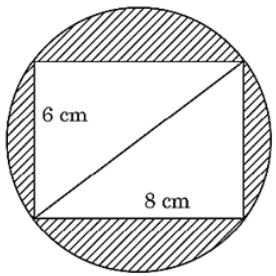
Reeti prepares a Rakhi for her brother Ronit. The Rakhi consists of a rectangle of length $8 \ cm$ and breadth $6 \ cm$ inscribed in a circle as shown in the figure. Find the area of the shaded region. $($Use $\pi=3 \cdot 14)$
Image
Answer
Diagonal of rectangle $=\sqrt{6^2+8^2}=10$
$\therefore$  Radius of circle $ r=\frac{10}{2}=5$
Area of circle $=3.14 \times 5 \times 5$
$=78.5$
Area of rectangle $=6 \times 8=48$
Area of shaded region $=78.5-48$
$=30.5 \ cm^2$
$\therefore$ Area of shaded region is $30.5 \ cm^2$
$=30.5 \ cm^2$
$\therefore$ Area of shaded region is $30.5 \ cm^2$
View full question & answer
Question 32 Marks
Prove the trigonometric identity: $\frac{\sin \theta}{1+\cos \theta}+\frac{1+\cos \theta}{\sin \theta}=2 \operatorname{cosec} \theta$
Answer
We have,
$\text { LHS }=\frac{\sin \theta}{1+\cos \theta}+\frac{1+\cos \theta}{\sin \theta}$
$\Rightarrow \text { LHS }=\frac{\sin ^2 \theta+(1+\cos \theta)^2}{\sin ^\theta \theta(1+\cos \theta)}$
$\Rightarrow \text { LHS }=\frac{\sin ^2 \theta+1+2 \cos \theta+\cos ^2 \theta}{\sin \theta(1+\cos \theta)}$
$\Rightarrow \text { LHS }=\frac{\left(\sin ^2 \theta+\cos 2\right)+1+2 \cos \theta}{\sin \theta(1+\cos \theta)}$
$\Rightarrow \text { LHS }=\frac{1+1+2 \cos \theta}{\sin \theta(1+\cos \theta)}\left[\because \sin ^2 \theta+\cos ^2 \theta=1\right]$
$\Rightarrow \text { LHS }=\frac{2+2 \cos \theta}{\sin \theta(1+\cos \theta)}$
$=\frac{2(1+\cos \theta)}{\sin \theta(1+\cos \theta)}$
$=\frac{2}{\sin \theta}$
$=2 \operatorname{cosec} \theta$
$=\text { RHS }$
View full question & answer
Question 42 Marks
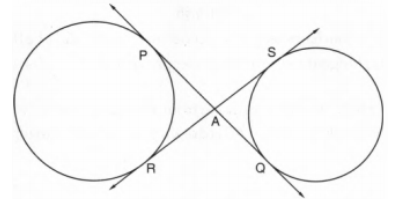
In fig common tangents $PQ$ and $RS$ to two circles intersect at $A$. Prove that $PQ=RS$.
Image
Answer
We have in given figure common tangents $PQ$ and $RS$ to two circles intersect at $A.$
Since tangents drawn from an external points to a circle are equal.
$\therefore AP=AR$ and $ AQ=AS$
$\therefore AP+AQ=AR+AS \text { [Adding] }$
$\Rightarrow PQ=RS$
Hence proved.
View full question & answer
Question 52 Marks
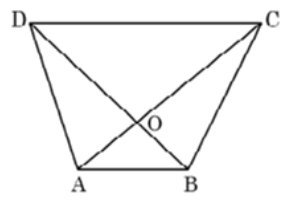
The diagonals of a quadrilateral $A B C D$ intersect each other at the point $O$ such that $\frac{A O}{B O}=\frac{C O}{O D}$
Image
Show that quadrilateral $A B C D$ is a trapezium.
View full question & answer
Question 62 Marks
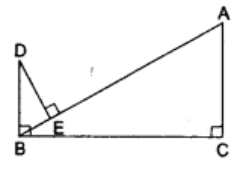
In the given figure, $\ce{DB \perp BC, DE \perp AB}$ and $\ce{AC \perp BC}$.
Prove that $\frac{BE}{DE}=\frac{AC}{BC}$
Image
Answer
In $\triangle \text{BED}$ and $\triangle \text{ACB}$, we have
$\angle \text{BED}=\angle \text{ACB}=90^{\circ}$
$\because \angle B+\angle C=180^{\circ}$
$\therefore \ce{BD \| AC}$
$\angle \text{EBD}=\angle CAB($ Alternate angles $)$
Therefore, by $\text{AA}$ similarity theorem, we get
$\triangle \text{BED} \sim \triangle \text{ACB}$
$\Longrightarrow \frac{BE}{AC}=\frac{DE}{BC}$
$\Longrightarrow \frac{BE}{DE}=\frac{AC}{BC}$
View full question & answer
Question 72 Marks
On comparing the ratios $\frac{a_1}{a_2}, \frac{b_1}{b_2}$ and $\frac{c_1}{c_2}$, find out whether the pair of linear equations are consistent, or inconsistent: $\frac{4}{3} x+2 y =8 ; 2 x +3 y =12$.
Answer
Given equations are:
$
\frac{4}{3} x+2 y=8 ; 2 x+3 y=12
$
Compare equation $\frac{4}{3} x+2 y=8$ with $a _1 x + b _1 y + c _1=0$ and $2 x +3 y =12$
with $a _2 x + b _2 y + c _2=0$, We get, $a_1=\frac{4}{3}, a _1=\frac{4}{3}, b_1=2, c _1=-8, a _2=2, b_2=3, c _2=-12$ $\frac{a_1}{a_2}=\frac{\frac{4}{3}}{2}=\frac{2}{3}, \frac{b_1}{b_2}=\frac{2}{3}$ and $\frac{c_1}{c_2}=\frac{8}{12}=\frac{2}{3}$
Here $\frac{a_1}{a_2}=\frac{b_1}{b_2}=\frac{c_1}{c_2}$
Therefore, the lines have infinitely many solutions.
Hence, they are consistent.
View full question & answer
2 Marks Questions - Maths STD 10 Questions - Vidyadip