Question 14 Marks
Read the following text carefully and answer the questions that follow:
Basant Kumar is a farmer in a remote village of Rajasthan. He has a small square farm land. He wants to do fencing of the land so that stray animals may not enter his farmland. For this, he wants to get the perimeter of the land. There is a pole at one corner of this field. He wants to hang an effigy on the top of it to keep birds away. He standing in one corner of his square field and observes that the angle subtended by the pole in the corner just diagonally opposite to this corner is $60^{\circ}$. When he retires 80 m from the corner, along the same straight line, he finds the angle to be $30^{\circ}$.
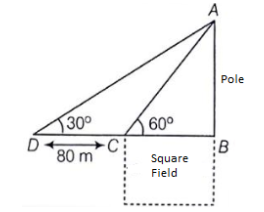
$i$. Find the height of the pole too so that he can arrange a ladder accordingly to put an effigy on the pole.
$ii$. Find the length of his square field so that he can buy material to do the fencing work accordingly.
$iii$. Find the Distance from Farmer at position $C$ and top of the pole?
OR
Find the Distance from Farmer at position $D$ and top of the pole?
Basant Kumar is a farmer in a remote village of Rajasthan. He has a small square farm land. He wants to do fencing of the land so that stray animals may not enter his farmland. For this, he wants to get the perimeter of the land. There is a pole at one corner of this field. He wants to hang an effigy on the top of it to keep birds away. He standing in one corner of his square field and observes that the angle subtended by the pole in the corner just diagonally opposite to this corner is $60^{\circ}$. When he retires 80 m from the corner, along the same straight line, he finds the angle to be $30^{\circ}$.
$i$. Find the height of the pole too so that he can arrange a ladder accordingly to put an effigy on the pole.
$ii$. Find the length of his square field so that he can buy material to do the fencing work accordingly.
$iii$. Find the Distance from Farmer at position $C$ and top of the pole?
OR
Find the Distance from Farmer at position $D$ and top of the pole?
Answer
View full question & answer→i. The following figure can be drawn from the question:
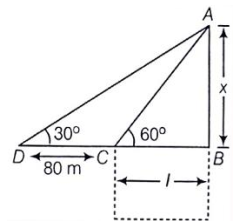
Here $A B$ is the pole of height $x$ metres and $B C$ is one side of the square field of length $1$ metres.
Now, $1=40$ metres We get,
$x=\sqrt{3} 1=40 \sqrt{3}=69.28$
Thus, height of the pole is $69.2$8 metres.
$ii$. The following figure can be drawn from the question:
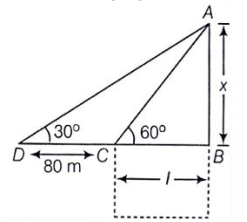
Here $AB$ is the pole of height $x$ metres and $BC$ is one side of the square field of length $1$ metres.
In $\triangle ABC$,
$\tan 60^{\circ}=\frac{x}{l}$
$\sqrt{3}=\frac{x}{l}$
$x=\sqrt{3} 1$
Now, in $\triangle A B D$,
$\tan 30^{\circ}=\frac{x}{80+l}$
$\frac{1}{\sqrt{3}}=\frac{\sqrt{3} l}{80+l}\ ($ From eq $(i))$
$80+1=3 l$
$2 l=80$
$1=40$
Thus, length of the field is $40$ metres.
$iii.$ The following figure can be drawn from the question:
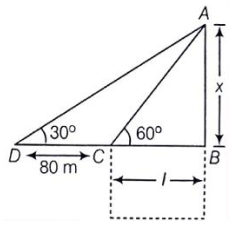
Here $A B$ is the pole of height $x$ metres and $B C$ is one side of the square field of length $1$ metres.
Distance from Farmer at position $C$ and top of the pole is $AC$ .
$\text { In } \triangle ABC$
$\cos 60^{\circ}=\frac{C B}{A C}$
$\Rightarrow A C=\frac{C B}{\cos 60^{\circ}}$
$\Rightarrow A C=\frac{40}{\frac{1}{2}}$
$\Rightarrow AC=80 m$
OR
The following figure can be drawn from the question:
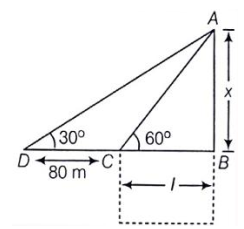
Here $AB$ is the pole of height $x$ metres and $BC$ is one side of the square field of length $1$ metres.
Distance from Farmer at position $D$ and top of the pole is $AD$
In $\triangle ABC$
$\cos 30^{\circ}=\frac{D B}{A D}$
$\Rightarrow A D=\frac{D B}{\cos 30^{\circ}}$
$\Rightarrow A D=\frac{120}{\frac{\sqrt{2}}{2}}=\frac{240}{\sqrt{3}}$
$\Rightarrow A C=138.56 m$
Here $A B$ is the pole of height $x$ metres and $B C$ is one side of the square field of length $1$ metres.
Now, $1=40$ metres We get,
$x=\sqrt{3} 1=40 \sqrt{3}=69.28$
Thus, height of the pole is $69.2$8 metres.
$ii$. The following figure can be drawn from the question:
Here $AB$ is the pole of height $x$ metres and $BC$ is one side of the square field of length $1$ metres.
In $\triangle ABC$,
$\tan 60^{\circ}=\frac{x}{l}$
$\sqrt{3}=\frac{x}{l}$
$x=\sqrt{3} 1$
Now, in $\triangle A B D$,
$\tan 30^{\circ}=\frac{x}{80+l}$
$\frac{1}{\sqrt{3}}=\frac{\sqrt{3} l}{80+l}\ ($ From eq $(i))$
$80+1=3 l$
$2 l=80$
$1=40$
Thus, length of the field is $40$ metres.
$iii.$ The following figure can be drawn from the question:
Here $A B$ is the pole of height $x$ metres and $B C$ is one side of the square field of length $1$ metres.
Distance from Farmer at position $C$ and top of the pole is $AC$ .
$\text { In } \triangle ABC$
$\cos 60^{\circ}=\frac{C B}{A C}$
$\Rightarrow A C=\frac{C B}{\cos 60^{\circ}}$
$\Rightarrow A C=\frac{40}{\frac{1}{2}}$
$\Rightarrow AC=80 m$
OR
The following figure can be drawn from the question:
Here $AB$ is the pole of height $x$ metres and $BC$ is one side of the square field of length $1$ metres.
Distance from Farmer at position $D$ and top of the pole is $AD$
In $\triangle ABC$
$\cos 30^{\circ}=\frac{D B}{A D}$
$\Rightarrow A D=\frac{D B}{\cos 30^{\circ}}$
$\Rightarrow A D=\frac{120}{\frac{\sqrt{2}}{2}}=\frac{240}{\sqrt{3}}$
$\Rightarrow A C=138.56 m$