Question 14 Marks
Answer
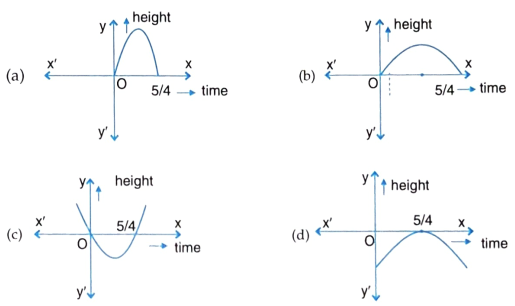
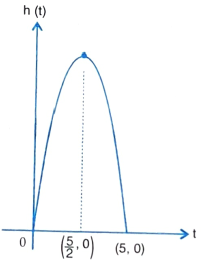
View full question & answer→(i) The zeroes of polynomial $h(t)=25 t-5 t^2$ are given by
$
h(t)=0 \Rightarrow 25 t-5 t^2=0 \Rightarrow 5 t(5-t)=0 \Rightarrow t=0,5
$
(ii) The maximum height achieved by ball $h\left(\frac{5}{2}\right)=25 \times \frac{5}{2}-5 \times\left(\frac{5}{2}\right)^2=\frac{125}{2}-\frac{125}{4}=\frac{125}{4}=31.25 m$
(iii) (a): The time taken by the ball to reach to the height of 30 m is given by
$
h(t)=30 \Rightarrow 25 t-5 t^2=30 \Rightarrow 5 t-t^2=6 \Rightarrow t^2-5 t+6=0 \Rightarrow(t-2)(t-3)=0 \Rightarrow t=2,3
$
So, the time taken by the ball to reach to the height of 30 m is 2 seconds.
OR
(b): When the height of the ball is 20 m
$
\text { i.e. } \quad h(t)=20 \Rightarrow 25 t-5 t^2=20 \Rightarrow 5 t-t^2=4 \Rightarrow t^2-5 t+4=0 \Rightarrow(t-1)(t-4)=0 \Rightarrow t=1,4$
Hence, the height of the ball was 20 m at $t=1$ second and at $t=4$ seconds.
$
h(t)=0 \Rightarrow 25 t-5 t^2=0 \Rightarrow 5 t(5-t)=0 \Rightarrow t=0,5
$
(ii) The maximum height achieved by ball $h\left(\frac{5}{2}\right)=25 \times \frac{5}{2}-5 \times\left(\frac{5}{2}\right)^2=\frac{125}{2}-\frac{125}{4}=\frac{125}{4}=31.25 m$
(iii) (a): The time taken by the ball to reach to the height of 30 m is given by
$
h(t)=30 \Rightarrow 25 t-5 t^2=30 \Rightarrow 5 t-t^2=6 \Rightarrow t^2-5 t+6=0 \Rightarrow(t-2)(t-3)=0 \Rightarrow t=2,3
$
So, the time taken by the ball to reach to the height of 30 m is 2 seconds.
OR
(b): When the height of the ball is 20 m
$
\text { i.e. } \quad h(t)=20 \Rightarrow 25 t-5 t^2=20 \Rightarrow 5 t-t^2=4 \Rightarrow t^2-5 t+4=0 \Rightarrow(t-1)(t-4)=0 \Rightarrow t=1,4$
Hence, the height of the ball was 20 m at $t=1$ second and at $t=4$ seconds.