Questions

Case study (4 Marks)

🎯

Test yourself on this topic

10 questions · timed · auto-graded

Question 14 Marks
Answer
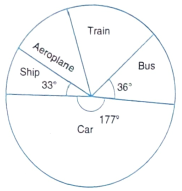
(i) Probability that a person travelled by bus or ship.
$\begin{array}{l}=\frac{\text { A rea of sector of sector angle } 36^{\circ}+\text { Area of sector of sector angle } 33^{\circ}}{\text { Area of circle }} \\ =\frac{\frac{36}{360} \times \pi r^2+\frac{33}{360} \times \pi r^2}{\pi r^2}=\frac{69}{360}=\frac{23}{120}\end{array}$
(ii) Most favourate mode of transport is car.
Probability that a person travelled by car $=\frac{\frac{177}{360} \times \pi r^2}{\pi r^2}=\frac{59}{120}$
∴ Number of persons who travelled by car $=\frac{59}{120} \times 120=59$
(iii) (a) Probability that a person travelled by train $=1-\frac{4}{5}=\frac{1}{5}$
∴ Number of people who travelled by train $=\frac{1}{5} \times 120=24$
OR
(b) Probability that a person travelled by aeroplane $=\frac{7}{60}$
∴ Number of persons who travelled by aeroplane $=\frac{7}{60} \times 120=14$
∴ Revenue collected by air company $=₹(14 \times 5000)=₹ 70,000$.
View full question & answer
Question 24 Marks
Answer
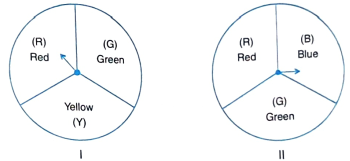
(i) The possible outcomes of the game are: RR, RB, RG, GR, GB, GG, YR, YB, YG
(ii) Total number of outcomes = 9. Purple can be made if the outcome is RB.
∴ Probability of making purple $=\frac{1}{9}$
(iii) We find that:
Probability of winning $₹ 10=\frac{1}{9}$ and, Probability of losing $₹ 5=\frac{8}{9}$
∴ Amount collected by the school from one participant $=₹\left(-10 \times \frac{1}{9}+5 \times \frac{8}{9}\right)=₹ \frac{10}{3}$
Hence, Amount collected by the school from 99 participants $=₹\left(\frac{10}{3} \times 99\right)=₹ 330$
(iv) Probability of winning $₹ 5=\frac{1}{9}$ and, Probability of loosing $₹ 5=\frac{8}{9}$
∴ Amount collected by the school from one participant $=₹ \left(-5 \times \frac{1}{9}+5 \times \frac{8}{9}\right)=₹ \frac{35}{9}$
Hence, Amount collected by the school from 99 participants $=₹\left(99 \times \frac{35}{9}\right)=₹ 385$
View full question & answer
Question 34 Marks
Answer
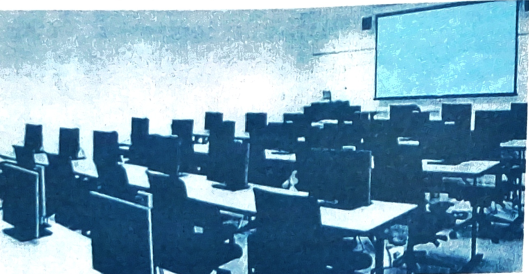
(i) Total number of schools = 1000
Number of schools having more than 100 computers = 80
∴ Probability that the school chosen at random has more than 100 computers $=\frac{80}{1000}=0.08$
(i) Number of schools having 50 or fewer computers = 250 + 200 + 290 = 740
∴ Required probability $=\frac{740}{1000}=0.74$
(ii) Number of schools having not more than 20 computers = 250 + 200 = 450
∴ Required probability $=\frac{450}{1000}=0.45$
(iv) Number of schools having 10 or less than 10 computers = 250
∴ Required probability $=\frac{250}{1000}=0.25$

View full question & answer
Question 44 Marks
Answer
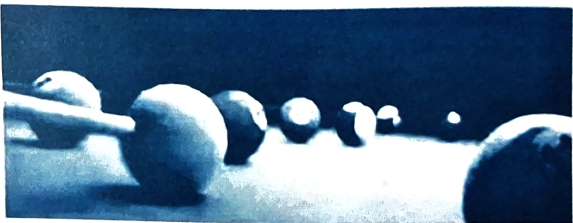
Out of 15 numbered pool balls, one ball can be drawn in 15 ways.
Total number of elementary events = 15
(i). There is exactly one ball bearing number 8. Therefore, a ball bearing number 8 can be drawn in one way.
∴ Favourable number of elementary events = 1
Hence, Probability that the drawn ball bears number $8=\frac{1}{15}$
(ii) There are 7 even numbered balls out of which one ball can be drawn in 7 ways
∴ Favourable number of elementary events = 7
Hence, probability that the drawn ball bears an even number $=\frac{7}{15}$
(iii) There are 5 balls bearing numbers which are multiple of 3
∴ Favourable number of elementary events = 5
Hence, probability that the drawn ball bears a number, which is multiple of 5 = $\frac{5}{15}=\frac{1}{3}$
(iv) There are 4 solid coloured balls bearing an even number 2, 4, 6, 8
∴ Favourable number of elementary events = 4
Hence, probability that the drawn ball is a solid coloured ball bearing an even number = $\frac{4}{15}$.
View full question & answer
Question 54 Marks
Answer
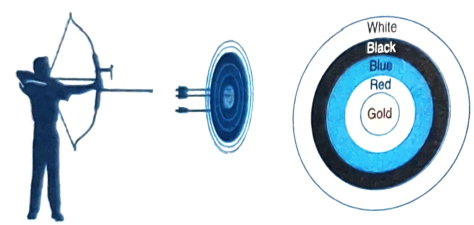
(i)(a): Radius of the archery target = 50cm .
∴ Area of archery target $=\pi \times 50^2 cm^2=2500 \pi cm^2$
∴ Area of gold scoring region $=\pi \times 10^2 cm^2=100 \pi cm^2$
∴,Probability that the arrow hits in gold scoring region $=\frac{100 \pi}{2500 \pi}=\frac{1}{25}$
(ii) (b): Area of red scoring region $=\pi\left(20^2-10^2\right) cm ^2=300 \pi cm^2$
∴ Probability that the arrow hits in red scoring area $=\frac{300 \pi}{2500 \pi}=\frac{3}{25}$
(iii) (d): Area of blue scoring region $=\pi\left(30^2-20^2\right) cm ^2=500 \pi cm^2$
∴ Probability that the arrow hits in blue scoring region $=\frac{500 \pi}{2500 \pi}=\frac{1}{5}$
(iv) (c): Area of black scoring region $=\pi\left(40^2-30^2\right) cm ^2=700 \pi cm^2$
∴ Probability that the arrow hits in black scoring region $=\frac{700 \pi}{2500 \pi}=\frac{7}{25}$
View full question & answer
Question 64 Marks
A class has 15 students whose ages are 14, 17, 15, 14, 21, 17, 19, 20, 16, 18, 20, 17, 16, 19 and 20 years. One student is selected in such a manner that each has the same chance of being selected and the age X of the selected student is recorded. Using the above information answer each of the following questions:
(i) If an Indian citizen becomes eligible to cast his vote after attaining 18 years of age, what is the probability that the selected student is an eligible voter?
(a) $\frac{2}{15}$$\quad$ (b) $\frac{2}{5}$$\quad$ (c) $\frac{1}{3}$$\quad$ (d) $\frac{7}{15}$
(ii) Probability of selecting a student who will be an eligible voter after one year, is
(a) $\frac{2}{5}$$\quad$ (b) $\frac{3}{5}$$\quad$ (c) $\frac{1}{5}$$\quad$ (d) $\frac{1}{3}$
(iii) Probability of selecting a non-eligible voter is
(a) $\frac{7}{15}$$\quad$ (b) $\frac{8}{15}$$\quad$ (c) $\frac{3}{5}$$\quad$ (d) $\frac{1}{5}$
(iv) $P(X \geq 20)$ =
(a) $\frac{1}{5}$$\quad$ (b) $\frac{7}{15}$$\quad$ (c) $\frac{4}{15}$$\quad$ (d) $\frac{1}{5}$
Answer
(i) (d). Total number of elementary events = 15
There are 7 students of age 18 or more years
Favourable number of ways = 7
Hence, required probability = $\frac{7}{15}$
(ii) (c): A student will be eligible to his vote after one year, if he is 17 years old now There are three students who are 17 years old now.
Favourable number of elementary events = 3
Probability of selecting an eligible voter = $\frac{3}{15}$ = $\frac{1}{5}$
(iii) (b): Required probability = 1 - P (selecting an eligible voter) $=1-\frac{1}{5}=\frac{4}{5}$
(iv) (c): Gamma(X >= 20) = Probability of selecting a student of age 20 years or more = $\frac{4}{15}$
View full question & answer
Question 74 Marks
Answer
(i) (d): Following are 8 possible outcomes in tossing three coins. HHH, HHT, HTH. THH. TTH, HTT, THT, TTT.
(ii) (a): Shikha looses entry fee, if she gets all tails.
So, required probability = $\frac{1}{8}$
(ii) (c): Shikha will get double the amount paid as entry fee i.e. ₹400, if she gets all heads.
So, required probability = $\frac{1}{8}$
Hence, the chances are $\frac{1}{8} \times 100 \%=12.5 \%$
(iv) (b): Shikha gets back her gets one of the following as outcome:
HHT, HTH, THH, HTT, THT, TTH.
So, required probability = $\frac{6}{8}$ = $\frac{3}{4}$
View full question & answer
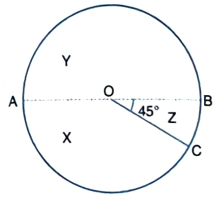
Question 84 Marks
Answer
(i) (d). Letr be the radius of the circular card-board. Then,
Area of the card-board $=\pi r^2$
Area of region $X=\frac{135}{360} \times \pi r^2=\frac{3}{8} \pi r^2$
∴ Required probability$=\frac{\frac{3}{8} \pi r^2}{\pi r^2}=\frac{3}{8}$
(ii)  (b): Area of region $\gamma=\frac{\pi}{2} r^2$
∴ Required probability $Y=\frac{\frac{\pi}{2} r^2}{\pi r^2}=\frac{1}{2}$
(iii) (c): Area of region $Z=\frac{45}{360} \pi r^2=\frac{\pi}{8} r^2$
∴ Required probability $=\frac{8}{\pi r^2}=\frac{1}{8}$
(iv) (b): Total area of region X and Z $=\frac{\pi r^2}{2}$
∴ Required probability $=\frac{\frac{\pi r^2}{2}}{\pi r^2}=\frac{1}{2}$
View full question & answer
Question 94 Marks
Answer
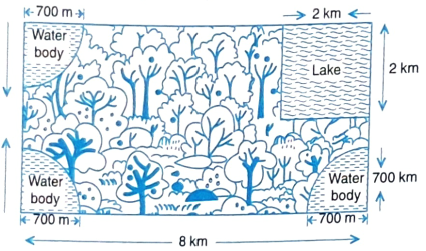
(i) (a): Area of the entire region $=(8 \times 5) km ^2=40 km^2$
Area of the lake $=(2 \times 2) km ^2=4 km^2$
∴ Probability that the helicopter crashed inside the lake = $\frac{4}{40}=\frac{1}{10}$
(ii) (b): Each water body is a quadrant of a circle of radius $\frac{700}{1000}$= 0.7km
Area of 3 water bodies $=\frac{3}{4} \times \frac{22}{7} \times(0.7)^2 km^2=\frac{231}{200} km^2$
∴ Probability that the helicopter crashed in one of the water bodies $=\frac{231}{200 \times 40}=\frac{231}{8000}=0.0288$
Chances of helicopter crashing in one of the water bodies = 2.88%
(iii) (c): Area of the water body nearer to the lake $=\frac{1}{4}\left(\frac{22}{7} \times 0.7 \times 0.7\right)=\frac{154}{400} km^2$
∴ Probability that the helicopter crashes in the water body nearer to the lake $=\frac{154}{400 \times 40}=\frac{77}{8000}$
(iv) (c): Area of three water bodies and lake $=\left(\frac{3}{4} \times \frac{22}{7} \times(0.7)^2+2 \times 2\right) km ^2=\frac{1031}{200} km^2$
∴ Probability that the helicopter crashes in a water body or in lake $=\frac{1031}{200 \times 40}=\frac{1031}{8000}$
View full question & answer
Question 104 Marks
View full question & answer
Case study (4 Marks) - Maths STD 10 Questions - Vidyadip