Question 515 Marks
Is it possible to design a rectangular park of perimeter 80m and area $400m^2$. If so, find its length and breadth.
AnswerLet the breadth of the rectangle be = xmeters. Then,
Perimeter = 80 metres
2(length + breadth) = 80
(length + x) = 40
length = 40 - x
And area of the rectangle
length × breadth = 400
$(40 - x)x = 400$
$40x - x^2 = 400$
$x^2 - 40x + 400 = 0$
$x^2 - 20x - 20x + 400 = 0$
$x(x - 20) - 20(x - 20) = 0$
$(x - 20)(x - 20) = 0$
$(x - 20)^2 = 0$
$(x - 20) = 0$
$x = 20$
Yes, it is possible.
Hence, breadth of the rectangular park be 20 metres and length be 20 metres.
View full question & answer→Question 525 Marks
Solve the following quadratic equations by factorization:
$\frac{\text{a}}{\text{x}-\text{b}}+\frac{\text{b}}{\text{x}-\text{a}}=2$
Answer$\frac{\text{a}}{\text{x}-\text{b}}+\frac{\text{b}}{\text{x}-\text{a}}=2$
$\Rightarrow\frac{\text{a}(\text{x}-\text{a})+\text{b}(\text{x}-\text{b})}{(\text{x}-\text{a})(\text{x}-\text{b})}=2$
$\Rightarrow ax - a^2 + bx - b^2 = 2x^2 - 2ax - 2bx + 2ab$
$\Rightarrow 2x^2 - 2ax - ax - 2bx - bx + a^2 + b^2 + 2ab = 0$
$\Rightarrow 2x^2 - 3x(a + b) + (a + b)^2 = 0$
$\Rightarrow 2x^2 - 2x(a + b) - x(a + b) + (a + b)^2= 0$
$\Rightarrow 2x[x - (a + b)] - (a + b)[x - (a + b)] = 0$
$\Rightarrow [2x - (a + b)] [(x - a + b)] = 0$
$\Rightarrow\text{x}=\frac{\text{a}+\text{b}}{2}$ or x = a + b
View full question & answer→Question 535 Marks
Find the roots the following quadratic equation (if they exist) by the method of completing the square.
$2\text{x}^2+\text{x}-4=0$
Answer$2\text{x}^2+\text{x}-4=0$
$\Rightarrow\text{x}^2+\frac{1}{2}\text{x}-\frac{4}{2}=0$ (Dividing by 2)
$\Rightarrow\text{x}^2+\frac{1}{2}\text{x}-2=0$
$\Rightarrow\text{x}^2+2\times\frac{1}{4}\times\text{x}+\Big(\frac{1}{4}\Big)^2-2-\Big(\frac{1}{4}\Big)^2=0$
$\begin{cases}-2-\Big[\frac{33}{16}-\frac{1}{16}\Big]\end{cases}$
$\Rightarrow\text{x}^2+2\times\frac{1}{4}\times\text{x}+\Big(\frac{1}{4}\Big)^2\\=2+\frac{1}{16}=\frac{33}{16}$
$\Rightarrow\Big(\text{x}+\frac{1}{4}\Big)^2=\Big(\pm\frac{\sqrt{33}}{4}\Big)^2$
$\Rightarrow\text{x}+\frac{1}{4}=\pm\frac{\sqrt{33}}{4}$
$=\frac{-1+\sqrt{33}}{4}$ or $\frac{\sqrt{33}-1}{4}$
and $\text{x}=\frac{-1}{4}-\frac{\sqrt{33}}{4}$
$=\frac{-1-\sqrt{33}}{4}$ or $\frac{-\sqrt{33}-1}{4}$
View full question & answer→Question 545 Marks
The numerator of a fraction is 3 less than the denominator. If 2 is added to both the numerator and the denominator, then the sum of the new fraction and the original fraction is $\frac{29}{20}.$ Find the original fraction.
AnswerLet in a fraction,
Denominator = x, then
Numerator = x - 3
and fraction $=\frac{\text{x}-3}{\text{x}}$
By adding 2 to both numerator and denominator the new fraction,
$\frac{\text{x}-3+2}{\text{x}+2}=\frac{\text{x}-1}{\text{x}+2}$
According to the given condition,
$\frac{\text{x}-3}{\text{x}}+\frac{\text{x}-1}{\text{x}+2}=\frac{29}{20}$
$\Rightarrow\frac{(\text{x}-3)(\text{x}+2)+\text{x}(\text{x}-1)}{\text{x}(\text{x}+2)}=\frac{29}{20}$
$\Rightarrow\frac{\text{x}^2+2\text{x}-3\text{x}-6+\text{x}^2-\text{x}}{\text{x}^2+2\text{x}}=\frac{29}{20}$
$\Rightarrow\frac{2\text{x}^2-2\text{x}-6}{\text{x}^2+2\text{x}}=\frac{29}{20}$
By cross multiplication,
$\Rightarrow40\text{x}^2-40\text{x}-120=29\text{x}^2+58\text{x}$
$\Rightarrow40\text{x}^2-40\text{x}-120-29\text{x}^2-58\text{x}=0$
$\Rightarrow11\text{x}^2-98\text{x}-120=0$
$\begin{Bmatrix}\because11\times(-120)=-1320\\ \therefore-1320=-110\times12\\-98=-110+12\end{Bmatrix}$
$\Rightarrow11\text{x}^2-110\text{x}+12\text{x}-120=0$
$\Rightarrow11\text{x}(\text{x}-10)+12(\text{x}-10)=0$
$\Rightarrow(\text{x}-10)(11\text{x}+12)=0$
Either $\text{x}-10=0,$ then $\text{x}=10$
Or $11\text{x}+12=0,$
Then $11\text{x}=-12$
$\Rightarrow\text{x}=\frac{-12}{11}$
But it is not possible being negative
$\therefore\text{x}=10$
and fraction $=\frac{\text{x}-3}{\text{x}}=\frac{10-3}{10}$
$=\frac{7}{10}$
View full question & answer→Question 555 Marks
Solve the following quadratic equations by factorization:
$\frac{2}{\text{x}+1}+\frac{3}{2(\text{x}-2)}=\frac{23}{5\text{x}},$ $\text{x}\neq0,-1,2$
Answer$\frac{2}{\text{x}+1}+\frac{3}{2(\text{x}-2)}=\frac{23}{5\text{x}}$
$\Rightarrow\frac{4\text{x}-8+3\text{x}+3}{2(\text{x}+1)(\text{x}-2)}=\frac{23}{5\text{x}}$
$\Rightarrow\frac{7\text{x}-5}{2(\text{x}^2-2\text{x}+\text{x}-2)}=\frac{23}{5\text{x}}$
$\Rightarrow\frac{7\text{x}-5}{2(\text{x}^2-\text{x}-2)}=\frac{23}{5\text{x}}$
$\Rightarrow 35x^2 - 25x = 46(x^2 - x - 2)$
$\Rightarrow 35x^2 - 25x = 46x^2 - 46x - 92$
$\Rightarrow 46x^2 - 46x - 92 - 35x^2 + 25x = 0$
$\Rightarrow 11x^2 - 21x - 92 = 0$
$\Rightarrow 11x^2 - 44x + 23x - 92 = 0$
$\Rightarrow 11x(x - 4) + 23(x - 4) = 0$
$\begin{Bmatrix}\because-92\times11=-1012\\\therefore-1012=-44\times23\\-21=-44+23\end{Bmatrix}$
⇒ (x - 4)(11x + 23) = 0Either x - 4 = 0,
then x = 4
or 11x + 23 = 0, then 11x = -23
$\Rightarrow\text{x}=\frac{-23}{11}$
$\therefore\text{x}=4,\frac{-23}{11}$
View full question & answer→Question 565 Marks
The sum of two numbers is 16. The sum of their reciprocals is $\frac{1}{3}.$ Find the numbers.
AnswerLet one numbers be x then other (16 - x)
Then according to question,
$\frac{1}{\text{x}}+\frac{1}{(16-\text{x})}=\frac{1}{3}$
$\frac{16-\text{x}+\text{x}}{\text{x}(16-\text{x})}=\frac{1}{3}$
$\frac{16}{(16\text{x}-\text{x}^2)}=\frac{1}{3}$
By cross multiplication,
$16x - x^2 = 48$
$x^2 - 16x + 48 = 0$
$x^2 - 12x - 4x - 48 = 0$
$x(x - 12) - 4(x - 12) = 0$
$(x - 12)(x - 4) = 0$
$(x - 12) = 0$
$x = 12$
$Or (x - 4) = 0$
$x = 4$
Since, x being a number,
Therefore,
When x = 12 then
16 - x = 16 - 12
16 - x = 4
Thus, two consecutive number be either 4, 12
View full question & answer→Question 575 Marks
For what value of $k, (4 - k)x^2 + (2k + 4) x + (8k + 1) = 0$, is a perfect square.
Answer$(4 - k)x^2 + (2k + 4) x + (8k + 1) = 0$
$Here, a = 4 - k, b = 2k + 4, c = 8k + 1$
$\therefore$ Discriminant $(D) = b^2 - 4ac$
$= (2k + 4)^2 - 4 \times (4 - k)(8k + 1)$
$= 4k^2 + 16k + 16 - 4(32k + 4 - 8k^2 - k)$
$= 4k^2 + 16k + 16 - 4(-8k^2 + 31k + 4)$
$= 4k^2 + 16k + 16 + 32k^2 - 124k - 16$
$= 36k^2 - 108k$
$\because$ The given quadratic equation is a perfect square,
$\therefore$ The roots are real and equal,
$\therefore$ $D = 0$
$\Rightarrow 36k^2 - 108k = 0$
$\Rightarrow k^2 - 3k = 0$
$Either k = 0$
$Or k - 3 = 0$
$k = 3$
$\therefore$ k = 0, 3
View full question & answer→Question 585 Marks
Solve the following quadratic equations by factorization:
$\frac{1}{(\text{x}-1)(\text{x}-2)}+\frac{1}{(\text{x}-2)(\text{x}-3)}+\frac{1}{(\text{x}-3)(\text{x}-4)}=\frac{1}{6}$
AnswerWe have been given,
$\frac{1}{(\text{x}-1)(\text{x}-2)}+\frac{1}{(\text{x}-2)(\text{x}-3)}+\frac{1}{(\text{x}-3)(\text{x}-4)}=\frac{1}{6}$
$\frac{(\text{x}-3)(\text{x}-4)+(\text{x}-1)(\text{x}-4)+(\text{x}-1)(\text{x}-2)}{(\text{x}-1)(\text{x}-4)(\text{x}-2)(\text{x}-3)}=\frac{1}{6}$
$\frac{3(\text{x}^2-5\text{x}+6)}{(\text{x}^2-5\text{x}+4)(\text{x}^2-5\text{x}+6)}=\frac{1}{6}$
$18 = x^2 - 5x + 4$
$x^2 - 5x - 14 = 0$
$x^2 - 7x + 2x - 14 = 0$
$x(x - 7) + 2(x - 7) = 0$
$(x + 2)(x - 7) = 0$
Therefore,
$x + 2 = 0$
$x = -2$
$x = 7$
Hence, x = -2 or x = 7
View full question & answer→Question 595 Marks
If the equation $\left(1+m^2\right) x^2+2 m c x+\left(c^2-a^2\right)=0$ has equal roots, prove that $c^2=a^2\left(1+m^2\right)$.
AnswerThe given equation $\left(1+m^2\right) x^2+2 m c x+\left(c^2-a^2\right)=0$, has equal roots,
Then prove that $c^2=a^2\left(1+m^2\right)$
Here, $a=\left(1+m^2\right), b=2 m c$ and $c=\left(c^2-a^2\right)$
As we know that $D=b^2-4 a c$
Putting the value of $a=\left(1+m^2\right), b=2 m c$ and $c=\left(c^2-a^2\right)$
$\Rightarrow D = b^2 - 4ac$
$\Rightarrow D = {2mc}^2 - 4 \times (1 + m^2) \times (c^2 - a^2)$
$\Rightarrow D = 4(m^2c^2) - 4(c^2 - a^2 + m^2c^2 - m^2a^2)$
$\Rightarrow D = 4m^2c^2 - 4c^2 + 4a^2 - 4m^2c^2 + 4m^2a^2$
$\Rightarrow D = 4a^2 + 4m^2a^2 - 4c^2$
The given equation will have real roots, if D = 0
$\Rightarrow 4a^2 + 4m^2a^2 - 4c^2 = 0$
$\Rightarrow 4a^2 + 4m^2a^2 = 4c^2$
$\Rightarrow 4a^2(1 + m^2) = 4c^2$
$Hence, c^2 = a^2(1 + m^2)$
View full question & answer→Question 605 Marks
If the roots of the equation$ (a^2 + b^2)x^2 - 2(ac + bd)x + (c^2 + d^2) = 0$ are equal, prove that $\frac{\text{a}}{\text{b}}=\frac{\text{c}}{\text{d}}$
Answer$(a^2 + b^2)x^2 - 2(ac + bd)x + (c^2 + d^2) = 0$
Here, $A = a^2 + b^2, B = -2(ac + bd), C = c^2 + d^2$
$\therefore$ Discriminant $P(D) = B^2 - 4AC$
$= [-2(ac + bd)]^2 - 4(a^2 + b^2)(c^2 + d^2)$
$= 4(ac + bd)^2 - 4[a^2c^2 + a^2d^2 + b^2c^2 + b^2d^2]$
$= 4[a^2c^2 + b^2d^2 + 2abcd] - 4[a^2c^2 + a^2d^2 + b^2c^2 + b^2d^2]$
$= 4a^2c^2 + 4b^2d^2 + 8abcd - 4a^2c^2 - 4a^2d^2 - 4b^2c^2 - 4b^2d^2$
$= 8abcd - 4a^2d^2 - 4b^2c^2$
$\because$ The roots are equal
$\therefore$ D = 0
$\therefore$ $8abcd - 4a^2d^2 - 4b^2c^2 = 0 (Dividing by -4)$
$\Rightarrow a^2d^2 + b^2c^2 - 2abcd = 0$
$\Rightarrow (ad - bc)^2 = 0$
$\Rightarrow ad - bc = 0$
$\Rightarrow ad = bc$
$\frac{\text{a}}{\text{b}}=\frac{\text{c}}{\text{d}}$
Hence proved.
View full question & answer→Question 615 Marks
The time taken by a person to cover 150km was 2.5 hrs more than the time taken in the return journey. If he returned at a speed of 10km/hr more than the speed of going, what was the speed per hour in each direction?
AnswerLet the going speed of the person be x km/hr
Given that, the return speed is 10km/hr more than the going speed
Return speed of the person = (x + 10) km/hr
Total distance covered = 150km,
Time taken for going $=\frac{150\text{km}}{\text{x}\text{ km/}\text{hr}}=\frac{150}{\text{x}}\text{hr}$
Time taken for returning $=\frac{150\text{km}}{\text{(x}\text{+10)}\text{ km/}\text{hr}}=\frac{150}{\text{(x+10)}}\text{hr}$
Given that, time taken for going is 2.5 hours more than the time for returning
i.e., $\frac{150}{\text{x}}\text{hr}-\frac{150}{\text{x}+10}\text{hr}=2.5\text{ hr}$
$\Rightarrow150\Big(\frac{1}{\text{x}}-\frac{1}{\text{x}+10}\Big)=\frac{25}{10}$
$\Rightarrow\text{150}\Big(\frac{\text{x}+10-\text{x}}{\text{x}(\text{x}+10)}\Big)=\frac{25}{10}$
$\Rightarrow\text{6}\text{(10)}=\frac{\text{x}(\text{x+10})}{10}$
$\Rightarrow 60 \times 10 = x^2 + 10x$
$\Rightarrow x^2 + 10x - 600 = 0$
$\Rightarrow x^2+ (30 - 20)x + (30 \times -20) = 0$
$\Rightarrow x^2 + 30x - 20x - (30 \times -20) = 0$
$\Rightarrow x (x + 30) - 20 (x + 30) = 0$
$\Rightarrow (x + 30) (x - 20) = 0$
$\Rightarrow x + 30 = 0 or x - 20 = 0$
$\Rightarrow x = -30 or x = 20$
Since, speed cannot be negative. So x = 20
$\therefore$ Speed of the person when going = 20km/hr
Now, speed of the person when returning = (x + 10) km/hr
= (20 + 10) km/hr
= 30km/hr
View full question & answer→Question 625 Marks
A cottage industry produces a certain number of pottery articles in a day. It was observed on a particular day that the cost of production on each article (in rupees) was 3 more than twice the number of articles produced on that day. If the total cost of production on that day was Rs. 90, find the number of articles produced and the cost of each article.
AnswerLet the number of article produced by the cottage industry be x
Then the cost of production of each article = Rs.(2x + 3)
It is given that total cost of production = Rs. 90
Therefore,
$x(2x + 3) = 90$
$2x^2 + 3x = 90$
$2x^2 + 3x - 90 = 0$
$2x^2 - 12x + 15x - 90 = 0$
$2x(x - 6) + 15 (x - 6) = 0$
$(x - 6)(2x + 15) = 0$
$(x - 6) = 0 or (2x + 15) = 0$
x = 6 or $\text{x}=\frac{-15}{2}$
Therefore, x cannot be negative.
So, when x = 6 then
$(2x + 3) = (2 × 6 + 3)$
$(2x + 3) = 12 + 3$
$(2x + 3) = 15$
Hence, the number of article produced by the cottage industry be x = 6 and the cost of production of each article = 15.
View full question & answer→Question 635 Marks
The hypotenuse of a right triangle is 25cm. The difference between the lengths of the other two sides of the triangle is 5cm. Find the lengths of these sides.
AnswerLength of the hypotenuse of a let right $\triangle\text{ABC}=25\text{cm}$
Let length of one of the other two sides = x cm
Then other side = x + 5cm
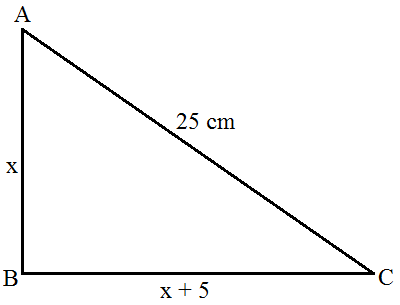
According to condition,
$(x)^2 + (x + 5)^2 = (25)^2$ (Using Pythagoras Theorem)
$\Rightarrow x^2 + x^2 + 10x + 25 = 625$
$\Rightarrow 2x^2 + 10x + 25 - 625 = 0$
$\Rightarrow 2x^2 + 10x - 600 = 0$
$\Rightarrow x^2 + 5x - 300 = 0 (Dividing by 2)$
$\Rightarrow x^2 + 20x - 15x - 300 = 0$
$\Rightarrow x(x + 20) - 15(x + 20) = 0$
$\Rightarrow (x + 20)(x - 15) = 0$
Either x + 20 = 0, then x = -20, which is not possible being negative
Or x - 15 = 0, then x = 15
One side = 15cm
and second side = 15 + 5 = 20cm View full question & answer→Question 645 Marks
Solve the following quadratic equations by factorization:
$\text{x}^2-\big(\sqrt{2}+1\big)\text{x}+\sqrt{2}=0$
Answer$\text{x}^2-\big(\sqrt{2}+1\big)\text{x}+\sqrt{2}=0$
$\Rightarrow(\text{x})^2-2\Big(\frac{\sqrt{2}+1}{2}\Big)\text{x}+\sqrt{2}=0$
$\Rightarrow(\text{x})^2-2\times\Big(\frac{\sqrt{2}+1}{2}\Big)\times\text{x}+\Big(\frac{\sqrt{2}+1}{2}\Big)^2-\frac{3-2\sqrt{2}}{4}=0$
$\begin{cases}\Big(\frac{\sqrt{2}+1}{2}\Big)^2-\frac{3-2\sqrt{2}}{4}\\=\frac{2+1+2\sqrt{2}}{4}-\frac{3-2\sqrt{2}}{4}=\sqrt{2}\end{cases}$
$\Rightarrow\Big(\text{x}-\frac{\sqrt{2}+1}{2}\Big)^2$
$=\frac{3-2\sqrt{2}}{4}$
$=\frac{2+1-2\sqrt{2}}{4}$
$=\Big(\pm\frac{\sqrt{2}-1}{2}\Big)^2$
$\therefore\text{x}-\frac{\sqrt{2}+1}{2}=\pm\frac{\sqrt{2}-1}{2}$
$\Rightarrow\text{x}=\frac{\sqrt{2}+1}{2}\pm\frac{\sqrt{2}-1}{2}$
$\therefore\text{x}=\frac{\sqrt{2}+1}{2}+\frac{\sqrt{2}-1}{2}$
$=\frac{2\sqrt{2}}{2}-\sqrt{2}$
and $\text{x}=\frac{\sqrt{2}+1}{2}-\frac{\sqrt{2}-1}{2}$
$=\frac{2}{2}=1$
Hence roots are $1,\sqrt{2}$
View full question & answer→Question 655 Marks
Two number differ by 4 and their product is 192. Find the numbers.
AnswerLet first number = x
Then second number = x - 4
According to the condition,
$\Rightarrow x(x - 4) = 192$
$\Rightarrow x^2 - 4x - 192 = 0$
$\Rightarrow x^2 - 16x + 12x - 192 = 0$
$\Rightarrow x(x - 16) + 12(x - 16) = 0$
$\Rightarrow (x - 16)(x + 12) = 0$
Either x - 16 = 0, then x = 16
Or x + 12 = 0, then x = -12
- If x = 16, then
First number = 16 and second number = 16 - 4 = 12
- If x = -12, then
First number = -12 and second number = -12 - 4 = -16
Hence numbers are 16, 12 or -12, -16 View full question & answer→Question 665 Marks
The diagonal of a rectangular field is 60 meters more than the shorter side. If the longer side is 30 meters more than the shorter side, find the sides of the field.
AnswerLet the length of smaller side of rectangle be = x metres then larger side be = x + 30 metres and their
diagonal be = x + 60 metres
Then, as we know that Pythagoras theorem
$x^2 + (x + 30)^2 = (x + 60)2$
$x^2 + (x + 30)^2 = (x + 60)^2$
$x^2 + x^2 + 60x + 900 = x^2 + 120x + 3600$
$2x^2 + 60x + 900 - x^2 - 120x - 3600 = 0$
$x^2 - 60x - 2700 = 0$
$x^2 - 90x + 30x - 2700 = 0$
$x(x - 90) + 30(x - 90) = 0$
$(x - 90)(x + 30) = 0$
$(x - 90) = 0$
$x = 90$
$Or (x + 30) = 0$
$x = -30$
But, the side of rectangle can neaver be negative.
Therefore, when x = 90 then
x + 30 = 90 + 30
x + 30 = 120
Hence, length of smaller side of rectangle be = 90 metres and larger side be = 120 metres.
View full question & answer→Question 675 Marks
Find the roots of the following quadratic equation (if they exist) by the method of completing the square.
$\text{x}^2-4\sqrt{2\text{x}}+6=0$
AnswerWe have been given that,
$\text{x}^2-4\sqrt{2\text{x}}+6=0$
Now we take the constant term to the right hand side and we get
$\text{x}^2-4\sqrt{2\text{x}}=-6$
Now add square pf half pf co-efficient of 'x' on both the sides. we have
$\text{x}^2-4\sqrt{2\text{x}}+(2\sqrt{2})^2=(2\sqrt{2})^2-6$
$\text{x}^2+(2\sqrt{2})^2-2(2\sqrt{2})\text{x}=2$
$(\text{x}-2\sqrt{2})^2)=2$
Since right hand side is a positive number, the roots of the equation exist. So, now take the square root on both the sideas and we get,
$\text{x}-2\sqrt{2}=\pm\sqrt{2}$
$\text{x}=2\sqrt{2}\pm\sqrt{2}$
Now, we have rthe value of 'x' as
$\text{x}=2\sqrt{2}+\sqrt{2}$
$\text{x}=3\sqrt{2}$
Also we have
$\text{x}=2\sqrt{2}-\sqrt{2}$
$=\sqrt{2}$
Therefore the roots of the equation are $3\sqrt{2}$ and $\sqrt{2}$
View full question & answer→Question 685 Marks
Find the value of k for which root are real and equal in the following equations:
$kx^2 + kx + 1 = -4x^2 - x$
AnswerThe given equation is $kx^2 + kx + 1 = -4x^2 - x$ bringing all the 'x' components to one side,
We get the equation as $x^2(4 + k) + x(k + 1) + 1 = 0$
This equation is in the form of the general quadratic equation i.e., $ax^2 + bx + c = 0$
Here a = 4 + k, b = k + 1 and c = 1
Given that the nature of the roots of the given equation are real and equal
i.e., $D = b^2 - 4ac = 0$
$\Rightarrow (k + 1)^2 - 4x(4 + k) \times 1 = 0$
$\Rightarrow k^2 + 1 + 2k - 16 - 4k = 0$
$\Rightarrow k^2 - 2k - 15 = 0 .....(i)$
The equation (i) is as of the form $ax^2 + bx + c$
Here a = 1, b = -2, c = -16 + 1 = -15
The value of k is obtained by $\text{k} = {-\text{b} \pm \sqrt{\text{b}^2-4\text{ac}} \over 2\text{a}}$
$\Rightarrow\text{k}=\frac{-(-2)+\sqrt{(-2)^2-4\times1\times-15}}{2\times1}=5$
$\Rightarrow\text{k}=\frac{-(-2)-\sqrt{(-2)^2-4\times1\times-15}}{2\times1}=-3$
$\therefore$ the value of k are 5 and -3 respectively for the given quadratic equation.
View full question & answer→Question 695 Marks
A passenger train takes 2 hours less for a journey of 300km if its speed is increased by 5km/hr from its usual speed. Find the usual speed of the train.
AnswerLet the usual speed of the train be x km/hr
Distance covered in the journey = 300km
Time taken by the train with usual speed $=\frac{300\text{km}}{\text{x}\text{ km/hr}}=\frac{300}{\text{x}}\text{hr}$
Now,
If the speed is increased by 5km/hr, the train taken 2 hours less for the same journey
Speed of the after increasing = (x + 5) km/hr
And time taken by the train after increasing the speed $=\frac{300\text{km}}{\text{x}+5\text{ km/hr}}=\frac{300}{\text{x}+5}\text{hr}$
We have,
$\frac{300}{\text{x}\text{}}\text{hr}-\frac{300}{\text{x}+5}\text{hr}=2\text{hr}$
$\Rightarrow300\Big(\frac{1}{\text{x}}-\frac{1}{\text{x}+5}\Big)=2$$$
$\Rightarrow300\Big(\frac{\text{x}+5-\text{x}}{\text{x}(\text{x}+5)}\Big)=2$
$\Rightarrow 300 (5) = 2(x(x + 5))$
$\Rightarrow 750 = x^2 + 5x$
$\Rightarrow x^2 + 5x - 750 = 0$
$\Rightarrow x^2 + 30x - 25x + (30 \times -25) = 0$
$\Rightarrow (x + 30) (x - 25) = 0$
$\Rightarrow x + 30 = or x - 25 = 0$
$\Rightarrow x = -30 or x = 25$
Since, speed cannot be negative, So x = 25
$\therefore$ The usual speed of the train = 25km/hr
View full question & answer→Question 705 Marks
if 2 is a root of the quadratic equation $3x^2 + px - 8 = 0$ and the quadratic equation $4x^2 - 2px + k = 0$ has equal roots, find the value of k.
AnswerThe given quadratic equation is $3x^2 + px - 8 = 0$, and one root is 2
Then, it satisfies the given equation.
$3(2)^2 + p(2) - 8 = 0$
$\Rightarrow 12 + 2p - 8 = 0$
$\Rightarrow 2p = -4$
$\Rightarrow p = -2$
The quadratic equation $4x^2 - 2px + k = 0$, has equal roots.
Putting the value of p, we get
$4x^2 - 2(-2)x + k = 0$
$\Rightarrow 4x^2 + 4x + k = 0$
Here, a = 4, b = 4 and c = k
As we knoe that $D = b^2 - 4ac$
Putting the value of a = 4, b = 4 and c = k
$\Rightarrow D = (4)^2 - 4(4)(k)$
$\Rightarrow D = 16 - 16k$
The given equation will have real and equal roots, if D = 0
Thus, 16 - 16k = 0
⇒ 16k = 16
⇒ k = 1
Therefore, the value of k is 1
View full question & answer→Question 715 Marks
Solve the following quadratic equations by factorization:
$\frac{\text{x}+3}{\text{x}+2}=\frac{3\text{x}-7}{2\text{x}-3}$
AnswerWe have, $\frac{\text{x}+3}{\text{x}+2}=\frac{3\text{x}-7}{2\text{x}-3}$
$\Rightarrow (x + 3)(2x - 3) = (x + 2)(3x - 7)$
$\Rightarrow 2x^2 - 3x + 6x - 9 = 3x^2 - x - 14$
$\Rightarrow 2x^2 + 3x - 9 = 3x^2 - x - 14$
$\Rightarrow x^2 - 3x - x - 14 + 9 = 0$
$\Rightarrow x^2 - 4x - 5 = 0$
$[1x - 5 = -5 - 4 = -5 + 1]$
$\Rightarrow x^2 - 5x + x - 5 = 0$
$\Rightarrow x(x - 5) + 1(x - 5) = 0$
$\Rightarrow (x - 5)(x + 1) = 0$
$\Rightarrow x - 5 = 0 or x + 1 = 0$
$\Rightarrow x = 5 = 0 or x = -1$
$\therefore$ x = 5 and x = -1 are the two roots of the given quadratic equation.
View full question & answer→Question 725 Marks
Solve the following quadratic equations by factorization:
$\frac{1}{\text{x}+4}-\frac{1}{\text{x}-7}=\frac{11}{30},$ $\text{x}\neq4,7$
Answer$\frac{1}{\text{x}+4}-\frac{1}{\text{x}-7}=\frac{11}{30},$ $\text{x}\neq4,7$
$\frac{\text{x}-7-\text{x}-4}{(\text{x}+4)(\text{x}-7)}=\frac{11}{30}$
$\frac{-11}{(\text{x}+4)(\text{x}-7)}=\frac{11}{30}$
$\frac{-1}{(\text{x}+4)(\text{x}-7)}=\frac{1}{30}$ (dividing both side by 11)
$(x + 4)(x - 7) = -30$
$x^2 + 4x - 7x - 28 + 30 = 0$
$\Rightarrow x^2 - 3x + 2 = 0$
$\begin{Bmatrix}\because2=(-2)\times(-1)\\-3=-2-1\end{Bmatrix}$
$\Rightarrow x^2- x - 2x + 2 =0$
$\Rightarrow x(x - 1) - 2(x - 1) = 0$
$\Rightarrow (x - 1)(x - 2) = 0$
Either x - 1 = 0, then x = 1
Or x - 2 = 0, then x = 2
$\therefore$ x = 1, 2
View full question & answer→Question 735 Marks
A piece of cloth costs Rs. 35. If the piece were 4m longer and each meter costs Rs. one less, the cost would remain unchanged. How long is the piece?
AnswerLet initial length of the cloth be x m, and cost per each meter of cloth be Rs. y
Totsl cost of piece of cloth will be length of colth x cost per each meter xy
But given that xy = Rs. 35
$\Rightarrow\text{y}=\text{Rs.}\frac{35}{\text{x}}$
And also,
Given that if the piece were 4m longer and each meter costs Rs. 1 less the cost would remain unchanged.
Length of the cloth will be (x + 4)m and cost per each meter of cloth will be Rs. (y - 1)
Total cost of piece of cloth will be Rs. (x + 4)(y - 1)
But, Rs. (x + 4)(y - 1) = Rs. 35
xy + 4y - x - 4 = 35
$\Rightarrow35+4\Big(\frac{35}{\text{x}}\Big)-\text{x}-4=35$
$\Rightarrow\frac{140-\text{x}^2-4\text{x}}{\text{x}}=0$
$\Rightarrow x^2 + 4x - 140 = 0$
$\Rightarrow x^2 + 14x - 10x + (14x - 10) = 0$
$\Rightarrow x(x + 14) - 10(x + 14) = 0$
$\Rightarrow (x + 14)(x - 10) = 0$
$\Rightarrow (x + 14) = 0 or (x - 10) = 0$
$\Rightarrow x = -14 or x = 10$
Since length of the cloth cannot be in negative integers, the required length of cloth is 10m.
View full question & answer→Question 745 Marks
Determine two consecutive multiples of 3 whose product is 270.
AnswerLet first multiple of 3 = 3x
Then second multiple of 3 = 3x + 3
According to the condition,
$3x(3x + 3) = 270$
$\Rightarrow 9x^2 + 9x - 270 = 0$
$\Rightarrow x^2 + x - 30 = 0$ (Dividing by 9)
$\Rightarrow x^2 + 6x - 5x - 30 = 0$
$\Rightarrow x(x + 6) - 5(x + 6) = 0$
$\Rightarrow (x + 6)(x - 5) = 0$
Either x + 6 = 0, then x = -6
Or x - 5 = 0, then x = 5
- When x = -6, then
First number = 3x = 3 × (-6) = -18 and second number = -18 + 3 = -15
- If x = 5, then
First number = 3x = 3 × 5 = 15 and second number = 15 + 3 = 18
Hence number are 15, 18 or -18, -15 View full question & answer→Question 755 Marks
Find the roots of the following quadratic equation (if they exist) by the method of completing the square.
$2\text{x}^2+\text{x}+4=0$
AnswerWe have,
$2\text{x}^2+\text{x}+4=0$
$\Rightarrow2\Big(\text{x}^2+\frac{\text{x}}{2}-\frac{4}{2}\Big)=0$
$\Rightarrow\text{x}^2+2\times\frac{1}{2}\times\frac{1}{2}\times\text{x}-2=0$
$\Rightarrow\text{x}^2+2\text{x}\times\frac{1}{4}\times\text{x}+\Big(\frac{1}{4}\Big)^2-\Big(\frac{1}{4}\Big)^2-2=0$
$\Rightarrow\Big(\text{x}+\frac{1}{4}\Big)^2=\Big(\frac{1}{4}\Big)^2+2$
$\Rightarrow\Big(\text{x}+\frac{1}{4}\Big)^2=\frac{1}{16}+2$
$\Rightarrow\Big(\text{x}+\frac{1}{4}\Big)^2=\frac{1+2\times16}{16}$
$\Rightarrow\Big(\text{x}+\frac{1}{4}\Big)^2=\frac{1+32}{16}$
$\Rightarrow\Big(\text{x}+\frac{1}{4}\Big)^2=\frac{33}{16}$
$\Rightarrow\Big(\text{x}+\frac{1}{4}\Big)^2=\pm\sqrt{\frac{33}{16}}$
$\Rightarrow\text{x}+\frac{1}{4}=+\frac{\sqrt{33}}{4}$ or $\text{x}+\frac{1}{4}=-\frac{\sqrt{33}}{4}$
$\Rightarrow\text{x}=\frac{\sqrt{33}}{4}-\frac{1}{4}$ or $\text{x}=-\frac{\sqrt{33}}{4}-\frac{1}{4}$
$\Rightarrow\text{x}=\frac{\sqrt{33}-1}{4}$ or $\text{x}=-\frac{\sqrt{33}-1}{4}$
$\therefore\text{x}=\frac{\sqrt{33}-1}{4}$ or $\text{x}=-\frac{\sqrt{33}-1}{4}$ are thew two roots of the given equation.
View full question & answer→Question 765 Marks
Solve the following quadratoic equations by factorization:
$\frac{1}{2\text{a}+\text{b}+2\text{x}}=\frac{1}{2\text{a}}+\frac{1}{\text{b}}+\frac{1}{2\text{x}}$
Answer$\frac{1}{2\text{a}+\text{b}+2\text{x}}=\frac{1}{2\text{a}}+\frac{1}{\text{b}}+\frac{1}{2\text{x}}$$\Rightarrow\frac{1}{2\text{a}+\text{b}+2\text{x}}-\frac{1}{2\text{x}}=\frac{1}{2\text{a}}+\frac{1}{\text{b}}$
$\Rightarrow\frac{2\text{x}-(2\text{a}+\text{b}+2\text{x})}{(2\text{a}+\text{b}+2\text{x})2\text{x}}=\frac{\text{b}+2\text{a}}{2\text{ab}}$
$\Rightarrow\frac{-(2\text{a}+\text{b})}{(2\text{a}+\text{b}+2\text{x})2\text{x}}=\frac{(2\text{a}+\text{b})}{2\text{ab}}$
$\Rightarrow(2\text{a}+\text{b}+2\text{x})2\text{x}=-2\text{ab}$
$\Rightarrow4\text{ax}+2\text{bx}+4\text{x}^2+2\text{ab}=0$
$\Rightarrow4\text{x}^2+4\text{ax}+2\text{bx}+2\text{ab}=0$ (Dividing by 2)
$\Rightarrow2\text{x}^2+2\text{ax}+\text{bx}+\text{ab}=0$
$\Rightarrow2\text{x}(\text{x}+\text{a})+\text{b}(\text{x}+\text{a})=0$
$\Rightarrow(\text{x}+\text{a})(2\text{x}+\text{b})=0$
Either $\text{x}+\text{a}=0$ or $2\text{x}+\text{b}=0$
$\Rightarrow\text{x}=-\text{a}$ or $\text{x}=\frac{-\text{b}}{2}$
View full question & answer→Question 775 Marks
if -5 is a root of the quadratic equation $2x^2 + px - 15 = 0$ and the quadratic equation $p(x^2 - x) + k = 0$ has equal roots, find the value of k.
Answer$2x^2 + px - 15 = 0$
$\because$ -5 is its one root.
$\therefore$ It will satisfy it.
$\therefore$ $2(-5)^2 + p(-5) - 15 = 0$
$\Rightarrow 2 \times 25 - 5p - 15 = 0$
$\Rightarrow 50 - 15 - 5p = 0$
$\Rightarrow -5p + 35 = 0$
$\Rightarrow -5p = -35$
$\Rightarrow\text{p}=\frac{-35}{-5}$
⇒ p = 7
Now in equation,
$\Rightarrow p(x^2 - x) + k = 0$
$\Rightarrow 7(x^2 - x) + k = 0$
$\Rightarrow 7x^2 - 7x + k = 0$
Here a = 7, b = -7, c = k
$D or b^2 - 4ac$
$= (7)^2 - 4 \times 7 \times k$
$= 49 - 28k$
$\because$ Roots are real and equal
$\therefore$ D or $b^2 - 4ac = 0$
$\therefore$ 49 - 28k = 0
28k = 49
$\therefore\text{k}=\frac{49}{28}=\frac{7}{4}$
View full question & answer→Question 785 Marks
A motor boat whose speed in still water is 18km/hr takes 1 hour more to go 24km up stream that to return down stream to the same spot. Find the speed of the stream.
AnswerLet speed of the stream be x km/hr,
Speed of the boat upstream = (18 - x) km/hr
and Speed of the boat downstream = (18 + x) km/hr
Distance = 24km
$\frac{24}{18-\text{x}}-\frac{24}{18+\text{x}}=1$
$[\because\text{Time}=\frac{\text{Distance}}{\text{Speed}}]$
$=\frac{24[18+\text{x}-\text{(18}-\text{x})]}{(18-\text{x})\text(18+\text{x})}=1$
$=\frac{24(2\text{x})}{324-\text{x}^2}=1$
$x^2 + 48x - 324 = 0$
$x^2 + 54x - 6x - 324 = 0$
$x(x + 54) - 6(x + 54) = 0$
$(x - 6) (x + 54) = 0$
$x - 6 = 0 or x + 54 = 0$
$x = 6 or x = -54$
Since speed cannot be negative,
Speed of stream, x = 6 km/hr.
View full question & answer→Question 795 Marks
In a class test, the sum of the marks obtained by P in Mathematics and science is 28. Had he got 3 marks more in mathematics and 4 marks less in Science. The product of his marks would have been 180. Find his marks in two subjects.
AnswerLet number of marks obtained by P in mathematics and science be x and y respectively.
Given that sum of these two is 28
⇒ x + y = 28
⇒ x = 28 - y
Given that if x becomes (x + 3) i.e., marks in mathematics is increased by 3 and y
becomes (y - 4) i.e., marks in science is decreased by 4, The product of these two
becomes by 4,
$\Rightarrow (x + 3)(y - 4) = 180$
$\Rightarrow (28 - y + 3)(y - 4) = 180 $[\because$ x = 28 - y$]$$
$\Rightarrow (31 - y)(y - 4) = 180$
$\Rightarrow 31y - 31 \times 4 - y2 + 4y = 180$
$\Rightarrow 35y - y2 - 124 = 180$
$\Rightarrow y^2 - 35y + 180 + 124 = 0$
$\Rightarrow y^2 - 35y + 304 = 0$
$\Rightarrow y^2 - 19y - 16y + (-19 \times -16) = 0$
$\Rightarrow y(y - 19) - 16(y - 19) = 0$
$\Rightarrow (y - 19)(y - 16) = 0$
$\Rightarrow y - 19 = 0 or y - 16 = 0$
$\Rightarrow y = 19 or y = 16$
It y = 19 so that x = 28 - 19 = 9
and y = 16 so that x = 28 - 16 = 12
View full question & answer→Question 805 Marks
An airplane take 1 hour less for a journey of 1200km if its speed is increased by 100km/hr from its usual speed. Find its usual speed.
AnswerLet the usal speed of aero plane be x km/hr. Then,
Increased speed of the aero plane = (x + 100) km/hr
Time taken by the areo plane usual speed to cover 1200km $=\frac{1200}{\text{x}}\text{hr}$
Time taken by the aero plane under increased speed to cover 1200km $=\frac{1200}{\text{(x}+100)}\text{hr}$
Therefore,
$\frac{1200}{\text{x}}-\frac{1200}{\text{(x}+100)}=1$
$\frac{\{1200(\text{x}+100)-1200\text{x}\}}{\text{x}(\text{x}+100)}=1$
$\frac{1200\text{x}+120000-1200\text{x}}{\text{x}^2+100\text{x}}=1$
$120000 = x^2 + 100x$
$x^2 + 100x - 120000 = 0$
$x^2+ 100x - 120000 = 0$
$x^2 - 300 x + 400x - 120000 = 0$
$x (x - 300) + 400(x - 300) = 0$
$(x - 300)(x + 400) = 0$
$So, either$
$(x - 300) = 0$
$x = 300$
$Or (x + 400) = 0$
$x = -400$
But, the speed of the aero plane can never be negative,
Hence, the usual speed of train is x = 300km/hr
View full question & answer→Question 815 Marks
Find the value of k for which the root are real and equal in the following equations:
$4x^2- (k + 1)x + (k + 1) = 0$
Answer$4x^2- (k + 1)x + (k + 1) = 0$
Here, $a = 4, b = -2(k + 1), c = k + 1$
$\therefore$ Discriminant $(D) = b^2 - 4ac$
$= [-2(k + 1)]^2 - 4 \times 4 \times (k + 1)$
$= 4(k^2 + 2k + 1) - 16(k + 1)$
$= 4k^2 + 8k + 4 - 16k - 16$
$= 4k^2 - 8k - 12$
$\because$ Roots are real and equal
$\therefore$ $D = 0$
$\Rightarrow 4k^2 - 8k - 12 = 0$
$\Rightarrow k^2 - 2k - 3 = 0 (Dividing by 4)$
$\Rightarrow k^2 - 3k + k - 3 = 0$
$\Rightarrow k(k - 3) + 3(k - 3) = 0$
Either (k - 3) = 0, then k = 3
or (k + 1) = 0, then k = -1
$\therefore$ k = -1, 3
View full question & answer→Question 825 Marks
Two squares have sides x cm and (x + 4)cm. The sum of their areas is $656cm^2$. Find the sides of the squares.
AnswerSide of first square = x cm
and side of the second square = (x + 4)cm
According to the condition,
$x^2 + (x + 4)^2 = 656$
$\Rightarrow x^2 + x^2 + 8x + 16 = 656$
$\Rightarrow 2x^2 + 8x + 16 - 656 = 0$
$\Rightarrow 2x^2 + 8x - 640 = 0$
$\Rightarrow x^2 + 4x - 320 = 0$
$\Rightarrow x^2 + 20x - 16x - 320 = 0$
$\Rightarrow x(x + 20) - 16(x + 20) = 0$
$\Rightarrow (x + 20)(x - 16) = 0$
Either x + 20 = 0, then x = -20 which is not possible beging negative
Or x - 16 = 0, then x = 16
Side of first square = 16cm
and Side second square = 16 + 4 = 20cm
View full question & answer→Question 835 Marks
The area of a rectangular plot is 528 $m^2$. The length of the plot(in metres) is one metre more then twice its breadth. Find the length and the breadth of the plot.
AnswerLet the breadth of the rectangular plot be xm.
Then, the length of the rectangular plot = (1 + 2x)m
According to the question,
Length × Breadth = Area
$\Rightarrow x(1 + 2x) = 528$
$\Rightarrow 2x^2 + x - 528 = 0$
$\Rightarrow 2x^2 + 33x - 32x - 528 = 0$
$\Rightarrow x(2x + 33) - 16(2x + 33) = 0$
$\Rightarrow (x - 16)(2x + 33) = 0$
$\Rightarrow x - 16 = 0 or 2x + 33 = 0$
$\Rightarrow x - 16 = 0 or 2x + 33 = 0$
$\Rightarrow x = 16$ or $\text{x}=-\frac{33}{2}$
Since, length and breadth of the rectangle cannot be negative.
Thus, the breadth of the rectangular plot is 16m and the length of the rectangular plot is (1 + 2 × 16) = 33m.
View full question & answer→Question 845 Marks
If $\text{x}=\frac{2}{3}$ and x = -3 are the roots of the equation $ax^2 + 7x + b = 0$, find the values of a and b.
AnswerWe have been given that,
$\text{ax}^2+7\text{x}+\text{b}=0,$ $\text{x}=\frac{2}{3},\text{x}=-3$
We have to find a and b
Now, if $\text{x}=\frac{2}{3}$ is a root of the equation, then it should satisfy the equation completely, Therefore we substitute $\text{x}=\frac{2}{3}$ in the above equation we get,
$\text{a}\Big(\frac{2}{3}\Big)^2+7\Big(\frac{2}{3}\Big)+\text{b}=0$
$\frac{4\text{a}+42+9\text{b}}{9}=0$
$\text{a}=\frac{-9\text{b}-42}{4}\ ....(\text{i})$
Also, if x = -3 is a root of the equation, then it should satisfy the euation completely. Therefore we substitute x = -3 in the above equation we get
$a(-3)^2 + 7(-3) + b = 0$
$9a - 21 + b = 0 .....(ii)$
Now, we multiply equation (ii) by 9 and then subtract equation (i) from it. So, we have,
$81a + 9b - 189 - 4a - 9b - 42 = 0$
$77a - 231 = 0$
$\text{a}=\frac{231}{77}$
a = 3
Now, put this value of 'a' in equation (ii) in order to get the value of 'b'. So,
9(3) + b - 21 = 0
b = -6
Therefore, we have a = 3 and b = -6
View full question & answer→Question 855 Marks
Find the value of k for which the following equations have real and equal roots:
$k^2x^2 - 2(2k - 1)x + 4 = 0$
AnswerThe given quadric equation is $k^2x^2 - 2(2k - 1)x + 4 = 0$, and roots real and equal.
Then find the value of k.
Here, $a = k^2, b = -2(2k - 1)$ and c = 4
As we know that $D = b^2 - 4ac$
Putting the value of $a = k^2, b = -2(2k - 1)$ and $c = 4$
$= {-2(2k - 1)}^2 - 4 \times k^2 \times 4$
$= {4(4k^2 - 4k + 1)} - 16k^2$
$= 16k^2 - 16k + 4 - 16k^2$
$= -16k + 4$
The given equation will have eqal and equal roots, ifb $D = 0$
$-16k + 4 = 0$
$16k = 4$
$\text{k}=\frac{4}{16}$
$\text{k}=\frac{1}{4}$
Therefore, the value of $\text{k}=\frac{1}{4}$
View full question & answer→Question 865 Marks
Find the value of k for which the root are real and equal in the following equations:
$5x^2 - 4k + 2 + k(4x^2 - 2x - 1) = 0$
Answer$5x^2 - 4k + 2 + k(4x^2 - 2x - 1) = 0$
$\Rightarrow 5x^2 - 4k + 2 + 4kx^2 - 2kx - k = 0$
$\Rightarrow (5 + 4k)x^2- (4 + 2k)x + (2 - k) = 0$
Here, a = 5 + 4k, b = -(4 + 2k), c = 2 - k
$\therefore$ Discriminant $(D) = b^2 - 4ac$
$= [-(4 + 2k)]^2 - 4 \times (5 + 4k)(2 - k)$
$= 16 + 4k^2+ 16k - 4(10 - 5k + 8k - 4k^2)$
$= 16 + 4k^2 + 16k - 40 + 20k - 32k + 16k^2$
$= 20k^2 + 4k - 24$
$\because$ Roots are real and equal
$\therefore$ $D = 0$
$\Rightarrow 20k^2 + 4k - 24 = 0$
$\Rightarrow 5k^2 + k - 6 = 0 (Dividing by 4)$
$\Rightarrow 5k^2 + 6k - 5k - 6 = 0$
$\Rightarrow k(5k + 6) - 1(5k + 6) = 0$
$\Rightarrow (5k + 6)(k - 1) = 0$
Either 5k + 6 = 0, then 5k = -6
$\Rightarrow\text{k}=\frac{-6}{5}$
or $k - 1 = 0$
$k = 1$
Thus roots are $\frac{-6}{5},1$
View full question & answer→Question 875 Marks
Solve the following quadratic equations by factorization:
$3\sqrt{5}\text{x}^2+25\text{x}-10\sqrt{5}=0$
Answer$3\sqrt{5}\text{x}^2+25\text{x}-10\sqrt{5}=0$
$\sqrt{5}\bigg(3\text{x}^2+\frac{25}{\sqrt{5}}\text{x}-\frac{10\sqrt{5}}{\sqrt{5}}\bigg)=0$
$\Rightarrow\sqrt{5}\big[3\text{x}^2+5\sqrt{5}\text{x}-10\big]=0$
$\big(\text{Dividing by}\sqrt{5}\big)$
$\Rightarrow\big[3\text{x}^2-\sqrt{5}\text{x}+6\sqrt{5}\text{x}-10\big]=0$
$\Rightarrow3\text{x}^2-\sqrt{5}\text{x}+6\sqrt{5}\text{x}-10=0$
$\Rightarrow\text{x}\big(3\text{x}-\sqrt{5}\big)+2\sqrt{5}\big(3\text{x}-\sqrt{5}\big)=0$
$\Rightarrow\big(3\text{x}-\sqrt{5}\big)\big(\text{x}+2\sqrt{5}\big)=0$
Either $3\text{x}-\sqrt{5}=0,$ then $3\text{x}=\sqrt{5}$
$\Rightarrow\text{x}=\frac{\sqrt{5}}{3}$
or $\text{x}+2\sqrt{5}=0,$ then $\text{x}=-2\sqrt{5}$
$\therefore\text{x}=\frac{\sqrt{5}}{3},-2\sqrt{5}$
View full question & answer→Question 885 Marks
Solve the following quadratic equations by factorization:
$4x^2 + abx - (a^2 - b^2) = 0$
AnswerWe have been given
$4x^2 + abx - (a^2 - b^2) = 0$
$4x^2 + 2(a+b)x - 2(a - b)x - (a^2 - b^2) = 0$
$2x(2x + a + b) - (a - b)(2x + a + b) = 0$
$(2x - (a - b))(2x + a + b) = 0$
Therefore,
2x - (a - b) = 0
2x = a - b
$\text{x}=\frac{\text{a}-\text{b}}{2}$
or, 2x + a + b = 0
2x = -(a + b)
$\text{x}=\frac{-(\text{a}+\text{b})}{2}$
Hence, $\text{x}=\frac{\text{a}-\text{b}}{2}$ or $\text{x}=\frac{-(\text{a}+\text{b})}{2}$
View full question & answer→Question 895 Marks
A train travels 360km at a uniform speed. If the speed had been 5km/hr more, it would have taken 1 hour less for the same journey. Find the speed of the train.
AnswerLet the Original speed of train be x km/hr, Tnen,
Increased speed of the train =(x + 5) km/hr
Time taken by the train under usual speed to cover 360km $=\frac{360}{\text{x}}\text{hr}$
Time taken by the train under increased speed to cover 360km $=\frac{360}{\text{(x}+5)}\text{hr}$
Therefore
$\frac{360}{\text{x}}-\frac{360}{\text{(x}+5)}=1$
$\frac{\{360\text{(x}+5)-360\text{x\}}}{\text{x}\text{(x}+5)}=1$
$\frac{360\text{x}+1800-360\text{x}}{\text{x}^2+5\text{x}}=1$
$\frac{360\text{x}+1800-360\text{x}}{\text{x}^2+5\text{x}}=1$
$1800 = x^2+ 5x$
$x^2 + 5x = 1800 = 0$
$x^2 - 40x + 45x - 1800 = 0$
$x(x - 40) + 45(x - 40) = 0$
$(x - 40)(x + 45) = 0$
So, either
$(x - 40) = 0$
$x = 40$
$Or (x + 45) = 0$
But, the speed of the train can never be negative.
Hence, the orginal speed of train is x = 40km/hr.
View full question & answer→Question 905 Marks
The speed of a boat in still water is 8km/hr. It can go 15km upstream and 22km downstream in 5 hours. Find the speed of the stream.
AnswerLet the speed of stream be x km/hr then
Speed downstream = (8 + x) km/hr
Therefore, Speed upstream = (8 - x) km/hr
Time taken by the boat to go 15km upstream $=\frac{15}{(8-\text{x)}}\text{hr}$
Time taken by the boat to returns 22km downstream $=\frac{22}{(8+\text{x)}}\text{hrs}$
Now it is given that the boat returns to the same point in 5 hr,
So,
$\frac{15}{(8-\text{x)}}+\frac{22}{(8+\text{x)}}=5$
$\frac{15(8+\text{x)}+22(8-\text{x)}}{(8-\text{x)}(8+\text{x)}}=5$
$\frac{120+15\text{x}+176-22\text{x}}{64-\text{x}^2}=5$
$\frac{296-7\text{x}}{64-\text{x}^2}=5$
$5x^2 - 7x + 296 - 320 = 0$
$5x^2 - 7x - 24 = 0$
$5x^2- 15x + 8x -24 = 0$
$5x(x - 3) + 8(x - 3) = 0$
$(x - 3)(5x + 8) = 0$
x = 3, $\text{x}=-\frac{8}{5}$
But, the speed of the stream can never be negative.
Hence, the speed of the stream is x = 3km/hr.
View full question & answer→Question 915 Marks
Solve for x.
$\frac{16}{\text{x}}-1=\frac{15}{\text{x}+1},$ $\text{x}\neq0,-1$
AnswerWe have been given,
$\frac{16}{\text{x}}-1=\frac{15}{\text{x}+1},$ $\text{x}\neq0,-1$
Now we solve the above equation as follows,
$\Rightarrow (16 - x)(x + 1) = 15x$
$\Rightarrow 16x + 16 - x^2 - x = 15x$
$\Rightarrow 15x + 16 - x^2 - 15x = 0$
$\Rightarrow 16 - x^2 = 0$
$\Rightarrow x^2 - 16 = 0$
Now we also know that for an equation $ax^2 + bx + c = 0$, the discriminant is given by the following equation,
$D = b^2 - 4ac$
Now, according to the equation given to us we have, a = 1, b = 0 and c = -16
Therefore, the discriminant is given as,
$D = (0)^2 - 4(1)(-16)$
$D = 64$
Now, the roots of an equation is given by the following equation,
$\text{x} = {-\text{b} \pm \sqrt{\text{D}} \over 2\text{a}}$
Therefore, the roots of the equation are given as follows,
$\text{x}=\frac{-0\pm\sqrt{64}}{2(1)}$
$\text{x}=\frac{\pm8}{2}$
$\text{x}=\pm4$
Therefore, the value of $\text{x}=\pm4$
View full question & answer→Question 925 Marks
To fill a swimming pool two pipes are used. If the pipe of larger diameter used for 4 hours and the pipe of smaller diameter for 9 hours, only half of the pool can be filled. Find, how long it would take for each pipe to fill the pool separately, if the pipe of smaller diameter takes 10 hours more than the pipe of larger diameter to fill the pool?
AnswerLet the pipe of larger diameter takes x hours.
Then, the pipe of smaller diameter takes x + 10 hours to fill the pool.
Now, the part of the pool filled by the smaller pipe in 1 hour $=\frac{1}{\text{x}}$
and the part of the pool filled by the smaller pipe in 1 hour $=\frac{1}{\text{x}+10}$
If the larger pipe is used for 4 hours and the smaller pipe is used for 9 hours, only half of the pool can be filles,
$\therefore\frac{4}{\text{x}}+\frac{9}{\text{x}+10}=\frac{1}{2}$
$\Rightarrow\frac{4(\text{x}+10)+9\text{x}}{\text{x}(\text{x}+10)}=\frac{1}{2}$
$\Rightarrow\frac{4\text{x}+40+9\text{x}}{\text{x}^2+10\text{x}}=\frac{1}{2}$
$\Rightarrow 2(13x + 40) = x^2 + 10x$
$\Rightarrow x^2 + 10x - 26x - 80 = 0$
$\Rightarrow x^2 - 16x - 80 = 0$
$\Rightarrow x^2 - 20x + 4x - 80 = 0$
$\Rightarrow x(x - 20) + 4(x - 20) = 0$
$\Rightarrow (x + 4)(x - 20) = 0$
$\Rightarrow x + 4 = 0 or x - 20 = 0$
$\Rightarrow x = -4 or x = 20$
Since, time cannot be negative.
⇒ x = 20
Thus, the pipe of larger diameter takes 20 hours and the pipe of smaller diameter takes (20 + 10) = 30 hours to fill the pool separately.
View full question & answer→Question 935 Marks
Find the value of k for which the root are real and equal in the following equations:
$4x^2- 2(k + 1)x + (k + 4) = 0$
Answer$4x^2- 2(k + 1)x + (k + 4) = 0$
Here, a = 4, b = -2(k + 1), c = k + 4
$\therefore$ Discriminant $(D) = b^2 - 4ac$
$= [-2(k + 1)]^2 - 4 \times 4 \times (k + 4)$
$= 4(k^2 + 2k + 1) - 16(k + 4)$
$= 4k^2 + 8k + 4 - 16k - 64$
$= 4k^2 - 8k - 60$
$\because$ Roots are real and equal
$\therefore$ $D = 0$
$\Rightarrow 4k^2 - 8k - 60 = 0$
$\Rightarrow k^2 - 2k - 15 = 0 $(Dividing by 4)
⇒ k(k - 5) + 3(k - 5) = 0
Either k - 5 = 0, then k = 5
or k + 3 = 0, then k = -3
$\therefore$ k = 5, -3
View full question & answer→Question 945 Marks
Solve the following quadratic equations by factorization:
$a^2x^2 - 3abx + 2b^2 = 0$
AnswerWe have,
$a^2x^2 - 3abx + 2b^2 = 0$
$\Rightarrow a^2x^2 - abx - 2abx + 2b^2 = 0$
$[a^2 \times 2b^2 = 2a^2b^2 \Rightarrow 2a^2b^2 = 2ab \times ab = -2ab \times -ab \Rightarrow -3ab = -2ab - ab]$
$\Rightarrow ax(ax - b) - 2b(ax - b) = 0$
$\Rightarrow (ax - 2b)(ax - b) = 0$
$\Rightarrow ax = 2b or ax = b$
$\Rightarrow\text{x}=\frac{2\text{b}}{\text{a}}$ or $\text{x}=\frac{\text{b}}{\text{a}}$
$\therefore\text{x}=\frac{\text{b}}{\text{a}}$ and $\text{x}=\frac{2\text{b}}{\text{a}}$ are the two roots of the given quadratic equation.
View full question & answer→Question 955 Marks
In the following, determine whether the given values are solution of the given equation or not:
$\text{a}^2\text{x}^2-3\text{abx}+2\text{b}^2=0,$ $\text{x}=\frac{\text{a}}{\text{b}},\text{x}=\frac{\text{b}}{\text{a}}$
Answer$\text{a}^2\text{x}^2-3\text{abx}+2\text{b}^2=0,$ $\text{x}=\frac{\text{a}}{\text{b}}$ and $\text{x}=\frac{\text{b}}{\text{a}}$Here, $L.H.S. a^2x^2 - 3abx + 2b^2 = 0$ and R.H.S.
Substitute $\text{x}=\frac{\text{a}}{\text{b}}$ and $\text{x}=\frac{\text{b}}{\text{a}}$ in L.H.S.
$\Rightarrow\text{a}^2\Big(\frac{\text{a}}{\text{b}}\Big)^2-3\text{ab}\Big(\frac{\text{a}}{\text{b}}\Big)+2\text{b}^2$ and $\text{a}^2\Big(\frac{\text{b}}{\text{a}}\Big)^2-3\text{ab}\Big(\frac{\text{b}}{\text{a}}\Big)+2\text{b}^2$
$\Rightarrow\text{a}^2\Big(\frac{\text{a}^2}{\text{b}^2}\Big)-3\text{a}\times\text{a}+2\text{b}^2$ and $\text{a}^2\times\frac{\text{b}^2}{\text{a}^2}-3\text{b}\times\text{b}+2\text{b}^2$
$\Rightarrow\frac{\text{a}^4}{\text{b}^2}-3\text{a}^2+2\text{b}^2$ and $\text{b}^2-3\text{b}^2+2\text{b}^2$
$\Rightarrow\frac{\text{a}^4}{\text{b}^2}-3\text{a}^2+2\text{b}^2$ and $3\text{b}^2-3\text{b}^2=0$
$\Rightarrow\neq$ R.H.S. = R.H.S
$\therefore\text{x}=\frac{\text{b}}{\text{a}}$ is a solution and $\text{x}=\frac{\text{a}}{\text{b}}$ is not a solution for the given equation.
View full question & answer→Question 965 Marks
The sum of two number a and b is 15, and the sum of their reciprocals $\frac{1}{\text{a}}$ and $\frac{1}{\text{b}}$ is $\frac{3}{10}.$ Find the numbers a and b.
AnswerGiven that a and b be two numbers in such a way that b = (15 - a)
Then according to equation,
$\frac{1}{\text{a}}+\frac{1}{\text{b}}=\frac{3}{10}$
$\frac{(\text{b}+\text{a})}{\text{ab}}=\frac{3}{10}$
$\frac{(\text{a}+\text{b})}{\text{ab}}=\frac{3}{10}$
By cross multiplication
$10a + 10b = 3ab ....(i)$
Now putting the value of b in equation (i)
$10a + 10(15 - a) = 3a(15 - a)$
$10a + 150 - 10a = 45a - 3a^2$
$3a^2 - 45a + 150 = 0$
$3(a^2 - 15a + 50) = 0$
$(a^2 - 15a + 50) = 0$
$a^2 - 10a - 5a + 50 = 0$
$a(a - 10) - 5(a - 10) = 0$
$(a - 10)(a - 5) = 0$
$(a - 10) = 0$
$a = 10$
$Or (a - 5) = 0$
$a = 5$
Therefore,
when a = 10 then
$b = 15 - a$
$b = 15 - 10$
$b = 5$
And when a = 5 then
$b = 15 - a = 15 - 5$
$b = 10$
Thus, two consecutive number be either $a = 5, b = 10 or a = 10, b = 5$
View full question & answer→Question 975 Marks
A takes 10 days less than the time taken by B to finish a piece of work. If both A and B together can finish the work in 12 days, find the time taken by B to finish the work.
AnswerLret B takes x days to complete the piece of work.
B's one days work $=\frac{1}{\text{x}}$
Now, A takes 10 days less than of B to finish the same piece of work i.e., (x - 10) days.
A's one days work $=\frac{1}{\text{x}-10}$
Given that, both A and B together can finish the same work in 12 days.
(A and B)'s one days work $=\frac{1}{12}$
Now,
(A's one days work) + (B's one days work) $=\frac{1}{\text{x}}+\frac{1}{\text{x}-10}$ and (A + B)'s one days work $=\frac{1}{12}$
$\Rightarrow\frac{1}{\text{x}}+\frac{1}{\text{x}-10}=\frac{1}{12}$
$\Rightarrow\frac{\text{x}-10+\text{x}}{\text{x}(\text{x}-10)}=\frac{1}{12}$
$\Rightarrow (2x - 10) \times 12 = x(x - 10)$
$\Rightarrow 24x - 120 = x^2 - 10x$
$\Rightarrow x^2 - 10x - 24x + 120 = 0$
$\Rightarrow x^2 - 34x + 120 = 0$
$\Rightarrow x^2 - 30x - 4x + (-30 \times -4) = 0$
$\Rightarrow x(x - 30) - 4(x - 30) = 0$
$\Rightarrow (x - 30)(x - 4) = 0$
$\Rightarrow (x - 30) = 0 or (x - 4) = 0$
$\Rightarrow x = 30 or x = 4$
We can observe that, the value of x cannot be less than 10.
$\therefore$ The time taken by B to finish the work is 30 days.
View full question & answer→Question 985 Marks
Solve for x.
$\frac{\text{x}-1}{\text{x}-2}+\frac{\text{x}-3}{\text{x}-4}=3\frac{1}{3},$ $\text{x}\neq2,4$
Answer$\frac{\text{x}-1}{\text{x}-2}+\frac{\text{x}-3}{\text{x}-4}=3\frac{1}{3}$
$\Rightarrow\frac{(\text{x}-1)(\text{x}-4)+(\text{x}-3)(\text{x}-2)}{(\text{x}-2)(\text{x}-4)}=\frac{10}{3}$ [Solving improper fraction]
$\Rightarrow\frac{(\text{x}^2-5\text{x}+4)+(\text{x}^2-5\text{x}+6)}{(\text{x}-2)(\text{x}-4)}=\frac{10}{3}$
This can also be written as,
$\Rightarrow3[2\text{x}^2-10\text{x}+10]=10[(\text{x}-2)(\text{x}-4)]$
$\Rightarrow6\text{x}^2-30\text{x}+30=10\text{x}^2-60\text{x}+80$
By solving them, by taking all to one side, we get
$\Rightarrow(10\text{x}^2-60\text{x}+80)-(6\text{x}^2-30\text{x}+30)=0$
$\Rightarrow4\text{x}^2-30\text{x}+50=0$
Here, $\text{a}=4,\text{b}=-30,\text{c}=50$
Hence we get x by $\text{x} = {-\text{b} \pm \sqrt{\text{b}^2-4\text{ac}} \over 2\text{a}}$
$\Rightarrow\text{x}=-\frac{(-30)+\sqrt{(-30)^2-4\times4\times50}}{2(4)}$
$\Rightarrow\text{x}=\frac{30-\sqrt{900-800}}{8}$
$\Rightarrow\text{x}=\frac{300-\sqrt{100}}{8}=\frac{30-10}{8}$
$\Rightarrow\text{x}=\frac{20}{8}=\frac{5}{2}$
$\Rightarrow\text{x}=-\frac{(-30)+\sqrt{(-30)^2-4\times4\times50}}{2\times4}$
$\Rightarrow\text{x}=\frac{30+\sqrt{900-800}}{8}$
$\Rightarrow\text{x}=\frac{300+\sqrt{100}}{8}=\frac{30+10}{8}$
$\Rightarrow\text{x}=\frac{40}{8}=5$
$\therefore$ The value of c are 5 and $\frac{5}{2}$
View full question & answer→Question 995 Marks
In the following, determine whether the given values are solution of the given equation or not:
$2x^2 - x + 9 = x^2 + 4x + 3, x = 2, x = 3$
Answer$2x^2 - x + 9 = x^2 + 4x + 3, x = 2, x = 3$ When, $x = 2$
Substituting $x = 2$
$L.H.S. = 2x^2 - x + 9 = 2(2)^2 - 2 + 9$
$= 8 - 2 + 9 = 15$
$R.H.S. = x^2 + 4x + 3 = (2)^2 + 4 \times 2 + 3$
$= 4 + 8 + 3 = 15$
$\because$ L.H.S. = R.H.S.
$\therefore$ x = 2 is the solution
When, $x = 3$
$L.H.S. = 2x^2 - x + 9$
$= 2(3)^2 - 3 + 9$
$= 18 - 3 + 9 = 24$
$R.H.S. = x^2 + 4x + 3$
$= (3)^2 + 4 \times 3 + 3$
$= 9 + 12 + 3$
$= 24$
$\because$ L.H.S. = R.H.S.
$\therefore$ x = 3 is ths solution.
View full question & answer→Question 1005 Marks
At t minutes past 2 pm the time needed by the minutes hand and a clock to show 3 pm was found to be 3 minutes less than $\frac{\text{t}^2}{4}$ minutes. Find t.
AnswerWe know that, the time between 2 pm to 3 pm = 1 h = 60 minutes.
Given that, at t minutes past 2 pm, the time needed by the min. hand of a clock to show 3 pm
was found to be 3 min. less than $\frac{\text{t}^2}{4}$ min.
i.e., $\text{t}\Big(\frac{\text{t}^2}{4}-3\Big)=60$
$\Rightarrow 4t + t^2 - 12 = 240$
$\Rightarrow t^2 + 4t - 252 = 0$
$\Rightarrow t^2 + 18t - 14t - 252 = 0$ [by splitting the middle term]
$\Rightarrow t(t + 18) - 14(t + 18) = 0$
$\Rightarrow (t + 18)(t - 14) = 0$ [since, time cannot be negative, so t ≠ -18]
$\Rightarrow t = 14 min.$
Hence, the required value of is 14 minutes.
View full question & answer→