Questions · Page 2 of 2

2 Marks Questions

Question 512 Marks
Write down the decimal expansions of the following rational numbers by writing their denominators in the form $2^m \times 5^n$​​​​​​​, where, m, n are non-negative integers.
$\frac{13}{125}$
Answer
The given number is $\frac{13}{125}.$
$\frac{13}{125} = \frac{13}{5^{3}} = \frac{13}{5^{3} \times 2^0}$
$= \frac{13\times 2^{3}}{5^{3}\times 2^{3}} = \frac{13\times 8}{(10)^3} = \frac{104}{1000} = 0.104$
Thus, the decimal expansion of $\frac{13}{125}$ is 0.014.
View full question & answer
Question 522 Marks
Without actually performing the long division, state whether state whether the following rational numbers will have a terminating decimal expansion or a non terminating repeating decimal expansion.
$\frac{129}{2^2\times5^7\times7^{17}}$
Answer
Since the denominator is not of the form $2^m 5^n,$ and it also has $7$ as its factor, the decimal expansion of $\frac{129}{2^2\times5^77^{17}}$ is non-terminating repeating.
View full question & answer
Question 532 Marks
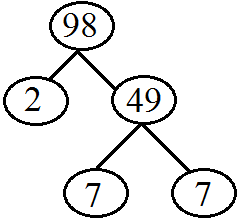
Write 98 as product of its prime factors.
Answer
Using factors tree for prime factorisation of 98.
prime factoris of 98 = 2 × 7 × 7
View full question & answer
Question 542 Marks
Define HCF of two positive integers and find the HCF of the following pairs of numbers:
240 and 6552
Answer
By applying Euclid’s division lemma
6552 = 240 × 27 + 72
Since remainder ≠ 0, apply division lemma on divisor of 240 and remainder 72.
240 = 72 × 3 + 24
Since remainder ≠ 0, apply division lemma on divisor of 72 and remainder 24.
72 = 24 × 3 + 0
$\therefore$ H.C.F of 6552 and 240 is = 24.
View full question & answer
Question 552 Marks
Find the HCF of the following pairs of integers and express it as a linear combination of them.
1288 and 575
Answer
By applying Euclid’s division lemma
1288 = 575 × 2 + 138 …..(i)
Since remainder ≠ 0, apply division lemma on division 575 and remainder 138.
575 = 138 × 4 + 23 …..(ii)
Since remainder ≠ 0, apply division lemma on division 138 and remainder 23 …..(iii)
HCF = 23
Now, 23 = 575 - 138 × 4 [from (ii)]
= 575 - [1288 - 575 × 2] × 4 [from (i)]
= 575 - 1288 × 4 + 575 × 8
= 575 × 9 - 1288 × 4
View full question & answer
Question 562 Marks
Use Euclid's division algorithm to find the HCF of:
136, 170 and 255
Answer
Given integers are 136, 170 and 255.
Let us first find the HCF of 136, 170 by Euclid lemma.
Clearly, 170 > 136. So, we will apply Euclid’s division lemma to 136 and 170.
170 = 136 × 1 + 34
Remainder is 34 which is a non-zero number.
Now, apply Euclid’s division lemma to 136 and 34.
136 = 34 × 4 + 0
The remainder at this stage is zero.
Therefore, 34 is the HCF of 136 and 170.
Now, again use Euclid’s division lemma to find the HCF of 34 and 255.
255 = 34 × 7 + 17
Remainder is 17 which is a non-zero number.
Now, apply Euclid’s division lemma to 34 and 17.
34 = 17 × 2 + 0
The remainder at this stage is zero.
Therefore, 17 is the HCF of 136, 170 and 255.
View full question & answer
Question 572 Marks
What can you say about the prime factorisations of the 43 of the following rationals:
0.120120012000120000...
Answer
We have,
0.120120012000120000...
We can see that it is a non-terminating repeating decimal expersion.
So, its denominator has factors others them 2 or 5.
View full question & answer
Question 582 Marks
Define $HCF$ of two positive integers and find the $HCF$ of the following pairs of numbers:
$75$ and $243$
Answer
Prime factors of 75 and 243 are
$75 = 3 \times 5 \times 5 = 3 \times 5^2$
$243 = 3 \times 3 \times 3 \times 3 \times 3 = 3^5$
$HCF (75, 243) =$ Product of the smallest power of each common prime factor in the number
$= 3$
View full question & answer
2 Marks Questions - Page 2 - Maths STD 10 Questions - Vidyadip