Question 15 Marks
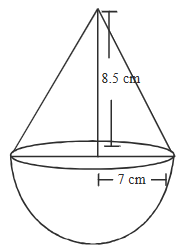
A solid is in the shape of a right$-$circular cone surmounted on a hemisphere, the radius of each of them being $7 \ cm$ and the height of the cone is equal to its diameter. Find the volume of the solid.
Answer$ r =7 \ cm$
$h = d =14 \ cm$
$\text { Volume of solid }$
$=\text { volume of cone }+ \text { volume of hemisphere }$
$=\frac{1}{3} \pi r ^2 h+\frac{2}{3} \pi r ^3$
$=\frac{1}{3} \times \frac{22}{7} \times(7)^2 \times 14+\frac{2}{3} \times \frac{22}{7} \times(7)^3$
$=\frac{1}{3} \times 22 \times 49 \times 2+\frac{2}{3} \times 22 \times 49$
$=\frac{2156}{3}+\frac{2156}{3}$
$=\frac{4312}{3}$
$=1437.33 \ cm^3$
View full question & answer→Question 25 Marks
The boilers are used in thermal power plants to store water and then used to produce steam. One such boiler consists of a cylindrical part in middle and two hemispherical parts at its both ends. Length of the cylindrical part is $7 m$ and radius of cylindrical part is $\frac{7}{2} m$. Find the total surface area and the volume of the boiler. Also, find the ratio of the volume of cylindrical part to the volume of one hemispherical part.
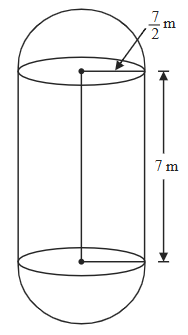
AnswerAs it is an open hemisphere, the area of one hemisphere will be:
$A=2 \pi \times r^2$
$A=2 \pi \times\left(\frac{7}{2}\right)^2$
$A=2 \pi \times\left(\frac{49}{4}\right)$
$A=2\left(\frac{22}{7}\right) \times\left(\frac{49}{4}\right)$
$A=11 \times 7$
$A=77$
So, the area of the two similar hemispheres at both ends will be :
$A_\text{hem}=2 \times 77$
$A_\text{hem}=154 m^2$
Calculating the surface area of the boiler's cylinder :
As it is an open cylinder, the area of the cylinder will be its Curved Surface Area, i.e.:
$A_{cy}=2 \pi \times r \times h$
$A_{cy}=2 \pi \times\left(\frac{7}{2}\right) \times 7$
$A_{cy}=2\left(\frac{22}{7}\right)\left(\frac{7}{2}\right) \times 7$
$A_{c y}=22 \times 7$
$A_{c y}=154 m^2$
So, the total area of the boiler is the sum of the areas of the cylinder and the two hemispheres i.e.
$A=154+154$
$A=308 m^2$
Calculating the volume of the two hemispheres:
The two hemispheres combine to form a complete sphere. The volume of this sphere thus is:
$ V _\text{ hem }=\left(\frac{4}{3}\right) \pi r ^3$
$V_\text{ hem }=\left(\frac{4}{3}\right)\left(\frac{22}{7}\right)\left(\frac{7}{2}\right)^3$
$V_{\text {hem }}=\left(\frac{4}{3}\right)\left(\frac{22}{7}\right)\left(\frac{343}{8}\right)$
$V_{\text {herm }}=179.67 m^3$
Calculating the volume of the boiler's cylinder:
As it is an open cylinder, the volume of the cylinder will be :
$V_{cy}=\pi r^2 \times h$
$V_{cy}=\left(\frac{22}{7}\right) \times\left(\frac{7}{2}\right)^2 \times(7)$
$V_{cy}=\frac{(49 \times 11)}{2}$
$V_{cy}=269.5 m^3$
So, the total volume of the boiler is the sum of the volumes of the cylinder and the two hemispheres i.e.
$V=179.76+269.5$
$V=449.26 m^3$
The volume of the cylindrical part is : $269.5 m^3$
The volume of one hemispherical boiler part is :
$\frac{179.67}{2}=89.835 m^{\circ}$
So, the ratio of the volume of the cylindrical to the hemispherical parts of the boiler is :
$=\frac{269.5}{89.835}$
$=3$
Required ratio $=3: 1$
View full question & answer→Question 35 Marks
In a hospital, used water is collected in a cylindrical tank of diameter 2 m and height 5 m. After recycling, this water is used to irrigate a park of hospital whose length is 25 m and breadth is 20 m. If tank is filled completely then what will be the height of standing water used for irrigating the park. Write your views on recycling of water.
AnswerWe know that the volume of a cylinder is given by the formula,
$V=\pi r^2 H$
Where $r$ is the radius of the base of the cylinder and $H$ is its height.
Here, $r=\frac{d}{2}=\frac{2}{2}=1 m$ and $h=5 m$
$\therefore V=(3.14)(1)^2(5)=15.7 m^3 \ldots . .(i)$
Also, Volume of a rectangular field is given by the formula,
$V=l b h,$
Where h is the height of the standing water.
Here, $l=25 m, b=20 m$
$V=25 \times 20 \times h=500(h) m^3\quad \quad \ldots \ldots(ii)$
The height of standing water used for irrigating the park can be found by equating the volume of cylindrical tank and the volume of water used for irrigating the park.
Equating equation (i) and (ii), we'll get
$\begin{array}{l}\Rightarrow 15.7=500(h) \\\Rightarrow \frac{15.7}{500}=h \\\Rightarrow h=0.0314 m\end{array}$
Hence, the height of the standing water is $0.0314 m$
Recycling of water is one of the best methods for sustainable development as it reduces wastage and help in reuse of water. It reduces water pollution and also helps in conservation of water.
View full question & answer→Question 45 Marks
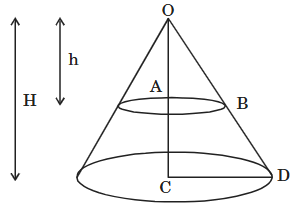
The height of a cone is 10 cm . The cone is divided into two parts using a plane parallel to its base at the middle of its height. Find the ratio of the volumes of the two parts.
Question 55 Marks
In a rain-water harvesting system, the rain-water from a roof of $22 m \times 20 m$ drains into a cylindrical tank having diameter of base 2 m and height 3.5 m. If the tank is full, find the rainfall in cm. Write your views on water conservation.
AnswerGiven:
Width of the roof $b=20 m$
Length of the roof $l=22 m$
Height of cylindrical vessel $H=3.5 m$
Base radius of cylindrical vessel $R=\frac{2}{2}=1 m$
Let $h$ cm of rainfall has taken place.
Now,
Total amount of rainfall = Volume of rain water collected in cylindrical vessel
$\begin{array}{l}\Rightarrow l b h=\pi R^2 H \\\Rightarrow 22 \times 20 \times h=\frac{22}{7} \times(1)^2 \times 3.5 \\\Rightarrow 440 h=\frac{22}{7} \times 3.5 \Rightarrow h=\frac{22}{7} \times \frac{3.5}{440} \\\Rightarrow h=0.025 m \\\therefore h=2.5 cm\end{array}$
It is very important to conserve water for sustainable development. For conserving water different methods can be put in use. Rain water harvesting is one of them it not only avoids wastage of water but also helps in fulfilling all demands of water in summers.
View full question & answer→Question 65 Marks
Due to heavy floods in a state, thousands were rendered homeless. 50 schools collectively offered to the state government to provide place and the canvas for 1500 tents to be fixed by the government and decide to share the whole expenditure equally. The lower part of each tent is cylindrical of base radius 2.8 m and height 3.5 m, with conical upper part of same base radius but of height 2.1 m. If the canvas used to make the tents costs Rs. 120/sq. m, find the amount shared by each school to set up the tents. What value is generated by the above problem?
$(\text { use } \pi=\frac{22}{7})$
AnswerLet the slant height, radius and height of the cone be $l, r$ and h respectively.
Let $H$ be the height of the cylindrical base of the tent. Slant height is given by $l^2=h^2+r^2$
$\begin{array}{l}l^2=(2.1)^2+(2.8)^2 \\l^2=4.41+7.84 \\l^2=12.25 \\l=\sqrt{12.25}=3.5 m\end{array}$
The canvas used for each tent = CSA of cylindrical base + CSA of conical upper part
The canvas used for each tent$=2 \pi r H+\pi r l$
$\begin{array}{l}=\pi r(2 H+l)=\pi \times 2.8 \times(2(3.5)+3.5) \\=\frac{22}{7} \times 2.8 \times 10.5 \\=92.4 m^2\end{array}$
So, canvas used for 1 tent is $92.4 m^2$
Thus, canvas used for 1500 tents
$=(92.4 \times 1500) m^2$
Cost of canvas is Rs $120 / sq$. m
So, cost of canvas for 1500 tents
$=\operatorname{Rs}(92.4 \times 1500 \times 120)$
As 50 schools participated to provide the tents. Therefore, the amount shared by each school to set up the tents
$=\frac{92.4 \times 1500 \times 120}{50}=\text { Rs } 3,32,640$
Thus, the amount shared by each school to set up the tents is Rs. $3, 32,640.$
View full question & answer→Question 75 Marks
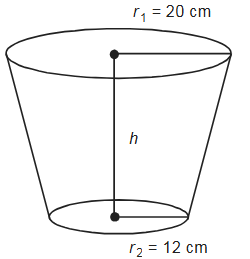
A bucket open at the top is in the form of a frustum of a cone with a capacity of $12308.8 cm^3$. The radii of the top and bottom circular ends are 20 cm and 12 cm respectively. Find the height of the bucket and the area of metal sheet used in making the bucket. (Use $\pi=3.14$)
View full question & answer→Question 85 Marks
A container open at the top, is in the form of a frustum of a cone of height 24 cm with radii of its lower and upper circular ends as 8 cm and 20 cm respectively. Find the cost of milk which can completely fill the container at the rate of 21 per litre. [Use $\pi=\frac{22}{7}$ ]
AnswerConsider a frustum of cone of height $(h) 24 cm$, radius of lower end $(r) 8 cm$ and radius of upper end $(R) 20 cm$.
Volume of frustum of cone $=\frac{\pi}{3} h\left(R^2+R r+r^2\right)$
Substitute the values of $R, r$ and h in the above equation
Volume of frustum of cone
$=\frac{\pi}{3}(24)\left(20^2+20 \times 8+8^2\right)$
Volume of frustum of cone
$=\frac{\pi}{3}(24)(400+160+64)$
Volume of frustum of cone $=\frac{\pi}{3}(24)(624)$
Volume of frustum of cone $=15689.14 cm^3$
The cost of milk for 1 litre is Rupees 21.
Since,
$1L=1,000 cm^3, 15689.14 cm^3=\frac{15689.14}{1,000}=15.69 L$
Cost of 15.68 L of milk is $15.69 \times 21=$ ₹ $329.49$
View full question & answer→Question 95 Marks
From each end of a solid metal cylinder, metal was scooped out in hemispherical form of same diameter. The height of the cylinder is 10 cm and its base is of radius 10 cm. The rest of the cylinder is melted and converted into a cylindrical wire of 1.4 cm thickness. Find the length of the wire. $[ \text {Use}$ $=\frac{22}{7}]$
AnswerThe height of the cylinder is 10 cm and its base is of radius 4.2 cm.
Let $r$ be the radius of the base of the cylinder and the hemisphere and $h$ be the height of the cylinder.
Let $R$ and $H$ be the radius and the height of the cylindrical wire respectively.
Volume of the cylinder $=\pi r^2 h$
$\begin{array}{l}=\frac{22}{7} \times 4.2^2 \times 10 \\=554.4 cm^3\end{array}$
Volume of the hemispherical part scooped out = $2 \times$ volume of the hemisphere
$\begin{array}{l}=2 \times \frac{2}{3} \times \pi \times r^3 \\=\frac{4}{3} \times \frac{22}{7} \times 4.2^3 \\=310.464 cm^3\end{array}$
Remaining volume of the cylinder after scooping out two hemispheres $=554.4 cm^3-310.464 cm^3$
$=243.936 cm^3$
Diameter of the cylindrical wire is given 1.4 cm So, the radius of the cylindrical wire is 0.7 cm The volume of the wire = Remaining volume of the cylinder after scooping out two hemispheres
$\Rightarrow \pi \times 0.7^2 \times h=243.936$
Where, $h$ is the length of the wire.
$\begin{array}{l}\Rightarrow 243.936=1.54 \times h \\\Rightarrow h=\frac{243.936}{1.54} \\h=158.4 cm\end{array}$
View full question & answer→Question 105 Marks
Water is flowing at the rate of $2.52 km / h$ through a cylindrical pipe into a cylindrical tank, the radius of whose base is 40 cm, if the increase in the level of water in the tank, in half an hour is 3.15 m, find the internal diameter of the pipe.
AnswerLet us suppose the internal radius of the pipe is $r$ m and the distance covered by the water in half an hour will be the length of the cylindrical pipe i.e.
$H=2.52 \times \frac{1}{2}=1.26 km=1.26 \times 1000 m=1260 m,$
Now radius of base of cylindrical tank is 40 cm i.e. 0.4 m and height is 3.15 m,
Hence volume of water filled in tank in half an hour will be,
$\begin{array}{l}\text {Volume}=\pi r^2 h=\frac{22}{7} \times 0.4 \times 0.4 \times 3.15=22 \times 0.16 \times 0.45 \\=22 \times 0.072 \\\Rightarrow 1.584 m^3\end{array}$
Now this volume is same as volume of water released by the pipe,
Volume of water released by pipe $=1.584 m^3$
$\begin{array}{l}\Rightarrow \pi r^2 H=1.584 \\\Rightarrow \pi r^2 \times 1260=1.584 \\\Rightarrow r^2=\frac{1.584}{\pi \times 1260}=\frac{1.584 \times 7}{22 \times 1260}=\frac{0.072}{180}=\frac{0.004}{10} \\=0.0004 \\\Rightarrow r^2=0.0004 \Rightarrow r=0.02\end{array}$
Hence the internal radius of the pipe is, $r =0.02 m$
Therefore diameter is 0.04 m or 4 cm.
View full question & answer→Question 115 Marks
A well of diameter 4 m is dug 14 m deep. The earth taken out is spread evenly all around the well to form a 40 cm high embankment. Find the width of the embankment.
AnswerLet $h$ be the depth of the well, $h=14 m$ and let $r$ be the radius of the well,
$r=d / 2=4 / 2=2 m$
Now let $R$ be the outer radius of the embankment, and $h$ be the height of the embankment i.e. $h^{\prime}=40 cm=0.4 m$,
Now as we know volume of the embankment and volume of the well will be same,
Therefore,
Volume of well = Volume of the embankment
$\begin{array}{l}\Rightarrow \pi r^2 h=\pi R^2 h^{\prime}-\pi r^2 h^{\prime} \\\Rightarrow \pi r^2 h=\pi h^{\prime}\left(R^2-r^2\right)\end{array}$
Taking $\pi$ common from both sides,
$\Rightarrow r^2 h=h^{\prime}\left(R^2-r^2\right)$
Now substituting values of $r, h, h^{\prime}$ and solving for $R$,
$\begin{array}{l}\Rightarrow 2^2 \times 14=0.4\left(R^2-2^2\right) \Rightarrow \frac{4 \times 14}{0.4}=R^2-4 \\\Rightarrow 10 \times 14=R^2-4 \Rightarrow 140+4=R^2 \\\Rightarrow R^2=144 \\\therefore R=12\end{array}$
Now since $R=12 m$ and $r=2 m$, Therefore Width of the embankment will be difference of the outer radius $(R)$ and inner radius(r),
Width $= R - r =12-2=10 m$
Hence, width of the embankment is 10 m.
View full question & answer→Question 125 Marks
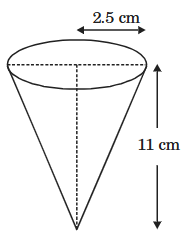
Sushant has a vessel, of the form of an inverted cone, open at the top, of height 11 cm and radius of top as 2.5 cm and is full of water. Metallic spherical balls each of diameter 0.5 cm are put in the vessel due to which $\frac{2}{5}$th of the water in the vessel flows out. Find how many balls were put in the vessel. Sushant made the arrangement so that the water that flows out irrigates the flower beds. What value has been shown by Sushant?
View full question & answer→Question 135 Marks
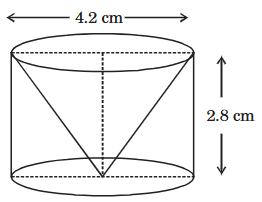
From a solid cylinder of height 2.8 cm and diameter 4.2 cm, a conical cavity of the same height and same diameter is hollowed out. Find the total surface area of the remaining solid. $[ \text {Take} $ $\pi=\frac{22}{7}]$
View full question & answer→Question 145 Marks
150 spherical marbles, each of diameter 1.4 cm, are dropped in a cylindrical vessel of diameter 7 cm containing some water, which are completely immersed in water. Find the rise in the level of water in the vessel.
AnswerLet $h$ be the rise in the level of water in the vessel. Diameter of spherical marble $=1.4 cm$
Radius of spherical marble $=\frac{1.4}{2}=0.7 cm$
Volume of spherical marble $=\frac{4}{3} \pi r^3$
Volume of spherical marble $=\frac{4}{3} \times \frac{22}{7}(0.7)^3$
Volume of spherical marble
$=\frac{30.184}{21}=1.437 cm^3$
Volume occupied by 150 spherical marbles
$=150 \times 1.437=215.6 cm^3$
Volume of water increased
$=\pi r^2 h=\frac{22}{7} \times(3.5)^2 \times h$
Volume of water increased = Volume of 150 spherical marbles.
$\begin{array}{l}\frac{22}{7} \times(3.5)^2 \times h=215.6 \\h=\frac{215.6 \times 7}{22 \times(3.5)^2} \\h=\frac{1509.2}{269.5}=5.6 cm\end{array}$
The level of water increased by 5.6 cm.
View full question & answer→Question 155 Marks
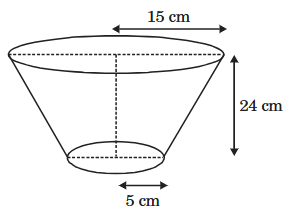
A bucket open at the top and made up of a metal sheet is in the form of a frustum of a cone. The depth of the bucket is 24 cm and the diameters of its upper and lower circular ends are 30 cm and 10 cm respectively. Find the cost of metal sheet used in it at the rate of Rs. 10 per $100 cm^2$. [Use $\pi=3.14$ ]
Answer
We know that,
Diameter of upper end of bucket $=30 cm$
Hence, Radius ( $r_1$ ) of upper end of bucket $=15 cm$
Diameter of lower end of bucket $=10 cm$
Hence, Radius $\left(r_2\right)$ of lower end of bucket $=5 cm$
Height $(h)$ of bucket $=24 cm$
Slant height $(l)$ of frustum
$\begin{array}{l}=\sqrt{\left(r_1-r_2\right)^2+h^2}=\sqrt{(15-5)^2+24^2} \\=\sqrt{100+576}=\sqrt{676}=26 cm\end{array}$
Area of metal sheet required to make the bucket $=$ CSA of frustum + area of the base of bucket
$\begin{array}{l}=\pi\left(r_1+r_2\right) l+\pi r^2 \\=\pi(15+5) 26+\pi(5)^2 \\=520 \pi+25 \pi=545 \pi cm^2\end{array}$
Cost of $100 cm^2$ metal sheet $=$ Rs 10
Cost of $545 \pi cm^2$ metal sheet
$R s .545 \times 3.14 \times \frac{10}{100}=R s .171 .13$
Hence the total cost is Rs. 171.13. View full question & answer→Question 165 Marks
Water is flowing through a cylindrical pipe, of internal diameter 2 cm, into a cylindrical tank of base radius 40 cm, at the rate of $0.4 m / s$. Determine the rise in level of water in the tank in half an hour.
AnswerWe know,
Internal diameter of circular end of pipe $=2 cm$
$\therefore$ Radius ( $r_1$ ) of circular end of pipe
$=1 c m=\frac{1}{100} m=0.01 m$
Speed of water $=0.4 m / s =0.4 \times 60=24$ metre/min
Length of water column in one minute $=24 m$
Volume of water that flows through the pipe in
$\begin{array}{l}1 \text { minute}=\pi r_1^2 h \\=\pi(0.01)^2 \times 24=0.0024 \pi m^3\end{array}$
Volume of water that flows through the pipe in 30 minutes $=30 \times 0.0024 \pi m^3=0.072 \pi m^3$
$\therefore$ Radius $(r_3)$ of base of cylindrical tank $=40 cm$ $=0.4 m$
Let the rise in level of the water in the cylindrical tank filled in 30 minutes be $h m$.
Now, Volume of water filled in tank in 30 minutes $=$ Volume of water flowed in 30 minutes from the pipe.
$\begin{array}{l}\therefore \pi \times\left(r_2\right)^2 \times h=0.072 \pi \\\Rightarrow(0.4)^2 \times h=0.072 \\\Rightarrow 0.16 \times h=0.072 \\\Rightarrow h=\frac{0.072}{0.16} \\\Rightarrow h=0.45 m=45 cm\end{array}$
Hence the rise in the level in half an hour is 45 cm.
View full question & answer→Question 175 Marks
A drinking glass is in the shape of the frustum of a cone of height 14 cm. The diameters of its two circular ends are 4 cm and 2 cm. Find the capacity of the glass. [Use $\pi=\frac{22}{7}$ ]
AnswerGiven that, the height of the frustum of a cone $=$ 14 cm
The diameters of its two circular ends are 4 cm and 2 cm .
$\therefore$ The radius of its two circular ends will be 2 cm and 1 cm respectively.
Let us suppose, radius of one end, $r_1=2 cm$, and Radius of another end, $r_2=1 cm$
Volume of the frustum $=\frac{1}{3} \pi h\left(r_1^2+r_2{ }^2+r_1 r_2\right)$
$\begin{array}{l}=\frac{1}{3} \times \frac{22}{7} \times 14\left(2^2+1^2+2 \times 1\right) \\=\frac{1}{3} \times 22 \times 2(4+1+2) \\
=\frac{1}{3} \times 22 \times 14=\frac{308}{3}=102.6 cm^3\end{array}$
Therefore, capacity of the glass in the shape of a frustum is $102.6 cm^3$.
View full question & answer→Question 185 Marks
A hemispherical tank, full of water, is emptied by a pipe at the rate of $\frac{25}{7}$. How much time will it take to empty half the tank if the diameter of the base of the tank is 3 m ?
AnswerDiameter of the base of the hemispherical tank $=3 m$
$\therefore$ The radius of the hemispherical $\operatorname{tank}=\frac{3}{2} m$
volume of the hemispherical tank $=\frac{2}{3} \pi r ^2$
$=\frac{2}{3} \times \frac{22}{7} \times \frac{3}{2} \times \frac{3}{2} \times \frac{3}{2}=\frac{99}{14} m^3$
$\therefore$ The amount of water in the hemispherical
$\operatorname{tank}=\frac{99}{14} \times 1000\left[1 m^3=1000 L\right]$
$=\frac{99000}{14}$ litres
Volume of water to be emptied $=\frac{1}{2} \times$ Volume of the tank
$=\frac{1}{2} \times \frac{99000}{14}$ litres
$=\frac{99000}{28}$ litres
Now, it is given that tank is emptied at the rate of $\frac{25}{7}$ litres per second.
$\therefore$ Time taken to empty $\frac{99000}{28}$ litres $=\frac{\frac{99000}{28}}{\frac{25}{7}}$
$=\frac{7}{25} \times \frac{99000}{28}$ seconds $=\frac{693000}{700}$ seconds
$=990$ seconds $=\frac{990}{60}$ minutes $=16.5$ minutes
Therefore, it will take 16.5 minutes to empty half the tank.
View full question & answer→Question 195 Marks
From a solid cylinder whose height is 15 cm and diameter 16 cm , a conical cavity of the same height and same diameter is hollowed out. Find the total surface area of the remaining solid. [Take $\pi=3.14$ ]
AnswerTotal surface area of remaining portion will be $=$ Curved surface area of cylinder $+$ Curved surface area of cone $+$ Area of the base of the cylinder
$=2 \pi r h+\pi r l+\pi r^2$
Here, $h=15 cm$,
Slant height of cone, $l=\sqrt{h^2+r^2}$
$\begin{array}{l}l=\sqrt{15^2+8^2}=\sqrt{225+64}=\sqrt{289} \\l=17 cm\end{array}$
Now total surface area of remaining portion is,
$\begin{array}{l}\text { TSA }=\pi r l+\pi r^2+2 \pi r h \\\Rightarrow \pi r(l+r+2 h) \\\Rightarrow 3.14 \times 8(17+8+2 \times 15) \\\Rightarrow 3.14 \times 8(55) \\\Rightarrow 3.14 \times 440 \\\Rightarrow 1381.6\end{array}$
Hence the required total surface area is $1381.6.$
View full question & answer→Question 205 Marks
A solid is in the shape of a hemisphere surmounted by a cone. If the radius of hemisphere and base radius of cone is 7 cm and height of cone is 3.5 cm, find the volume of the solid. (Take $\pi=\frac{22}{7}$ )
View full question & answer→Question 215 Marks
The diameter of lower and upper ends of a bucket in the form of a frustum of a cone are 10 cm and 30 cm respectively. If its height is 24 cm, find:
(i) The area of the metal sheet used to make the bucket.
(ii) Why we should avoid the bucket made by ordinary plastic? [Use $\pi=3.14$]
Answer(i) Here, $h=24 cm, r_1=30 cm$ and $r_2=5 cm$
$\begin{array}{l}l=\sqrt{h^2+\left(r_1-r_2\right)^2}=\sqrt{24^2+(15-5)^2} \\= \sqrt{676}=26 cm\end{array}$
Total surface area $=$ Curved surface Area of frustum + Area of base
$\begin{array}{l}=\pi\left(r_1+r_2\right) L+\pi r_2^2 \\=\pi(15+5) \times 26+\pi(5)^2 \\=3.14 \times 20 \times 26+25 \times 3.14\end{array}$
$\begin{array}{l}=3.14(520+25) \\=545 \times 3.14 \\=1711.3 cm^2\end{array}$
Hence, the Area of metal sheet used to make the bucket is $1711.3 cm^2$
(ii) Plastics are non biodegradable. That is, plastic material mostly end as harmful waste that pollutes the environment and causes health problems, we should avoid using plastic.
View full question & answer→Question 225 Marks
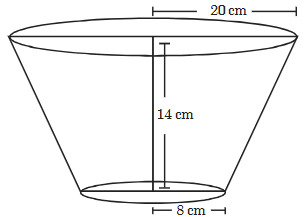
A container open at the top and made up of a metal sheet, is in the form of a frustum of a cone of height 14 cm with radii of its lower and upper circular ends as 8 cm and 20 cm , respectively. Find the capacity of the container.
Question 235 Marks
A container opened at the top and made up of a metal sheet, is in the form of a frustum of a cone of height 16 cm with radii of its lower and upper ends as 8 cm and 20 cm respectively. Find the cost of milk which can completely fill the container, at the rate of Rs. 50 per litre. Also find the cost of metal sheet used ot make the container, if it costs Rs. 10 per $100 cm^2$ (Take $\pi=3.14$ )
AnswerIn order to find cost of milk which can completely fill container, we need to find volume (in litres)
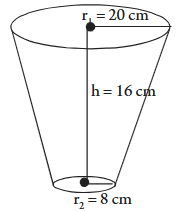
$\begin{aligned}\text { Volume of container } & =\text { Volume of frustum } \\& =\frac{1}{3} \pi h\left(r_1^2+r_2^2+r_1 r_2\right)\end{aligned}$
$\begin{aligned}\text {Here,}\quad h & =\text { height }=16 cm, \\ r _1 & =\text { radius of upper end }=20 cm \\ r _2 & =\text { radius of lower end }=8 cm\end{aligned}$
Now, Volume of container
$\begin{aligned}& =\frac{1}{3} \times 3.14 \times 16\left[20^2+8^2+20 \times 8\right] \\& =\frac{3.14 \times 16}{3} \times[400+64+160] \\= & 16.74 \times 624=10445.76 cm^2 \\= & \frac{10445.76}{1000} \text { litre } \quad\left[\because 1000 cm^2=1 \text { litre }\right] \\= & 10.44576 \text { litre. }\end{aligned}$
Now, Cost of 1 litre milk = Rs. 50
$\therefore$ Cost of 10.44576 litre milk
$\begin{array}{l}=\text { Rs. } (50 \times 10.44576) \\=\text { Rs. } 522.28=\text { Rs. } 522\end{array}$
Now, we need to find the cost of metal.
To find the cost of metal, we need to find the area of container.
Since container is closed from bottom,
Area of container $=$ Area of frustum + Area of bottom circle $=\pi\left(r_1+r_2\right) l+\pi r_2^2$
Here, $r_1=20 cm, r _2=8 cm$
$\begin{array}{l}l=\sqrt{h^2+\left(r_1-r_2\right)^2} \\l=\sqrt{(16)^2+(20-8)^2} \\=\sqrt{256+144} \\=\sqrt{400} \\=20 cm \\\therefore \text { Area of container }=3.14(20+8) \times 20+314 \times 8^2 \\=3.14[28 \times 20+64]=3.14[560+64] \\=3.14 \times 624=1959.36 cm^2\end{array}$
$\because$ Cost of making $100 cm^2$ metal sheet $=$ Rs. 10
Cost of making $1 cm^2$ metal sheet $=$ Rs. $\frac{10}{100}$
Cost of making $1959.36 cm^2$ metal sheet
$\begin{array}{l}=\text { Rs. } \frac{10}{100} \times 1959.36 \\=\text { Rs. } \frac{1959.36}{10} \\=\text { Rs. } 195.93 \\=\text { Rs. } 196\end{array}$
Hence, Cost of milk = Rs. 522 and cost of metal sheet = Rs. 196 View full question & answer→