Questions · Page 2 of 2

M.C.Q (1 Marks)

MCQ 511 Mark
What is the total surface area of a solid hemisphere of diameter 'd'?
  • A
    $3 \pi d^2$
  • B
    $2 \pi d^2$
  • C
    $\frac{1}{2} \pi d^2$
  • $\frac{3}{4} \pi d^2$
Answer
Correct option: D.
$\frac{3}{4} \pi d^2$
(d)
Total surface area of a solid hemisphere of radius r is $S=3 \pi r^2=3 \pi\left(\frac{d}{2}\right)^2=\frac{3}{4} \pi d^2$
View full question & answer
MCQ 521 Mark
Water in a river which is 3 m deep and 40 m wide is flowing at the rate of 2km/hr. How much water will fall into the sea in 2 minutes?
  • A
    $800 m^3$
  • B
    $4000 m^3$
  • $8000 m^3$
  • D
    $2000 m^3$
Answer
Correct option: C.
$8000 m^3$
(c)
Length of water column formed in two minutes in a river flowing at the rate of $2 km / hr =\left(\frac{2000}{60} \times 2\right) m =\frac{200}{3} m$
∴ Volume of water that falls into the sea in 2 minutes
= Volume of a cuboid of dimensions 3 m x 40 m x $\frac{200}{3} m=\left(3 \times 40 \times \frac{200}{3}\right) m ^3=8000 m^3$
View full question & answer
MCQ 531 Mark
The volume of a right circular cone whose area of the base is $156 cm^2$ and the vertical height is 8 cm, is
  • A
    $2496 cm^3$
  • B
    $1248 cm^3$
  • C
    $1664 cm^3$
  • $416 cm^3$
Answer
Correct option: D.
$416 cm^3$
(d)
Volume of cone = 1/3 (Area of base x Height) $=\frac{1}{3} \times 156 \times 8 cm^3=416 cm^3$
View full question & answer
MCQ 541 Mark
The sum of the length, breadth and height of a cuboid is 6sqrt(3) cm and the length of its diagonal is $2 \sqrt{3} cm$.The total surface area of the cuboid is
  • A
    $48 cm^2$
  • B
    $72 cm^2$
  • $96 cm^2$
  • D
    $108 cm^2$
Answer
Correct option: C.
$96 cm^2$
(c)
Let the length, breadth and height of the cuboid be a, b and c centimeters long. It is given that
$a+b+c=6 \sqrt{3}$ and $\sqrt{a^2+b^2+c^2}=2 \sqrt{3}$
$\Rightarrow \quad(a+b+c)^2=108$ and $a^2+b^2+c^2=12$
$\therefore \quad(a+b+c)^2=a^2+b^2+c^2+2(a b+b c+c a)$
$\Rightarrow \quad 108=12+$ Surface area of the cuboid $\Rightarrow$ Surface area of the cuboid $=96 cm^2$
View full question & answer
MCQ 551 Mark
Three solid cubes have a face diagonal 4sqrt(2) cm each. Three other solid cubes have a face diagonal of $8 \sqrt{2} cm$ each.All the cubes are melted together to form a cube. The length of an edge of the cube formed is
  • 12 cm
  • B
    24 cm
  • C
    18 cm
  • D
    26 cm
Answer
Correct option: A.
12 cm
(a)
Let the lengths of edges of two sets of three cones each be a cm and b cm respectively. Then,
$\sqrt{2} a=4 \sqrt{2}$ and $\sqrt{2} b=8 \sqrt{2} \Rightarrow a=4$ and $b=8$
Let the length of an edge of new cube formed be c cm. Then,
$c^3=3 \times 4^3+3 \times 8^3=192+1536=1728=12^3 \Rightarrow c=12 cm$
View full question & answer
MCQ 561 Mark
If three cubes of same metal whose edges are 6 cm, 8 cm and 10 cm melted and formed into a single cube, then the length of the diagonal of the larger cube formed is
  • A
    $4 \sqrt{3} cm$
  • B
    $15 \sqrt{3} cm$
  • $12 \sqrt{3} cm$
  • D
    $1\sqrt{3} cm$
Answer
Correct option: C.
$12 \sqrt{3} cm$
(c)
Let the length of an edge of the larger cube be a cm. Then,
$a^3=6^3+8^3+10^3=216+512+1000=1728=12^3 \Rightarrow a=12$
Length of the diagonal of the larger cube $=\sqrt{3} a=12 \sqrt{3} cm$
View full question & answer
MCQ 571 Mark
The edge of a cube whose volume is equal to that of a cuboid of dimensions 8 cm x 4 cm x 2 cm is
  • A
    6 cm
  • 4 cm
  • C
    2 cm
  • D
    6 cm
Answer
Correct option: B.
4 cm
(b)
Let the length of an edge of the cube be a cm. Then,
$a^3=8 \times 4 \times 2 \Rightarrow a^3=2^3 \times 2^2 \times 2 \Rightarrow a^3=2^6 \Rightarrow a=2^2=4 cm$
View full question & answer
MCQ 581 Mark
The volume of the largest right circular cone that can be carved out from a solid cube of edge 2 cm is
  • A
    $\frac{4 \pi}{3} cm^3$
  • B
    $\frac{5 \pi}{3} cm^3$
  • C
    $\frac{8 \pi}{3} cm^3$
  • $\frac{2 \pi}{3} cm^3$
Answer
Correct option: D.
$\frac{2 \pi}{3} cm^3$
(d)
Height of the right circular cone = 2 cm., Radius of the cone = 1 cm.
$\therefore \quad$ Volume $=\frac{1}{3} \pi \times 1^2 \times 2 cm^3=\frac{2}{3} \pi cm^3$
View full question & answer
MCQ 591 Mark
A solid consists of a circular cylinder surmounted by a right circular cone. The height of the cone is h. If the total volume of the solid is 3 times the volume of the cone, then the height of the circular cylinder is
  • A
    $2 h$
  • B
    $\frac{3}{2} h$
  • C
    $\frac{h}{2}$
  • $\frac{2 h}{3}$
Answer
Correct option: D.
$\frac{2 h}{3}$
(d)
Let H be the height of the cylinder. It is given that $\frac{1}{3} \pi r^2 h+\pi r^2 H=3\left(\frac{1}{3} \pi r^2 h\right)$
⇒ $\pi r^2 h=\frac{2}{3} \pi r^2 h$
⇒ $H=\frac{2}{3} h$
View full question & answer
MCQ 611 Mark
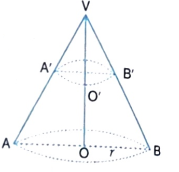
If a cone is cut into two parts by a horizontal plane passing through the mid-point of its axis, then the ratio of the volumes of the upper part and the cone is
  • 1:8
  • B
    1:5
  • C
    1:7
  • D
    1:6
Answer
Correct option: A.
1:8
(a)
Let r be the radius of base and h be the height of the cone. It is given that $V O^{\prime}=\frac{h}{2}$
Triangles VO'A' and VOA are similar.
$\therefore \quad \frac{V O^{\prime}}{V O}=\frac{O^{\prime} A^{\prime}}{O A}=\frac{h^{\prime} / 2}{h}=\frac{O^{\prime} A^{\prime}}{r}=O^{\prime} A^{\prime}=\frac{r}{2}$
Thus,$V A^{\prime} B^{\prime}$is a cone of height h/2 and base radius r/2 Let $V_1$ be its volumes.Then,
$V_1=\frac{\pi}{3}\left(\frac{r}{2}\right)^2\left(\frac{h}{2}\right)=\frac{1}{8}\left(\frac{\pi}{3} r^2 h\right)=\frac{V}{8}$, where $V$ is the volume of cone $V A B$.
$\Rightarrow V_1: V=1: 8$
Image
View full question & answer
MCQ 621 Mark
The ratio of lateral surface area to that total surface area of a cylinder with base diameter 1.6 m and height 20 cm is
  • A
    1:7
  • 1:5
  • C
    7:1
  • D
    5:1
Answer
Correct option: B.
1:5
(b)
We have, r = radius of base = 0.8m = 80 cm and height = 20 cm.
Let $S_1$ and $S_2$ denote respectively the lateral and total surface areas. Then,
$S_1=2 \pi r h$ and $S_2=2 \pi r(h+r) \Rightarrow S_1: S_2=\frac{h}{h+r}=\frac{20}{20+80}=\frac{1}{5}$
View full question & answer
MCQ 631 Mark
The surface area of a cube is $216 cm^2$,its volume is
  • A
    $144 cm^3$
  • B
    $196 cm^3$
  • C
    $212 cm^3$
  • $216 cm^3$
Answer
Correct option: D.
$216 cm^3$
(d)
Let the length of each side of the cube be a cm. Then,
Surface area = $216 cm^2 \Rightarrow 6 a^2=216 \Rightarrow a^2=36 \Rightarrow a=6$
Volume $=a^3=6^3 cm^3=216 cm^3$
View full question & answer
MCQ 641 Mark
The of a sphere is 6 cm. It is melted and drawn into a wire of diameter 2 mm. The length of the wire is
  • 36 m
  • B
    32 m
  • C
    38 m
  • D
    34 m
Answer
Correct option: A.
36 m
(a)
Let the length of the wire be 1 cm. Then,
Volume of metal in a wire of radius 0.1cm = Volume of metal in sphere is radius 3cm
$\Rightarrow \quad \pi(0.1)^2 \times l=\frac{4}{3} \pi \times 3^3 \Rightarrow \frac{l}{100}=36 \Rightarrow l=3600 cm=36 m$
View full question & answer
MCQ 651 Mark
If the height and base radius of a cone, each is increased by 50%, then the ratio between the volume of the given cone and the new cone is
  • 8:27
  • B
    27:8
  • C
    4:9
  • D
    2:3
Answer
Correct option: A.
8:27
(a)
Letr and h denote respectively the base radius and height of the cone. Then, its volume $V_1$ is given by $V=\frac{1}{3} \pi r^2 h$.
New radius $=r+50 \%$ of $r=r+\frac{r}{2}=\frac{3}{2} r$, New height $=h+50 \%$ of $h=h+\frac{h}{2}=\frac{3}{2} h$
Let $V_2$be the volume of the new cone. Then,
$V_2=\frac{1}{3} \pi\left(\frac{3}{2},\right)^2 \times\left(\frac{3}{2} h\right)=\frac{27}{8}\left(\frac{1}{3} \pi r^2 h\right)=\frac{27}{8} V_1 \Rightarrow \frac{V_1}{V_2}=\frac{8}{27}$
View full question & answer
MCQ 661 Mark
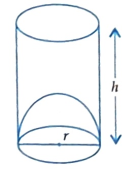
The capacity of the cylindrical vessel with the hemispherical bottom portion raised upwards as shown in Fig., is
Image
  • $\frac{\pi}{3}(3 h-2 r) r^2$
  • B
    $\frac{\pi}{3}(3 h+2 r) r^2$
  • C
    $\frac{\pi}{2}(2 h-3 r) r^2$
  • D
    $\frac{\pi}{2}(2 h+3 r) r^2$
Answer
Correct option: A.
$\frac{\pi}{3}(3 h-2 r) r^2$
(a)
Let V be the capacity of the vessel. Then, $V=\pi r^2 h-\frac{2}{3} \pi r^3=\frac{\pi}{3}(3 h-2 r) r^2$
View full question & answer
MCQ 671 Mark
The radius of the base and height of a cone are 4 cm and 9 cm respectively. If its height is decreased and base radius is increased each by 2 cm, then the ratio of the volume of the new cone to that of the original cone is
  • A
    5:2
  • 7:4
  • C
    9:2
  • D
    8:3
Answer
Correct option: B.
7:4
(b)
Let $V_1$ and $V_2$ be the volumes of old and new cones. Then,
$\frac{V_1}{V_2}=\frac{\frac{1}{3} \pi \times 4^2 \times 9}{\frac{1}{3} \pi \times 6^2 \times 7}=\frac{16 \times 9}{36 \times 7}=\frac{4}{7} \Rightarrow \frac{V_2}{V_1}=\frac{7}{4}=7: 4$
View full question & answer
MCQ 681 Mark
A solid sphere is cut into two hemispheres. The ratio of the surface areas of sphere to that of two hemispheres taken together is
  • A
    1:1
  • B
    1:4
  • 2:3
  • D
    3:2
Answer
Correct option: C.
2:3
(c)
Letr be the radius of the solid sphere. Then,
S = Surface area of sphere $=4 \pi r^2$
$S_1=$Sum of the surface areas of two hemispheres $=3 \pi r^2+3 \pi r^2=6 \pi r^2$
$S: S_1=4 \pi r^2: 6 \pi r^2=2: 3$
View full question & answer
MCQ 691 Mark
If a solid sphere surface area $48 cm^2$ is bisected into two hemisphere , then the total surface area of any one of the hemisphere is
  • A
    $48 cm^2$
  • B
    $60 cm^2$
  • C
    $24 cm^2$
  • $36 cm^2$
Answer
Correct option: D.
$36 cm^2$
(d)
Letr be the radius of solid sphere. It is given that its total surface area is $48 cm^2$.
$4 \pi r^2=48 \Rightarrow \pi r^2=12 \Rightarrow 3 \pi r^2=36$
Hence, total surface area of one of the hemispheres is $36 cm^2$
View full question & answer
MCQ 701 Mark
If the radii of the bases of a cylinder and a cone are in the ratio 3: 4 and their heights are in the ratio 2: 3, then the ratio between the volume of cylinder to that of the cone is
  • A
    7:5
  • B
    5:7
  • C
    8:9
  • 9:8
Answer
Correct option: D.
9:8
(d)
Let the radii of the bases of a cylinder and a cone be $r_1$ and $r_2$ respectively. Further, let the heights of the cylinder and cone be $h_1$ and $h_2$ respectively. It is given that $r_1: r_2=3: 4$ and $h_1$ and $h_2$= 2 : 3 Let $V_1$ and $V_2$ be the volumes of cylinder and cone respectively. Then,
$V_1=\pi r_1^2 h_1$ and $V_2=\frac{1}{3} \pi r_1^2 h_2 \Rightarrow \frac{V_1}{V_2}=3\left(\frac{r_1}{r_2}\right)^2\left(\frac{h_1}{h_2}\right)=3\left(\frac{3}{4}\right)^2 \times \frac{2}{3}=9 \cdot 8$
View full question & answer
MCQ 711 Mark
If the perimeters of the bases of two right circular cones are in the ratio 3: 4 and their volumes are in the ratio 9: 32, then the ratio of their heights is
  • A
    1:3
  • B
    2:1
  • 1:2
  • D
    1:3
Answer
Correct option: C.
1:2
(c)
Let the radii of two cones be $r_1$ and $r_2$ and their heights be $h_1$ and $h_2$.Then, perimeters of their bases are $2 \pi r_1$ and $2 \pi r_2$. Volumes of the cones are $\frac{1}{3} \pi r_1^2 h_1$ and $\frac{1}{3} \pi r_2^2 h_2$.respectively. It is given that $\begin{array}{l}2 \pi r_1: 2 \pi r_2=3: 4 \Rightarrow r_1: r_2=3: 4 \Rightarrow \frac{r_1}{r_2}=\frac{3}{4} \\ \frac{1}{3} \pi r_1^2 h_1: \frac{1}{3} \pi r_2^2 h_2=9: 32 \Rightarrow r_1^2 h_1: r_2^2 h_2=9: 32 \Rightarrow \frac{r_1^2 h_1}{r_1 h_1}=\frac{9}{32}\end{array}$
From (i) and (ii), we obtain
$\frac{9}{16} \frac{h_1}{h_2}=\frac{9}{32} \Rightarrow \frac{h_1}{h_2}=\frac{1}{2} \Rightarrow h_1: h_2=1: 2$
View full question & answer
MCQ 721 Mark
The curved surface area of a cone having height 24 cm and radius 7 cm, is
  • A
    $528 cm^2$
  • B
    $1056 cm^2$
  • $550 cm^2$
  • D
    $500 cm^2$
Answer
Correct option: C.
$550 cm^2$
(c)
Let l be the slant height of the cone. Then, $I=\sqrt{7^2+24^2}=\sqrt{625}=25 cm$
$\therefore \quad$ Curved surface area $=\pi r l=\frac{22}{7} \times 7 \times 25 cm^2=550 cm^2$
View full question & answer
MCQ 731 Mark
Curved surface area of a cylinder of height 5 cm is $94.2 cm^2$. Radius of the cylinder is (Take pi = 3.14 )
  • A
    2 cm
  • 3 cm
  • C
    2.9 cm
  • D
    6 cm
Answer
Correct option: B.
3 cm
(b)
Letr cm be the length of the radius of cylinder of height h = 5cm .
Curved surface area $=94.2 cm^2 \Rightarrow 2 \pi h=94.2 \Rightarrow 2 \times 3.14 \times r \times 5=94.2 \Rightarrow r=3 cm$
View full question & answer
MCQ 741 Mark
If the diagonal of a cube is 17.32 cm, then its volume is
  • $1000 cm^3$
  • B
    $1732 cm^3$
  • C
    $173.2 cm^3$
  • D
    $10000 cm^3$
Answer
Correct option: A.
$1000 cm^3$
(a)
Let the length of each edge of the cube be a cm. Then, its diagonal is $\sqrt{3} a$. Given that
$\begin{array}{ll} & \sqrt{3} a=17.32 \Rightarrow \sqrt{3} a=10 \times 1.732 \Rightarrow \sqrt{3} a=10 \times \sqrt{3} \Rightarrow a=10 \\ \therefore & \text { Volume of the cube }=a^3=10^3 cm^3=1000 cm^3\end{array}$
View full question & answer
M.C.Q (1 Marks) - Page 2 - Maths STD 10 Questions - Vidyadip