Question 15 Marks
View full question & answer→Questions
5 Marks Questions
🎯
Test yourself on this topic
11 questions · timed · auto-graded
Question 25 Marks
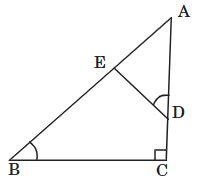
In $\triangle A B C$, If $\angle A D E=\angle B$, then prove that $\triangle A D E \sim \triangle A B C$.
Also if $A D=7.6 cm, A E=7.2 cm, B E=4.2 cm$ and $B C=5.4 cm$, then find $D E$.
Also if $A D=7.6 cm, A E=7.2 cm, B E=4.2 cm$ and $B C=5.4 cm$, then find $D E$.
Answer
View full question & answer→In $\triangle A D E$ and $\triangle A B C$
Given,
$
\begin{array}{ll}
\angle A D E=\angle B & (\text { Given }) \\
\angle A=\angle A & \text { (Common) } \\
\angle C=\angle E & \left(\text { each } 90^{\circ}\right)
\end{array}
$
Hence, $\triangle A D E \sim \triangle A B C$ by R.H.S criterion.
Now $\triangle A D E \sim \triangle A B C$
So,
$
\begin{array}{l}
\frac{A C}{A E}=\frac{A B}{A D}=\frac{B C}{D E} \\
A B=B E+A E \\
\Rightarrow A B=4.2+7.2=11.4 cm
\end{array}
$
Now, $\frac{A C}{A E}=\frac{A B}{A D}=\frac{B C}{D E}$
$
\Rightarrow \frac{A C}{7.2}=\frac{11.4}{7.6}=\frac{5.4}{D E}
$
Now, $\Rightarrow \frac{11.4}{7.6}=\frac{5.4}{D E}$
$
\begin{array}{l}
\Rightarrow 11.4 \times D E=5.4 \times 7.6 \\
\Rightarrow D E=\frac{7.6 \times 5.4}{11.4}
\end{array}
$
Hence $D E=3.6 cm$.
Given,
$
\begin{array}{ll}
\angle A D E=\angle B & (\text { Given }) \\
\angle A=\angle A & \text { (Common) } \\
\angle C=\angle E & \left(\text { each } 90^{\circ}\right)
\end{array}
$
Hence, $\triangle A D E \sim \triangle A B C$ by R.H.S criterion.
Now $\triangle A D E \sim \triangle A B C$
So,
$
\begin{array}{l}
\frac{A C}{A E}=\frac{A B}{A D}=\frac{B C}{D E} \\
A B=B E+A E \\
\Rightarrow A B=4.2+7.2=11.4 cm
\end{array}
$
Now, $\frac{A C}{A E}=\frac{A B}{A D}=\frac{B C}{D E}$
$
\Rightarrow \frac{A C}{7.2}=\frac{11.4}{7.6}=\frac{5.4}{D E}
$
Now, $\Rightarrow \frac{11.4}{7.6}=\frac{5.4}{D E}$
$
\begin{array}{l}
\Rightarrow 11.4 \times D E=5.4 \times 7.6 \\
\Rightarrow D E=\frac{7.6 \times 5.4}{11.4}
\end{array}
$
Hence $D E=3.6 cm$.
Question 35 Marks
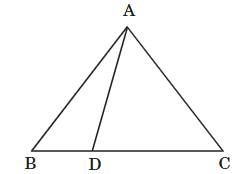
In the given figure $\triangle A B C$ is an equilateral. D is a point on $B C$ such that $B D=\frac{1}{3} B C$ Prove that $9 A D^2=7 A B^2$
View full question & answer→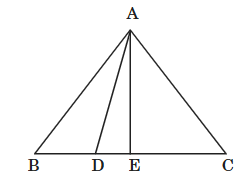
Question 45 Marks
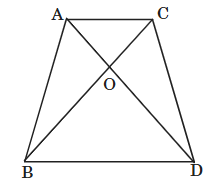
In the given figure, $A B C$ and $D B C$ are two triangles on the same base $B C$. If $A D$ intersects $B C$ at $O$, show that $\frac{\operatorname{ar}(\triangle A B C)}{\operatorname{ar}(\triangle D B C)}=\frac{A O}{D O}$
View full question & answer→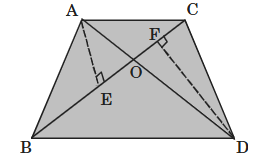
Question 55 Marks
Two poles of height $p$ and $q$ metres are standing vertically on a level ground, a metres apart. Prove that the height of the point of intersection of the lines joining the top of each pole to the foot of the opposite pole is given by $\frac{p q}{p+q}$ metres.
View full question & answer→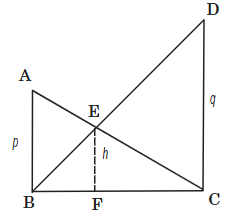
Question 65 Marks
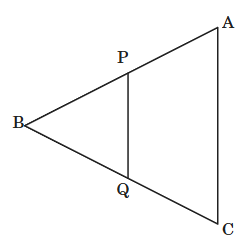
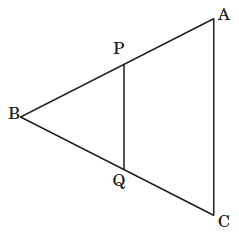
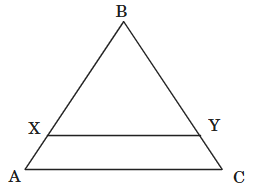
In the given figure, in $\triangle A B C, X Y| | A C$ and $X Y$ divides the $\triangle A B C$ into two regions such that $\operatorname{ar}(\triangle B X Y)=) 2 \operatorname{ar}(A C Y X)$. Determine $\frac{A X}{A B}$.
Answer
$\begin{array}{l}\operatorname{ar}(\triangle B X Y)=2 \operatorname{ar}(A C Y X) . \\\operatorname{ar}(\triangle B X Y)=2 \operatorname{ar}(\triangle A B C-\triangle B X Y) \\\operatorname{3ar}(\triangle B X Y)=2 \operatorname{ar}(\triangle A B C) \\\Rightarrow \frac{\operatorname{ar}(\triangle B X Y)}{\operatorname{ar}(\triangle A B C)}=\frac{2}{3} \quad \ldots \text { (i) }\end{array}$
Consider $\triangle B X Y$ and $\triangle A B C$,
$\angle B X Y=\angle B A C$ (Corresponding angles as $X Y \| A C)$
$\angle B Y X=\angle B C A$ (Corresponding angles as $X Y \| A C)$
$\begin{array}{l}\therefore \triangle B Y X \cong \triangle B C A \text { (AA similarity criterion) } \\\Rightarrow \frac{\operatorname{ar}(\triangle B X Y)}{\operatorname{ar}(\triangle A B C)}=\left(\frac{B X}{A B}\right)^2\quad \quad \ldots\ldots\text{(ii)}\end{array}$
From (i) and (ii),
$\left(\frac{B X}{A B}\right)^2=\frac{2}{3}$
Now, $B X=A B-A X$
$\begin{array}{l}\left(\frac{A B-A X}{A B}\right)^2=\frac{2}{3} \\\Rightarrow\left(1-\frac{A X}{A B}\right)^2=\frac{2}{3}\end{array}$
Taking square root,
$\begin{array}{l}1-\frac{A X}{A B}=\sqrt{\frac{2}{3}} \\\Rightarrow \frac{A X}{A B}=1-\sqrt{\frac{2}{3}}\end{array}$
View full question & answer→$\begin{array}{l}\operatorname{ar}(\triangle B X Y)=2 \operatorname{ar}(A C Y X) . \\\operatorname{ar}(\triangle B X Y)=2 \operatorname{ar}(\triangle A B C-\triangle B X Y) \\\operatorname{3ar}(\triangle B X Y)=2 \operatorname{ar}(\triangle A B C) \\\Rightarrow \frac{\operatorname{ar}(\triangle B X Y)}{\operatorname{ar}(\triangle A B C)}=\frac{2}{3} \quad \ldots \text { (i) }\end{array}$
Consider $\triangle B X Y$ and $\triangle A B C$,
$\angle B X Y=\angle B A C$ (Corresponding angles as $X Y \| A C)$
$\angle B Y X=\angle B C A$ (Corresponding angles as $X Y \| A C)$
$\begin{array}{l}\therefore \triangle B Y X \cong \triangle B C A \text { (AA similarity criterion) } \\\Rightarrow \frac{\operatorname{ar}(\triangle B X Y)}{\operatorname{ar}(\triangle A B C)}=\left(\frac{B X}{A B}\right)^2\quad \quad \ldots\ldots\text{(ii)}\end{array}$
From (i) and (ii),
$\left(\frac{B X}{A B}\right)^2=\frac{2}{3}$
Now, $B X=A B-A X$
$\begin{array}{l}\left(\frac{A B-A X}{A B}\right)^2=\frac{2}{3} \\\Rightarrow\left(1-\frac{A X}{A B}\right)^2=\frac{2}{3}\end{array}$
Taking square root,
$\begin{array}{l}1-\frac{A X}{A B}=\sqrt{\frac{2}{3}} \\\Rightarrow \frac{A X}{A B}=1-\sqrt{\frac{2}{3}}\end{array}$
Question 75 Marks
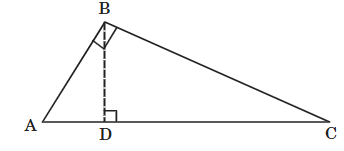
Prove that, in a right triangle, the square on the hypotenuse is equal to the sum of the squares on the other two sides.
Question 85 Marks
View full question & answer→
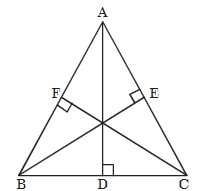
Question 95 Marks
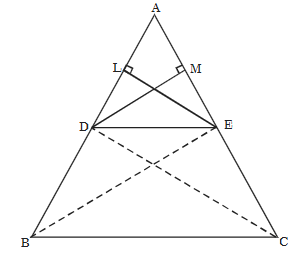
If a line is drawn parallel to one side of a triangle to intersect the other two sides in distinct points, prove that the other two sides are divided in the same ratio.
Question 105 Marks
Construct a triangle with sides 5 cm 6 cm and 7 cm and then another triangle whose sides are $\frac{3}{5}$ of the corresponding sides of the first triangle.
View full question & answer→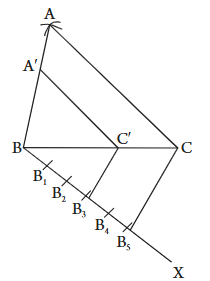
Question 115 Marks
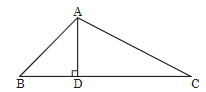
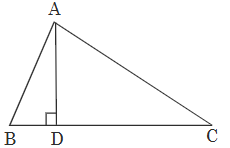
In $\triangle ABC$ (Figure), $AD \perp BC$. Prove that $AC ^2= AB ^2+ BC ^2-2 BC \times BD$
View full question & answer→