Questions · Page 2 of 2

5 Marks Questions

Question 515 Marks
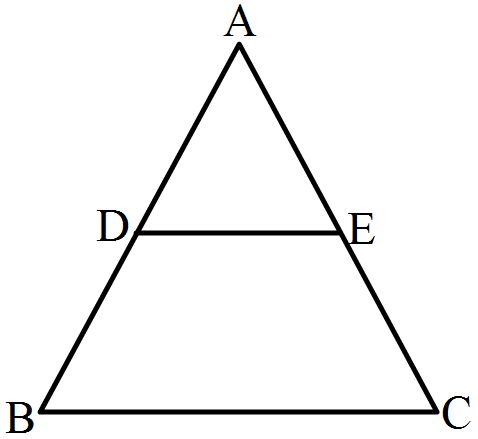
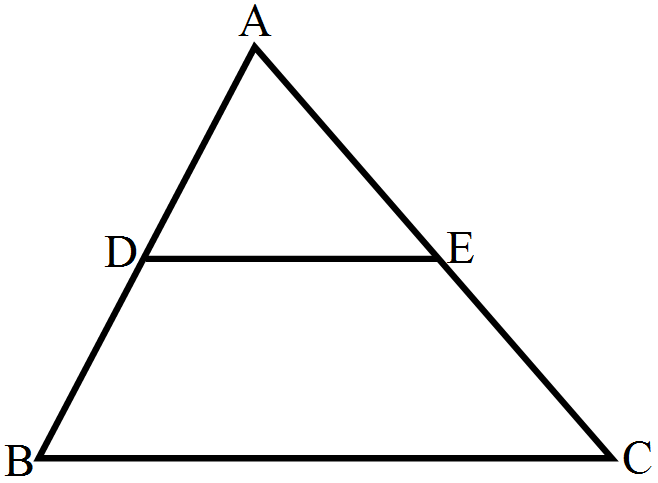
In $\triangle\text{ABC},\text{D}$ and $\text{E}$ are the midpoint of AB and AC respectively. Find the ratio of the areas of $\triangle\text{ADE}$ and $\triangle\text{ABC}.$
Answer
It is given that D and E are midpoint of AB and AC.
Applying midpoint theorem, we can conclude that DE || BC.
Hence, by B.P.T we get:
$\frac{\text{AD}}{\text{AB}}=\frac{\text{AE}}{\text{AC}}$
Also, $\angle\text{A}=\angle\text{A}$
Applying SAS similarity theorem, we can conclude that $\triangle\text{ADE}\sim\triangle\text{ABC}.$
Therefore, the ratio of the areas of these triangles will be equal to the ratio of squares of their corresponding sides.
$\therefore\frac{\text{ar}(\triangle\text{ADE})}{\text{ar}(\triangle\text{ABC})}=\frac{\text{DE}^2}{\text{BC}^2}$
$=\frac{\big(\frac{1}{2}\text{BC}\big)^2}{\text{BC}^2}$
$=\frac{1}{4}$
View full question & answer
Question 525 Marks
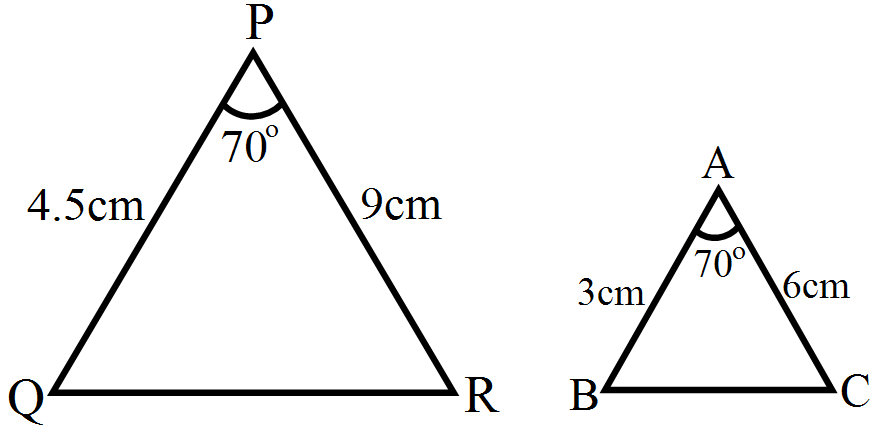
Two triangles ABC and PQR are such that AB = 3cm, AC = 6cm, $\angle\text{A}=70^\circ,\text{PR}=9\text{cm},\angle\text{P}=70^\circ$ and $\text{PQ}=4.5\text{cm}.$ show that $\triangle\text{ABC}\sim\triangle\text{PQR}$ and state the similarity criterion.
Answer

In $\triangle\text{ABC}$ and $\triangle\text{PQR},$
$\angle\text{A}=\angle\text{P}=70^\circ\ ...\ \text{(Given)}$
$\frac{\text{AB}}{\text{PQ}}=\frac{3}{4.5}=\frac{2}{3}$
$\frac{\text{AC}}{\text{PR}}=\frac{6}{9}=\frac{2}{3}$
$\Rightarrow\frac{\text{AB}}{\text{PQ}}=\frac{\text{AC}}{\text{PR}}$
so, $\triangle\text{ABC}\sim\triangle\text{PQR}$ ...(SAS criterion for similarity)
View full question & answer
Question 535 Marks
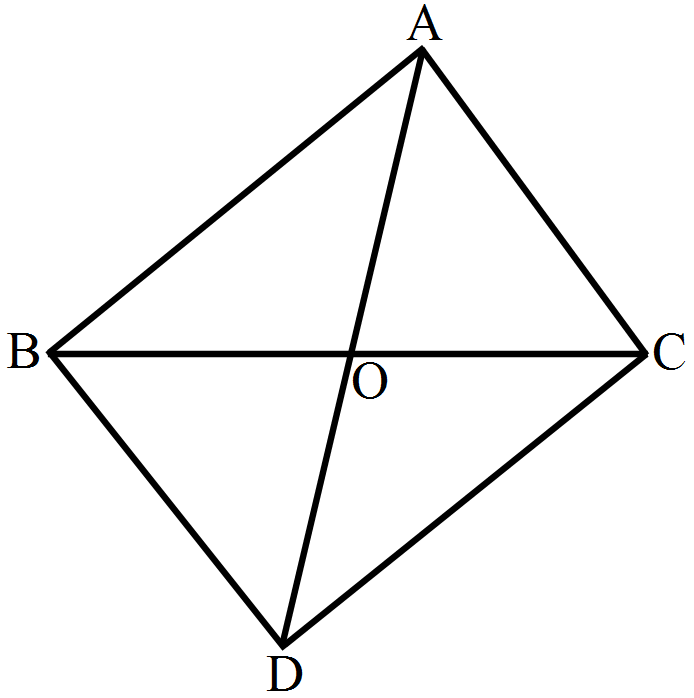
Find the length of each side of a rhombus whose diagonals are 24cm and 10cm long.
Answer

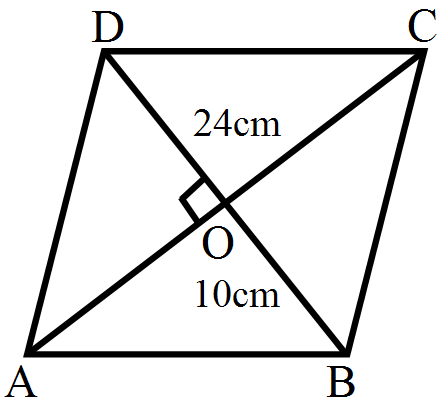
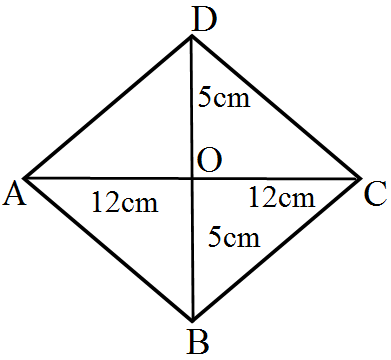
Let ABCD be the rhobbus with diagonals AC and BD intersecting each other at O.
We know that the diagonals of a rhombus bisect each other at right angles.
$\therefore$ if AC = 24cm and BD = 10cm, AO = 12cm and BO = 5cm
Applying Pythagoras theorem in right- angled triangle AOB, we get:
$AB^2 = AO^2 + BO^2 = 12^2 + 5^2 = 144 + 25 = 169$
AB = 13cm
Hence, the lenght of each side of the given rhombus is 13cm
View full question & answer
Question 545 Marks
For the following statments state whether true (T) or false(F):If O is any point inside a rectangle ABCD then $OA^2 + OC^2 = OB^2 + OD^2$​​​​​​​
Answer
Construction: Draw EF || AB through O.
In $\triangle OEA$ and $\triangle OFC$, by pythagoras theorem,
$O A^2=O E^2+A E^2 \text { and } O C^2=O F^2+C F^2$
Adding the two equations, we get
$O A^2+O C^2=O E^2+A E^2+O F^2+C F^2 \ldots \ldots \text { (i) }$
$\triangle OFB$ and $\triangle ODE$, by pythagoras theorem,
$O B^2=O F^2+F B^2 \text { and } O D^2=O E^2+D E^2$
Adding the two equation, we get
$O B^2+O D^2=O F^2+F B^2+O E^2+D E^2$
By Construction since EF || CD,
$D E=C F \text { and } A E=F B$
So, from (i) and (ii), we have
$O A^2+O C^2=O B^2+O D^2$
View full question & answer
Question 555 Marks
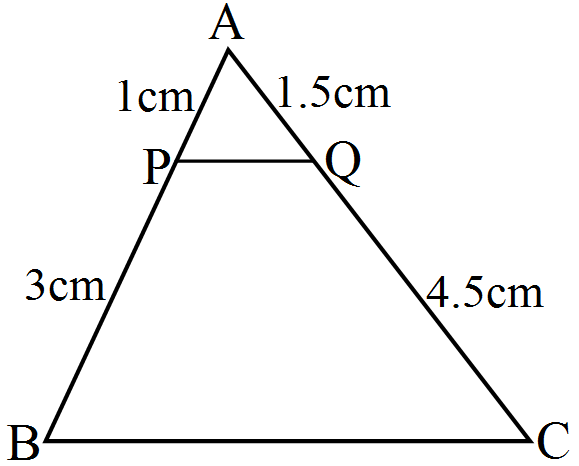
In the given figure, ABC is a triangle and PQ is a straight line meeting AB in P and AC in Q. If AP = 1cm. PB = 3cm, AQ = 1.5cm, QC = 4.5cm, Prove that area of $\triangle\text{APQ}$ is $\frac{1}{16}$ of the area of $\triangle\text{ABC}.$
Answer
We have:
$\frac{\text{AP}}{\text{AB}}=\frac{1}{1+3}=\frac{1}{4}$ and $\frac{\text{AQ}}{\text{AC}}=\frac{1.5}{1.5+4.5}=\frac{1.5}{6}=\frac{1}{4}$
$\Rightarrow\frac{\text{AP}}{\text{AB}}=\frac{\text{AQ}}{\text{AC}}$
Also,
$\angle\text{A}=\angle\text{A}$
By SAS similarity, we can conclude that $\triangle\text{APQ}\sim\triangle\text{ABC}$
$\frac{\text{ar}(\triangle\text{APQ})}{\text{ar}(\triangle\text{ABC})}=\frac{\text{AP}^2}{\text{AB}^2}=\frac{1^2}{4^2}=\frac{1}{16}$
$\Rightarrow\frac{\text{ar}(\triangle\text{APQ})}{\text{ar}(\triangle\text{ABC})}=\frac{1}{16}$
$\Rightarrow\text{ar}(\triangle\text{APQ})=\frac{1}{16}\times\text{ar}(\triangle\text{ABC})$
Hence proved.
View full question & answer
Question 565 Marks
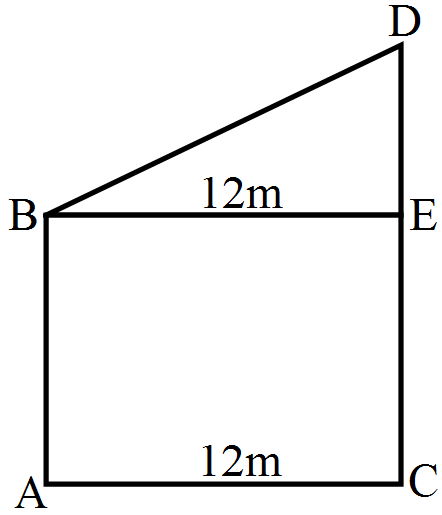
Two vertical poles of height 9m and 14m stand on a plane ground. If the distance between their feet is 12m, find the distance between their tops.
Answer
Let AB and CD be the given vertical poles. Then, AB = 9m, CD = 14m and AC = 12m
Const Draw, BE || AC. Then, CE = AB = 9m and BE = AC = 12m $\therefore\text{ DE} = \text{(CD} -\text{ CE)}$ $= (14 - 9)$ $= 5\text{m}$ In right $\triangle\text{BED},$ we have $\text{BD}^2=\text{BE}^2+\text{DE}^2$ $=\Big[(12)^2+(5)^2\Big]\text{m}^2$ $=(144+25)\text{m}^2$ $=169\text{m}^2$ $\Rightarrow\text{BD}=\sqrt{169}=13\text{m}$ Hence, the distance between their tops is 13m.
View full question & answer
Question 575 Marks
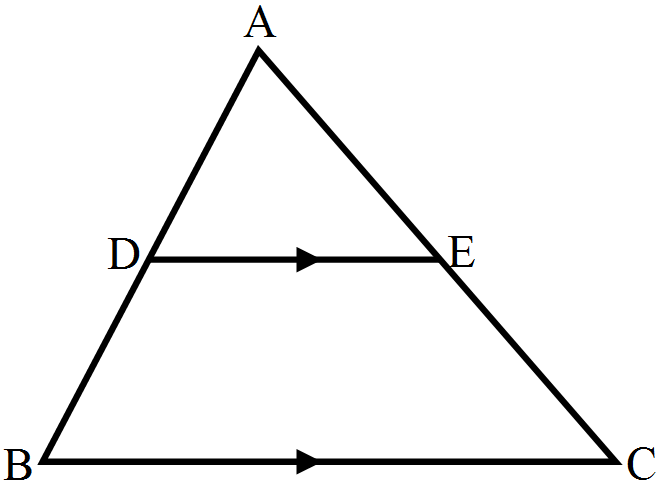
In the given figure, DE || BC and DE : BC = 3 : 5. Calculate the ratio of the areas of $\triangle\text{ADE}$ and the trapezium BCED.
Answer
It is given that DE || BC.
$\therefore\angle\text{ADE}=\angle\text{ABC}$ (Corresponding angles)
$\angle\text{AED}=\angle\text{ACB}$ (Corresponding angles)
Applying AA similarity theorem, we can conclude that $\triangle\text{ADE}\sim\triangle\text{ABC}.$
$\therefore\frac{\text{ar}(\triangle\text{ABC})}{\text{ar}(\triangle\text{ADE})}=\frac{\text{BC}^2}{\text{DE}^2}$
Subtracting 1 from both sides, we get:
$\frac{\text{ar}(\triangle\text{ABC})}{\text{ar}(\triangle\text{ADE})}-1=\frac{5^2}{3^2}-1$
$\Rightarrow\frac{\text{ar}(\triangle\text{ABC})-\text{ar}(\triangle\text{ADE})}{\text{ar}(\triangle\text{ADE})}=\frac{25-9}{9}$
$\Rightarrow\frac{\text{ar}(\triangle\text{BCED})}{\text{ar}(\triangle\text{ADE})}=\frac{16}{9}$
or, $\frac{\text{ar}(\triangle\text{ADE})}{\text{ar}(\triangle\text{BCED})}=\frac{9}{16}$
View full question & answer
Question 585 Marks
For the following statments state whether true (T) or false(F):
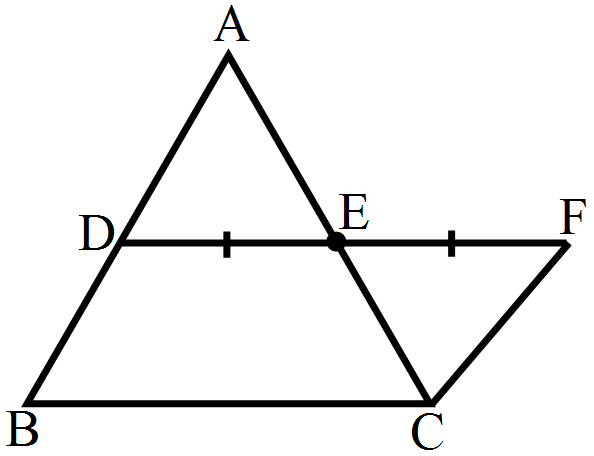
The length of the line segment joining the midpoint of any two sides of a triangle is equal to half the length of the third side.
Answer
True. Solution:
Construction: Produce DE to F that DE = EF. By the Basic proportinality theorem, DE || BC That is, DF || BC ....(i) In $\triangle\text{ADE}$ and $\triangle\text{CEF},$ $\angle\text{AED}=\angle\text{CEF}$ ....(Vertically opposite angles) $\text{DE}=\text{EF}$ ....(Costruction) $\text{AE}=\text{EC}$ ....(E is mid-point of AC) $\Rightarrow\triangle\text{ADE}\cong\triangle\text{CEF}$....(SAS congruence criterion) $\angle\text{ADE}=\angle\text{CFE}$ ....(cpct) $\Rightarrow\text{AD }||\text{ CF}$ that is, $\text{AD }||\text{ CF}\Rightarrow\text{BD }||\text{ CF}\dots(\text{ii})$ So, from (i) and (ii) BDFC is a parallelogram. ⇒ DF = BC So, $\text{DE}=\frac{1}{2}\text{DF}=\frac{1}{2}\text{BC}$
View full question & answer
Question 595 Marks
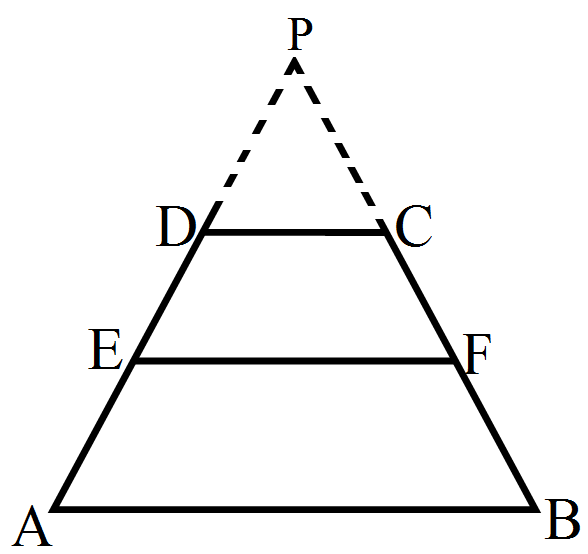
Show that the line segment which joins the midpoint of the oblique sides of a trapezium is parallel to the parallel sides.
Answer
Let the trapezium be ABCD with E and F as the points of AD and BC, respectively. Produce AD and BC to meet at P.
In $\triangle\text{PAB},\text{ DC }|| \text{ AB}.$ Applying Thales' theorem, we get: $\frac{\text{PD}}{\text{DA}}=\frac{\text{PC}}{\text{CB}}$ Now, E and F are the midpoint of AD and BC, respectively. $\Rightarrow\frac{\text{PD}}{2\text{DE}}=\frac{\text{PC}}{2\text{CF}}$ $\Rightarrow\frac{\text{PD}}{\text{DE}}=\frac{\text{PC}}{\text{CF}}$ Applying the converse of Thales' theorem in $\triangle\text{PEF},$ we get that DC || EF. Hence, EF || AB. Thus. EF is parallel to both AB and DC. This completes the proof.
View full question & answer
Question 605 Marks
For the following statments state whether true (T) or false(F):
If two triangles are similar then their corresponding angles are equal and their corresponding sides are equal.
Answer
False.
Solution:
Two triangles are said to be similar to each other if:
  1. Their corresponding angles are equal.
  2. Their corresponding sides are proportional.
View full question & answer
Question 615 Marks
The perimeters of two similar triangles ABC and PQR are 32cm and 24cm respectively. If PQ = 12cm, find AB.
Answer
$\triangle\text{ABC}$ and $\triangle\text{PQR}$ are similar triangles, therefore corresponding sides of both the triangle are proportional.
So, $\frac{\text{Perimeter of }\triangle\text{ABC}}{\text{Perimeter of }\triangle\text{PQR}}=\frac{\text{AB}}{\text{PQ}}$
Let, AB = x cm
Then, $\frac{\text{x}}{12}=\frac{32}{24}$
$\text{x}=\frac{32\times12}{24}=16\text{cm}$
Hence, AB = 16cm
View full question & answer
Question 625 Marks
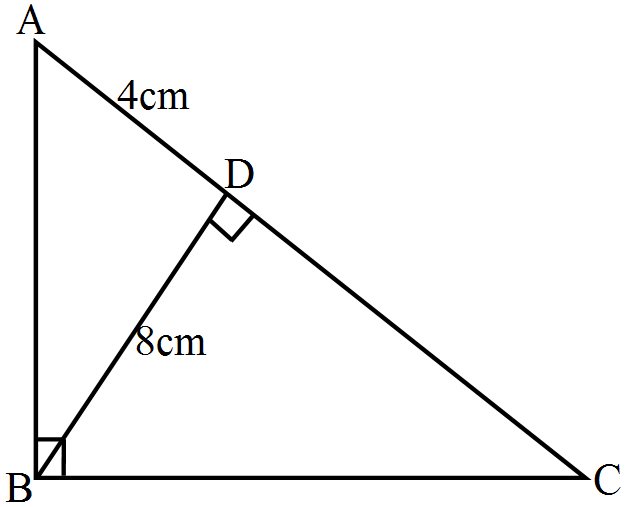
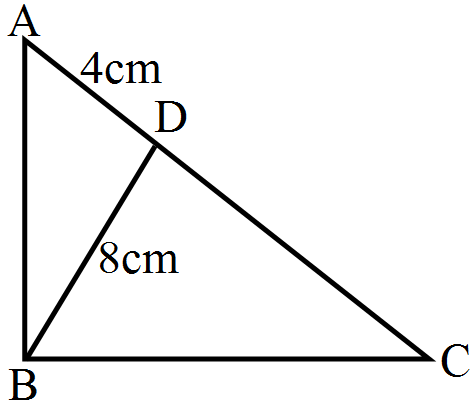
In the given figure, $\angle\text{ABC}=90^\circ$ and $\text{BD}\perp\text{AC}.$ If BD = 8cm, AD = 4cm, find CD.
Answer

Given that BD = 8cm, AD = 4cm
In $\triangle\text{DBA}$ and $\triangle\text{DCB},$ we have
$\angle\text{BDA}=\angle\text{CDB}=90^\circ$
$\angle\text{DBA}=\angle\text{DCB}$ $\big[\text{each}=90^\circ-\angle\text{A}\big]$
$\therefore\triangle\text{DBA}\sim\triangle\text{DCB}$ (by AAA similaritiy)
$\therefore\frac{\text{BD}}{\text{CD}}=\frac{\text{AD}}{\text{BD}}$
$\Rightarrow\text{CD}=\frac{\text{BD}^2}{\text{AD}}$
$\Rightarrow\text{CD}=\frac{(\text{8)}^2}{\text{4}}=\frac{64}{4}=16\text{cm}$
Hence, CD= 16cm
View full question & answer
Question 635 Marks
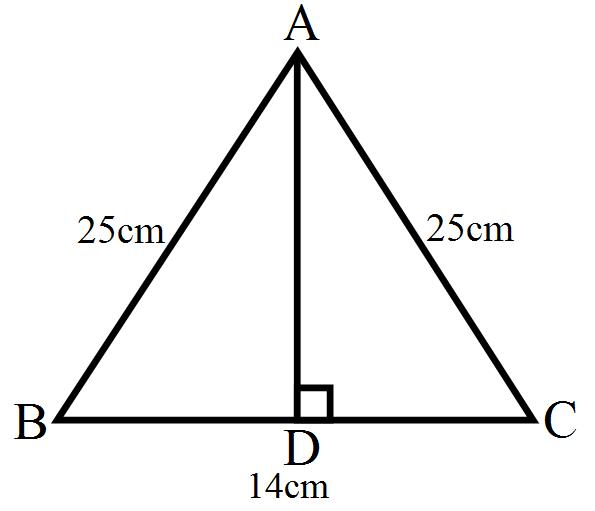
Each of the equal sides of an isosceles triangle is 25cm. Find the length of its altitude if the 14cm.
Answer

Let $\triangle\text{ABC}$ be the isosceles triangle and AD be the altitude.
The height of an isosceles triangles is the same as its median.
So, BD = DC = 7cm
$\triangle\text{ADB}$ is a right.angled triangle.
By Pythagoras theorem,
$AB^2 = AD^2 + BD^2$
$\Rightarrow AD^2 = AB^2- BD^2$
$\Rightarrow AD^2= 25^2 - 7^2$
$\Rightarrow AD^2 = 625 - 49$
$\Rightarrow AD^2 = 576$
$\Rightarrow AD = 24cm$
Hence, the length of the altitude is 24cm.
View full question & answer
Question 645 Marks
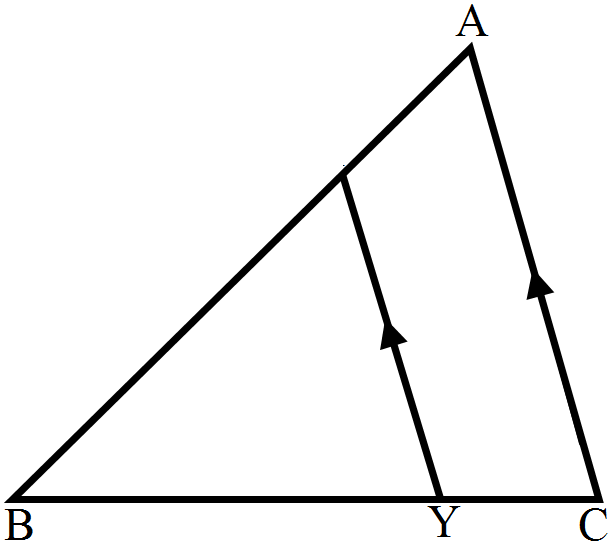
In the given figure, XY || AC and XY divides $\triangle\text{ABC}$ into two regions, equal in area. Show that $\frac{\text{AX}}{\text{AB}}=\frac{(2-\sqrt{2})}{2}.$
Answer
In $\triangle\text{ABC}$ and $\triangle\text{BXY},$ we have:
$\angle\text{B}=\angle\text{B}$
$\angle\text{BXY}=\angle\text{BAC}$ (Corresponding angles)
Thus, $\triangle\text{ABC}\sim\triangle\text{BXY}$ (AA criterion)
$\therefore\frac{\text{ar}(\triangle\text{ABC})}{\text{ar}(\triangle\text{BXY})}=\frac{\text{AB}^2}{\text{BX}^2}=\frac{\text{AB}^2}{\text{(AB}-\text{AX})^2}\dots(\text{i})$
Also, $\frac{\text{ar}(\triangle\text{ABC})}{\text{ar}(\triangle\text{BXY})}=\frac{2}{1}$ $\{\therefore(\triangle\text{BXY})=\text{ar}(\text{trapezium AXYC})\}\dots(\text{ii})$
From (i) and (ii), we have:
$\Rightarrow\frac{\text{AB}^2}{(\text{AB}-\text{AX})^2}=\sqrt{2}$
$\Rightarrow\frac{(\text{AB}-\text{AX})}{\text{AB}}=\frac{1}{\sqrt{2}}$
$\Rightarrow1-\frac{\text{AX}}{\text{AB}}=\frac{1}{\sqrt{2}}$
$\Rightarrow\frac{\text{AX}}{\text{AB}}=1-\frac{1}{\sqrt{2}}$
$=\frac{\sqrt{2}-1}{\sqrt{2}}=\frac{(2-\sqrt{2})}{\sqrt{2}}$
View full question & answer
Question 655 Marks
The sides of certain triangles are given below. Determine them are right triangles:
$(\text{a} - 1)\text{cm},2\sqrt{\text{a}}\text{ cm},(\text{a} + 1)\text{cm}.$
Answer
For a given triangle to be a right angled, the sum of the squares of the two sides must be equal to the square of the largest side.
Let $\text{p}=(\text{a} - 1)\text{cm},\text{q}=2\sqrt{\text{a}}\text{ cm}$ and $\text{r}=(\text{a}+1)\text{cm}^2$
$\text{p}^2+\text{q}^2=\Big[(\text{a}-1)^2+\big(2\sqrt{\text{a}}\big)^2\Big]\text{cm}^2$
$=\big(\text{a}^2+1-2\text{a}+4\text{a}\big)\text{cm}^2$
$=\big(\text{a}^2+1+2\text{a}\big)\text{cm}^2=(\text{a}+1)^2\text{cm}^2$
$\text{r}^2=(\text{a}+1)^2\text{cm}^2$
$\therefore\text{p}^2+\text{q}^2=\text{r}^2$
Hence, the given triangle is a right triangle.
View full question & answer
Question 665 Marks
If $\triangle\text{ABC}\sim\triangle\text{DEF}$ such that 2AB = DE and BC = 6cm, find EF.
Answer
$\therefore\triangle\text{ABC}\sim\triangle\text{DEF}$
$\therefore\frac{\text{AB}}{\text{DE}}=\frac{\text{BC}}{\text{EF}}$
$\Rightarrow\frac{1}{2}=\frac{6}{\text{EF}}$
$\Rightarrow\text{EF}=12\text{cm}$
View full question & answer
Question 675 Marks
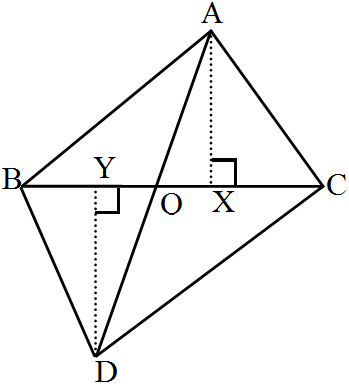
In the given figure, $\triangle\text{ABC}$ and $\triangle\text{DBC}$ have the same base BC. If AD and BC intersect at O, prove that $\frac{\text{ar}(\triangle\text{ABC})}{\text{ar}(\triangle\text{DBC})}=\frac{\text{AO}}{\text{DO}}.$
Answer

Construction: Draw $\text{AX}\perp\text{CO}$ and $\text{DY}\perp\text{BO}.$
As,
$\frac{\text{ar}(\triangle\text{ABC})}{\text{ar}(\triangle\text{DBC})}=\frac{\frac{1}{2}\times\text{AX}\times\text{BC}}{\frac{1}{2}\times\text{DY}\times\text{BC}}$
$\Rightarrow\frac{\text{ar}(\triangle\text{ABC})}{\text{ar}(\triangle\text{DBC})}=\frac{\text{AX}}{\text{DY}}\dots(\text{i})$
In $\triangle\text{ABC}$ and $\triangle\text{DBC},\angle\text{AXY}=\angle\text{DYO}=90^\circ(\text{By construction})$
$\angle\text{AOX}=\angle\text{DOY}(\text{Vertically opposite angles})$$\therefore\triangle\text{AXY}\sim\triangle\text{DYO }(\text{By AA criterion})$
This completes the proof.
View full question & answer
Question 685 Marks
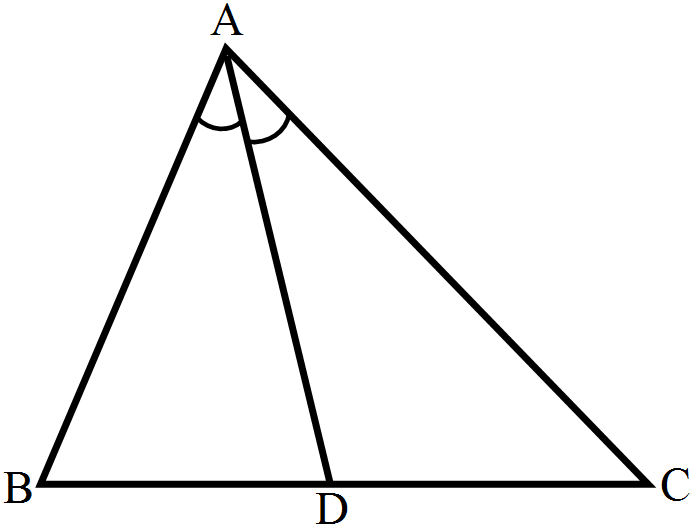
In a $\triangle\text{ABC},\text{AD}$ is the bisector of $\angle\text{A}.$
If AB = 10cm, AC = 14cm and BC = 6cm, find BD and DC.
Answer
It is given that AD bisects $\angle\text{A}.$
Applying angle-bisector theorem in $\triangle\text{ABC},$ we get:
$\frac{\text{BD}}{\text{DC}}=\frac{\text{AB}}{\text{AC}}$
Let BD be x cm.
Therefore, DC = (6 - x)cm
$\Rightarrow\frac{\text{x}}{6-\text{x}}=\frac{10}{14}$
$\Rightarrow14\text{x}=60-10\text{x}$
$\Rightarrow24\text{x}=60$
$\Rightarrow\text{x}=2.5\text{cm}$
Thus, BD = 2.5cm
DC = 6 - 2.5 = 3.5cm
View full question & answer
Question 695 Marks
In the adjoining figure, ABC is a triangle in which AB = AC. If D and E are points on AB and AC respectively such that AD = AE, show that the points B, C, E and D are concyclic.
Answer
Given:
AD = AE ...(i)
AB = AC ...(ii)
Subtracting AD from both sides, we get:
⇒ AB - AD = AC - AD
⇒ AB - AD = AC - AE (Since, AD = AE)
⇒ BD = EC ...(iii)
Dividing equation (i) by equation (iii), we get:
$\frac{\text{AD}}{\text{DB}}=\frac{\text{AE}}{\text{EC}}$
Dividing the converse pf Thales' theorem, DE || BC
$\Rightarrow\angle\text{DEC}+\angle\text{ECB}=180^\circ$ (Sum of interior angles on the same side of a transversal line is 180º)
$\Rightarrow\angle\text{DEC}+\angle\text{CBD}=180^\circ$ $($Since, AB = AC ⇒ $\angle\text{B}=\angle\text{C})$
Hence, quadrilateral BDED is cyclic.
Therefore, B, C, E and D are concyclic points.
View full question & answer
Question 705 Marks
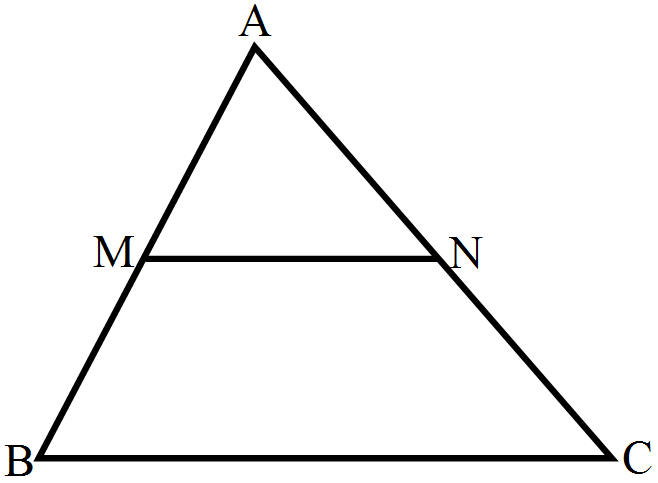
In the given figure, MN || BC and AM : MB = 1 : 2
Find $\frac{\text{area}(\triangle\text{AMN})}{\text{area}(\triangle\text{ABC})}.$
Answer
In $\triangle\text{ABC}$ and $\triangle\text{AMN},$
So, $\angle\text{M}=\angle\text{B}$ and $\angle\text{N}=\angle\text{C}$ ....(corresponding angles)
$\Rightarrow\triangle\text{ABC}\sim\triangle\text{AMN}$ ....(AA criterion for similarity)
$\Rightarrow\frac{\text{area}(\triangle\text{AMN})}{\text{area}(\triangle\text{ABC})}=\frac{\text{AM}^2}{\text{AB}^2}$
Now, $\frac{\text{AM}}{\text{MB}}=\frac{1}{2}$
$\Rightarrow\frac{\text{MB}}{\text{AM}}=2$
By Componendo,
$\Rightarrow\frac{\text{MB}+\text{AM}}{\text{AM}}=2+1$
$\Rightarrow\frac{\text{AB}}{\text{AM}}=3$
$\Rightarrow\frac{\text{AM}}{\text{AB}}=\frac{1}{3}$
So, $\Rightarrow\frac{\text{area}(\triangle\text{AMN})}{\text{area}(\triangle\text{ABC})}=\bigg(\frac{\text{AM}^2}{\text{AB}^2}\bigg)^2=\bigg(\frac{1}{3}\bigg)=\frac{1}{9}.$
View full question & answer
Question 715 Marks
Find the length of each side of a rhombus whose diagonals are 24cm and 10cm long.
Answer

In an rhombus, the diagonals are perpendicular bisectors of each other, and side are equal to eachother.
So, $\text{AO}=\frac{1}{2}\text{AC}=12\text{cm}$
$\text{OD}=\frac{1}{2}\text{BD}=5\text{cm}$
In right-angled $\triangle\text{AOD},$
$\text{AD}^2=\text{AO}^2+\text{OD}^2$
$\Rightarrow\text{AD}^2=\text{12}^2+\text{5}^2$
$\Rightarrow\text{AD}^2=\text{144}+\text{25}$
$\Rightarrow\text{AD}^2=\text{169}$
$\Rightarrow\text{AD}=\text{13}\text{cm}$
So, the length of the each side of the rhombus is 13cm.
View full question & answer
Question 725 Marks
State the SSS-criterion for similarity of trianglrs.
Answer
If the corresponding sides of two triangles are proportional then their corresponding angles are equal, and hence the two triangles are similar.
View full question & answer
Question 735 Marks
If $\triangle\text{ABC}\sim\triangle\text{DEF}$ such that 2AB = DE and BC = 6cm, find EF.
Answer
Given $\triangle\text{ABC}\sim\triangle\text{DEF}$ and 2AB = DE and BC = 6cm
$\Rightarrow\frac{\text{AB}}{\text{DE}}=\frac{\text{BC}}{\text{EF}}$
$\Rightarrow\frac{1}{2}=\frac{6}{\text{EF}}$
$\Rightarrow\text{EF}=3\text{cm}$
View full question & answer
Question 745 Marks
For the following statments state whether true (T) or false(F):
In a $\triangle\text{ABC},\text{AB}=6\text{cm},\angle\text{A}=45^\circ$ and $\text{AC}=8\text{cm}$ and in a $\triangle\text{DEF},\text{DF}=9\text{cm},\angle\text{D}=45^\circ$and $\text{DE}=12\text{cm},$ then $\triangle\text{ABC}\sim\triangle\text{DEF}.$
Answer
False.
Solution:
Given that,
$\angle\text{A}=45^\circ,\text{AB}=6\text{cm}$ and $\text{AC}=8\text{cm}$
$\angle\text{D}=45^\circ,\text{DF}=9\text{cm}$ and $\text{DE}=12\text{cm}$
Consider, $\triangle\text{ABC}$ and $\triangle\text{DFE},$
$\angle\text{A}=\angle\text{D}=45^\circ$
$\frac{\text{AB}}{\text{DE}}=\frac{6}{12}=\frac{1}{2}$
$\frac{\text{AC}}{\text{DF}}=\frac{8}{9}$
$\Rightarrow\frac{\text{AB}}{\text{DF}}\not=\frac{\text{AC}}{\text{DF}}$
Thus, the triangles are not similar.
View full question & answer
Question 755 Marks
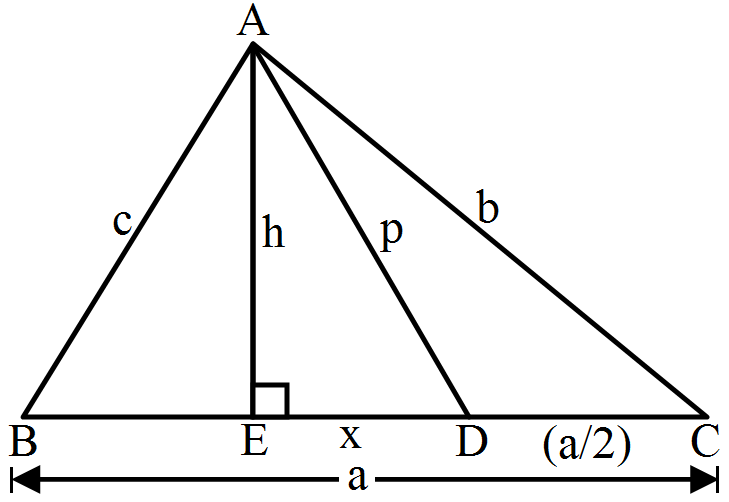
In the given figure, D is the midpoint of side BC and $\text{AE}\perp\text{BC}.$ If BC = a, AC = b, AB = c, ED = x, AD = p and AE = h, prove that.

$\text{b}^2=\text{p}^2+\text{ax}+\frac{\text{a}^2}{4}$
Answer
Given: D is the midpoint of side $\text{BC},\text{AE}\perp\text{BC},\text{BC}=\text{a},\text{AC}=\text{b},\text{AB}=\text{c},\text{ED}=\text{x},\text{AD}=\text{p}$ and $\text{AE}=\text{h}$
In $\triangle\text{AEC},\angle\text{AEC}=90^\circ$
$\text{AD}^2=\text{AE}^2+\text{ED}^2$ (by pythagoras theorem)
$\Rightarrow\text{p}^2=\text{h}^2+\text{x}^2$
In $\triangle\text{AEC},\angle\text{AEC}=90^\circ$
$\text{AC}^2=\text{AE}^2+\text{EC}^2$ (by pythagoras theorem)
$\text{b}^2=\text{h}^2+\Big(\text{x}+\frac{\text{a}}{\text{2}}\Big)^2=\big(\text{h}^2+\text{x}^2\big)+\text{ax}+\frac{\text{a}^2}{4}$
$\therefore\text{b}^2=\text{p}^2+\text{ax}+\frac{\text{a}^2}{4}\dots(1)$
View full question & answer
Question 765 Marks
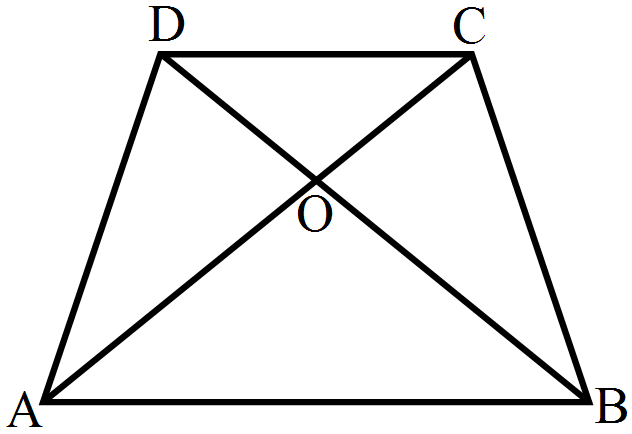
In a trapezium ABCD, it is given that AB || CD and AB = 2CD. Its diagonals AC and BD intersect at the point O such that $\text{ar}(\triangle\text{AOB})=84\text{cm}^2.$ Find $\text{ar}(\triangle\text{COD}).$
Answer

The diagonals of a trapezium divide each other proportionally.
$\angle\text{CDO}=\angle\text{OBA}$ ...(alternate angles)
$\angle\text{COD}=\angle\text{AOB}$ ...(vertically opposite angles)
$\Rightarrow\triangle\text{COD}=\triangle\text{AOB}$ ...(AA criterion for similarity)
$\Rightarrow\frac{\text{ar}(\triangle\text{COD})}{\text{ar}(\triangle\text{AOB})}=\frac{\text{CD}^2}{\text{AB}^2}$
$\Rightarrow\frac{\text{ar}(\triangle\text{COD})}{84}=\frac{1^2}{2^2}$
$\Rightarrow\text{ar}(\triangle\text{COD})=21\text{cm}^2$
View full question & answer
5 Marks Questions - Page 2 - Maths STD 10 Questions - Vidyadip