Question 12 Marks
Why are carbon and its compounds used as fuels for most applications?
Answer
View full question & answer→Carbon and its compounds are used as fuels because they burn in air releasing a lot of heat energy.
50 questions · timed · auto-graded
When soap is used for washing clothes with hard water, a large amount of soap in water reacts with the calcium and magnesium ions of hard water to form an insoluble precipitate called scum. This makes the cleaning of clothes difficult.
$\text{Fat or oil} + \text{NaOH} \xrightarrow{\text{heat}} \text{Soap} + \text{Glycerol}.$
The process of making soap by the hydrolysis of fats and oils with alkalis is called Saponification.Raw Materials required for preparation of soap in Laboratory:
Vegetable oil, Sodium Hydroxide, Common salt, Beaker, Bunsen burner. TEST: soaps are mostly basic in nature and we can do litmus test red litmus will turn to blue.$\text{C}_2\text{H}_5\text{OH}+\text{H}_2\text{SO}_4\xrightarrow{\Delta}\text{CH}_2=\text{CH}_2+\text{H}_2\text{O}+\text{H}_2\text{SO}_4$
Charcoal is considered a better fuel than wood because:
CH3COOH(aq) + NaHCO3(s) + CH3COONa(aq) + H2O(i) + CO2(g)
One H atom of C2H6 is replaced by a CHO group.
Graphite:
Soaps | Sodium metal | ||
1. | Soap are made from fat and alkali by specification method. | 1. | Detergents are carbonic compounds which are not alkaline. |
2. | There are cheap. | 2. | They are costly. |
3. | There are not suitable for delicate clothes. | 3. | They are suitable for delicate clothes. |
4. | They are clean better in hot water. | 4. | They clean both in hot and cold water. |
5. | They don’t produce lather with hard water and are not able to clean the cloth. | 5. | They clean the cloth even in hard water. |
C20H2×20 + 2 = C20 H42
C20H20×2 = C20H40
C20H2×20-2 = C20H38
$\text{CH}_3\text{COCH}_2\text{CH}_3$
$\text{CH}_3-\text{CH}-\text{CH}_3\\ \ \ \ \ \ \ \ \ \ \ |\\ \ \ \ \ \ \ \ \ \text{OH}$
$\text{HCOOH}$
$\text{CH}_3\text{COOCH}_3$
Two nitrogen atoms will each share three electrons to form three covalent bonds and make a nitrogen molecule (N2).
This is a picture of a nitrogen molecule.
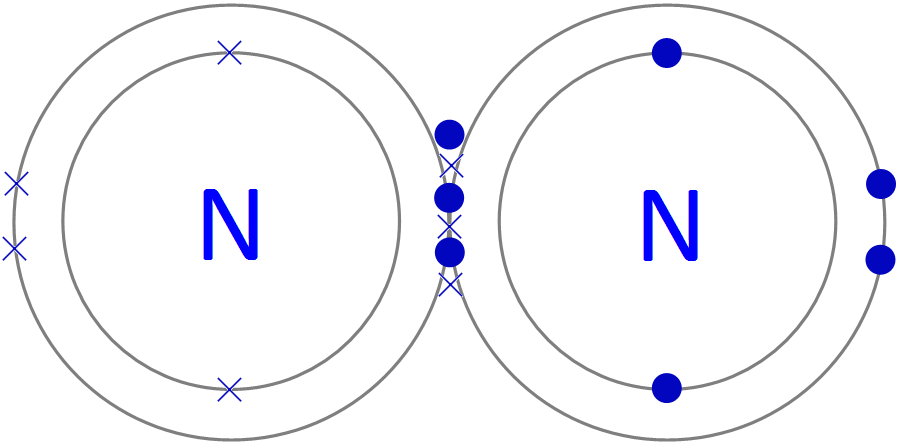
By sharing the six electrons where the shells touch each nitrogen atom can count 8 electrons in its outer shell.
These full outer shells with their shared electrons are now stable.
The N2 molecule will not react further with other nitrogen atoms.
$\text{CH}_3\text{CH}_2\text{OH}+2[\text{O}]\xrightarrow[]{\ \ \ \ \ \ \ \ \ \ }\text{CH}_3\text{COOH}+\text{H}_2\text{O}\\\text{Ethanol}\ \ \ \ \ \ \ \ \ \ \ \text{Nascent}\ \ \ \ \ \text{Ethanoic acid}\ \ \text{Water}\\\ \ \ \ \ \ \ \ \ \ \ \ \ \ \ \ \ \ \ \ \ \ \ \ \ \text{Oxygen}$