Questions · Page 2 of 5

M.C.Q

MCQ 511 Mark
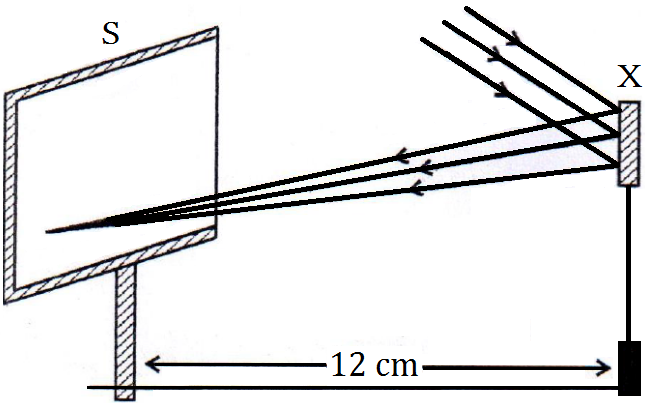
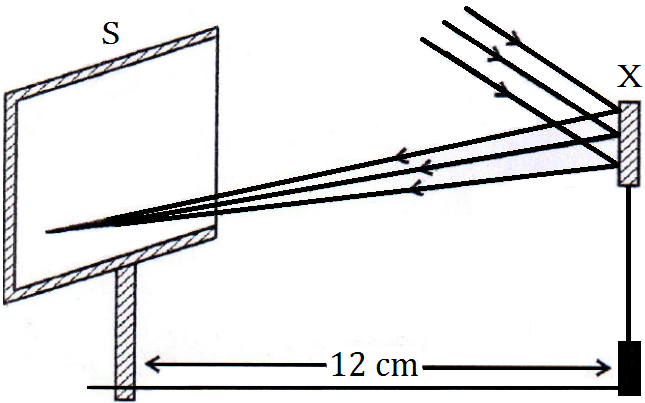
Study the following diagram and select the correct statement about the device $'X\ ' :$
  • A
    Device $'X\ '$ is a concave mirror of radius of curvature $12\ cm.$
  • B
    Device $'X\ '$ is a concave mirror of focal length $6\ cm.$
  • Device $'X\ '$ is a concave mirror of focal length $12\ cm.$
  • D
    Device $'X\ ' $is a convex mirror of focal length $12\ cm.$
Answer
Correct option: C.
Device $'X\ '$ is a concave mirror of focal length $12\ cm.$
From the figure, we can see that the light rays coming from infinity get reflected by the device $'X\ '$ and converge at a point at a distance $12\ cm$ from it. Therefore, the device $'X\ '$ is a concave mirror of focal length $12\ cm.$
View full question & answer
MCQ 521 Mark
A student has obtained an image of a distant object on a screen to determine the focal length $\mathrm{F}_1$ of the given lens. His teacher after checking the image, gave him another lens of focal length $\mathrm{F}_2$ and asked to focus the same object on the same screen. The student found that to obtain a sharp image he has to move the lens away from the screen. From this finding we may conclude that both the lenses given to the student were :
  • A
    Concave and $\text{F}_{1}<\text{F}_{2}$
  • B
    Convex and $\text{F}_{1}<\text{F}_{2}$
  • Convex and $\text{F}_{1}>\text{F}_{2}$
  • D
    Concave and $\text{F}_{1}>\text{F}_{2}$
Answer
Correct option: C.
Convex and $\text{F}_{1}>\text{F}_{2}$
The lens is convex, as it forms real image. As mentioned in the second case, the image distance $(v)$ is increasing; hence, the object distance $(u)$ is decreasing. The lens formula is $1 / F=1 / v-1 / u \Rightarrow F=u v / u-v$ For convex lens, object distance $=-\mathrm{u}$ Image distance $={ }^{+} \mathrm{v} \Rightarrow \mathrm{F}=\mathrm{uv/} \mathrm{u}+\mathrm{v}$ where $F$ is the focal length of the lens. Therefore, $F$ is lesser for the second lens of focal length $F_2$. Hence, $F_1>F_2$.
Hence, the correct option is $C$.
View full question & answer
MCQ 531 Mark
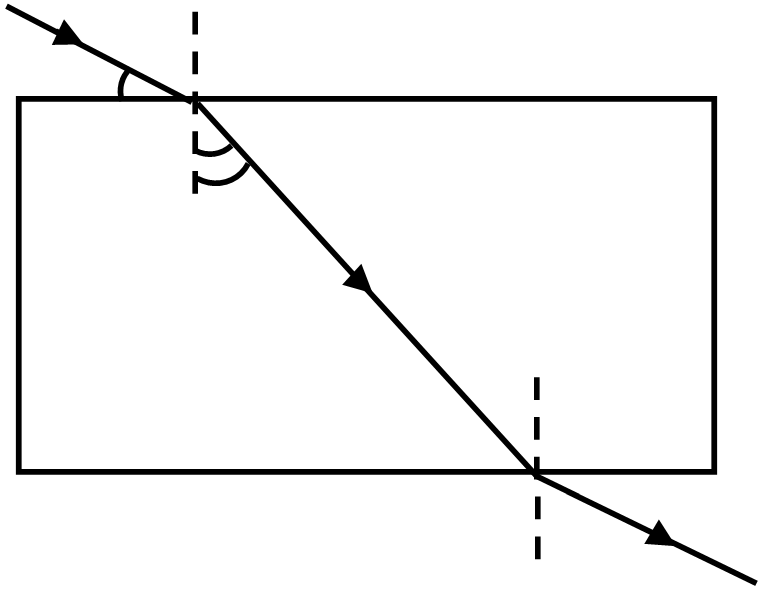
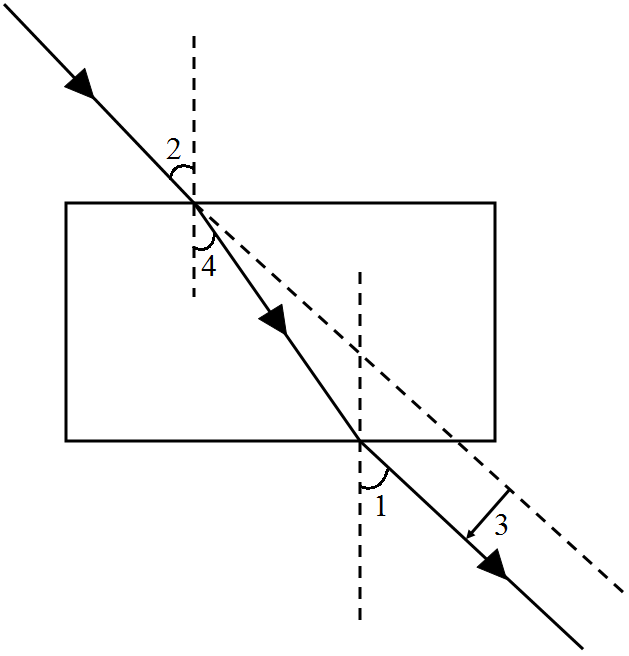
The correct sequencing of angle of incidence, angle of emergence, angle of refraction and lateral displacement shown in the following diagram by digits $\{1, 2, 3\}$ and $4$ is :
  • A
    $\{2, 4, 1, 3\}$
  • $\{2, 1, 4, 3\}$
  • C
    $\{1, 2, 4, 3\}$
  • D
    $\{2, 1, 3, 4\}$
Answer
Correct option: B.
$\{2, 1, 4, 3\}$
Angle $2$ is angle of incidence. As, it is formed between the incident ray and the normal.
Angle $1$ is angle of emergence. As, it is formed between the emergent ray with normal.
Angle $4$ is angle of refraction. As, it is formed between the refracted ray and the normal.
$3$ shows the lateral displacement.
Hence, the correct answer is $\{2, 1, 4, 3\}$
View full question & answer
MCQ 541 Mark
To determine the approximate focal length of the given convex lens by focussing a distant object $($say, a sign board$),$ you try to focus the image of the object on a screen. The image you obtain on the screen is always :
  • A
    Erect and laterally inverted.
  • B
    Erect and diminished.
  • Inverted and diminished.
  • D
    Virtual, inverted and diminished.
Answer
Correct option: C.
Inverted and diminished.
When the object is at infinity, then the image is formed at the focus of the concave mirror. The image formed in this case is always inverted and diminished i.e. smaller in size as that of the object.
View full question & answer
MCQ 551 Mark
Study the following diagram and select the correct statement about the device 'X':
  • A
    Device 'X' is a concave mirror of radius of curvature 12 cm.
  • B
    Device 'X' is a concave mirror of focal length 6 cm.
  • Device 'X' is a concave mirror of focal length 12 cm.
  • D
    Device 'X' is a convex mirror of focal length 12 cm.
Answer
Correct option: C.
Device 'X' is a concave mirror of focal length 12 cm.
C. Device 'X' is a concave mirror of focal length 12 cm.
View full question & answer
MCQ 561 Mark
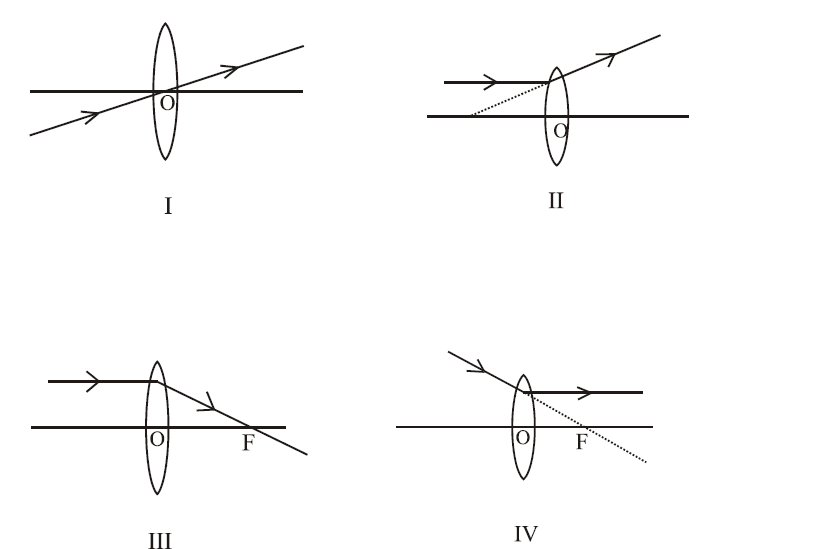
A student has obtained a magnified image of a flame on a screen using a convex lens. To draw the corresponding ray diagram, to show the image formation, which of the following two rays whose paths after refraction are shown he should select?
  • A
    $\ce{I}$ and $\ce{II}$
  • B
    $\ce{II}$ and $\ce{III}$
  • C
    $\ce{III}$ and $\ce{IV}$
  • $\ce{I}$ and $\ce{III}$
Answer
Correct option: D.
$\ce{I}$ and $\ce{III}$
Convex lens is a converging lens. Therefore, rays $\ce{I}$ and $\ce{III}$ represent the path of the refracting ray from a convex lens $($converging lens$)$. Figure $\ce{II}$ and $\ce{IV}$ show the refracting ray being diverged. So, the ray diagrams are incorrect.
View full question & answer
MCQ 571 Mark
A student has obtained the image of a distant object with a concave mirror to determine its focal length. If he has selected a well illuminated red building as object, which of the following correctly describes the features of the image formed?
  • A
    Virtual, inverted, diminished image in red shade.
  • B
    Real, erect, diminished image in pink shade.
  • Real, inverted, diminished image in red shade.
  • D
    Virtual, erect, enlarged image in red shade.
Answer
Correct option: C.
Real, inverted, diminished image in red shade.
To measure the focal length of the mirror, the object should be taken at infinity.
Therefore, the image formed by the concave mirror would be real, inverted, diminished and red in shade.
Hence, the correct option is $C.$
View full question & answer
MCQ 581 Mark
On the basis of their experiment, "To trace the path of a ray of light through a rectangular glass slab," students of a class arrived at which one of the following conclusions :
  • A
    Angle of incidence is greater than the angle of emergence.
  • B
    Angle of emergence is smaller than the angle of refraction.
  • C
    Emergent ray is parallel to the refracted ray.
  • Incident ray and emergent ray are parallel to each other.
Answer
Correct option: D.
Incident ray and emergent ray are parallel to each other.
View full question & answer
MCQ 591 Mark
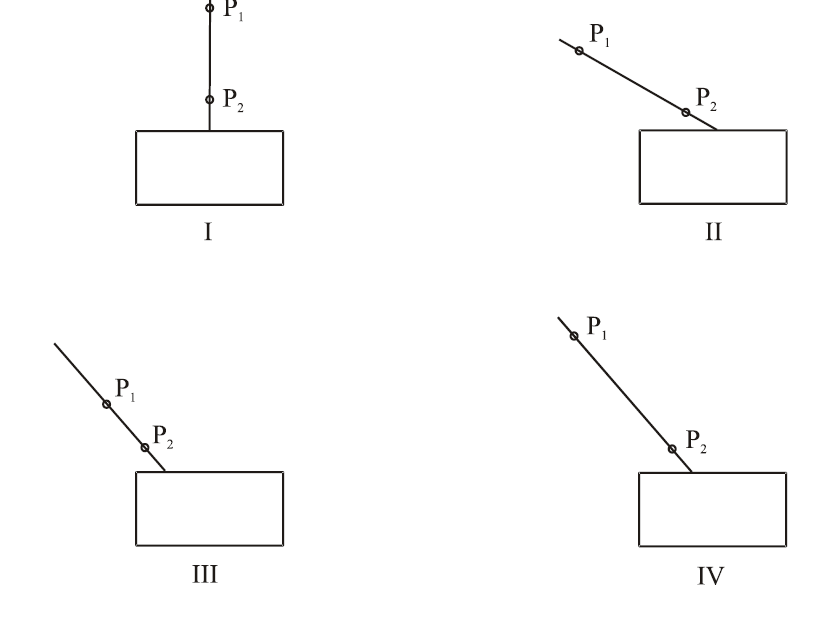
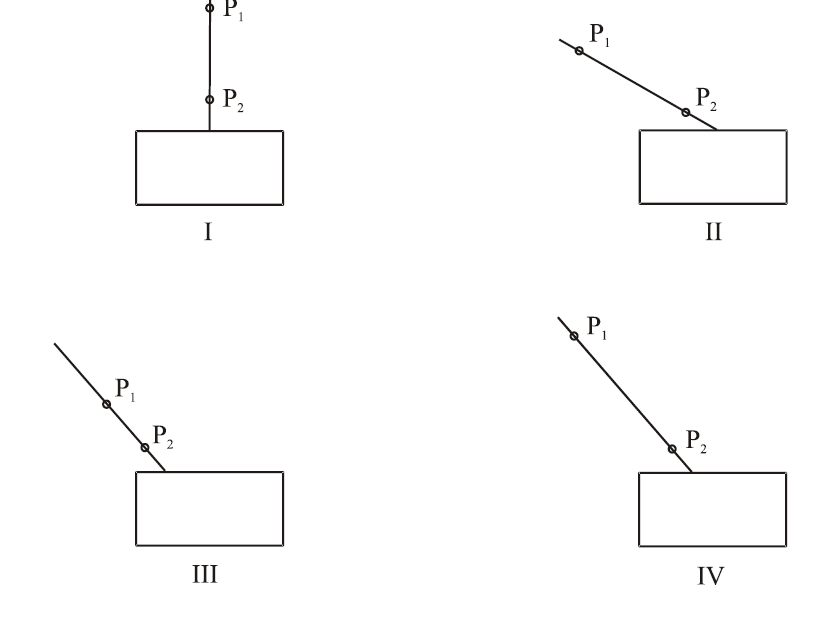
Study the following four experimental set $-$ ups $\ce{I, II, III}$ and $\ce{IV}$ for the experiment, " To trace the path of a ray of light through a Rectangular glass slab.”

Which of the marked set $-$ ups is likely to give best results $(P_1$ and $P_2$ are the positions of pins fixed on the incident ray$)\ ?$
  • A
    $\ce{I}$
  • $\ce{II}$
  • C
    $\ce{III}$
  • D
    $\ce{IV}$
Answer
Correct option: B.
$\ce{II}$
Experiment $\ce{II}$ will give the best result because it has the largest angle of incidence, due to which the lateral displacement between the incident ray and emergent ray will be maximum.
View full question & answer
MCQ 601 Mark
A student was asked by his teacher to find the image distance for various object distances in case of a given convex lens. He performed the experiment with all precautions and noted down his observations in the following table :
S. No.
Object distance $(cm)$
Image distance $(cm)$
$1$ $60$ $15$
$2$ $48$ $16$
$3$ $36$ $21$
$4$ $24$ $24$
$5$ $18$ $36$
$6$ $16$ $48$
After checking the observation table the teacher pointed out that there is mistake in recording the image distance in one of the observation. Find the serial number of the observation having faulty image distance:
  • A
    $2$
  • $3$
  • C
    $5$
  • D
    $6$
Answer
Correct option: B.
$3$
In observation No. $3$ the focal length comes out to be $13.26\ cm$ whereas, the focal length for all other observation is $12\ cm.$
View full question & answer
MCQ 611 Mark
Three students $A, B$ and $C$ focussed a distant building on a screen with the help of a concave mirror. To determine focal length of the concave mirror they measured the distances as given below:
Student $A$ : From mirror to the screen.
Student $B$ : From building to the screen.
Student $C$ : From building to the mirror.
Who measured the focal length correctly:
  • Only $A$
  • B
    Only $B$
  • C
    $A$ and $B$
  • D
    $B$ and $C$
Answer
Correct option: A.
Only $A$
A concave mirror always forms the image of a distant object at its focus. In the given case the distance between the mirror and the screen is equal to the focal length of the mirror. Thus, the student $A$ measures the focal length correctly.
View full question & answer
MCQ 621 Mark
A student obtained a sharp image of a candle flame placed at the distant end of the laboratory table on a screen using a concave mirror to determine its focal length. The teacher suggested him to focus a distant building about $1 \ km$ far from the laboratory, for getting more correct value of the focal length. In order to focus the distant building on the same screen the student should slightly move the :
  • A
    Mirror away from the screen.
  • B
    Screen away from the mirror.
  • Screen towards the mirror.
  • D
    Screen towards the building.
Answer
Correct option: C.
Screen towards the mirror.
The object, i.e., the distant building is at a distance of $1\ km$ from the laboratory. That is, for the concave mirror, the building $($object$)$ is at infinity. In order to obtain a sharp image of the building, the student must slightly move the screen towards the mirror.
View full question & answer
MCQ 631 Mark
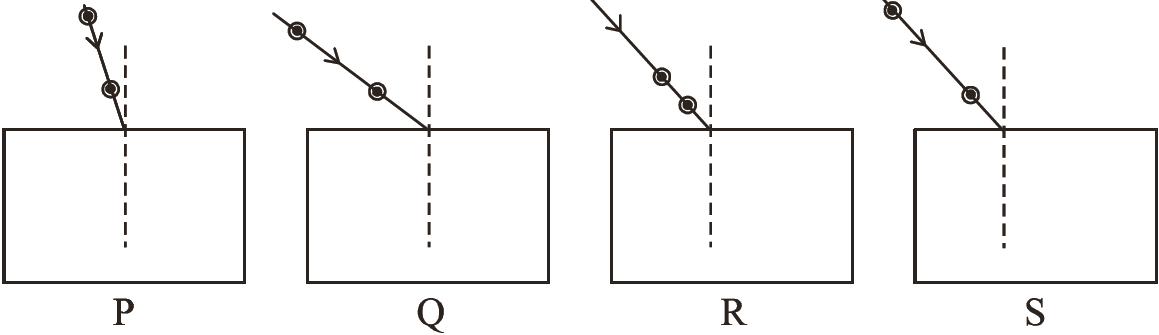
Select from the following the best experimental set-up for tracing the path of a ray of light passing through a rectangular glass slab:
  • A
    P.
  • B
    Q.
  • C
    R.
  • S.
Answer
Correct option: D.
S.
d. S.
View full question & answer
MCQ 641 Mark
A student has obtained a point image of a distant object using the given convex lens. To find the focal length of the lens he should measure the distance between the:
  • A
    Lens and the object only.
  • Lens and the screen only.
  • C
    Object and the image only.
  • D
    Lens and the object and also between the object and the image.
Answer
Correct option: B.
Lens and the screen only.
B. Lens and the screen only.
View full question & answer
MCQ 651 Mark
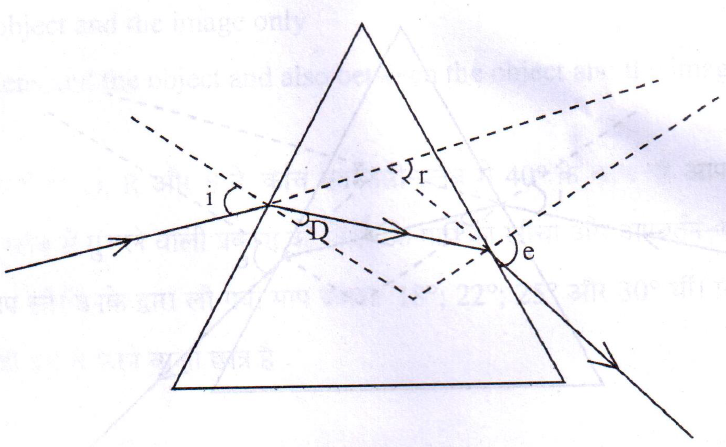
After tracing the path of a ray of light through a glass prism a student marked the angle of incidence ($\angle\text{i}$), angle of refraction ($\angle\text{r}$), angle of emergence ($\angle\text{e}$) and the angle of deviation ($\angle\text{D}$) as shown in the diagram. The correctly marked angles are:
  • A
    $\angle\text{i}$ and $\angle\text{r}.$
  • $\angle\text{i} $ and $\angle\text{e}.$
  • C
    $\angle\text{i} $, $\angle\text{e} $ and $\angle\text{D}.$
  • D
    $\angle\text{i}$, $\angle\text{r}$ and $\angle\text{e}.$
Answer
Correct option: B.
$\angle\text{i} $ and $\angle\text{e}.$
B. $\angle\text{i} $ and $\angle\text{e}.$
View full question & answer
MCQ 661 Mark
A student has obtained an image of a distant object on a screen to determine the focal length $F_1$ of the given lens. His teacher after checking the image, gave him another lens of focal length $F_2$ and asked to focus the same object on the same screen. The student found that to obtain a sharp image he has to move the lens away from the screen. From this finding we may conclude that both the lenses given to the student were :
  • A
    Concave and $\text{F}_{1} < \text{F}_{2}$
  • B
    Convex and $\text{F}_{1} < \text{F}_{2}$
  • Convex and $\text{F}_{1} > \text{F}_{2}$
  • D
    Concave and $\text{F}_{1} > \text{F}_{2}$
Answer
Correct option: C.
Convex and $\text{F}_{1} > \text{F}_{2}$
The lens is convex, as it forms real image. As mentioned in the second case, the image distance $(v)$ is increasing; hence, the object distance $(u)$ is decreasing. The lens formula is $1 / F=1 / v-1 / u \Rightarrow F=u v / u-v$ For convex lens, object distance $=-u$ Image distance $={+} v \Rightarrow F=u v / u+v$ where $F$ is the focal length of the lens. Therefore, $F$ is lesser for the second lens of focal length $F_2$. Hence, $F_1 > F_2$ Hence, the correct option is $C.$
View full question & answer
MCQ 671 Mark
Study the following four experimental set $-$ ups $\ce{I, II, III}$ and $\ce{IV}$ for the experiment, " To trace the path of a ray of light through a Rectangular glass slab.”

Which of the marked set-ups is likely to give best results $(P_1$ and $P_2$ are the positions of pins fixed on the incident ray$)\ ?$
  • A
    $\ce{I}$
  • $\ce{II}$
  • C
    $\ce{III}$
  • D
    $\ce{IV}$
Answer
Correct option: B.
$\ce{II}$
Experiment $\ce{II} :$ will give the best result because it has the largest angle of incidence, due to which the lateral displacement between the incident ray and emergent ray will be maximum.
View full question & answer
MCQ 681 Mark
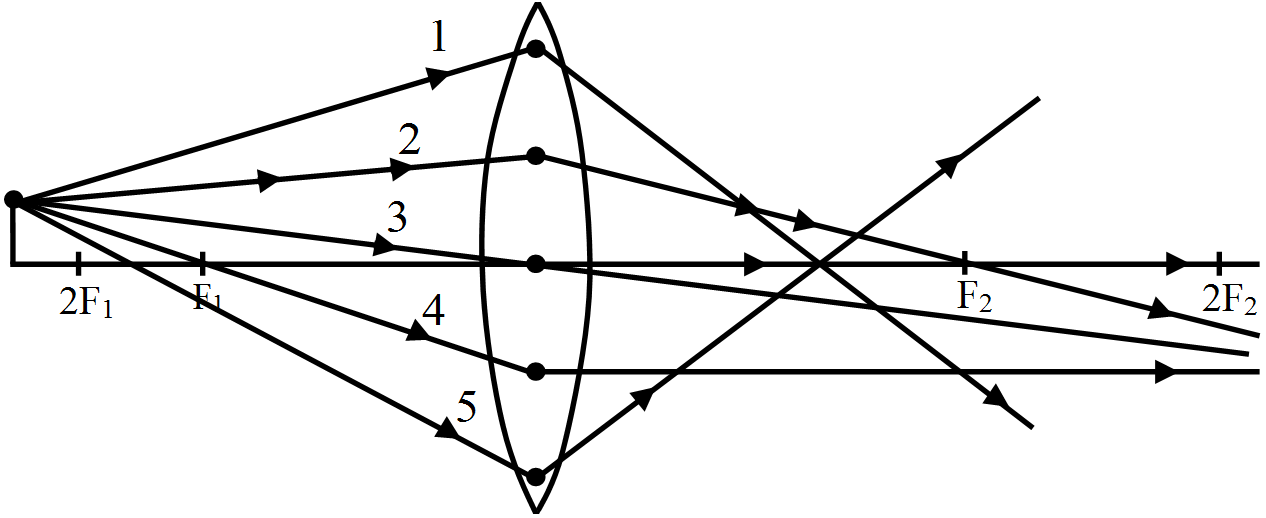
Out of the five incident rays shown in the figure find the three rays that are obeying the laws of refraction and may be used for locating the position of image formed by a convex lens :
  • A
    $1,2$ and $3$
  • $2,3$ and $4$
  • C
    $3,4$ and $5$
  • D
    $1,2$ and $4$
Answer
Correct option: B.
$2,3$ and $4$
View full question & answer
MCQ 691 Mark
A student obtained a sharp image of a burning candle, placed at the farther end of a laboratory table, on a screen using a concave mirror. For getting better value of focal length of the mirror, the subject teacher suggested him for focusing a well illuminated distant object. What should the student do?
  • A
    He should move the mirror away from the screen.
  • He should move the mirror slightly towards the screen.
  • C
    He should move the mirror as well as the screen towards the newly selected object.
  • D
    He should move only the screen towards the newly selected object.
Answer
Correct option: B.
He should move the mirror slightly towards the screen.
As the subject teacher suggested the student for focusing a will illuminated distant object, the image distance is increased. Due to this the object distance would decrease and thus the distance between the mirror and the screen should be decreased. Therefore, the mirror should be moved slightly towards the screen.
View full question & answer
MCQ 701 Mark
Select from the following the best set $-$ up for tracing the path of a ray of light through a rectangular glass slab :
  • $I$
  • B
    $II$
  • C
    $III$
  • D
    $IV$
Answer
Correct option: A.
$I$
View full question & answer
MCQ 711 Mark
After tracing the path of rays of light through a glass slab for three different angles of incidence, a student measured the corresponding values angle of refraction $r$ and angle of emergence $e$ and recorded them in the table given below :
S. No. $\angle\text{ i}$ $\angle\text{ i}$ $\angle\theta$
$I$ $30^{0}$ $20^{0}$ $31^{0}$
$II$ $40^{0}$ $25^{0}$ $40^{0}$
$III$ $50^{0}$ $31^{0}$ $49^{0}$
The correct observations are :
  • A
    $\ce{I}$ and $\ce{II}$
  • B
    $\ce{II}$ and $\ce{III}$
  • C
    $\ce{I}$ and $\ce{III}$
  • $\ce{I, II}$ and $\ce{III}$
Answer
Correct option: D.
$\ce{I, II}$ and $\ce{III}$
In a glass slab refraction : angle of incidence $(i) =$ angle of emergence $(e)$ Since here in all cases angle of incidence $(i)$ is nearly equal to the angle of emergence $(e),$ so all the values are correct.
View full question & answer
MCQ 721 Mark
In an experiment to trace the path of a ray of light through a glass prism for different values of angle of incidence a student would find that the emergent ray :
  • A
    Is parallel to the incident ray.
  • B
    Perpendicular to the incident ray.
  • C
    Is parallel to the refracted ray.
  • Bends at an angle to the direction of incident ray.
Answer
Correct option: D.
Bends at an angle to the direction of incident ray.
The paths followed by the incident ray and the emergent ray on passing through a prism are different. Upon refraction of a ray of light through prism, the emergent ray is always at an angle $($namely, the Angle of Deviation$)$ with the incident ray.
Thus, option $(4)$ is correct.
View full question & answer
MCQ 731 Mark
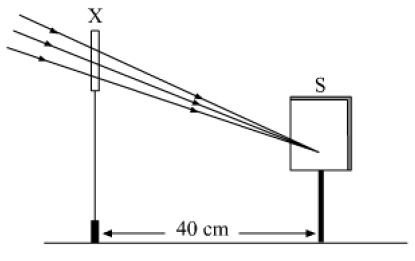
A student focused the image of a distant object using a device $'X\ ’$ on a while screen $'S\ ’$ as shown in the figure. If the distance of the screen from the device is $40 \ cm,$ select the correct statement about the device.
  • A
    The device $X$ is a convex lens of focal length $20 \ cm.$
  • B
    The device $X$ is a concave mirror of focal length $40 \ cm.$
  • C
    The device $X$ is a convex mirror of radius of curvature $40 \ cm.$
  • The device $X$ is a convex lens of focal length $40 \ cm.$
Answer
Correct option: D.
The device $X$ is a convex lens of focal length $40 \ cm.$
View full question & answer
MCQ 741 Mark
A student traces the path of a ray of white light through a rectangular glass slab and marks, the angles of incidence $(\angle \text{ i})$, refraction $(r)$ and emergence $(e)$ as shown.
  • A
    $i$ only
  • B
    $i$ and $r$
  • $i$ and $e$
  • D
    $r$ and $e$
Answer
Correct option: C.
$i$ and $e$
Incident and emergent angles are always measured from the normal of the plane.
View full question & answer
MCQ 751 Mark
A student obtained a sharp image of the grills of a window on a screen using a concave mirror. His teacher remarked that for getting better results a well lit distant object $($preferably the sun$)$ should be focussed on the screen. What should be done for this purpose?
  • A
    Move the screens lightly away from the mirror.
  • Move the mirrors lightly towards the screen.
  • C
    Move the screen and the mirror away from the object.
  • D
    Move the screen and the mirror towards the object.
Answer
Correct option: B.
Move the mirrors lightly towards the screen.
When the image distance increases, object distance decreases. Thus, distance between the mirror and screen will decrease. So, the mirror should be moved towards the screen.
View full question & answer
MCQ 761 Mark
To determine the focal length of a convex lens by obtaining a sharp image of a distant object we generally follow the following steps which are not in proper sequence.
  1. Hold the lens between the object and the screen.
  2. Measure the distance between the lens and the screen.
  3. Select a well lit distant object.
  4. Place a screen opposite to the object on the lab table.
  5. Adjust the position of the lens to form a sharp image.
The correct sequence of these steps is :
  • A
    $\ce{c, a, d, e, b}$
  • $\ce{c, d, a, e, b}$
  • C
    $\ce{c, d, e, a, b}$
  • D
    $\ce{c, a, c, d, b}$
Answer
Correct option: B.
$\ce{c, d, a, e, b}$
The correct sequence to find the focal length of a convex lens for obtaining a sharp image of a distant object will be as follows: Select a well lit distant object, Place a screen opposite to the object on the lab table, Adjust the position of the lens to form a sharp image. Hold the lens between the object and the screen and they Measure the distance between the lens and the screen.
View full question & answer
MCQ 771 Mark
While tracing the path of a ray of light passing through a rectangular glass slab student tabulated his observations given below:
S. No.
$\angle \text{ i}$
$\angle \text{ r}$
$\angle \text{ e}$
$I$
$60^{0}$
$40^{0}$
$61^{0}$
$II$
$50^{0}$
$36^{0}$
$51^{0}$
$III$
$40^{0}$
$28^{0}$
$39^{0}$
$IV$
$30^{0}$
$20^{0}$
$31^{0}$
The correct observation is :
  • A
    $I$
  • B
    $II$
  • C
    $III$
  • $IV$
Answer
Correct option: D.
$IV$
View full question & answer
MCQ 781 Mark
To determine focal length of a concave mirror a student obtains the image of a well lit distant object on a screen. To determine the focal length of the given concave mirror he needs to measure the distance between :
  • A
    Mirror and the object.
  • Mirror and the screen.
  • C
    Screen and the object.
  • D
    Screen and the object and also mirror and the screen.
Answer
Correct option: B.
Mirror and the screen.
View full question & answer
MCQ 791 Mark
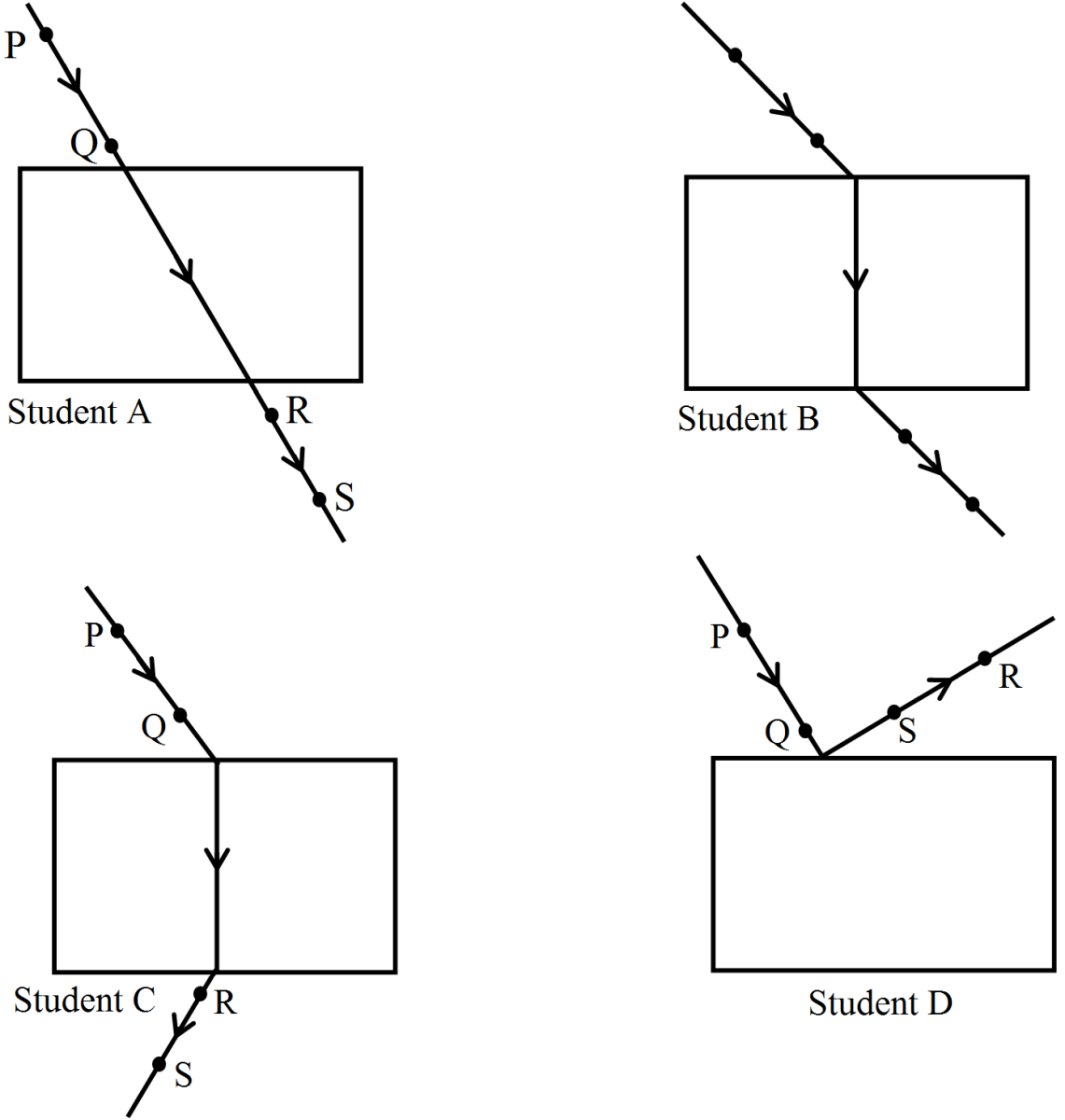
Four students $\ce{A, B, C}$ andDtracedthe paths of incident ray and the emergent ray by fixing pins $P$ and $Q$ for incident ray and pins $R$ and $S$ for emergent ray for ray of lightpassing through a glass slab.The correct emergent ray was traced by the student :
  • A
    $A$
  • $B$
  • C
    $C$
  • D
    $D$
Answer
Correct option: B.
$B$
View full question & answer
MCQ 801 Mark
Mohan obtained a sharp inverted image of a distant tree on the screen placed behind the lens. He then moved the screen and tried to look through the lens in the direction of the object. He would see :
  • A
    A blurred image on the wall of the laboratory.
  • B
    An erect image of the tree on the lens.
  • C
    No image as the screen has been removed.
  • An inverted image of the tree at the focus of the lens.
Answer
Correct option: D.
An inverted image of the tree at the focus of the lens.
Correct option is an inverted image of the object at the focus of the lens. We use screen just to show the presence of the image but if we remove it image will still forms at focus only.
View full question & answer
MCQ 811 Mark
To find the focal length of a concave mirror Rahul focuses a distant object with this mirror. The chosen object should be :
  • A
    A tree.
  • B
    Abuilding.
  • C
    Window.
  • The sun.
Answer
Correct option: D.
The sun.
The chosen object must be sun, because parallel rays coming from infinity converge or meet at focus.
View full question & answer
MCQ 821 Mark
For finding the focal length of a convex lens by obtaining the image of a distant object, one should use as the object :
  • A well lit distant tree.
  • B
    Window grill in the classroom.
  • C
    Any distant tree.
  • D
    A lighted candle kept at the other end of the table.
Answer
Correct option: A.
A well lit distant tree.
A well lit distant tree will be best to use as the brighter object will give more accurate and brighter image of the object. In this case it'll be easy for us to find the focal length of the lens.
View full question & answer
MCQ 831 Mark
Rahim recorded the following sets of observations while tracing the path of ray of light passing through a rectangular glass slab for different angles of incidence.
S. No. Angle of incidence Angle of refraction Angle of emergence
$I$ $45^{0}$ $41^{0}$ $45^{0}$
$II$ $40^{0}$ $38^{0}$ $38^{0}$
$III$ $45^{0}$ $41^{0}$ $40^{0}$
$IV$ $41^{0}$ $45^{0}$ $41^{0}$
The correct observation is recorded at serial number:
  • $I$
  • B
    $II$
  • C
    $III$
  • D
    $IV$
Answer
Correct option: A.
$I$
View full question & answer
MCQ 841 Mark
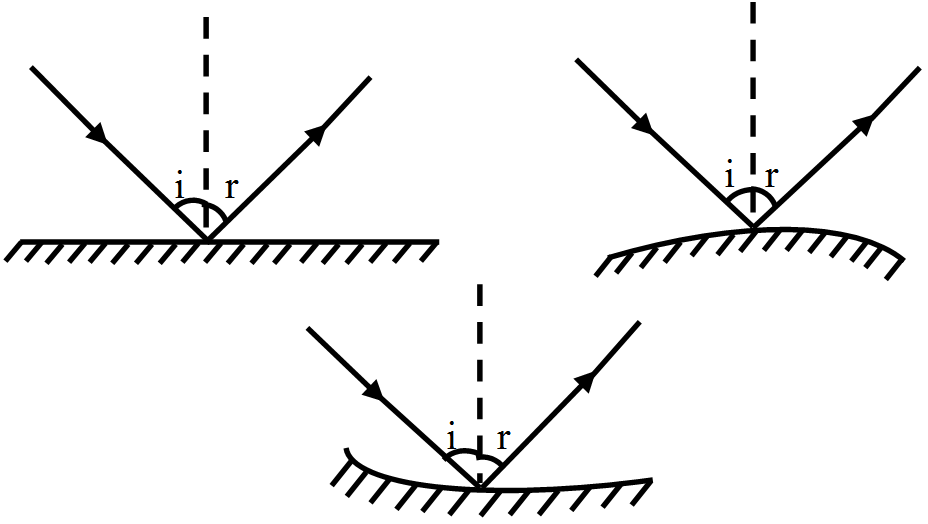
The laws of reflection hold true for :
  • A
    Plane mirrors only.
  • B
    Concave mirrors only.
  • C
    Convex mirrors only.
  • All reflecting surfaces.
Answer
Correct option: D.
All reflecting surfaces.
We know that from the laws of reflection, the incident ray, the reflected ray and the normal to the reflecting surface all lie in the same plane.
Also, the angle of reflection is equal to the angle of incidence.
The laws of reflection hold good for all reflecting surfaces irrespective of their shapes whether plane or curved.
View full question & answer
MCQ 851 Mark
When an object is kept within the focus of a concave mirror, an enlarged image is formed behind the mirror. This image is :
  • A
    Real.
  • B
    Inverted.
  • C
    Virtual and inverted.
  • Virtual and erect.
Answer
Correct option: D.
Virtual and erect.
Object between Principal Focus $(F)$ and Pole $(P)$: When the object is placed between principal focus and pole of a concave mirror, an enlarged, virtual and erect image is formed behind the mirror.
View full question & answer
MCQ 861 Mark
Whatever be the position of the object, the image formed by a mirror is virtual, erect and smaller than the object. The mirror then must be :
  • A
    Plane.
  • B
    Concave.
  • Convex.
  • D
    Either concave or convex.
Answer
Correct option: C.
Convex.
It should be a convex mirror. This is because when an object is in front of a convex mirror, irrespective of its distance, a virtual, erect and diminished image of the object is obtained.
View full question & answer
MCQ 871 Mark
A lens of power $+\ 2D$ are placed in close contact with each other. The combination will behave like :
  • A
    A convergent lens of focal length $50\ cm.$
  • A convergent lens of focal length $100\ cm.$
  • C
    A convergent lens of focal length $150\ cm.$
  • D
    A divergent lens of focal length $100\ cm.$
Answer
Correct option: B.
A convergent lens of focal length $100\ cm.$
$P_1=2 D$
$P_2=-1 D$
$\text { Combination power }=\mathrm{P}_1+\mathrm{P}_2$
$=2+(-1)$
$=+1 \mathrm{D}$
net power is positive so it will be convergent.
Combination focal length $=\frac{100}{\text{P}}=\frac{100}{1}=100\text{ cm}$
It will behave like a convergent lens of focal length $100\ cm$
View full question & answer
MCQ 881 Mark
A convex lens has a focal length of 10cm. At which of the following position should an object be placed so that this convex lens may act as a magnifying glass?
  • A
    15cm
  • 7cm
  • C
    20cm
  • D
    25cm
Answer
Correct option: B.
7cm
b. 7cm
Explanation:
Since the image of an object placed between the focus and the optical centre of a convex lens is enlarged and virtual.
View full question & answer
MCQ 891 Mark
A convex mirror of focal length f forms an image $\frac{1}{\text{n}^{\text{th}}}$ of the size of the object. The distance of the object from the mirror is :
  • A
    $\frac{\text{n+1}}{\text{n}}\text{f}$
  • B
    $(\text{n} +1)\text{f}$
  • $(\text{n} -1)\text{f}$
  • D
    $\frac{\text{n - 1}}{\text{n}}\text{f}$
Answer
Correct option: C.
$(\text{n} -1)\text{f}$
Will use the formula, $\text{m}=\frac{\text{f}}{(\text{f-u})}\ ...(1)$
$\ce{HERE},$
$\text{m}=+\frac{1}{\text{n}};$
$f = +f ; u = –u . ($since mirror is convex$).$
So, using those, equation $(1)$ becomes,
$\big(\frac{1}{\text{n}}\big)=\frac{\text{f}}{(\text{f+u)}}$
$(f + u) = nf$
$u = nf – f$
$u = (n - 1) f.$
View full question & answer
MCQ 901 Mark
A lens of focal length $12\ cm$ forms an erect image three times the size of the object. The distance between the object and image is :
  • A
    $8\ cm$
  • $16\ cm$
  • C
    $24\ cm$
  • D
    $36\ cm$
Answer
Correct option: B.
$16\ cm$
$16\ cm$
Given,
Magnification $, m = 3$
Focal length $f = 12\ cm$
Image distance $v = ?$
Object distance $u = ?$
We know that,
$\text{m}=\frac{\text{v}}{\text{u}}$
Therefore,
$3=\frac{\text{v}}{\text{u}}$
$3\text{u}=\text{v}$
Putting these value in lens formula, we get
$\frac{1}{\text{v}}-\frac{1}{\text{u}}=\frac{1}{\text{f}}$
$\Rightarrow\frac{1}{3\text{u}}-\frac{1}{\text{u}}=\frac{1}{12}$
$\Rightarrow\frac{1-3}{\text{u}}=\frac{1}{12}$
$\Rightarrow\frac{-2}{3\text{u}}=\frac{1}{12}$
$\Rightarrow3\text{u}=-24$
$\Rightarrow{\text{u}}=\frac{-24}{3}$
$\Rightarrow{\text{u}}=-6\text{ cm}$
$\Rightarrow{\text{v}}=3\text{u}$
$\Rightarrow{\text{v}}=-8\times3$
$\Rightarrow{\text{v}}=-24\text{ cm}$
Here, minus sign show that image is formed on the left side of the lens.
Distance between image and object $= 24 - 8 = 16\ cm$
View full question & answer
MCQ 911 Mark
An object is $0.09m$ from a magnifying lens and the image is formed $36\ cm$ from the lens. The magnification produced is :
  • A
    $0.4$
  • B
    $1.4$
  • $4.0$
  • D
    $4.5$
Answer
Correct option: C.
$4.0$
Magnification is given by,
$\text{Magnificatioin(m)}=\frac{\text{distance of image from the lens}}{\text{distance of object from the lens}}$
$\text{m}=\frac{-36\text{m}}{-0.09\text{m}}=\frac{36\text{ cm}}{9\text{ cm}}=4$
View full question & answer
MCQ 921 Mark
The figure given alongside shows the image of a clock as seen a plane mirror. The correct time is : Figure.
  • A
    $2.25$
  • B
    $2.35$
  • C
    $6.45$
  • $9.25$
Answer
Correct option: D.
$9.25$
since the image formed by a plane mirror is laterally inverted.
View full question & answer
MCQ 931 Mark
Large number of thin stripes of black paint are made on the surface of a convex lens of focal length $20\ cm$ to catch the image of a white horse. The image will be :
  • A zebra of black stripes.
  • B
    A horse of black stripes.
  • C
    A horse of less brightness.
  • D
    A zebra of less brightness.
Answer
Correct option: A.
A zebra of black stripes.
Large number of thin stripes of black paint are made on the surface of a convex lens of focal length a zebra of black stripes.
View full question & answer
MCQ 941 Mark
The power of a converging lens is $4.5D$ and that of a diverging lens is $3D$. The power of this combination of lenses placed close together is :
  • A
    $+\ 1.5D$
  • B
    $+\ 7.5D$
  • C
    $-\ 7.5D$
  • $-\ 1.5D$
Answer
Correct option: D.
$-\ 1.5D$
Because power of lens adds up when placed in combination.
Therefore, Net power $= 4.5D + (-3.0D) = -\ 1.5D$
View full question & answer
MCQ 951 Mark
If a magnification of $, −1\ ($minus one$)$ is to be obtained by using a converging mirror, then the object has to be placed :
  • A
    Between pole and focus.
  • At the centre of curvature.
  • C
    Beyond the centre of curvature.
  • D
    At infinity.
Answer
Correct option: B.
At the centre of curvature.
If a magnification of $−1 \ ($minus one$)$ is to be obtained by using a converging mirror, the object needs to be placed at the centre of curvature so that an image of same size as the object can be formed.
View full question & answer
MCQ 961 Mark
The image formed by a concave mirror is real, inverted and of the same size as the object. The position of the object must then be :
  • A
    At the focus.
  • B
    Between the centre of curvature and focus.
  • At the centre of curvature.
  • D
    Beyond the centre of curvature.
Answer
Correct option: C.
At the centre of curvature.
The reason being, the image formed by a concave mirror is real, inverted and of the same size as the object. The position of the object must then be at the centre of curvature.
View full question & answer
MCQ 971 Mark
Only one of the following applies to a concave lens. This is :
  • A
    Focal length is positive.
  • B
    Image distance can be positive or negative.
  • C
    Height of image can be positive or negative.
  • Image distance is always negative.
Answer
Correct option: D.
Image distance is always negative.
Because a concave lens always forms a virtual image on the left side of the lens.
View full question & answer
MCQ 981 Mark
Which one of the following materials cannot be used to make a lens?
  • A
    Water.
  • B
    Glass.
  • C
    Plastic.
  • Clay.
Answer
Correct option: D.
Clay.
Since it is opaque and does not let light to pass through it.
View full question & answer
MCQ 991 Mark
The image formed by a concave mirror is virtual, erect and magnified. The position of object is :
  • A
    At focus.
  • Between focus and centre of curvature.
  • C
    At pole.
  • D
    Between pole and focus
Answer
Correct option: B.
Between focus and centre of curvature.
The reason being, the image formed by a concave mirror is virtual, erect and magnified. The position of the object is between the pole and the focus.
View full question & answer
MCQ 1001 Mark
Two big mirrors $A$ and $B$ are fitted side by side on a wall. A man is standing at such a distance from the wall that he can see the erect image of his face in both the mirrors. When the man starts walking towards the mirrors, he find that the size of his face in mirror $A$ goes on increasing but that in mirror $B$ remains the same.
  • A
    Mirror $A$ is concave and mirror $B$ is convex.
  • B
    Mirror $A$ is plane and mirror $B$ is concave.
  • Mirror $A$ is concave and mirror $B$ is plane.
  • D
    Mirror $A$ is convex and mirror $B$ is concave.
Answer
Correct option: C.
Mirror $A$ is concave and mirror $B$ is plane.
Image formed by a plane mirror is virtual, erect and of the same size as the object.Image formed by a concave mirror is virtual, erect and larger than the object.
View full question & answer
M.C.Q - Page 2 - Science STD 10 Questions - Vidyadip