Questions

[3 Mark Questions]

🎯

Test yourself on this topic

8 questions · timed · auto-graded

Question 13 Marks
Image
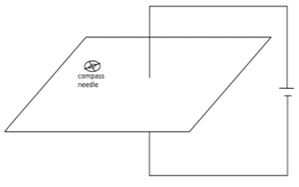
Mona was doing an experiment with a magnetic compass and a straight current-carrying wire. She observed that as she moved the compass away from the current-carrying wire, the deflection of the compass needle reduced.
A. Explain why the deflection of the compass needle reduced as Mona moved away the compass needle from the current carrying wire.
B. Mention one thing that could have changed in the circuit of the wire that could increase the deflection of the needle.
C. Explain with reason what will be the direction of the magnetic field associated with the wire for the case described by the above figure.
Answer
A. Magnetic field strength is inversely proportional to the distance from the current carrying wire. Hence when Mona moved the compass away from the current carrying wire, the magnetic effect was less on it and hence the deflection was less. (1)
B. Magnetic field strength is directly proportional to the current in the wire. So, Mona could increase the current in the circuit to observe a greater deflection in the compass needle. (1)
C. The battery suggests that the current is going from top of the plane to the bottom of the plane. Using the right hand thumb rule we can say that the magnetic field will be clockwise. (1)
View full question & answer
Question 23 Marks
$A. $State the relationship between the resistance $R$ of a wire to its length I and cross sectional area $A.$ Use the mathematical symbols to arrive at the final formula.
$B.$      Using the formula define the resistivity of a material.
Answer
$A. R \propto l$
$R \propto \frac{l}{A}$
$R =\rho \frac{l}{A}$.
$B. R =\rho \frac{l}{A}$
$\rho= R \frac{A}{l}$ for $A =1m^2$ and $I = 1\ m$, we have
$p = R$
Hence resistivity is the resistance offered by a wire of length $1$ m having a cross sectional area of $1 m^2. (1.5)$
View full question & answer
Question 33 Marks
A. What is the fundamental difference between hypermetropia and myopia 3 in terms of the optical experience of a person?
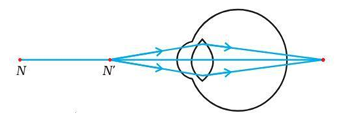
B. The diagram below shows a special case of an eye defect.
(i) What is the defect that is shown in the figure?
(ii) State one cause for such a defect?
(iii) Explain with reason if a concave lens can be used to correct the defect.
Image
Answer
A. Hypermetropia is a defect that causes difficulty in focusing on near objects, with clearer vision observed for distant objects. In Myopia distant objects appear blurry while near objects are seen clearly. (1)
B. (i) The image shows a case of hypermetropia. (0.5)
(ii) shortening of the eyeball or focal length of the eye lens becomes too long. (0.5)
(iii) No the concave lens would diverge the rays coming to the eyeball and will push the image even further, but a convex lens should be used which will help to converge the rays and create the image at the exact place on the retina. (1)
View full question & answer
Question 43 Marks
A. In a family of four individuals, the father possessed long ears and the mother possessed short ears. If the parents had pure dominant and recessive traits respectively, then calculate the ratio of genetic makeup of F2 generation. Show a suitable cross.(2)
B. If father had short ears and the mother had long ears, explain what effect it will have on the ratio of genetic makeup in F2 generation. (1)
Answer
(Any letter which clearly indicated dominant and recessive ears, example, L or E or any other)
A. LL x II
F1= LI
LIX LI
1LL:2LI:1II. (2)
B. No change in ratio/the ratio of F2 generation will still be 1LL:2LI:1II/ ratio will be the same.
As the cross is still between a pure dominant and recessive allele/ genes/traits/characters/as shown in the cross above. (1)
View full question & answer
Question 53 Marks
Water is used by the leaves of the plants for photosynthesis but rather than watering the leaves, we water the plant through the soil. How does this water reach the leaves of the plant?
Answer
• In plants, the water is absorbed by the plants from the soil through the roots. Xylem tissue of the roots, stems and leaves are interconnected to form a continuous system of water conducting channels. (1)
• During the day, when stomata are open, the transpiration pull becomes the major driving force for the movement of water in the xylem. (1)
• Evaporation of water molecules from the stomata creates a suction which pulls water from the xylem cells of roots to the stem and then to the leaves. (1)
View full question & answer
Question 63 Marks
Comment on the following statements:
(i) Bee sting is treated with baking soda paste whereas wasp sting is treated with dilute vinegar.
(ii) Farmers treat soil with quicklime when tilling.
(iii) Ancient sculptures and marble structures are conserved by treating them with certain chemicals."
Answer
(i) As bee sting is acidic and wasp sting is basic. (1)
(ii) To change the nature of soil to (neutral or basic). (1)
(iii) To protect sculptures from the effects of certain gases present in environment and acid rain. (1)
View full question & answer
Question 73 Marks
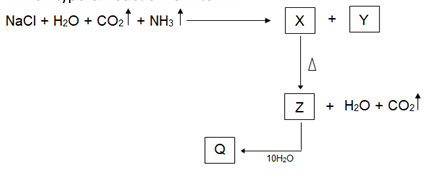
(i) In the given series of reactions, name the compounds X and Z.
(ii) Which type of reaction is X to Z?
Image
(iii) You are given 3 unknown solutions A, B, and C with pH values of 6, 8 and 9.5 respectively. In which solution will the maximum number of hydronium ions be present? Arrange the given samples in the increasing order of H+ ion concentration.
Answer
(i) $X = NaHCO _3 ; Z = Na _2 CO _3$ (0.5+0.5)
(ii) Decomposition reaction (0.5)
(iii) Solution A (0.5)
(iv) Increasing order or H+ ions C<B<A (1)
View full question & answer
Question 83 Marks
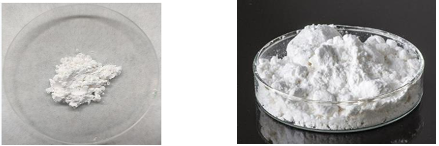
A. Anirudh took two metal oxides; aluminium oxide and magnesium oxide as shown in the pictures given below. But he forgot to label them. How will you guide/ help Anirudh to identify the oxides and label them?
Image
$B$. In an activity Aishu was given two substances; Copper Sulphide $\ce{(Cu2S)}$ and Copper Oxide $\ce{(Cu2O)}$ to obtain copper from these compounds. She was able to extract Copper successfully. Illustrate with the help of chemical equations how Aishu might have completed the activity.
Answer
$A .$ Aqueous solution of magnesium oxide turns red litmus to blue.
Aluminium oxide is amphoteric and insoluble in water.
Thus, it does not change the colour of either blue or red litmus.
OR
Magnesium oxide reacts with acid only whereas Aluminium oxide reacts with acids and bases, which are amphoteric. $(1)$

$B.\ce{ 2Cu_2S + 3O_2(g)  ->[{Heat}]  2Cu_2O(s) + 2SO_2(g)}$
$\ce{ 2Cu_2O + Cu_2S  ->[{Heat}]  6Cu(s) + SO_2(g) (1+1)}$
View full question & answer
[3 Mark Questions] - Science STD 10 Questions - Vidyadip