Question 14 Marks
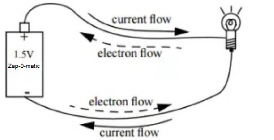
The rate of flow of charge is called electric current. The SI unit of electric current is Ampere (A). The direction of flow of current is always opposite to the direction of flow of electrons in the current.
The electric potential is defined as the amount of work done in bringing a unit-positive test charge from infinity to a point in the electric field. The amount of work done in bringing a unit positive test charge from one point to another point in an electric field is defined as potential difference.
$V_{A B}=V_{B}-V_{A}=\frac{W_{B A}}{q}$
The SI unit of potential and potential difference is volt.
i. Write the formula of voltage in terms of work done, current, time and charge.
ii. What is the number of electrons flowing per second in a conductor if 1 A current is passing through it?
iii. What would be the potential difference between the two terminals of a battery, if 100 joules of work is required to transfer 20 coulombs of charge from one terminal of the battery to other?
OR
The 2 C of charge is flowing through a conductor in 100 ms , then what would be the current in the circuit?
The electric potential is defined as the amount of work done in bringing a unit-positive test charge from infinity to a point in the electric field. The amount of work done in bringing a unit positive test charge from one point to another point in an electric field is defined as potential difference.
$V_{A B}=V_{B}-V_{A}=\frac{W_{B A}}{q}$
The SI unit of potential and potential difference is volt.
i. Write the formula of voltage in terms of work done, current, time and charge.
ii. What is the number of electrons flowing per second in a conductor if 1 A current is passing through it?
iii. What would be the potential difference between the two terminals of a battery, if 100 joules of work is required to transfer 20 coulombs of charge from one terminal of the battery to other?
OR
The 2 C of charge is flowing through a conductor in 100 ms , then what would be the current in the circuit?
Answer
View full question & answer→i. $V=\frac{W}{q}=\frac{W}{I t}$
ii. $I=1 \mathrm{~A}, t=1 \mathrm{~s}$
$\mathrm{q}=\mathrm{It}=1 \times 1=1 \mathrm{C}$
$n=\frac{q}{e}=\frac{1}{1.6 \times 10^{-19}}=6.25 \times 10^{18}$
iii. The potential difference is the work done in moving a unit of positive electric charge from one point to another.
$\mathrm{W}=100 \mathrm{~J}, \mathrm{q}=20 \mathrm{C}$
$V=\frac{W}{q}=\frac{100}{20}=5 \mathrm{~V}$
OR
$\mathrm{q}=2 \mathrm{C}, \mathrm{t}=100 \mathrm{~ms}=0.1 \mathrm{~s}$
$I=\frac{q}{t}=\frac{2}{0.1}=20 \mathrm{~A}$
ii. $I=1 \mathrm{~A}, t=1 \mathrm{~s}$
$\mathrm{q}=\mathrm{It}=1 \times 1=1 \mathrm{C}$
$n=\frac{q}{e}=\frac{1}{1.6 \times 10^{-19}}=6.25 \times 10^{18}$
iii. The potential difference is the work done in moving a unit of positive electric charge from one point to another.
$\mathrm{W}=100 \mathrm{~J}, \mathrm{q}=20 \mathrm{C}$
$V=\frac{W}{q}=\frac{100}{20}=5 \mathrm{~V}$
OR
$\mathrm{q}=2 \mathrm{C}, \mathrm{t}=100 \mathrm{~ms}=0.1 \mathrm{~s}$
$I=\frac{q}{t}=\frac{2}{0.1}=20 \mathrm{~A}$