Question 14 Marks
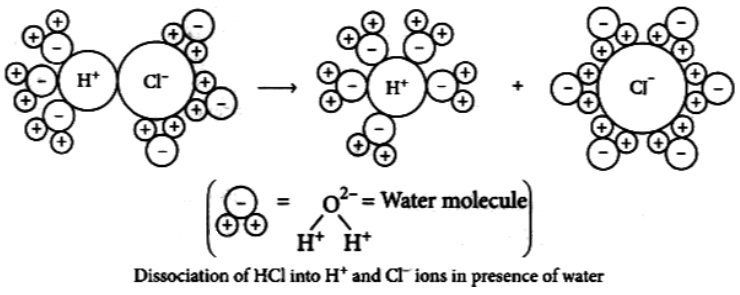
The acidic behaviour of acids is due to the presence of hydrogen ( $H ^{+}$) ions in them. They produce hydrogen ions in the presence of water. Water is a polar solvent and this property of water helps in weakening the bond between the ions and makes them soluble.
Hence, acids and bases produce ions in aqueous solutions. It may be noted that a dry HCl gas or a solution of hydrogen chloride in organic, non-polar solvents like toluene or benzene do not show acidic properties. This is because hydrogen chloride does not undergo ionization in toluene.
The reason why HCl splits into $H ^{+}$and $Cl ^{-}$ions in presence of water lies in the fact that water molecules, being polar, pull the $H ^{+}$and $Cl ^{-}$ions apart and thus, the bond in HCl is broken.
i. Which acids are present in bee stings?
ii. If the pH of a solution is 8 , then find its $\left[ H ^{+}\right]$ion.
iii. If you are given water, Hydrochloric acid, and Acetic acid, then mention increasing the order of acid strength.
OR
If you are provided $H _3 PO _4, C _2 H _5 OH , H _2 CO _3$, and $CH _3 COOH$, then which compound does not give $H ^{+}$ions in an aqueous solution?
Hence, acids and bases produce ions in aqueous solutions. It may be noted that a dry HCl gas or a solution of hydrogen chloride in organic, non-polar solvents like toluene or benzene do not show acidic properties. This is because hydrogen chloride does not undergo ionization in toluene.
The reason why HCl splits into $H ^{+}$and $Cl ^{-}$ions in presence of water lies in the fact that water molecules, being polar, pull the $H ^{+}$and $Cl ^{-}$ions apart and thus, the bond in HCl is broken.
i. Which acids are present in bee stings?
ii. If the pH of a solution is 8 , then find its $\left[ H ^{+}\right]$ion.
iii. If you are given water, Hydrochloric acid, and Acetic acid, then mention increasing the order of acid strength.
OR
If you are provided $H _3 PO _4, C _2 H _5 OH , H _2 CO _3$, and $CH _3 COOH$, then which compound does not give $H ^{+}$ions in an aqueous solution?
Answer
View full question & answer→i. Formic acid is the common name for methanoic acid and it is present in a bee stings.
ii. $\mathrm{pH}=-\log _{10}\left[\mathrm{H}^{+}\right]=8$
$\log 10\left[\mathrm{H}^{+}\right]=-8 \\
{\left[\mathrm{H}^{+}\right]=10^{-8} \mathrm{~mol} / \mathrm{L}}$
iii. Water < Acetic acid < Hydrochloric acid
OR
$\mathrm{C}_{2} \mathrm{H}_{5} \mathrm{OH}$ is not an ionic compound, it is a covalent compound and hence does not give $\mathrm{H}^{+}$ions in aqueous solution.
ii. $\mathrm{pH}=-\log _{10}\left[\mathrm{H}^{+}\right]=8$
$\log 10\left[\mathrm{H}^{+}\right]=-8 \\
{\left[\mathrm{H}^{+}\right]=10^{-8} \mathrm{~mol} / \mathrm{L}}$
iii. Water < Acetic acid < Hydrochloric acid
OR
$\mathrm{C}_{2} \mathrm{H}_{5} \mathrm{OH}$ is not an ionic compound, it is a covalent compound and hence does not give $\mathrm{H}^{+}$ions in aqueous solution.