Questions

[5 marks Questions]

🎯

Test yourself on this topic

6 questions · timed · auto-graded

Question 15 Marks
A thin converging lens form a real magnified image and virtual magnified image of an object in front of it.
i. Write the positions of the objects in each case.
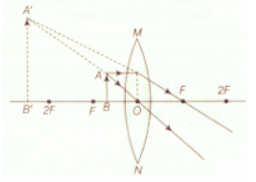
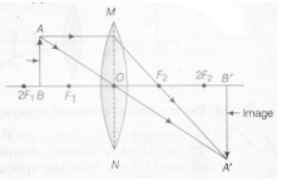
ii. Draw ray diagrams to show the image formation in each case.
iii. How will the following be affected on cutting this lens into two halves along the principal axis?
a. Focal length
b. Intensity of the image formed by half lens
Answer
i. a. Object is placed between F and 2F of thin converging lens .
b. Object is placed between optical centre and F.
ii. The ray diagrams for real magnified and virtual magnified images are as follows:
Part (a) :
Image

Part (b)
Image
iii. a. There will be no change in focal length of converging lens.
b. Intensity will become one-fourth and brightness of lens will be less .
View full question & answer
Question 25 Marks
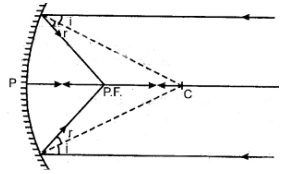
Define the principal focus of concave mirror.
Answer
Light rays that are parallel to the principal axis of a concave mirror converge at a specific point on its principal axis after
reflecting from the mirror. This point is known as the principal focus of the concave mirror
Principal focus (p.f.) is a point on principal axis of a concave mirror where the rays parallel to principal axis meet after reflection
from the mirror.

Image

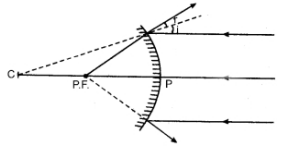
Additional reading. For convex mirror, principal focus is a point on principal axis of a convex mirror where rays parallel to
principal axis appear to diverge from after reflection from the mirror.

Image
View full question & answer
Question 35 Marks
'Nervous and hormonal systems together perform the function of control and coordination in human beings.' Justify the statement.
Answer
The working together of various organs of human being in a systematic, controlled and efficient way to produce a proper response to various stimuli is known as coordination.
In human beings, the control and coordination is brought about by both nervous system and endocrine system. Nervous system
consists of receptors that receive the stimulus from surrounding environment and send the message received by them to the spinal cord and brain in form of electrical impulses through the sensory nerves.
The motor nerves then transmit the response to the effector. The effectors are mainly the muscles and glands of our body. Thus,
endocrine glands secreting hormones are directly or indirectly controlled by the nervous system. For example, when an emergency stimulus is detected by the nervous system, the stimulus is detected by the nervous system , the stimulus is received and analysed by central nervous system that send message to effectors to provide proper response. At the same time, the sympathetic nervous system activates adrenal gland to release adrenaline that prepares body by increasing heart rate, blood pressure,respiration and dilates pupil etc.
Hence, control and coordination in humans (or animals) depend on two things for transmitting information, i.e. chemical signals
of hormones and nerve impulses.
If they depended only on nerve impulses through nerve cells, only a limited range of tissues would be stimulated. Since, they get
additional chemical signals as well, a large number of tissues are stimulated. This is why animals can show a wide range of
response to stimulus.
View full question & answer
Question 45 Marks
State the basic requirements for sexual reproduction? Write the importance of such reproduction in nature?
Answer
The basic requirements for sexual reproduction are the involvement of male and female individuals which will contribute the male
and female gametes respectively. The gametes are haploid that are produced through meiosis which on fertilization produce a zygote and the normal diploid number of chromosomes is restored in offsprings.
The importance of sexual reproduction is as follows:
i. It provides variations in species.
ii. Two individuals are required one male and another female.
iii. Specialized organ called sex organ are involved in this type of reproduction
iv. It promotes diversity of characters in offsprings.
v. It results in recombination of genes thus increase chances of genetic variations.
vi. It plays an important role in origin of new species.
View full question & answer
Question 55 Marks
Explain the mechanism of the cleaning action of soaps.
Answer
The action of soap is based on the presence of both hydrophilic and hydrophobic groups in a soap molecule. A soap molecule
consists of two parts:
i. A short ionic part comprising the carboxylate salt, $- COONa ^{+}$ . This is the polar end. This is water soluble (i.e. hydrophilic or water-attracting) and, therefore, remains attached to water.
ii. A long hydrocarbon chain which is the non-polar end. This end is hydrophobic (i.e. water-repelling) and is soluble in oil and
grease.
Image

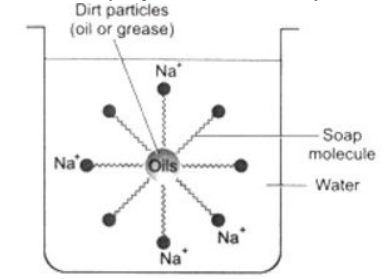
Micelle formation: The soap molecule may be represented as a structure as shown in the figure. When soap is dissolved in
water, it forms a colloidal suspension. In this colloidal suspension, the soap molecules adhere together to form micelles and
remain radially suspended in water with the hydrocarbon end towards the centre and the ionic end directed outward.
Image

The dirt particles always adhere to the oily or greasy layer present on the skin or clothes. When a dirty cloth is dipped into a
soap solution, its non-polar hydrocarbon end of micelles attach to the grease or oil present in dirt and polar end remains in
water layer. The subsequent mechanical action of rubbing (agitation), dislodges the oily layer from the dirty surface shaping it
into small globules. A stable emulsion of oil in water is formed. The emulsified oil or grease globules bearing the dirt can be
washed away with water.
View full question & answer
Question 65 Marks
a. A compound X undergoes addition reaction with $H _2$ to form a compound Y having molecular mass 30 g $mol ^{-1}$ . X decolorises bromine water and burns with a smoky flame. Identify X and Y and write chemical equations of the reactions involved.
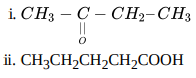
b. Write the structural formulae of (i) Butanone, and (ii) Pentanoic acid.
c. Would you be able to check if water is hard by using a detergent? Give reason to justify your answer.
Answer
a. X - Ethene /Ethyne $/ C _3 H _4 / C _2 H _7$unsaturated hydrocarbon
Y - Ethane / saturated hydrocarbon and the chemical equation:
$CH _2= CH _2+ H _2 \xrightarrow{ Ni } CH _3- CH _3$
b.
Image
c. No
Because detergents give foam/lather with hard water
View full question & answer