Questions

3 Marks Question

🎯

Test yourself on this topic

7 questions · timed · auto-graded

Question 13 Marks
Explain in short the meaning of an Accounting Equation.
Answer
An Accounting Equation is a mathematical expression which shows that the assets and liabilities of a firm are equal. An Accounting Equation is based on the Dual Aspect Concept of accounting meaning, every transaction has dual aspect or two aspects debit and credit. It holds that for every debit there is a credit of equal amount and vic? versa. It means, total claims (those of outsiders and of the proprietors) will always be equal to the total assets of the firm. The claims, also known as equities, are of two types:
  1. Owner's equity or capital
  2. Liabilities or amounts due to outsiders (i.e., Outsider's Equity).
We can express it mathematically as follows:
Assets = Equities (Total Claims)
OR
Assets = Liabilities + Capital

OR
Liabilities = Assets - Capital

OR
Capital = Assets - Liabilities
View full question & answer
Question 23 Marks
Ram started business on $1st$ April, $2018$ with a Capital of $25,000$ and a loan of $12,500$. On $31^{st}$ March, $2019$, his assets were $50,000$. Find his capital as on $31^{st}$ March, $2019$ and the profit earned during the year.
Answer
Closing Capital is difference between the assets and liabilities. Thus
liabilities = 12,500 (Loan)
and assets = 50000.
Therefore capital = 50,000 - 12,500 = 37,500
Profit = Closing Capital - Opening Capital + Drawings - Additional Capital
Profit = 37,500 - 25,000 + 0 - 0
Profit = 12,500
View full question & answer
Question 33 Marks
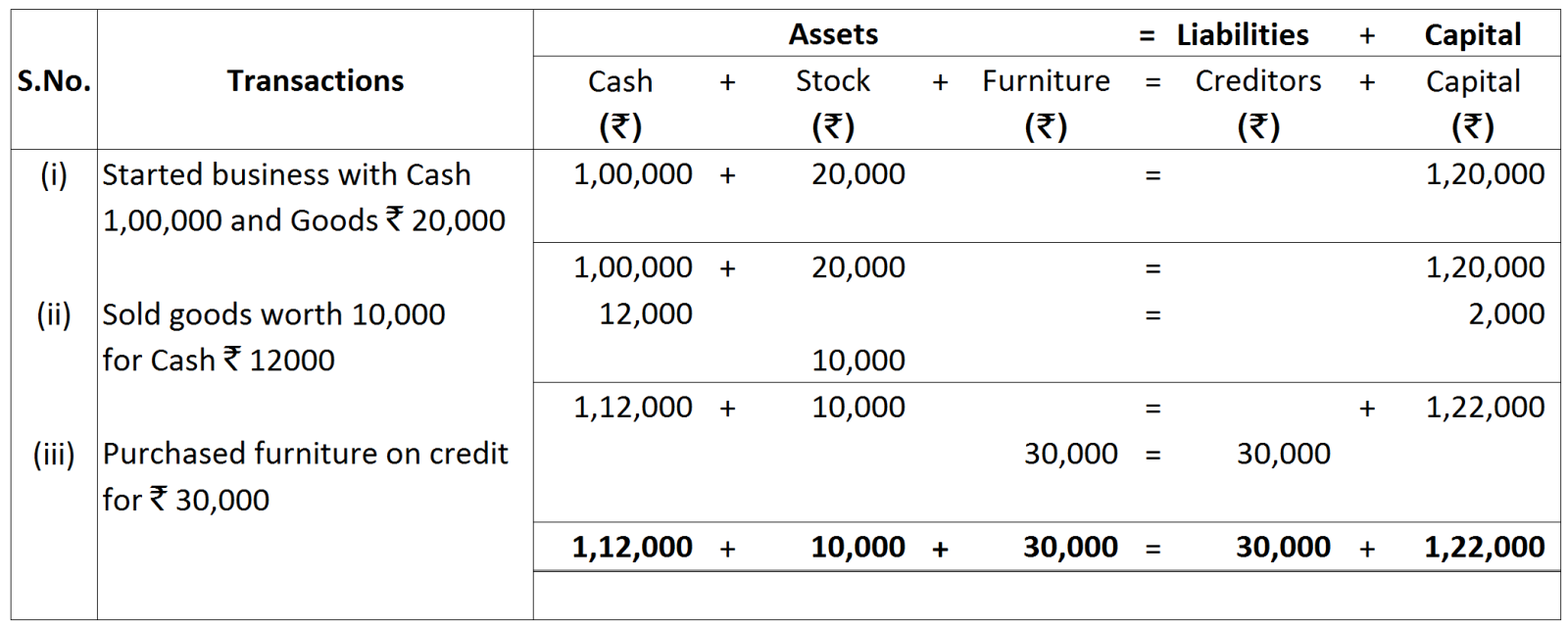
Prepare Accounting Equation from the following:
  1. Started business with cash ₹ 1,00,000 and Goods ₹
    20,000.
  2. Sold goods worth ₹ 10,000 for cash ₹ 12,000.
  3. Purchased furniture on credit for ₹ 30,000.
Answer

Assets = 1,12,000 + 10,000 + 30,000 = ₹ 1,52,000
Liabilities = ₹ 30,000
Capital = ₹ 1,22,000
View full question & answer
Question 43 Marks
Prepare an Accounting Equation from the following:
  1. Started business with cash ₹ 1,00,000.
  2. Purchased goods for cash ₹ 20,000 and on credit ₹ 30,000.
  3. Sold goods for cash costing ₹ 10,000 and on credit costing ₹ 15,000 both at a profit of 20%
View full question & answer
Question 53 Marks
Determine the missing amounts on the basis of the Accounting Equation:
S.no
Assets
=
Liabilities
+
Capital
(i)
20,000
=
15,000
+
?
(ii)
?
=
5,000
+
10,000
(iii)
10,000
=
?
+
8,000
Answer
S.no
Assets
=
Liabilities
+
Capital
(i)
20,000
=
15,000
+
₹ 2,000
(ii)
5,000
=
5,000
+
10,000
(iii)
10,000
=
₹ 15,000
+
8,000
View full question & answer
Question 63 Marks
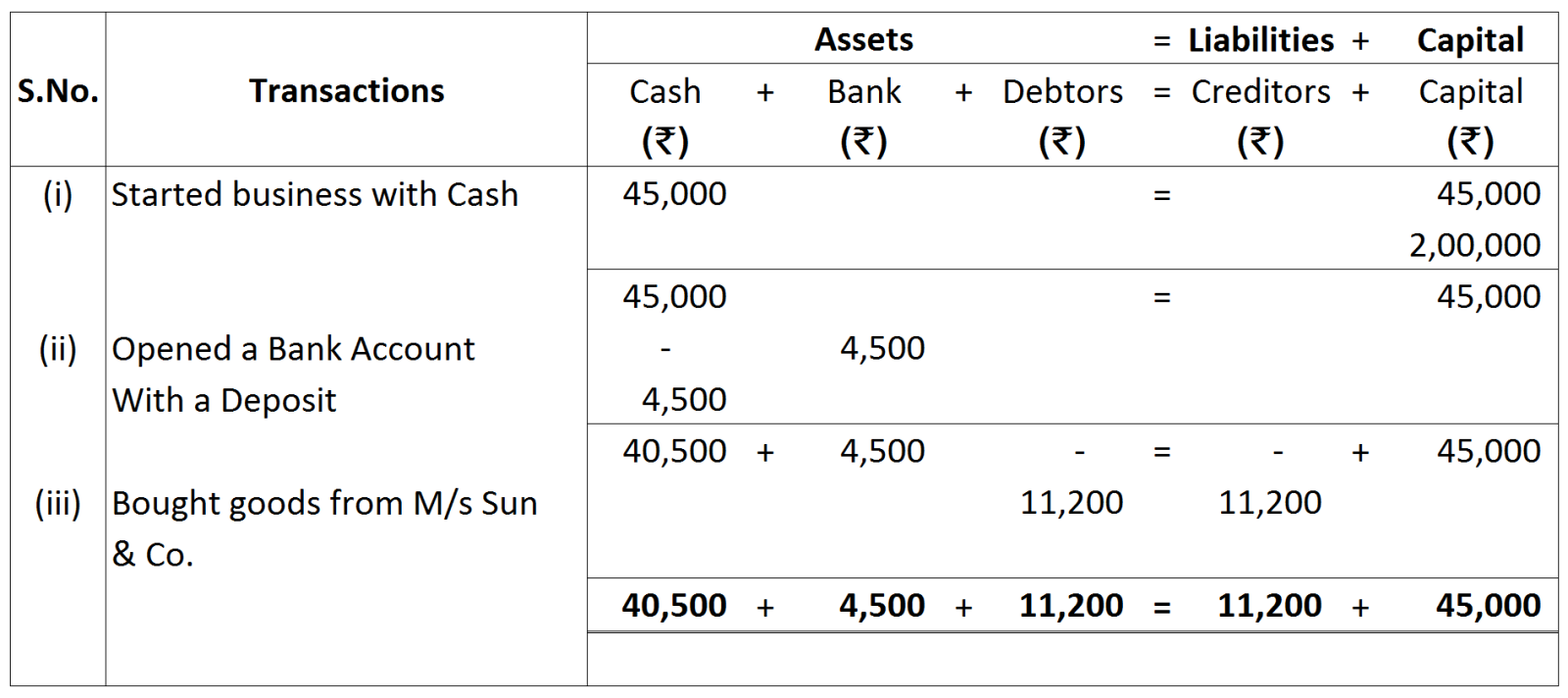
What will be effect of the following on the Accounting Equation?
  1. Started business with cash ₹ 45,000
  2. Opened a Bank Account with a deposit of ₹ 4,500
  3. Bought goods from M\s. Sun & Co. for ₹ 11,200
Answer

Total = Cash + Bank + Stock
Assets = 40,500 + 4,500 + 11,200 = ₹ 56,200
Liabilities = ₹ 11,200
Capital = ₹ 45,000
View full question & answer
Question 73 Marks
Show the accounting equation on the basis of following transactions:
  1. Ram started business with ₹ 25,000.
  2. Purchased goods from Shyam ₹ 10,000.
  3. Sold goods to Sohan costing ₹ 1,500 for ₹ 1,800.
View full question & answer
3 Marks Question - Account STD 11 Commerce Questions - Vidyadip