Questions

6 Marks Question

🎯

Test yourself on this topic

28 questions · timed · auto-graded

Question 16 Marks
On 1st January, 2019, A drew a bill on B for ₹ 10,000 payable after 3 months. B accepted the bill and returned it to A. After 10 days, A endorsed the bill to his creditor C. On the due date, the bill was dishonoured and C paid ₹ 50 as noting charges.
Record the transactions in the books of A, B and C.
View full question & answer
Question 26 Marks
Vinod sold goods to Darbara Singh for ₹ 1,000 on 1st January, 2019. He drew on the latter a bill for the amount payable 3 months after date. He discounted the bill with his bank for ₹ 990 on 4th January, 2019. On maturity, the bill is duly met. Make the Journal entries in the books of Vinod and Darbara Singh.
View full question & answer
Question 36 Marks
Explain any three of the following:
  1. Retiring of Bills of Exchange.
  2. Holder in due course.
  3. Bills sent to bank for collection.
  4. Noting charges.
View full question & answer
Question 46 Marks
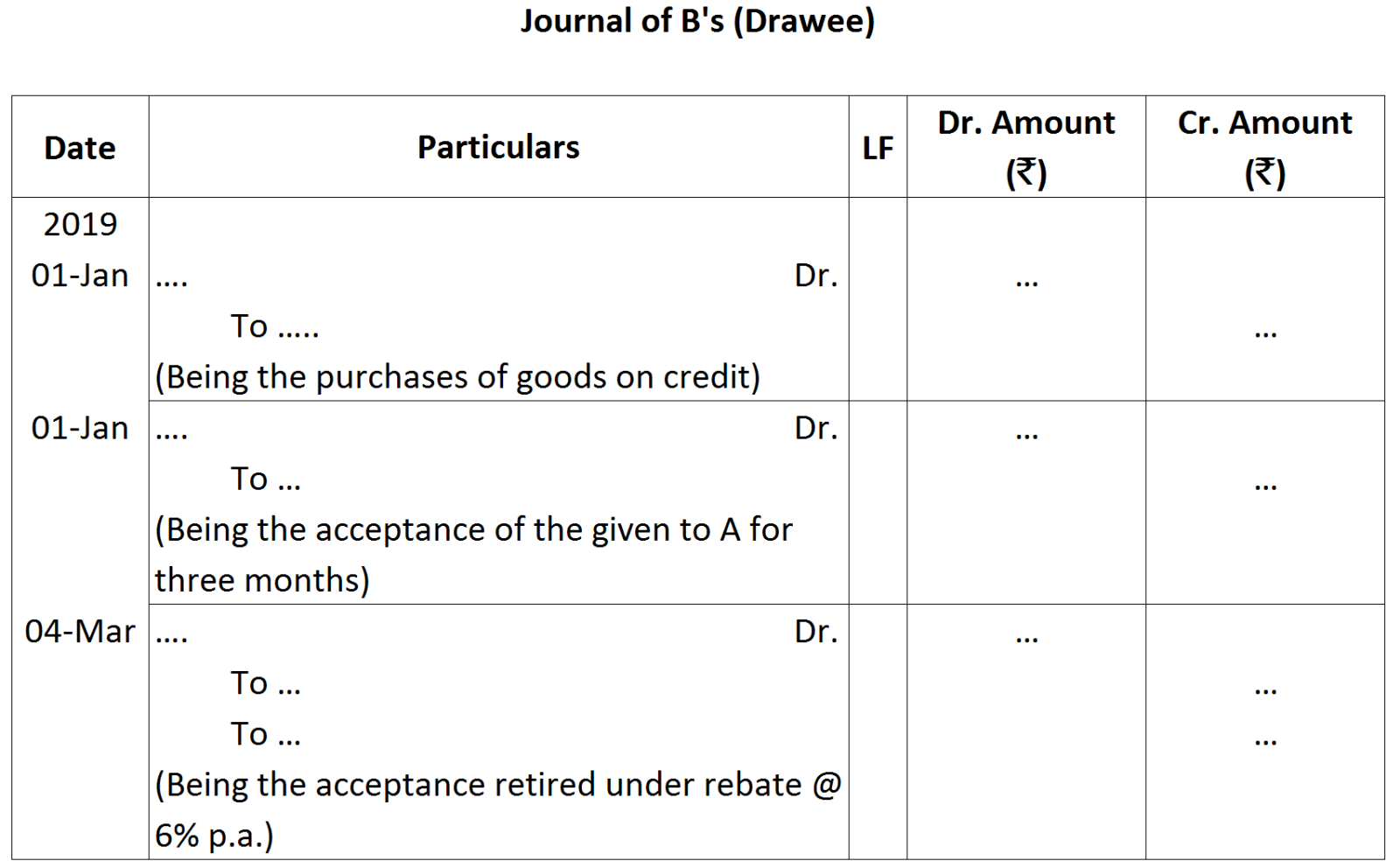
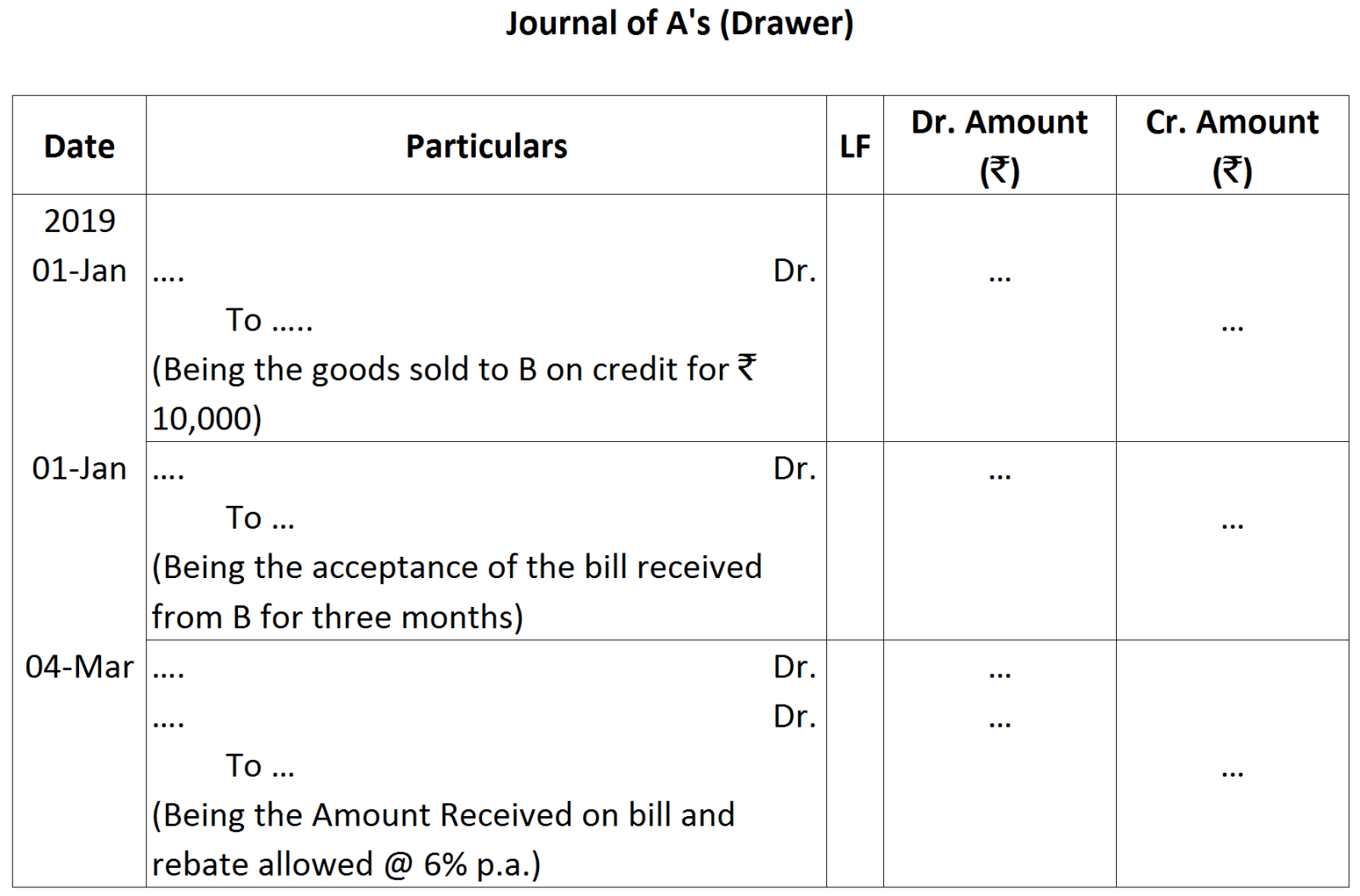
Leena sold goods to Meena on 1st March, 2009 for ₹ 68,000 and drew two Bills of Exchange of the equal amount upon Meena payable after three months. Leena immediately discounted the first bill with her bank at 12% p.a. The bill was dishonoured by Meena and Bank paid ₹ 55 as noting charges.
The second bill was retired on 4th May, 2009 under a rebate of 6% p.a. with mutual agreement.
Journalise the above in the books of Leena and Meena.
View full question & answer
Question 56 Marks
Calculate the due dates of the bills in the following cases:
Date of Bill
Tenure (Period)
(i)
1st December, 2018
60 Days
(ii)
30th April, 2019
2 Months
(iii)
28th January, 2019
1 Month
(iv)
23rd November, 2018
2 Months
(v)
29th May, 2018
4 Months
View full question & answer
Question 66 Marks
X sells goods for ₹ 40,000 to Y on 1st January, 2019 and on the same day draws a bill on Y at three months for the amount. Y accepts it and returns it to X, who discounted it on 4th January, 2019 with his bank at 6% p.a. The acceptance is dishonoured on the due date and the noting charges were paid by bank being ₹ 200.
On 4th April, 2019, Y accepts a new bill at three months for the amount then due to X together with interest at 12% p.a.
Make Journal entries to record these transactions in the books of X.
View full question & answer
Question 76 Marks
Give the Journal entries for the following:
  1. B's acceptance to us for ₹ 1,000 due this day, renewed at his request for 3 months with interest @ 6% p.a.
  2. Our bill to Chandra for ₹ 5,000 renewed for 2 months with interest @ 6% p.a.
  3. B's acceptance of ₹ 3,000 is discharged on his paying us cash ₹ 1,000 and accepting a fresh bill for the balance with interest ₹ 100.
View full question & answer
Question 86 Marks
On 1st June, 2019, A sold goods to B for ₹ 250. B gave to A his acceptance payable 1 month after date. Before maturity B requests A to renew it, which A does adding ₹ 10 to the new bill for interest.
Make the necessary Journal entries to record these transactions in the books of both Aand B.
View full question & answer
Question 106 Marks
On 1st January, 2019, X sold goods of ₹ 20,000 to Y and drew a bill on Y at three months for the amount. Y accepted the bill. The bill is met on maturity. Pass the necessary Journal entries in the books of X and Y, if X discounted the bill @ 12% p.a. from bank on 4th January.
View full question & answer
Question 116 Marks
On 1st March, 2019, R accepted a Bill of Exchange of ₹ 20,000 from S payable 3 months after date in full settlement of his dues. On the same day S endorsed the Bill of Exchange to T together with a cheque for ₹ 5,000 in settlement of his debt to the latter. On 2nd March, 2019, T discounted the Bill of Exchange @ 6% p.a. with his bank. On maturity the Bill of Exchange was dishonoured.
Journalise the transactions in the books of R and T.
View full question & answer
Question 126 Marks
Dinesh received from Shridhar an acceptance for ₹ 3,000 on 1st September, 2018 at 3 months. Dinesh got the acceptance discounted at 9% p.a. from his bank. On the due date, Shridhar paid the required amount.
Give the Journal entries in the books of Dinesh and Shridhar.
View full question & answer
Question 136 Marks
A sells goods of ₹ 10,000 on 1st March, 2019 to B on credit. B accepts a bill on the same date for the amount payable three months after date. A discounts the bill at 6% p.a. from bank on 4th April. On maturity, the bill is met by B. Pass the necessary Journal entries in the books of both the parties.
View full question & answer
Question 146 Marks
On 15th June, 2019, X sold to Y goods to the value of ₹ 15,000 drawing upon the latter two bills, one for ₹ 10,000 payable 2 months after date and other for ₹ 5,000 payable 3 months after date, X discounted the first bill with his bank at 6% p.a. and endorsed the second bill in favour of his creditor, Z. The first bill was met on maturity but the second was dishonoured. Z paid ₹ 50 as noting charges. On 1st October, Y cleared his account to X by paying ₹ 5,100 which included ₹ 50 as interest.
Record the necessary Journal entries in the books of both X and Y.
View full question & answer
Question 156 Marks
A sold goods to B on 1st September, 2018 for ₹ 16,000. B immediately accepted a 3 months bill. On the due date, B requested that the bill be renewed for a further period of 2 months. A agreed provided interest at 9% p.a. was paid immediately in cash. To this Bwas agreeable. The second bill was met on the due date. Give the Journal entries in the books of A.
View full question & answer
Question 166 Marks
On 1st January, 2008, A sold goods to B for ₹ 1,00,000 received ₹ 25,000 in cash and drew two bills, first ₹ 45,000 and second for ₹ 30,000 of two months each. Both bills were duly accepted by B. First bill was endorsed to C in settlement of his account of ₹ 45,000 and second bill was discounted from the bank at the rate of 12% p.a. On the due date of these bills, both bills were dishonoured, C has paid ₹ 100 and bank has paid ₹ 80 as noting charges.
Pass Journal entries in the books of A, B and C.
View full question & answer
Question 176 Marks
A owed B ₹ 8,000. He gave a bill for the same on 1st August, 2018 payable after 4 months at the Bank of India, Chandni Chowk, Delhi. Immediately after receiving the bill, B endorsed it to C in payment of his debt. On 1st September, C discounted the bill at 12% p.a. The bill is met on due date.
Pass the necessary Journal entries in the books of A, B and C.
View full question & answer
Question 186 Marks
Amar sells goods to Bhola for ₹ 10,000 plus CGST and SGST @ 9% each. He receives the GST amount in cash and draws upon Bhola a bill for the balance amount payable 3 months after date. The bill is accepted by Bhola. Amar discounts the bill with his bank at a discount of ₹ 150 inclusive of all charges. Bhola fails to meet this bill on maturity. Amar pays off his bank and his expenses amounting to ₹ 100. Bhola gives a fresh bill of 2 months' date to Amar for ₹ 10,250, which he meets at maturity. Show necessary Journal entries in Amar's books.
View full question & answer
Question 196 Marks
On 1st January, 2019 for goods sold, Ramesh drew a Bill of Exchange on Mahesh for ₹ 4,000, for a period of 3 months. Mahesh accepts it and returns to Ramesh. Ramesh then endorses it to Mukesh who in turn endorses it to Suresh on 1st February, 2019. The bill is then discounted by Suresh on the same date with his bank at 5% p.a. On the due date the bill is dishonoured.
Pass the necessary Journal entries in the books of all the four parties.
View full question & answer
Question 206 Marks
A drew a bill of ₹ 1,000 on B for 3 months which was duly accepted by the latter. A endorsed the bill to C in full payment of his own acceptance to C for a like amount. C endorsed the bill to B.
Pass the Journal entries in the books of A, B and C.
View full question & answer
Question 216 Marks
Ram owes ₹ 2,000 to Mohan on 1st January, 2019. On this date, he accepted a draft for the amount for 3 months. Mohan got the bill discounted at his bank @ 6% p.a. On the due date, the bill was dishonured, nothing charges ₹ 20. Ram agreed to pay ₹ 520 immediately and accept another bill for the remaining amount for 3 months together with interest at 9% p.a. This bill was met on the due date. Give the Journal entries in the books of both the parties.
View full question & answer
Question 226 Marks
X draws a bill on Y for ₹ 2,000 on 1st January, 2019, Y accepts the same and returns it to X. The bill was drawn by X in full settlement of a debt owing by Y amounted to ₹ 2,050. Xdiscounts the bill on the same date with the Central Bank of India for ₹ 1,980. On maturity the bill was duly met by Y.
Give the entries in the books of X and Y.
Suppose the bill is dishonoured, what entries will be passed?
View full question & answer
Question 246 Marks
X draws on Y a bill for ₹ 4,000 which was duly accepted by Y. Y meets the bill on its due date. Show what entries would be passed in the books of X under each of the following circumstances:
  1. If X retains the bill till due date.
  2. If X discounts the same with his banker paying ₹ 100 for discount.
  3. If X endorses the same to his creditor Z in full settlement of his debt of ₹ 4,080.
  4. If X sends the bill to his banker for collection the next day.
View full question & answer
Question 256 Marks
A purchases goods worth ₹ 6,200 from B and gives him his acceptance for ₹ 6,000 in full satisfaction. B purchases goods worth ₹ 10,000 from C and endorses the bill to him, paying the balance by cheque. On maturity the bill is dishonoured, noting charges amounted to ₹ 100.
Give the Journal entries in the books of A, B and C.
View full question & answer
Question 266 Marks
On 1st May, 2019 Merchant & Co. sold goods to AB & Co. valued at ₹ 500 and drew upon them a bill at 3 months for the amount. AB & Co. accepted the draft on presentation. When the bill was about to mature. AB & Co. expressed their inability to meet it, and offered to pay Merchant & Co. ₹ 200 in cash and to accept a fresh bill for the balance plus interest at 6% p.a. for 3 months. Merchant & Co. agreed to the proposal and bill was renewed. On maturity, the bill was duly met.
Make the entries in the books of both the parties to record the above transactions.
View full question & answer
Question 276 Marks
A bill for ₹ 1,000 is drawn by A on B and accepted by the latter payable at the New Delhi, Bank of India. Show what entries should be passed in the books of A under each of the following circumstances:
  1. If A retained the bill till the due date and then realized it on maturity.
  2. If A discounted it with his bank for ₹ 950.
  3. If A endorsed it to his creditor C in full settlement of his debt.
  4. If A sent it to his bank for collection.
Also, give the necessary entries in each of the cases if the bill is dishonoured.
View full question & answer
Question 286 Marks
A owed B ₹ 400. A accepted a Bill of Exchange at 3 months for this amount which B discounted for ₹ 380.
Give the necessary Journal entries in the books of A and B if this bill is:
  1. Dishonoured on the due date.
  2. Met at maturity.
  3. Retired under rebate at 6% p.a. 2 months before its maturity.
View full question & answer
6 Marks Question - Account STD 11 Commerce Questions - Vidyadip