Question types

Accounts from Incomplete Records Single Entry System question types

83 questions across 5 question groups — pick any mix to generate a Account paper with step-by-step answer keys.

83
Questions
5
Question groups
5
Question types
Sample Questions

Accounts from Incomplete Records Single Entry System questions

One sample from each question group in this chapter. Select any group above to see the full set with answer keys.

Bills Payable honoured during the year will be debited to:
  • A
    Cash Account.
  • Bills Payable Account.
  • C
    Creditors Account.
  • D
    None of these.

Answer: B.

View full solution
When closing capital is greater than opening capital it means:
  • A
    Profit.
  • B
    Loss.
  • Profit if fresh capital is not introduced.
  • D
    No profit, no Loss.

Answer: C.

View full solution
In case of net worth method of Single Entry System, profit is ascertained by:
  • Comparing the capital in the beginning of the accounting period and the capital at the end of the accounting period.
  • B
    Preparing a Profit and Loss Account.
  • C
    Preparing a Balance Sheet.
  • D
    None of these.

Answer: A.

View full solution
Sales are calculated by adding:
  • A
    Cash sales and cash received from debtors.
  • B
    Credit sales and cash received from debtors.
  • Cash sales and credit sales.
  • D
    None of the above.

Answer: C.

View full solution
Q 113 Marks Question3 Marks
Why the statement of assets and liabilities prepared under Single Entry System at the end of the accounting period is called a Statement of Affairs instead of Balance Sheet?
View full solution
Q 123 Marks Question3 Marks
From the following particulars, prepare Total Creditors Account:
 
Credit purchases 2,40,000
Cash purchases 50,000
payment to creditors 2,10,000
Discount allowed by them 5,000
Bills Payable accepted 30,000
Creditors in the beginning of the year 90,000
View full solution
Q 143 Marks Question3 Marks
Mayank does not keep proper records of his business, he gives you the following information:
 
Opening Capital 1,00,000
Closing Capital 1,25,000
Drawings during the year 30,000
Capital added during the year 37,500
Calculate the profit or loss for the year.
View full solution
Q 153 Marks Question3 Marks
Cash sales of a business in a year were ​₹ 85,000, the Cost of Goods Sold (including direct expenses) was ₹ 97,000 and Gross Profit as shown by the Trading Account for the year was ₹ 1,29,000. Calculate Credit Sales during the year.
View full solution
Q 164 Marks Question4 Marks
Creditors on 1st April, 2017 were ₹ 15,000, Purchases on credit were ₹ 30,000, Cash paid to Creditors during 2017-18 was ₹ 20,000, Returns Outward (regarding credit purchases) were ₹ 1,000 and Bills Payable accepted during the year ₹ 10,000. Find the balance of Creditors on 31st March, 2018.
View full solution
Q 174 Marks Question4 Marks
From the following information, calculate Total Sales made during the period:
 
Debtors as on 1st April, 2017 20,400
Cash received from debtors during the year (as per Cash Book) 60,800
Returns Inward 5,400
Bad Debts 2,400
Debtors as on 31st March, 2018 27,600
Cash Sales (as per Cash Book) 56,800
View full solution
Q 194 Marks Question4 Marks
Calculate Total Sales from the following information:
 
Bills Receivables as on 1st April, 2017 7,800
Debtors as on 1st April, 2017 30,800
Cash received on maturity of Bills Receivable during the year 20,900
Cash received from Debtors 70,000
Bad Debts written off 4,800
Returns Inward 8,700
Bills Receivable dishonoured 1,800
Bills Receivable on 31st March, 2018 6,000
Debtors as on 31st March, 2018 25,500
Cash Sales during the year 15,900
View full solution
Q 204 Marks Question4 Marks
From the following information supplied by X, who keeps his books on Single Entry System, you are required to calculate Total Purchases:
 
Opening balance of Bills Payable 5,000
Opening balance of Creditors 6,000
Closing balance of Bills Payable 7,000
Closing balance of Creditors 4,000
Cash paid to Creditors during the year 30,200
Bills Payable discharged during the year 8,900
Returns Outward 1,200
Cash Purchases 25,800
View full solution
Q 216 Marks Question6 Marks
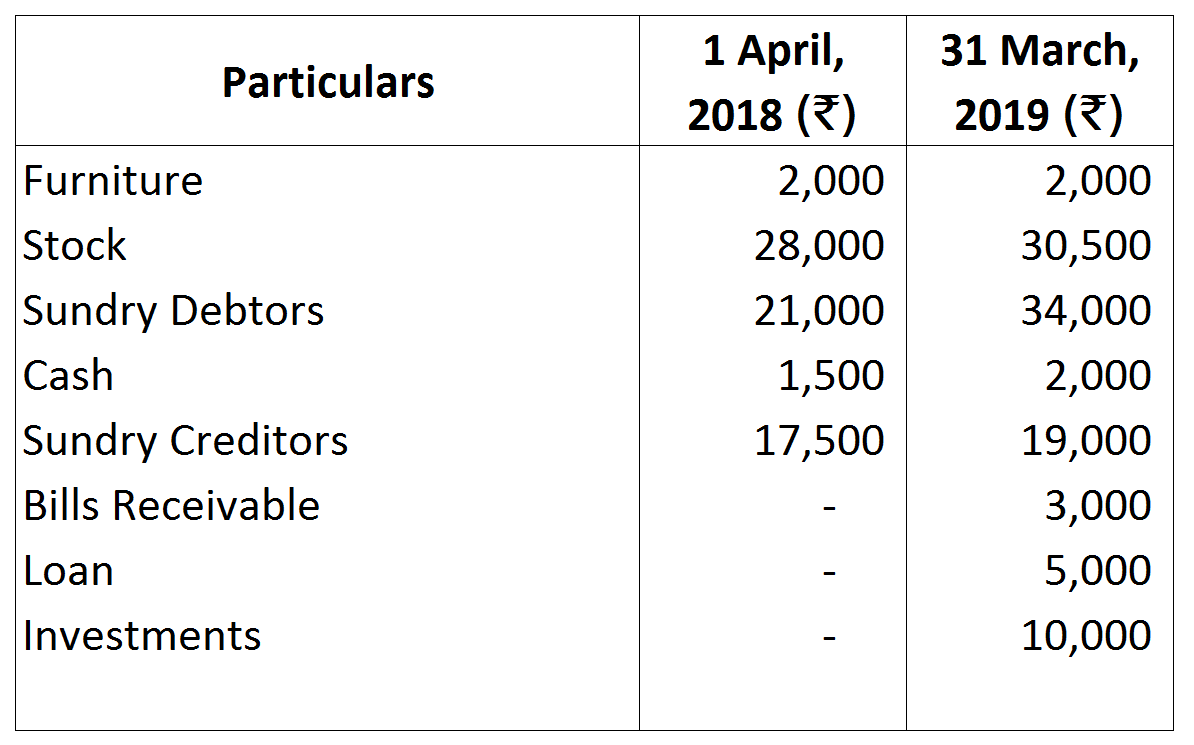
Hari maintains his books of account on Single Entry System. His books provide the following information:
His drawings during the year were ₹ 5,000 Depreciate furniture by 10% and provide a reserve for Bad and Doubtful Debts at 10% on Sundry Debtors. Prepare the statement showing the profits for the year.
View full solution
Q 226 Marks Question6 Marks
Krishan started his business on 1st April, 2018 with a Capital of ₹ 1,00,000. On 31st March, 2019, his assets were:
 
Cash 3,200
Stock 34,800
Debtors 31,000
Plant 85,000
He owed ₹ 12,000 to sundry creditors and ₹ 10,000 to his brother on that date. He withdrew ₹ 2,000 per month for his personal expenses. Ascertain his profit.
View full solution
Q 236 Marks Question6 Marks
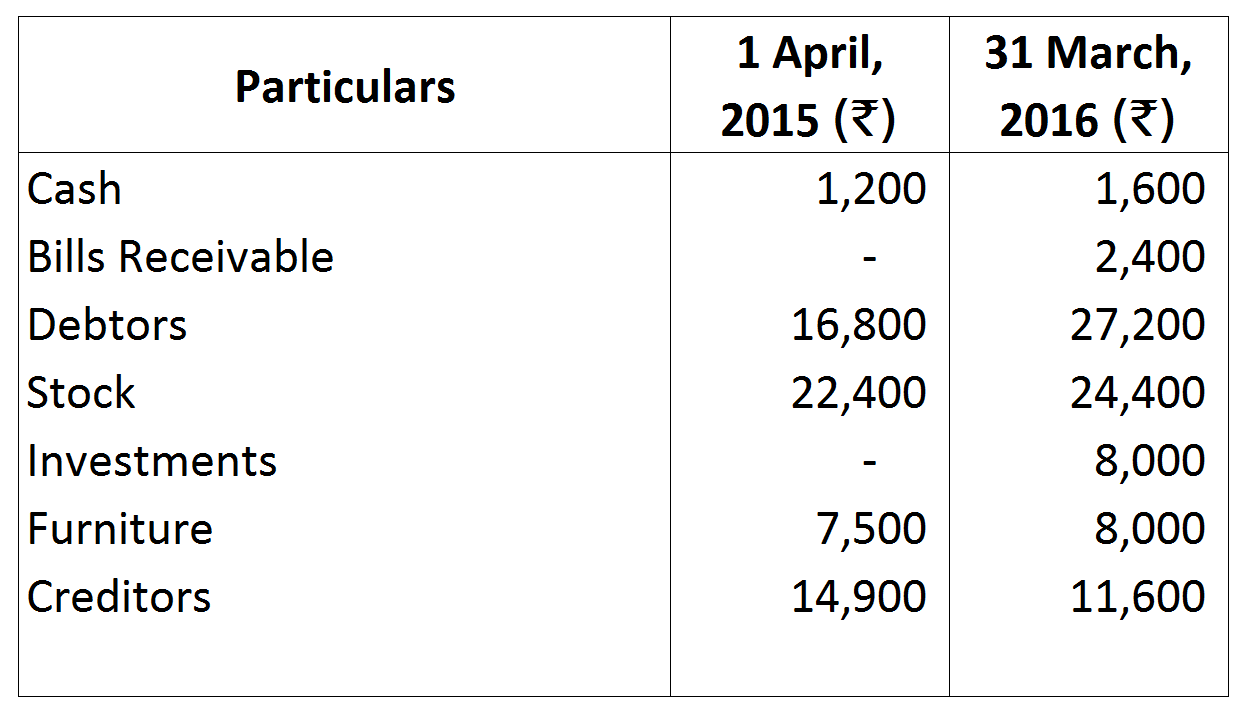
Shruti maintains her books of account from Incomplete Records. Her books provide the following information:
She withdrew ₹ 500 per month for personal expenses. She sold her Investments of ₹ 16,000 at 5% premium and introduced the amount into business.
You are required to prepare a Statement of Profit or Loss for the year ending 31st March, 2016.
View full solution
Q 256 Marks Question6 Marks
A commenced business on 1st April, 2018 with a capital of ₹ 10,000. He immediately bought Furniture and Fixtures for ₹ 2,000. On 1st October, 2018, he borrowed ₹ 5,000 from his wife @ 9% p.a. (interest not yet paid) and introduced a further capital of his own amounting to ₹ 1,500. A drew @ ₹ 300 per month at the end of each month for household expenses. On 31st March, 2019 his position was as follows:
Cash in Hand ₹ 2,800; Sundry Debtors ₹ 4,800; Stock ₹ 6,800; Bills Receivable ₹ 1,600; Sundry Creditors ₹ 500 and owing for Rent ₹ 150. Furniture and Fixtures to be depreciated by 10%.
Ascertain the profit or loss made by A during 2018-19.
View full solution

Generate a Accounts from Incomplete Records Single Entry System paper free

Pick question groups from the list above, set marks and difficulty, and export a branded PDF with step-by-step answer keys. First 3 chapters free — no signup.

Download App