Questions

4 Marks Question

🎯

Test yourself on this topic

9 questions · timed · auto-graded

Question 14 Marks
What is meant by provision for doubtful debts? How are the relevant accounts prepared and what journal entries are recorded in final accounts? How is the amount for provision for doubtful debts calculated?
Answer
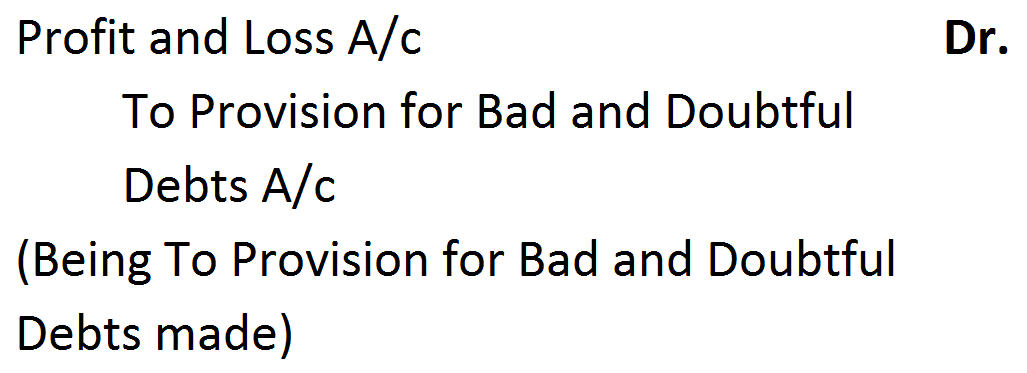
The provision for doubtful-debts is provided after deducting the amount of bad-debts from the debtors. The provision for doubtful-debts is provided because of the rationale that the actual amount of bad-debts will only be known in the next year, when the amount of debtors will get realised. Thus, it will only then be known as to how many of the debtors have become bad. Thus, in order to bridge-up the expected future loss, we create a provision for doubtful-debts. For the provision for doubtful-debts, we prepare debtors account and provision for doubtful-debts account. For recording bad-debts, the following journal entry is passed.
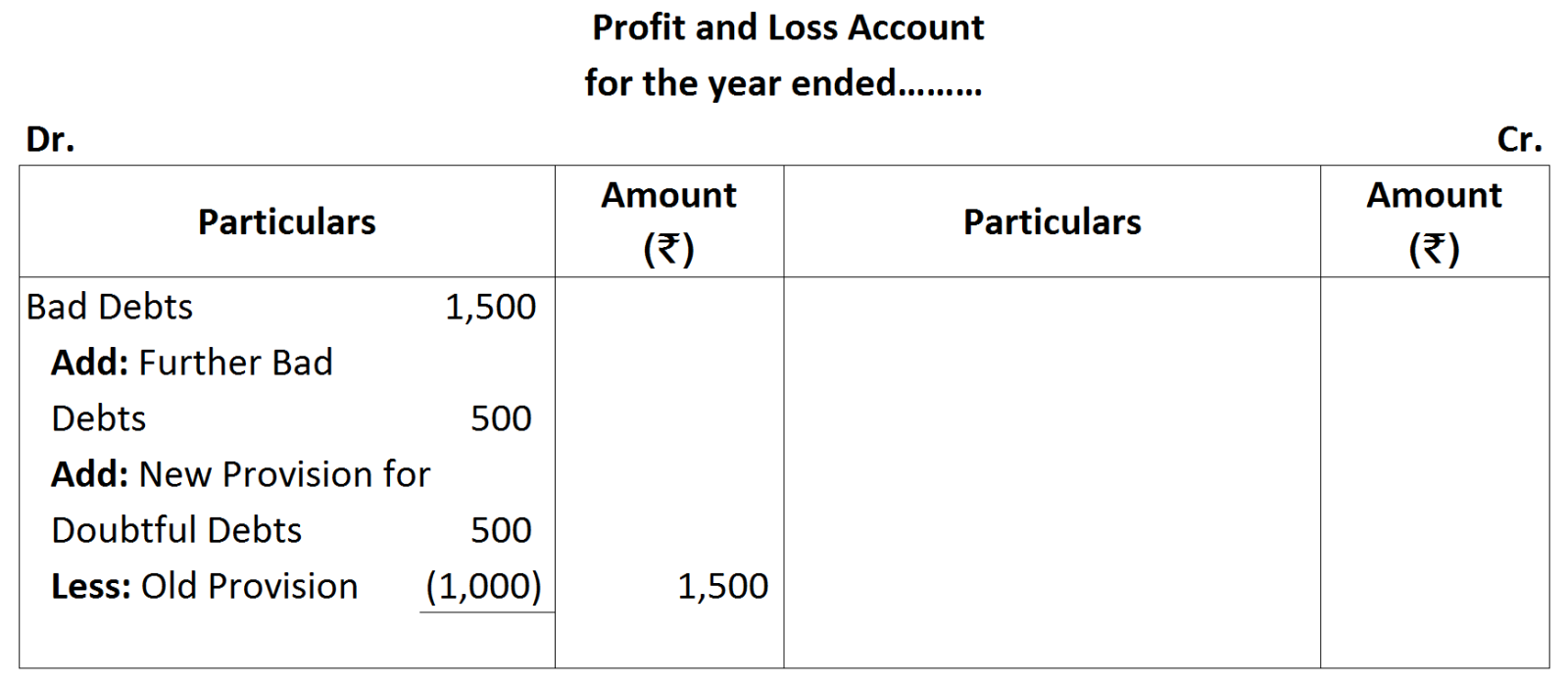
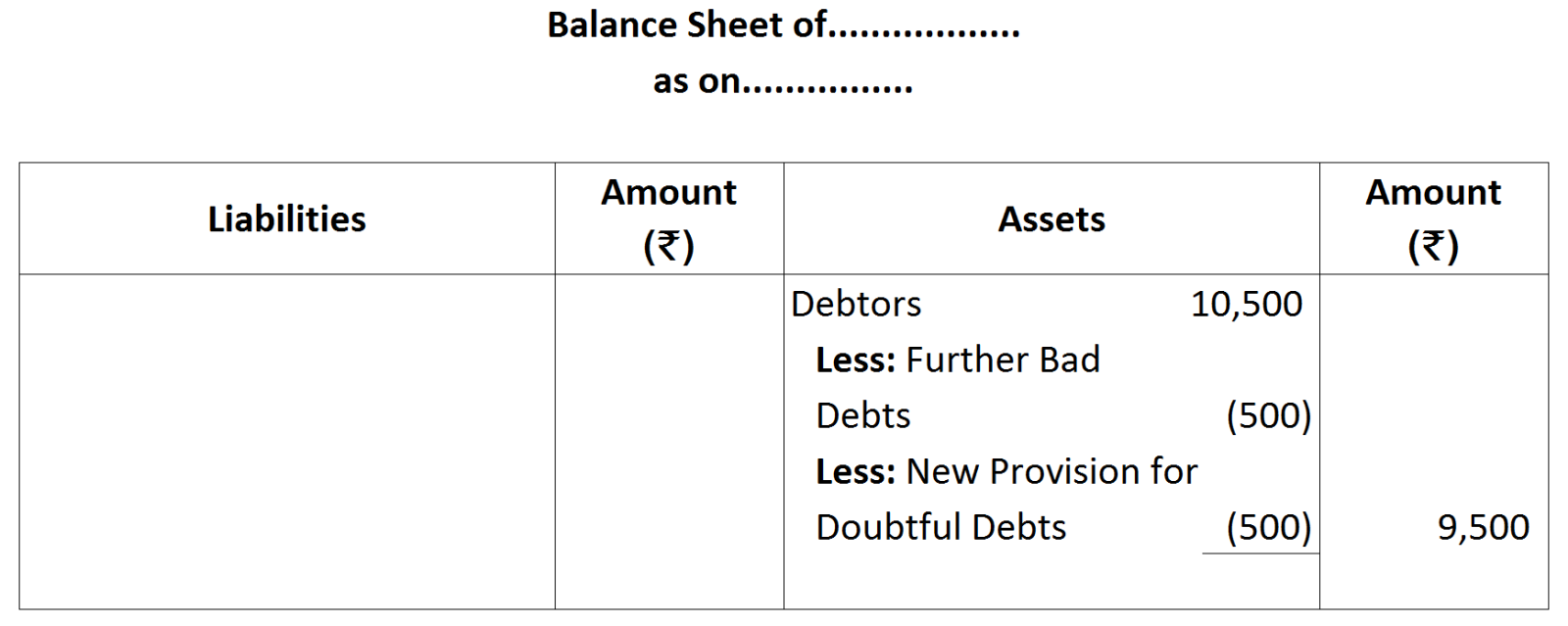
Example: An extract from a Trial Balance as on December 31, 2010.
Debtors
Provision for Doubtful Debts as on January 01, 2010
Bad Debts Account
10,500
1,000
1,500
Adjustment:
  1. Further bad-debts amount to Rs 500.
  2. Create a provision for doubtful-debts at 5% on debtors.
Explanation The provision for Doubtful Debt as on January 01, 2010 was ₹ 1,000 and the Bad Debts during the year were ₹ 1,500. In addition to this, there was a further Bad Debt of ₹ 500 which was known at the end of the year i.e., December 31, 2010. Now we need to create a provision for Doubtful Debts at 5% on debtors.
View full question & answer
Question 24 Marks
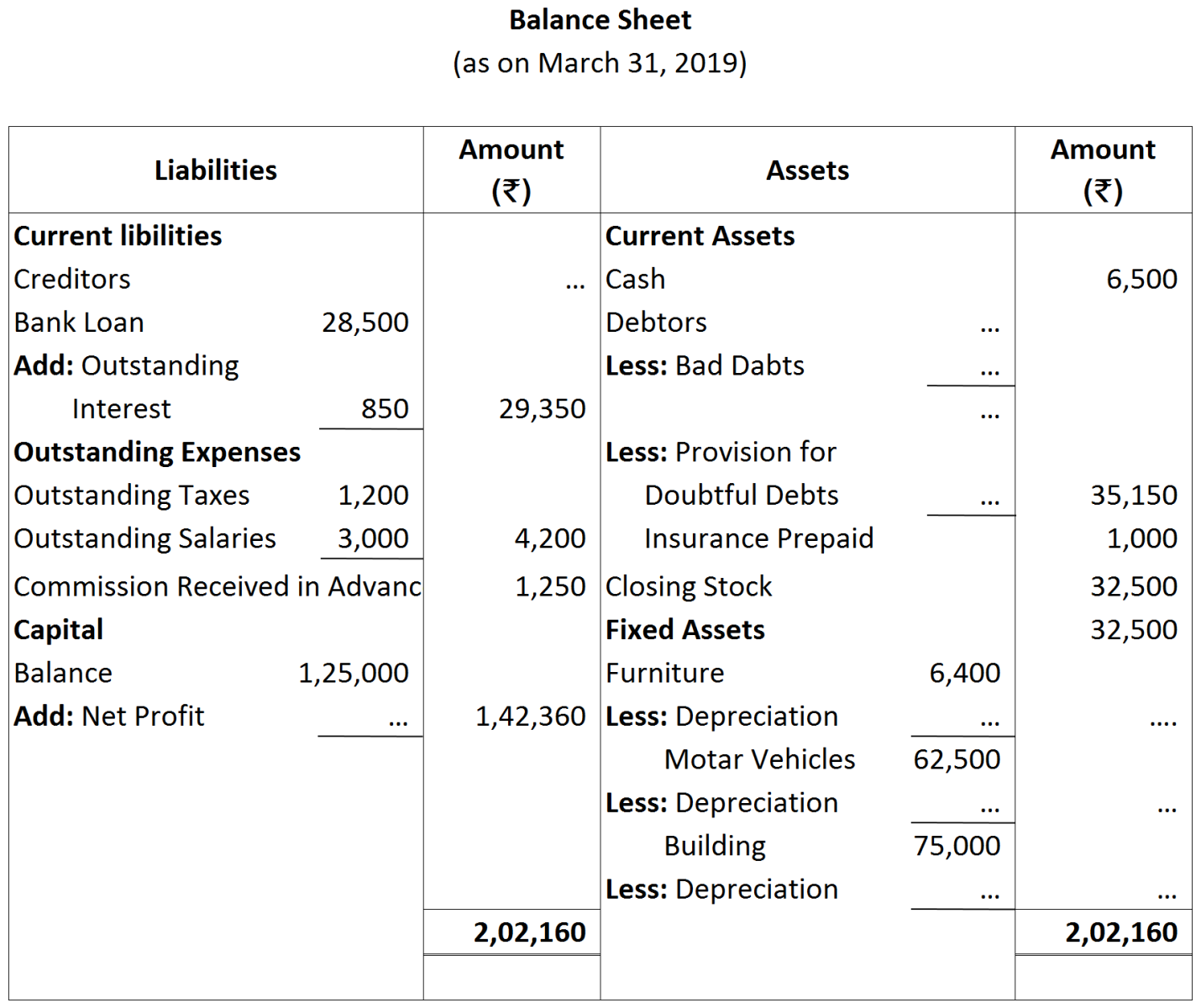
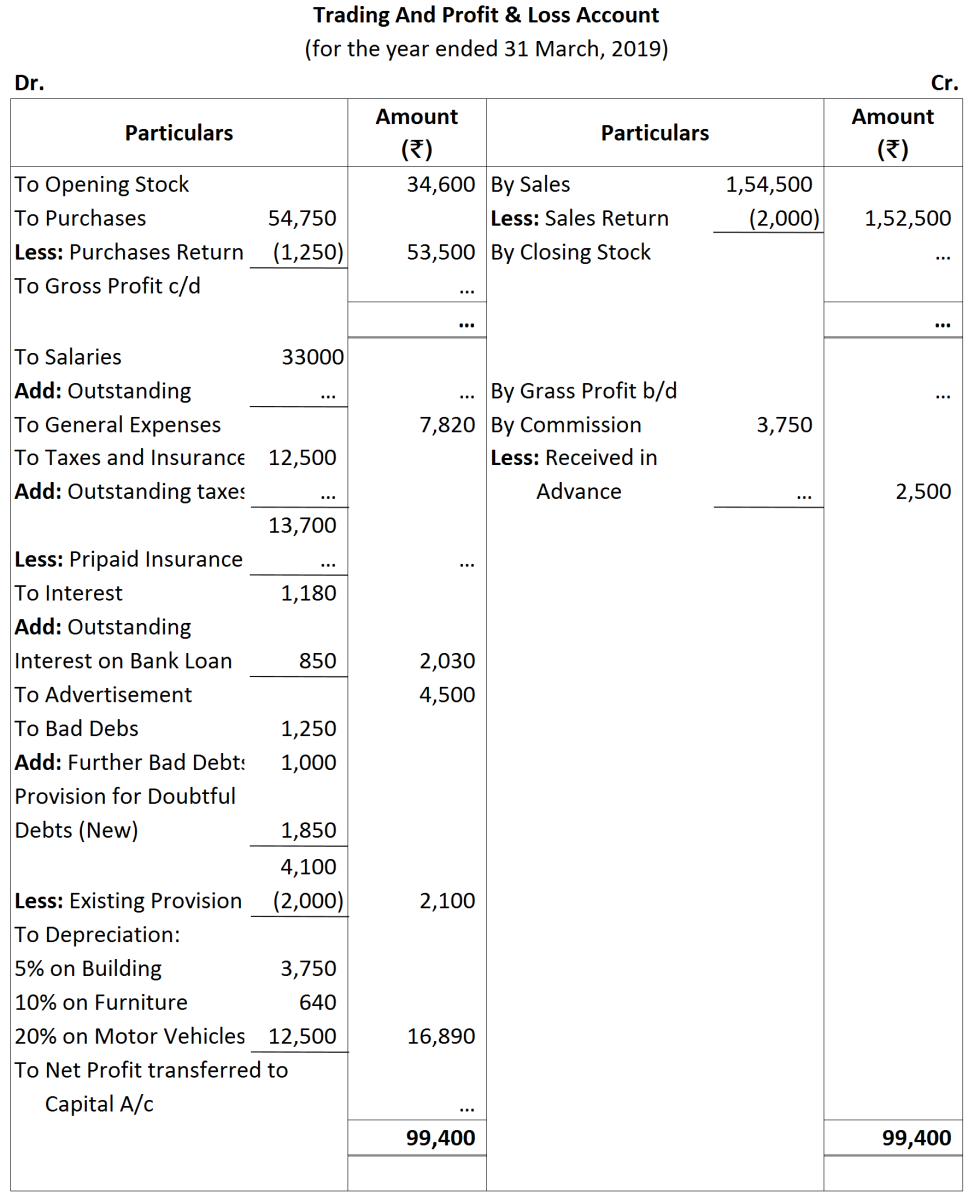
In the following Trading and Profit and Loss Account for the ended 31st March, 2019 and Balance Sheet as on that date, determine the missing information:

View full question & answer
Question 34 Marks
Give the similarities of Cash Book with Journal?
Answer
  1. Just like a journal, transactions in the Cash book are recorded for the first time from source documents.
  2. Just like a journal, transactions in the Cash book are recorded datewise, i.e., in a chronological order, as and when they take place.
  3. Just like a journal, transactions from Cash book are also posted to the relevant accounts (except Cash account) in the ledger.
  4. Just like a journal, a Cash book also contains a Ledger Folio Column.
View full question & answer
Question 44 Marks
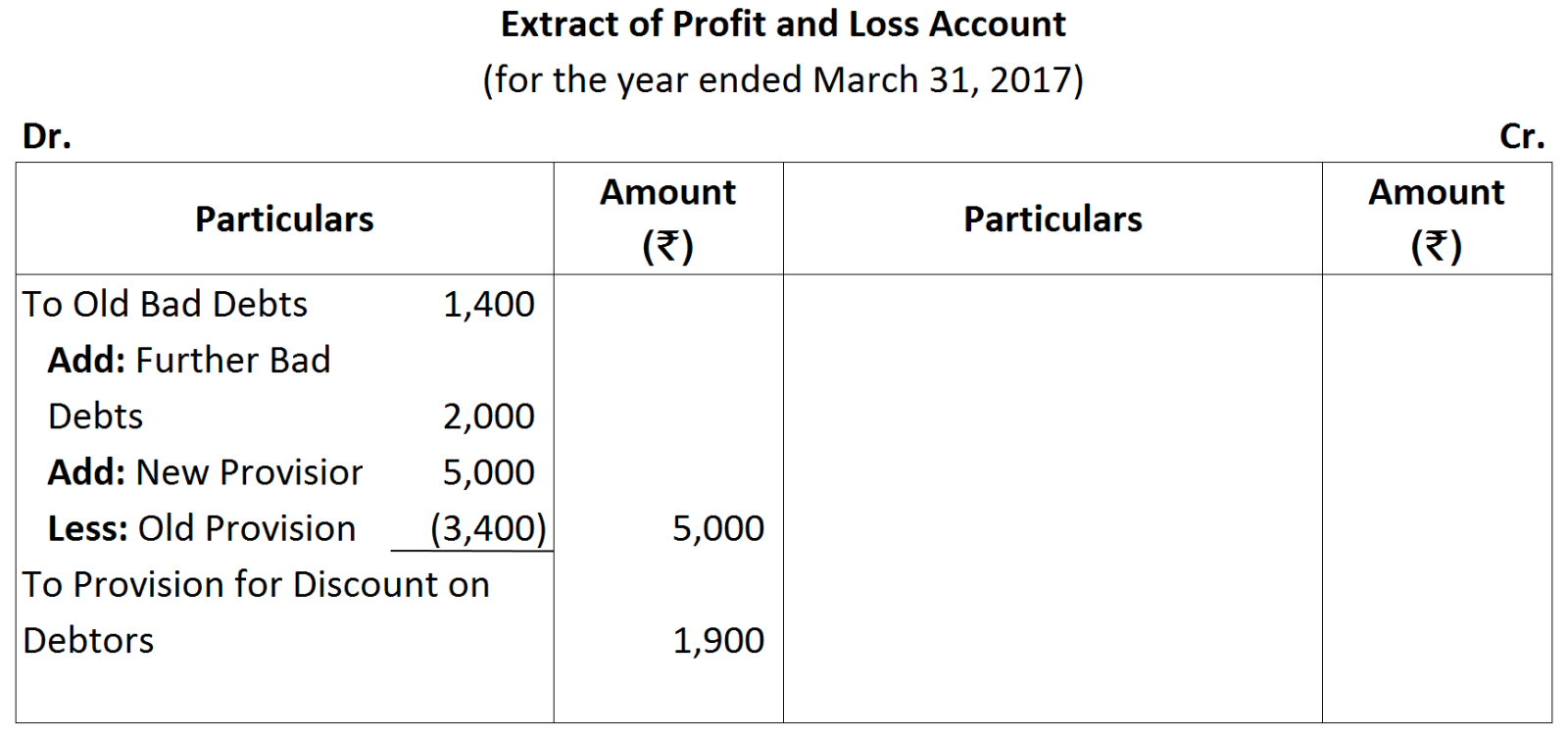
Extract of a Trial Balance as at March 31, 2017 is as follows:
Sundry Debtors
₹ 1,02,000
Bad Debts
₹ 1,400
Provision for doubtful debts
₹ 3,400
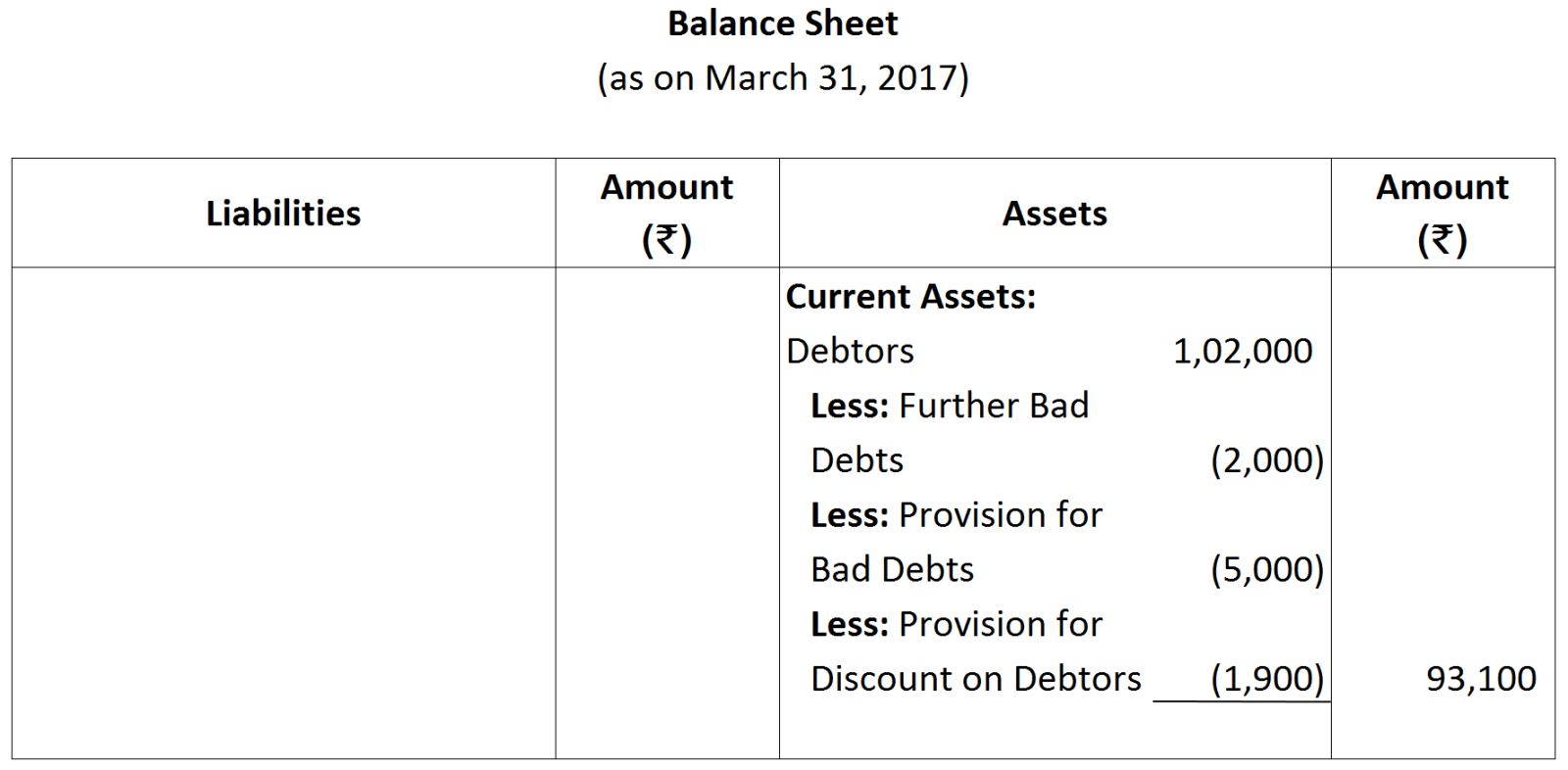
Additional information: A debtor of ₹ 2,000 could not be recovered. It is decided to maintain Provision for Doubtful Debtors @ 5% on Debtors and Provision for Discount at @ 2%. How these adjustments will be shown in Financial Statements?
Answer


Working Notes:
WN 1: Calculation of Provision for Doubtful Debts,
Provision for Doubtful Debts $=(\text{Debtors}-\text{Further Bad Debts})\times\frac{\text{Rate}}{100}$
$=(1,02,000-2,000)\times\frac{5}{100}=5,000$
WN 2: Calculation of Provision for Discount on Debtors,
Provision for Discount on Debtors = (Debtors - Further Bad Debts - Provision for Doubtful Debts) $\times\frac{\text{Rate}}{100}$
$=(1,02,000-2,000-5,000)\times\frac{2}{100}=1,900$
View full question & answer
Question 54 Marks
Why is it necessary to record the adjusting entries in the preparation of final accounts?
Answer
It is extremely important to record the adjusting entries in the preparation of final accounts.
  1. This is done in order to assess the true net profit or net loss of the business organisation.
  2. It helps us record those adjustments which were left or omitted and were not recorded in the accounts.
  3. It assists us to separate all the financial transactions into a year-wise category. The financial statements include only those entries which belong to the current year. It rules out the previous and forthcoming years’ entries which are the basis for accrual basis of accounting.
  4. Further, it provides us the room for making various provisions which are made at the end of the year, after assessing the entire year’s performance.
View full question & answer
Question 64 Marks
Prepare the bad debts account, provision for account, profit and loss account and balance sheet from the following information as on March 31, 2017
 
Debtors
80,000
Bad debts
2,000
Provision for doubtful debts
5,000
Adjustments :
Bad debts 500 Provision on debtors @ 3%.
View full question & answer
Question 74 Marks
What are adjusting entries? Why are they necessary for preparing final accounts?
Answer
Adjusting entries are the entries of those adjustments which are given outside the trial balance and which help us reflect the true financial position i.e., profit or loss of an organisation. According to the double-entry system, all the adjustments given outside the Trial Balance are posted at two places. The adjusting entries are necessary they enable us to post and take into account those items which are omitted or entered with the wrong amount and/or recorded under wrong heads.
The treatment of adjusting entries is necessary.
  1. It helps us assess the true financial position of an organisation based on accrual basis of accounting.
  2. It helps us know the actual figure of profit or loss.
  3. It records the omitted entries and rectifies the errors made.
  4. It helps in providing depreciation and making different provisions, such as Bad Debts and depreciation.
View full question & answer
Question 84 Marks
Give the journal entries for the following adjustments:
  1. Outstanding salary ₹ 3,500.
  2. Rent unpaid for one month at ₹ 6,000 per annum.
  3. Insurance prepaid for a quarter at ₹ 16,000 per annum.
  4. Purchase of furniture costing ₹ 7,000 entered in the purchases book.
View full question & answer
Question 94 Marks
The following balances appeared in the trial balance of M/s Kapil Traders as on March 31, 2017
 
Sundry debtors
30,500
Bad debts
500
Provision for doubtful debts
2,000
The partners of the firm agreed to records the following adjustments in the books of the Firm: Further bad debts ₹ 300. Maintain provision for bad debts 10%. Show the following adjustments in the bad debts account, provision account, debtors account, profit and loss account and balance sheet.
View full question & answer
4 Marks Question - Account STD 11 Commerce Questions - Vidyadip