Questions

3 Marks Question

🎯

Test yourself on this topic

5 questions · timed · auto-graded

Question 13 Marks
Write notes on the following:
  1. Accrued Income.
  2. Unearned Income.
  3. Provision for Doubtful Debts.
Answer
  1. Accrued Income: It is quite common that certain items of income such as interest on securities, commission, rent etc., are earned during the current year but have not been actually received by the end of the current year.
  2. Unearned Income: It may also happen that a certain income is received in the current year but the whole amount of it does not belong to the current year. Such portion of this income which belongs to the next year is known as 'Unearned Income' or 'Income received but not earned'.
  3. Provision for Doubtful Debts: Even after deducting the amount of actual bad-debts from the debtors, the list of debtors at the end of the year may include some debts which are either bad or doubtful. As the amount of actual loss on account of current year bad-debts would be known only in the next year when the amount is realised from debtors, a provision is created to cover any possible loss on account of bad-debts likely to occur in future. Such a provision is created at a fixed percentage on debtors every year and is called “Provision for Bad and Doubtful Debts'.
View full question & answer
Question 23 Marks
A Company purchased a Machine on 1-4-2008 at a cost of ₹ 3,10,000, estimated residual value ₹ 10,000 with a useful life of 15 years. Depreciation is charged under straight line method till 31-3-2018. After 10 years, an expert recommended that the asset to be used for 10 more years. What is the depreciation for the year 2018-19 under straight line method assuming residual value to remain same?
Answer
Annual Depreciation upto 31-3-2018,
$\frac{3,10,000-10,000}{15}=₹\ 20,000\text{ per year}$
Book Value of Machinery on 31-3-2018
$3,10,000-(20,000\times10)=1,10,000$
Depreciation for the year 2018-19
$\frac{1,10,000-10,000}{10}=₹\ 10,000$
View full question & answer
Question 33 Marks
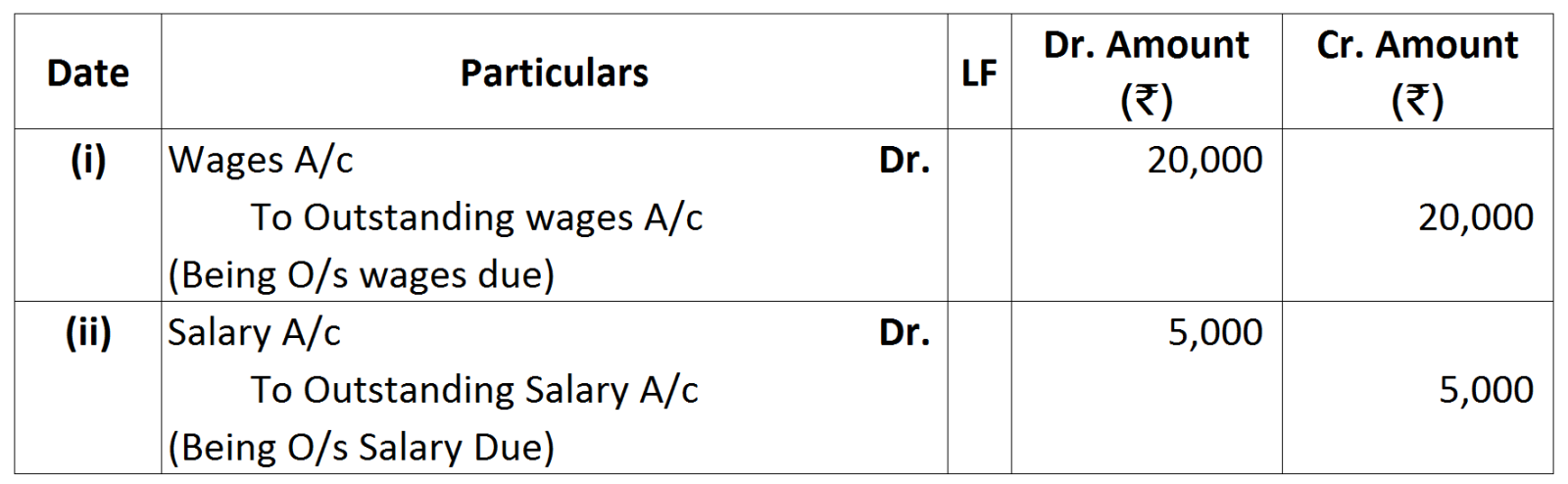
What is meant by Outstanding Expenses? Give its adjusting entry.
Answer
Outstanding Expenses: These are the expenses which have been incurred during the year but have been left unpaid on the date of preparation of final accounts. In other words, the benefit of such expenses has been derived during the year but the payment of which has not yet been made.
Adjustment:
View full question & answer
Question 43 Marks
Goods costing ₹ 26,000 were sent to a customer at 20% profit on sale on sale or return basis. Customer returned goods of the selling price of ₹ 7,000. At what amount the remaining goods with the costomer will be shown in the Balance Sheet?
View full question & answer
Question 53 Marks
Explain the following with examples:
  1. Capital Expenditure
  2. Revenue Expenditure
  3. Deferred Revenue Expenditure.
Answer
  1. Capital Expenditure: Any expenditure which is incurred in acquiring or increasing the value of a fixed asset is termed as capital expenditure. As such, the amount spent on the purchase of Land and Building, Plant and Machinery, Furniture etc. is capital expenditure. Such expenditure yields benefit over a long period and hence is written in Assets.
  2. Revenue Expenditure: Any expenditure, the benefit of which is received during the current year itself is termed as revenue expenditure. As such, all the revenue expenditures are debited to Trading and Profit & Loss Account.
  3. Deferred Revenue Expenditure: There are certain expenditures which are revenue in nature but the benefit of which is likely to be derived over a number of years. Such expenditures are termed as 'Deferred Revenue Expenditures'.
View full question & answer
3 Marks Question - Account STD 11 Commerce Questions - Vidyadip