Questions

4 Marks Question

🎯

Test yourself on this topic

14 questions · timed · auto-graded

Question 14 Marks
Discuss direct oral investigation method of collecting primary data.
Answer
According to this method the investigator has to collect his information himself personally from the source concerned. It means the investigator should be are the spot where the enquiry concerned. It means the investigator should be at the spot where the enquiry is being conducted, it is also expected that the investigator should be very polite and courteous. Further he should acquaint himself with the surrounding situation and must know their local customs and tradition.
Advantages:
  1. The information collected by this method is reliable and accurate
  2. It is a good method for intensive investigation.
  3. This method is flexible. Investigator can make requisite changes in the language of the question or otherwise as per the comfort of respondent.
  4. Data obtained by this method are more uniform and homogeneous.
  5. This method gives a satisfactory result provided the scope of inquiry is narrow.
Disadvantages:
  1. This methods is not suitable for extensive inquiry.
  2. Its required a lot of expenses and time.
  3. The bias on the part of investigator can damage the whole inquiry.
  4. Sometimes the informant may be reluctant to answered the question Suitability This method is suitable when scope of enquiry is limited and much accuracy is required.
View full question & answer
Question 24 Marks
Which factors will you consider in determining sample size? Explain.
Answer
Essentials of a good sample are as follows:
  1. Representativeness: A good sample should be representative of the entire population. It should have same characteristics as the entire population. It is possible when samples are selected at random i.e. each and every item was given equal chance of selection.
  2. Independence: Items comprising the sample should be independent of each other. It means that selection of one item should not be dependent on selection of other item.
  3. Homogeneity: There should be uniformity in sample in terms of units and other characteristic. If two different samples are taken from same population, they should give similar results.
  4. Adequacy: Sample should be adequate to give accurate results. In this context there are two laws of statistics- Law of Inertia of Large Numbers and Law of Statistical Regularity.
View full question & answer
Question 34 Marks
What precautions are necessary in using secondary data?
Answer
The investigator should take precautiotrs before using the secondary data. In this connectiory following precautions should be taken into account.
  1. Suitable Purpose of Investigation: The investigator must ensure that the data are suitable for the purpose of enquiry.
  2. Inadequate Data: Adequacy of the data is to be judged in the light of the requirements of the survey as well as the geographical area covered by the available data.
  3. Definition of Units: The investigator must ensure that the definitions of units which are used by him are the same as in the earlier investigation.
  4. Degree of Accuracy: The investigator should keep in mind the degree accuracy maintained by each investigator.
  5. Time and Condition of Collection of Facts: It should be ascertained before making use of available data to which period and conditions, the data was collected.
  6. Comparison: Investigator should keep in mind whether the secondary data' reasonable, consistent and comparable.
  7. Test Checking: The use of the secondary data must do test checking and see that totals and rates have been correctly calculated.
  8. Homogeneous Conditions: It is not safe to take published statistics at their face value without knowing their means, values and limitations.
View full question & answer
Question 44 Marks
"Secondary data is ready for reference, while primary data has to be collected and processed”. Keeping in view the above statement, differentiate between primary data and secondary data.
Answer
The differences between primary and secondary data are:
S. No. Basis Primary Data Secondary Data
1.
Originality
They are original.
They are not original.
2.
Time and Cost
The collection of primary data requires a lot of manpower, money and time.
This source is relatively cheaper.
 
3.
Precautions
No precaution is required while using primary data.
It should be used with great care and caution.
4.
Source
They are collected by some agency or person by using the various methods of data collection.
They are already collected and processed by some person or agency and are ready for use.
View full question & answer
Question 54 Marks
What are different sources of Secondary data?
Answer
Published Printed Sources: There are a variety of published printed sources. Their credibility depends on many factors. For example, on the writer, publishing company and time and date when published. New sources are preferred and old sources should be avoided as new technology and researches bring new facts into light.
  • Books: Books are available today on any topic that you want to research. The use of books start before even you have selected the topic. After selection of topics books provide insight on how much work has already been done on the same topic and you can prepare your literature review. Books are secondary source but most authentic one in secondary sources.
  • Journals/ periodicals: Journals and periodicals are becoming more important as far as data collection is concerned. The reason is that journals provide up-to date information which at times books cannot and secondly, journals can give information on the very specific topic on which you are researching rather talking about more general topics.
  • Magazines/ Newspapers: Magazines care also effective but not very reliable. Newspapers on the other hand are more reliable and in some cases the information can only be obtained from newspapers as in the case of some political studies.
Published Electronic Sources: As internet is becoming more advance, fast and reachable to the masses; it has been seen that much information that is not available in printed form is available on internet. In the past the credibility of internet was questionable but today it is not. The reason is that in the past journals and books were seldom published on internet but today almost every journal and book is available online. Some are free and for others you have to pay the price.
  • E-journals: E-journals are more commonly available than printed journals. Latest journals are difficult to retrieve without subscription but if your university has an e-library you can view any journal, print it and those that are not available you can make an order for them.
  • General Websites: Generally websites do not contain very reliable information so their content should be checked for the reliability before quoting from them.
  • Weblogs: Weblogs are also becoming common. They are actually diaries written by different people. These diaries are as reliable to use as personal written diaries.com Unpublished Personal Records: Some unpublished data may also be useful in some cases.
Diaries: Diaries are personal records and are rarely available but if you are conducting a descriptive research then they might be very useful. The Anne Franks diary is the most famous example of this. That diary contained the most accurate records of Nazi wars.
Letters: Letters like diaries are also a rich source but should be checked for their reliability before using them.
View full question & answer
Question 64 Marks
Discuss meaning, merits and demerits of telephonic interview and questionnaires filed through enumerators.
Answer
Telephonic Interviews: In this method, investigator collects information from respondents over telephone. He collects telephonic data of his respondents and calls them for getting information.
Advantages:
  1. It is very cheap and quick method of collecting data.
  2. This method provides information from distant places.
  3. This method involves less labor and time.
Disadvantages:
  1. In this method, person may be unwilling to respond and may disconnect the phone.
  2. This method is not so reliable and accurate as we can't read facial expressions and body language
  3. It lacks uniformity.
Questionnaires Filled By Enumerators: According into this method enumerators are appointed who go to the informants with the questionnaire and help them in recording the answer. Here the enumersators explain the background, aim and object of the problem under investigation and emphasize the necessity of giving correct answer. They also help the informants in understanding some technical term of question the concept of which is not clear to the informants. Thus the questionnaire is filled by the informants in the presence and help of the enumerators.
Advantages:
  1. The information collected by this method is reliable and accurate.
  2. It is a good method for intensive investigation.
  3. This method is flexible. Enumerator can make requisite changes in the language of the question or otherwise as per the comfort of respondent.
  4. Data obtained by this method are more uniform and homogeneous.
  5. This method gives a satisfactory result provided the scope of inquiry is narrow.
  6. This method can be used when respondents are illiterate.
Disadvantages:
  1. This methods is not suitable for extensive inquiry.
  2. Its required a lot of expenses and time as enumerators need to be paid for their services.
  3. The bias on the part of enumerator can damage the whole inquiry.
  4. Sometimes the informant may be reluctant to answer the question.
View full question & answer
Question 74 Marks
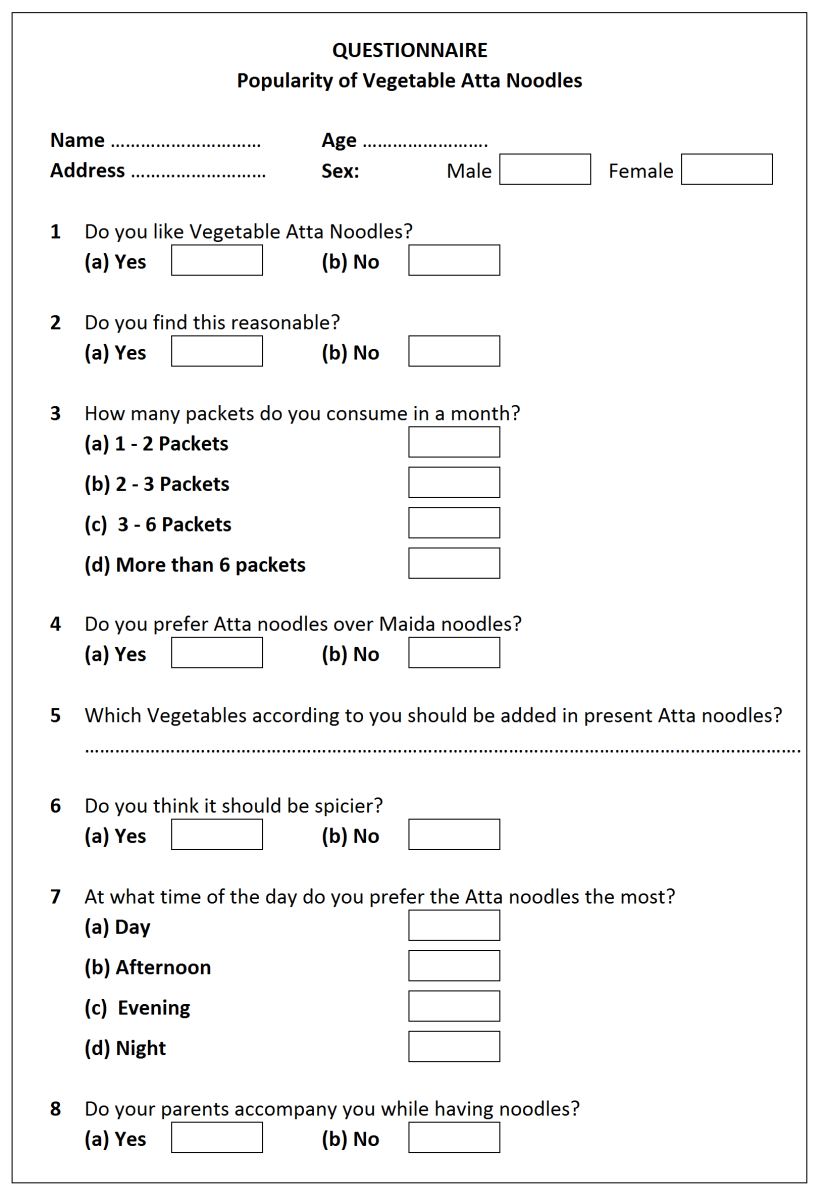
You want to do a research on the popularity of Vegetable Atta Noodles among children. Design a suitable questionnaire for collecting this information.
Answer
Solution is as follow:
View full question & answer
Question 84 Marks
Difference between primary and secondary data is of degree.
Answer
It is rightly said that the difference between primary data and secondary data is of degree. Data collected by X will be primary for X and secondary for everyone else. The one who collects any data, data are primary in his hands and as soon as any other person wants to use it, it becomes secondary. For example, Population Census is conducted by the government of India every 10 years, it is primary for the government but when a book writer takes data of demographic condition of India from the reports of these census, it is secondary for him. Therefore, it is rightly said first hand data. Only in first hand, it is primary. When it goes to second hand, it becomes secondary.
View full question & answer
Question 94 Marks
What are the objectives of classification of data?
Answer
The objectives of classification of data are:
  1. To make the data simple and brief: The main objective of classification is to condense the large data to make them easily understood. For example, if there are 100 students in a class then their marks can be put in the following way:
Marks Obtained (Out of 100)
No. of students
20-40
15
40-60
25
60-80
50
80-100
10
Total
100
  1. Helps in comparison. It facilitates comparison. Ungrouped and shapeless data cannot be compared. It can be possible with the help of classification. For example, the figures of weights of students of two classes are given below:
Wieghts in kgs.
Class A
Class B
20-30
5
10
30-40
10
12
40-50
20
15
50-60
15
13
60-70
 
 
Total
50
50
  1. To reveal the basic tabulation: Classification provides basis for tabulation. No tabulation is possible without classification.
  2. To bring out points of similarities and dissimilarities: Classification reveals clearly the points of similarities and dissimilarities in the statistical data.
For example, married and unmarried or employed and unemployed etc.
View full question & answer
Question 104 Marks
Discuss merits and demerits of deliberate sampling.
Answer
Merits
  1. Economical: It is less costly and less time consuming
  2. Proper Representation: It ensures proper representation of the universe when the investigation has full knowledge of the composition of the universe and is free from bias,
  3. Avoid Irrelevant Items: It prevents unnecessary and irrelevant items entering into the sample per chance.
  4. Intensive study: It ensures intensive study of the selected items.
  5. Accurate Results: It gives better results if the investigator is unbiased and has the capacity of keen observation and sound judgment.
Demerits
  1. Personal Bias: There is enough scope for bias or prejudices of the investigate to play and influence the selection.
  2. No equal chance: There is no equal chance for all the items of the universe being included in the sample.
  3. No Degree of Accuracy: There is no possibility of having any idea about the degree of accuracy achieved in the is investigation conducted by this method.
  4. No Possibility of Sample Error: There is no possibility of calculating the sample error the idea of which is based on the mathematical concepts which are no applicable to non-random methods of sampling.
  5. Unsuitable for Large Samples: This method is not suitable for the large samples where the size of both the universe and the sample is considerably mlarge.
View full question & answer
Question 114 Marks
CSO and NSSO are two major sources of secondary data. Comment.
Answer
Central Survey Organisation (CSO):
It is responsible for coordination of statistical activities in the country and for evolving and maintaining statistical standards. Its activities include compilation of National Accounts; conduct of Annual Survey of Industries and Economic Censuses, compilation of Index of Industrial Production, as well as Consumer Price Indices. It also deals with various social statistics, training, international cooperation, Industrial Classification etc. The CSO is headed by a Director-General who is assisted by 5 Additional Director-Generals looking after the National Accounts Division, Social Statistics Division, Economic Statistics Division, Training Division and the Coordination and Publication Division. Head office of CSO is located in the New Delhi. The Industrial Statistics Wing of CSO is located in Kolkata. The Computer Centre also under the CSO is located New Delhi.
National Sample Survey Organisation (NSSO):
Constitution of NSSO: Professor P.C. Mahalanobis, who as the head of the Indian Statistical Institute, had been directing the large-scale sample surveys of crop acreage and yield statistics for several years and proposed to the Government of India to set up a permanent survey organization to conduct national sample surveys to assist in socio-economic planning and policy-making. Accordingly, the National Sample Survey Organization (NSSO) came into being in 1950 and the first round of the NSS covering rural India, was conducted during October 1950 - March-1951. A wide range of surveys were covered since the first round.
The NSSO soon after its formation proceeded to conduct multi-subject household enquiries, designed to fill gaps in the data required for planning, in randomly selected villages and urban blocks spread over the entire geographical area of the country. With increasing demand for reliable estimates at State level and regional level, the need for large samples has been felt by Government and efforts made to enlarge the sample size over the years. At present the NSS covers, in each round, a sample of about 12,000 to 14,000 villages and blocks at the all-India level in the "Central sample" (covered by the NSSO) and an independent sample of about 14,000 to16,000 villages and block at the all-India level through “State sample" (covered by various State/ Union Territories). The field work for the Central sample is undertaken by a team of investigators of the Field Operations Division of the NSSO and that of State sample by Primary Investigators of Directorate of Economics and Statistics of the States.
View full question & answer
Question 124 Marks
Explain different types of non random sampling methods in short.
Answer
There are three primary types of non random sampling methods:
  1. Fuota Sampling: Quota sampling is designed to overcome the most obvious flaw of availability sampling. Rather than taking just anyone, you set quotas to ensure that the sample you get represents certain characteristics in proportion to their prevalence in the population. Note that for this method, you have to know something about the characteristics of the population ahead of time. Say you want to make sure you have a sample proportional to the population in terms of gender-you have to know what percentage of the population is male and female, then collect sample until yours matches. Marketing studies are particularly fond of this form of research design. The primary problem with this form of sampling is that even when we know that a quota sample is representative of the particular characteristics for which quotas have been set, we have no way of knowing if sample is representative in terms of any other characteristics. If we set quotas for gender and age, we are likely to attain a sample with good representativeness on age and gender, but one that may not be very representative in terms of income and education or other factors. Moreover, because researchers can set quotas for only a small fraction of the characteristics relevant to a study quota sampling is really not much better than availability sampling. To reiterate, you must know the characteristics of the entire population to set quotas; otherwise there's not much point to setting up quotas. Finally, interviewers often introduce bias when allowed to selfselect respondents, which is usually the case in this form of research. In choosing males 18-25, interviewers are more likely to choose those that are betterdressed, seem more approachable or less threatening. That may be understandable from a practical point of view, but it introduces bias into research findings.
  2. Judgment Sampling/ Purposive Sampling/ Deliberate Sampling: Purposive sampling is a sampling method in which elements are chosen based on purpose of the study. Purposive sampling may involve studying the entire population of some limited group (sociology faculty at Columbia) or a subset of a population (Columbia faculty who have won Nobel Prizes). As with other non-probability sampling methods, purposive sampling does not produce a sample that is representative of a larger population, but it can be exactly what is needed in some cases - study of organization, community, or some other clearly defined and relatively limited group.
  3. Convenience Sampling/ Availability: Sampling Convenience sampling is a method of choosing subjects who are available or easy to find. This method is also sometimes referred to as haphazard, accidental, or convenience sampling. The primary advantage of the method is that it is very easy to carry out, relative to other methods. A researcher can merely stand out on his/her favorite street corner or in his/her favorite tavern and hand out surveys. One place this used to show up often is in university courses. Years ago, researchers often would conduct surveys of students in their large lecture courses. For example, all students taking introductory sociology courses would have been given a survey and compelled to fill it out. There are some advantages to this design-it is easy to do, particularly with a captive audience, and in some schools you can attain a large number of interviews through this method.
The primary problem with Convenience sampling is that you can never be certain what population the participants in the study represent. The population is unknown, the method for selecting cases is haphazard, and the cases studied probably don't represent any population you could come up with.
However, there are some situations in which this kind of design has advantages - for example, survey designers often want to have some people respond to their survey before it is given out in the “real” research setting as a way of making certain the questions make sense to respondents. For this purpose, Convenience sampling is not a bad way to get a group to take a survey, though in this case researchers care less about the specific responses given than whether the instrument is confusing or makes people feel bad.
View full question & answer
Question 134 Marks
State the steps taken in collection of data.
Answer
Develop a complete plan for survey: It is important to draw a complete plan for a statistical survey before we start collecting data actually. Decide whether to adopt census method or sample method: For conducting survey on any issue, the investigator has two options sample and census. Which method will depend on budget, availability of time and accuracy requirement?
Preparing Questionnaire: Designing the questionnaire is influenced by many considerations like number of questions to be included, language of questions, types of questions, ordering of the questions etc.
Mode of Distribution of Questionnaire: There are different ways in which questionnaire can be sent. It can be for personal or by post or by e-mail. In personal it can be filled either by respondent or enumerator.
View full question & answer
Question 144 Marks
What are the qualities of a good questionnaire?
Answer
To draft a questionnaire or schedule is an art. The success of statistical investigation depends on proper drafting of the questionnaire. It is a highly specialized job and following points should be borne in mind:
  1. Brief and Limited Questions: The number of questions in a schedule should be brief and limited as far as possible. Only relevant questions to the problem under investigation should be added. Ideally it should be between 20-30.
  2. Simple and Clear: The questions should be simple, clear and precise. Its language should be very simple so that informants may easily understand.
  3. Unambiguous Questions: All unambiguous questions should be avoided at all, complicated and long-worded questions irritate the respondents which results in careless; replies.
  4. No Personal Questions: No personal question should be asked from, e respondents. Such questions should be avoided. For example,
  • Do you take alcohol?
  • Do you tell a lie?
  • Does your boss scold you?
  1. Use of Proper Words: Questions should be framed with right words. This ensures the validity. Starting a question with negative is undesirable. For example, Don't you think India is a corrupt country?
  2. Avoidance of Calculations: Questions should not be based on calculations. Only those questions should be asked which the respondents may reply immediately. Moreover, questions should avoid memories.
  3. Preference to Objective Questions: The objective type questions should be given preference. Either MCQ or yes no options should be given but in case of need and requirement of investigation, open ended questions can also be used.
  4. Logical Sequence of the Questions: The arrangement of the questions should be such that it involves a logical flow of questions. For example it is not sensible to ask a person:
  • What is your income?
  • Are you employed?
OR
  • How many kids do you have?
  • Are you married?
  1. Pre-testing: Before sending the questionnaire to the respondents, it must be properly tested. It will let investigator know the loopholes of questionnaire which he can rectify.
  2. Instructions: Precise and simple instructions of filling the questionnaire should be added in the foot note.
  3. Cross Examination: The questionnaire should be set in such a way that there may be cross examination of the information supplied by the informants. In fact, it is a check on false or inaccurate answers. For example, asking age as well date of birth is cross checking of right information
  4. Secret Outlay: Every respondent should be ensured that information given by them shall be kept secret.
  5. Attractive Questionnaire: Proper care should be taken to make the questionnaire attractive. A well set questionnaire will certainly impress the recipient.
View full question & answer