Questions · Page 1 of 2

3 Marks Question

🎯

Test yourself on this topic

50 questions · timed · auto-graded

Question 13 Marks
Define equilibrium price. Show with the help of a diagram, the effect on equilibrium price when demand increases and supply is perfectly elastic.
Answer
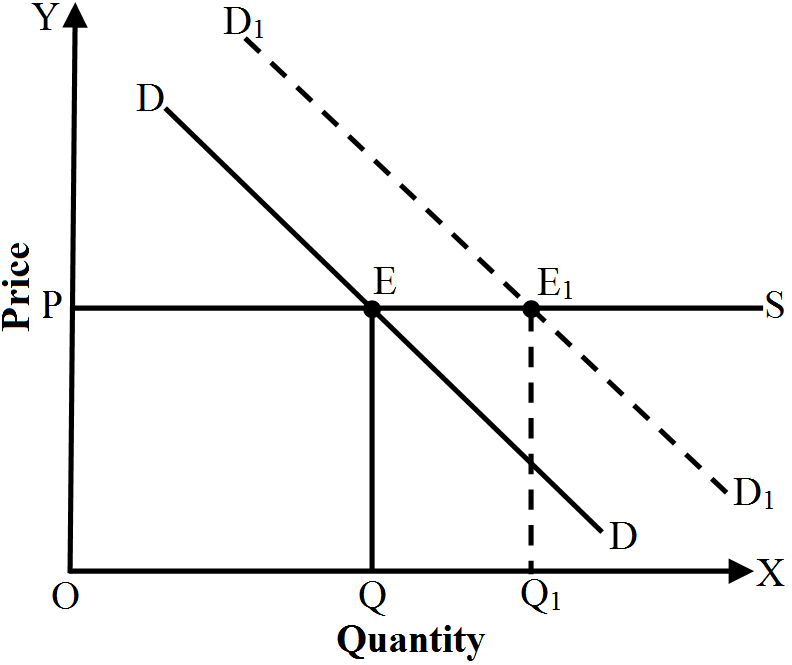
Equilibrium price is that price at which quantity demanded is equal to quantity supplied. Given figure shows that equilibrium price will remain unchanged ($OP$ only) despite increase in demand when supply is perfectly elastic.
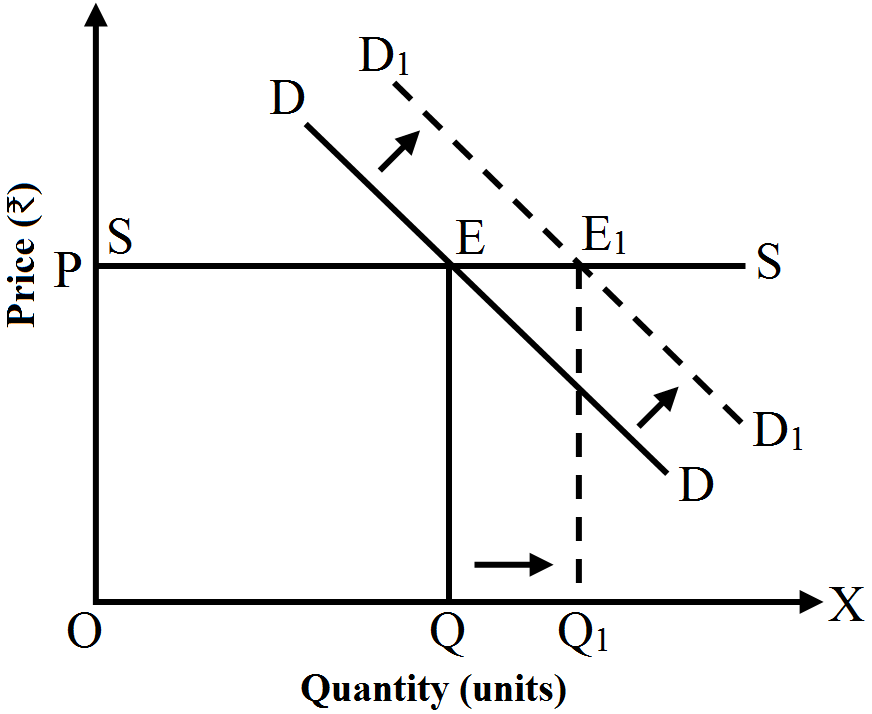
When demand increases, equilibrium quantity increases from $OQ$ to $OQ_1$​​​​​​​ but equilibrium price remains constant $(OP)$.
View full question & answer
Question 23 Marks
Explain why there are only a few firms in an oligopoly market?
Answer
This may be due to the presence of following factors:
  1. Huge set-up costs.
  2. Patent rights.
  3. License requirements.
  4. Control over raw material, etc.
View full question & answer
Question 33 Marks
How does a cost saving technological progress affect market price and the quantity exchanged of a commodity? Use diagram.
Answer
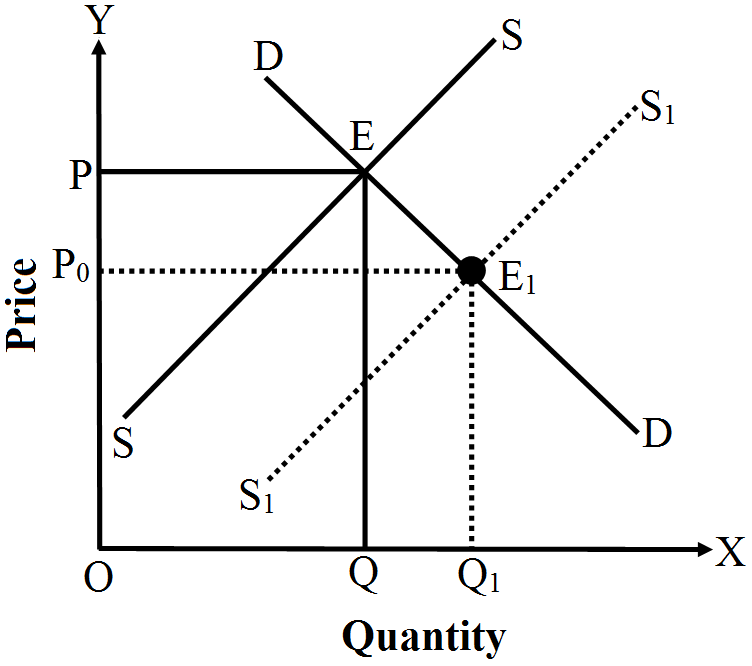
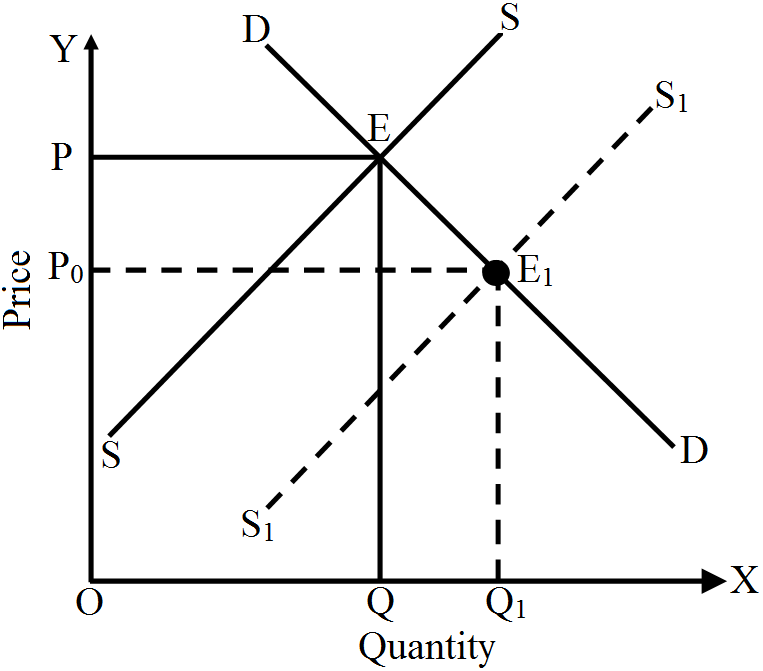
A cost saving technological progress reduces unit cost of production of a commodity. This will cause an increase in the supply of a commodity and lead to a rightward shift of the supply curve as shown in the diagram given. The demand curve of the commodity remaining the same, this will cause the market price of the commodity to fall and the equilibrium quantity to rise.

It is clear from the diagram that as a result of increase in supply, the supply curve shifts rightwards. As a result the price falls from $OP$ to $OP_0$ and the quantity rises from $OQ$ to $OQ_1$​​​​​​​.
View full question & answer
Question 43 Marks
Why price remains unaffected when supply curve is perfectly elastic and demand curve shifts?
Answer
Perfectly elastic supply implies a situation of infinite supply corresponding to a given price. In such a situation, if demand curve shifts to the right, implying increase in demand, there does not arise a situation of excess demand because even at the existing price, supply is infinite. Hence, price remains constant.
If there is decrease in demand, when demand curve shifts to the left, there is no possibility of fall in price. Because even the slightest fall in price would mean zero supply in a situation of perfectly elastic supply curve.
View full question & answer
Question 53 Marks
X and Y are complementary goods. Explain the sequence of effects of a fall in the price of X on the equilibrium price and quantity of Y.
Answer
In case of complementary goods, when the price of X falls, demand for commodity Y increases. As a result, demand curve of commodity Y will shift towards right but supply curve remains constant. Due to increase in demand of commodity Y, there will be excess demand. Therefore, supplier will be motivated to increase the price of commodity Y. The equilibrium price and quantity would tend to increase.
View full question & answer
Question 63 Marks
What is meant by prices being rigid? How can oligopoly behaviour lead to such an outcome?
Answer
Price rigidity means price under oligopoly tends to be fixed or constant despite the changes in demand and cost in the industry.
The firms under oligopoly believe that if they raise the price, the rivals will not follow it but if the firms cut down the price, the rival firms will also do the same. Thus, oligopoly firms prefer to stick at the existing price. This behaviour of oligopoly firms, to maintain a prevailing price is termed as price rigidity.
View full question & answer
Question 73 Marks
In the union budget, the excise duty on tea was reduced from ₹ $2$ per kg to ₹ $1$ per kg. All other things remaining unchanged, how will it affect the market price of tea? Use diagram.
Answer
When the excise duty on tea was reduced, the unit cost of production falls. This will cause an 'increase in the supply of tea and lead to a rightward shift of the supply curve. Assuming the demand curve of tea remaining the same, this will cause the market price of tea to fall and the quantity exchanged to rise.

It is clear from the diagram that as a result of increase in supply, the supply curve shifts rightwards. As a result, price falls from $OP$ to $OP_0$ and quantity exchanged rises from $OQ$ to $OQ_1$.
View full question & answer
Question 83 Marks
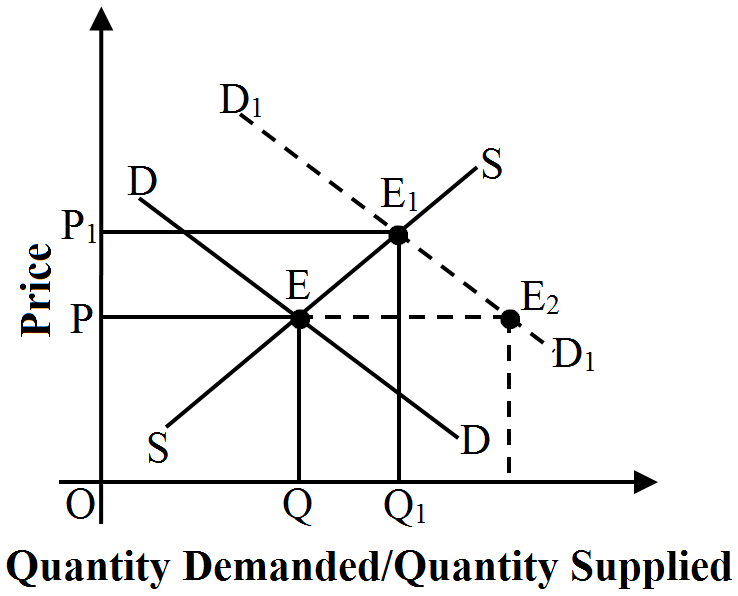
Market for a good is in equilibrium. There is an increase in demand for this good. Explain the chain of effects of this change.
OR
By the given equilibrium in the market, explain the chain of effects of increase of demand for a good.
OR
Explain with the help of a diagram, the effects of rightward shift of the demand curve of a commodity.
Answer
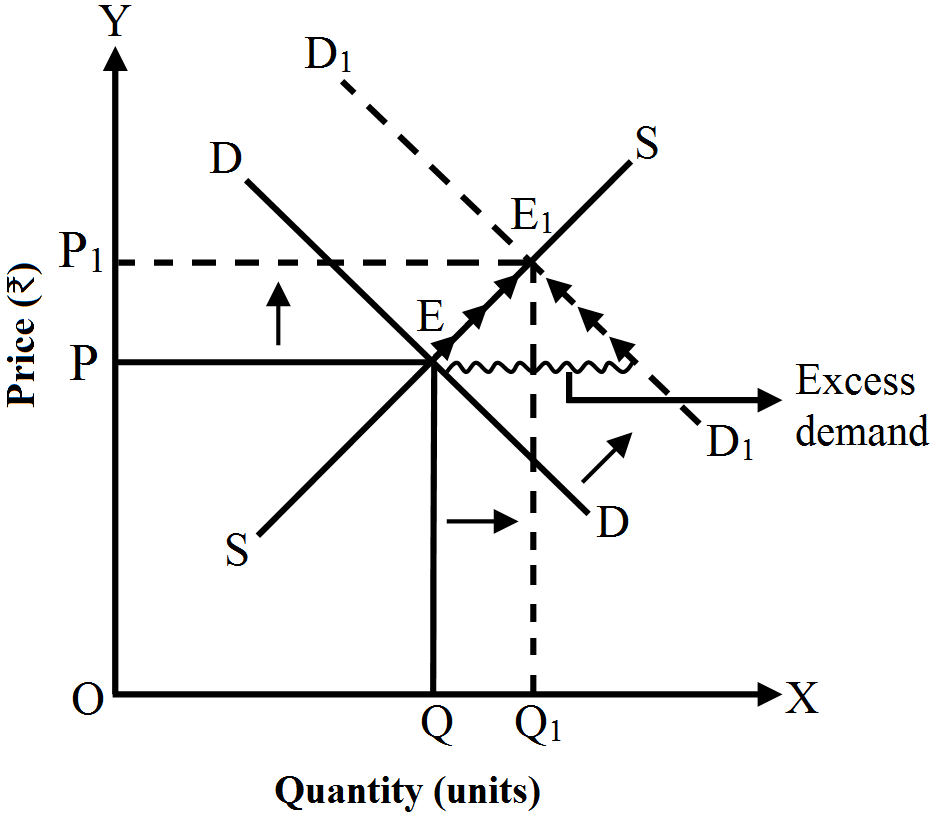
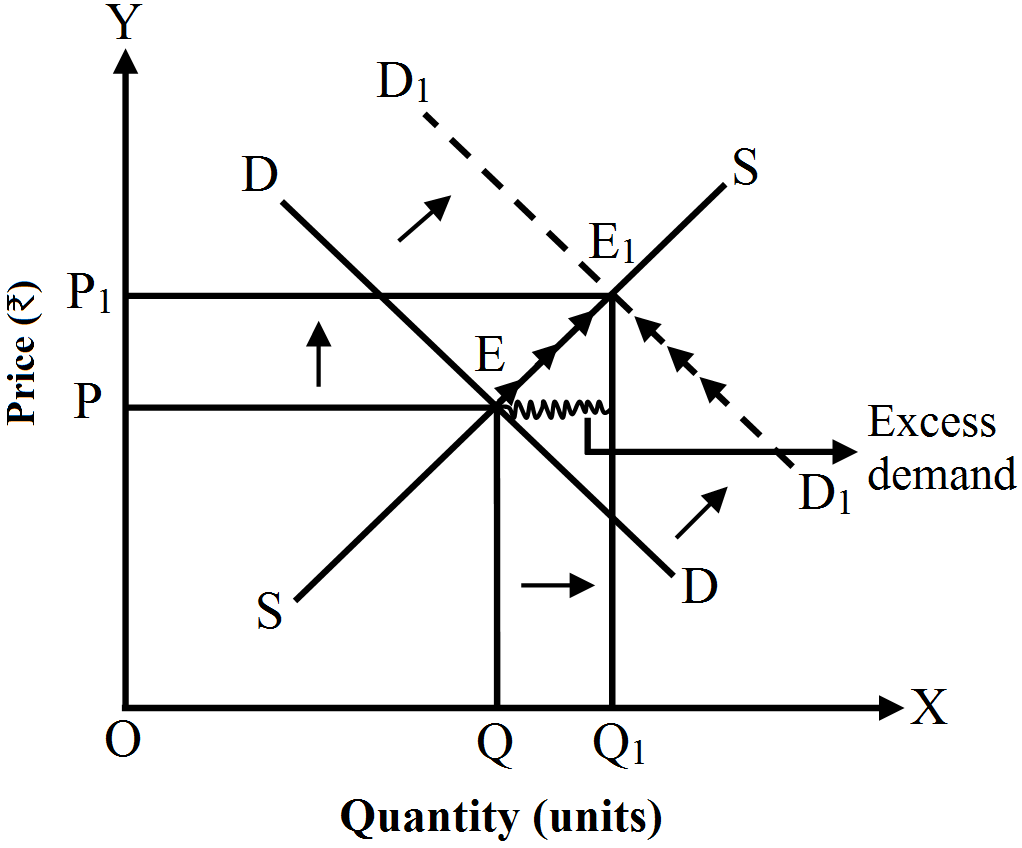
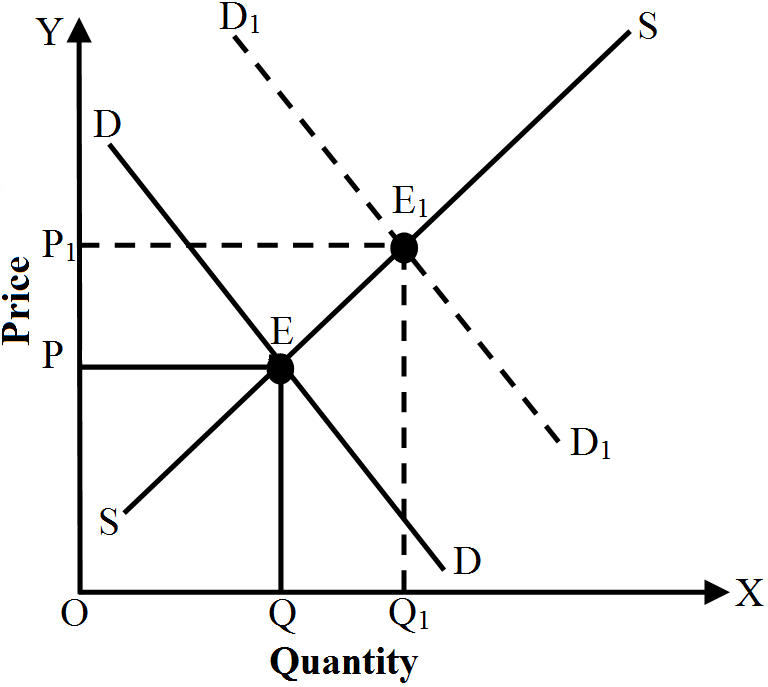
Equilibrium refers to the situation in which market demand is equal to market supply. The given diagram shows a situation of increase in demand. The demand curve shifts to the right, from $DD$ to $D_1D_1$ Equilibrium point shifts from $E$ to $E_1$. Consequently, equilibrium price rises from $OP$ to $OP$, and equilibrium quantity increases from $OQ$ to $OQ_1$​​​​​​​
​​​​​​​
View full question & answer
Question 93 Marks
State three features of perfect competition.
Answer
Three features of perfect competition are as follows:
  1. Large Number of Buyers and Sellers Under perfect competition, market is dominated by a large number of buyers and sellers.
  2. Homogeneous Product Under this form, all sellers sell identical products. It implies that there is no product differentiation.
  3. Free Entry and Exit of Firms In perfect competition, there is no restriction on the entry and exit of the firms. Any firm can enter or leave the market at any time.
View full question & answer
Question 103 Marks
Discuss briefly the meaning of "Price discrimination" and "Product differentiation" with example.
Answer
Price Discrimination It is a situation when a monopolist charges different prices from different buyers of the same product. This is generally done to maximise profits, e.g. in a monopoly, surgeon in your area may charge low fee from the poor patients and high fee from the rich patients. Product Differentiation It is a situation when different producers under monopolistic competition try to differentiate their product in terms of its shape, size, packing, trademark or brand name. This is done to attract buyers from the rival firms in the market.
View full question & answer
Question 113 Marks
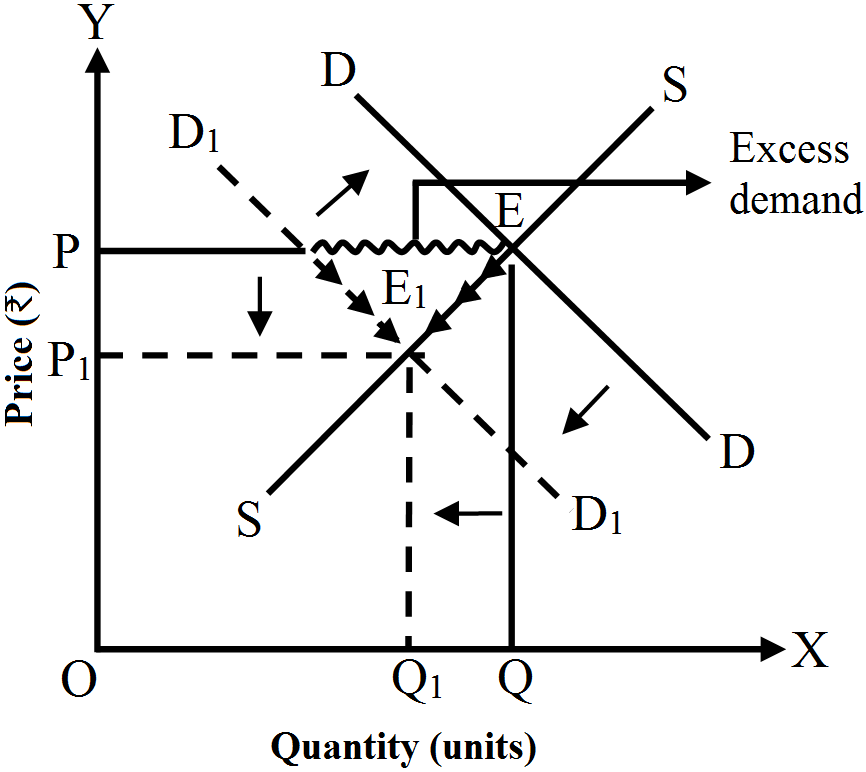
Suppose the price of a good is higher than equilibrium price. Explain the changes that will establish equilibrium price.
Answer
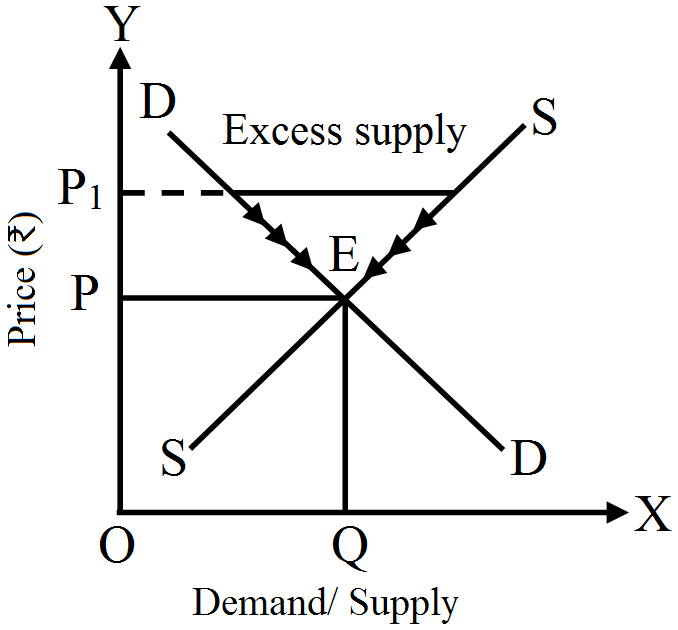
When price prevailing in the market is higher than equilibrium price, demand will be less than supply, i.e. there is excess supply in the market. Excess supply will force the market price to slide down causing extension of demand and contraction of supply. The process of extension and contraction would continue till the equilibrium between supply and demand is struck. Thus, equilibrium price will be restored through the free play of market forces.
View full question & answer
Question 123 Marks
Given below are four statements. Indicate for each whether it reflects an increase or decrease in demand; quantity demanded; supply; quantity supplied.
  1. Air Deccan reduces its average plane fare by 30% in order to attract more passengers.
  2. The government grants export subsidy to producers of oranges in Nagpur to increase the sale of oranges abroad.
  3. Wheat farmers decide to withhold wheat as the market price is low.
  4. OPEC decides to increase the international oil price.
Answer
  1. Increase in quantity demanded.
  2. Increase in supply.
  3. Decrease in supply.
  4. Decrease in quantity demanded.
View full question & answer
Question 133 Marks
Market demand and supply schedules of mangoes (per day) are given below:
Price (Per kg)
Qd (in kg)
Qs (in kg)
9
7
14
7
6
11
5
8
8
3
10
5
1
12
2
Determine:
Equilibrium price and equilibrium quantity.
Excess demand at ₹ 3 per kg.
Excess supply at ₹ 7 per kg.
Answer
  1. Equilibrium price = ₹ 5, Equilibrium quantity = 8kg.
  2. Excess demand = 10 - 5 = 5kg.
  3. Excess supply = 11 - 6 = 5kg.
View full question & answer
Question 143 Marks
At a given price, there is excess demand for a good. Explain how the equilibrium price will be reached.
OR
Explain the sequence of changes that will take place when there is excess demand of the commodity.
Answer
In a situation of excess demand, consumers are willing to buy greater amount of a commodity than what the producers are willing to sell. Accordingly, price of the commodity will be pushed up. This will cause expansion of supply and contraction of demand, until the equilibrium is restored.
View full question & answer
Question 153 Marks
How does the equilibrium price of a normal commodity change when income of its buyers falls? Explain the chain of effects.
Answer
For a normal commodity, decrease in income of the buyers means decrease in its demand. Accordingly, demand curve shifts leftward and both equilibrium price and equilibrium quantity tend to decrease.
In the given diagram, actual demand curve $DD$ and actual supply curve SS intersect at point E (i.e. equilibrium point). When income of the buyer decreases, the demand for normal good also falls and demand curve shifts leftward from $DD$ to $D_1D_1$. As a result, equilibrium price and quantity both are decreased from $OP$ to $OP_1$ and $OQ$ to $OQ_1$.
View full question & answer
Question 163 Marks
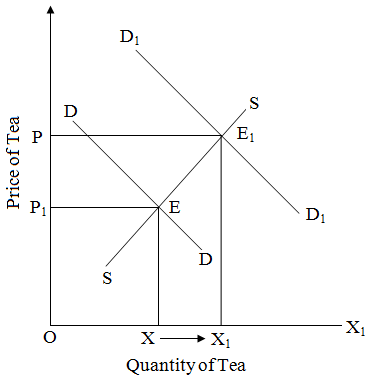
How will a change in price of coffee affect the equilibrium price of tea? Explain the effect on equilibrium quantity also through a diagram.
Answer
Tea and coffee are substitute goods. A change in price of coffee will directly influence the equilibrium price and quantity of tea. As a result the demand curve of tea will shift to the right (in case of an Increase in the price of coffee). The supply curve of tea remain same this will lead to an Increase in price $0$ tea $(P_1)$ and increase in quantity $(X_1)$.
View full question & answer
Question 173 Marks
Why a monopolist is considered as price maker?
Answer
Under monopoly competition there is a single seller dealing in the market and he holds power over the price he charges for a commodity, that's the reason we consider seller as a price maker. He can charge the price according to the market forces of demand and supply, by controlling the supply of the product.
View full question & answer
Question 183 Marks
Explain the implications of 'perfect knowledge about market' under perfect competition.
Answer
Perfect knowledge means that both buyers and sellers are fully informed about the market price. Therefore, no firm is in a position to charge a different price and no buyer will pay a higher price. As a result, a uniform price prevails in the market. In case of perfect competition, buyers and sellers have perfect knowledge of the market.
View full question & answer
Question 193 Marks
Under perfect competition, the seller is a price taker and under monopoly, he is price maker. Explain.
Answer
Under perfect competition, the price is determined by the industry because there are large number of sellers of homogeneous product. No single seller by changing the supply can influence the price. So, the firm is a price taker.
A monopolist is a single seller and determines the price himself. He is a price maker. There is no challenge to his price decisions as there are no other firms in the market and there are no close substitutes of his product. Barriers to entry of new firms further strengthen his position as a price maker.
View full question & answer
Question 203 Marks
"An increase in the demand for notebooks raises the quantity of notebooks demanded, but not the quantity supplied." Is this tatement true or false? Explain.
Answer
The statement that "an increase in the demand for notebooks raises the quantity of notebooks demanded, but not the quantity supplied," in general, is false. As given figure shows, the increase in demand for notebooks results in an increased quantity supplied.
View full question & answer
Question 213 Marks
Explain ‘large number of buyers and sellers' as a feature of perfectly competitive market.
Explain the implications of large number of buyers in a perfectly competitive market.
OR
Explain the implications of large number of sellers in a perfectly competitive market.
Answer
A perfectly competitive market is dominated by the presence of large number of buyers and sellers of a commodity, which means that there is no such buyer or seller in the market whose purchase or sale is so large as to impact the total sale or purchase in the market. Each buyer/ seller has only a fractional share in the market demand/ market supply. Hence, price is determined by the forces of market demand and market supply. No individual buyer or seller has any control over it. Each buyer/ seller has to accept the price as it is in the market.
View full question & answer
Question 223 Marks
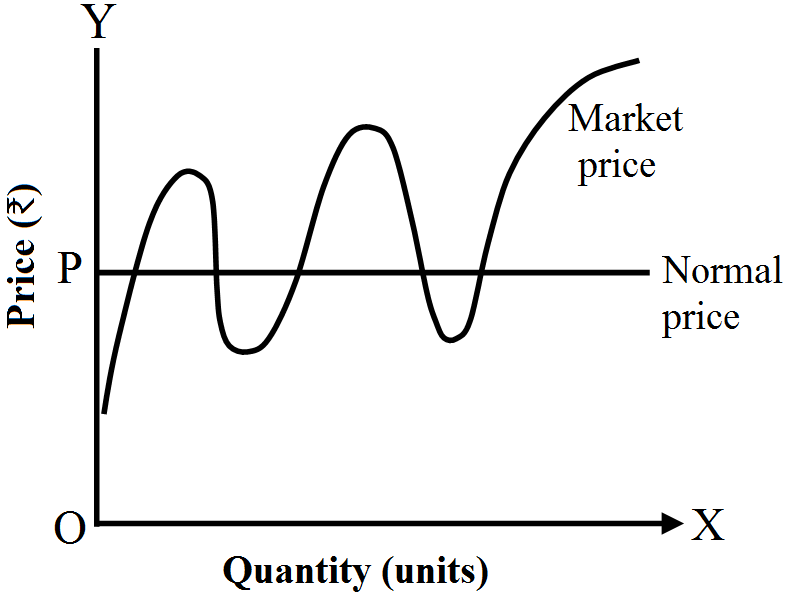
Make a difference between market price and normal price.
Answer
Market Price It is the price that exists in the market at a particular point of time, no matter, forces of supply and demand have adjusted themselves or not. Normal Price It is the price that is expected to exist when the forces of demand and supply have fully adjusted themselves. Market price always tends to move around the normal price as shown in the given figure.
View full question & answer
Question 233 Marks
Discuss the various ways in which a monopoly market structure may arise.
Answer
Monopoly market structure arises because of the following reasons:
  1. Patent Rights These are given to the new product or technology and it gives rise to monopoly as no one can use their technology without permission.
  2. Cartel Firm's negotiations with other firms with regards to pricing and output policy also give rise to monopoly.
  3. Government Licensing Such licensing to a particular company also gives rise to monopoly.
View full question & answer
Question 243 Marks
Explain the chain effects, if the prevailing market price is below the equilibrium price.
Answer
When market price is below the equilibrium price demand becomes greater than supply and excess demand emerges. Since buyers will not be able to buy all they want to buy there is competition between buyers leading to rise in price. Rise in price couses fall in demand (contraction) and rise in supply (expansion), This continues till the price reaches equilibrium again.
View full question & answer
Question 253 Marks
Explain any two features of monopoly.
Answer
Two features of monopoly are as follows:
  1. One Seller and Large Number of Buyers Under monopoly, there is a single producer of a commodity. He may be alone or there may be a group of partners or joint stock company or a state. However, there are a large number of buyers of the product.
  2. Restrictions on the Entry of New Firms Under monopoly, there are some restrictions on the entry of new firms into the monopoly industry. Generally, there are patent rights or exclusive control over a technique or raw material.
View full question & answer
Question 263 Marks
Mention the various cases in which equilibrium price remains same.
Answer
The equilibrium price remains same in the following cases:
  1. When increase in demand is equal to increase in supply.
  2. When decrease in demand is equal to decrease in supply.
  3. When demand increases and supply is perfectly elastic.
  4. When demand decreases and supply is perfectly elastic.
  5. When supply increases and demand is perfectly elastic.
  6. When supply decreases and demand is perfectly elastic.
View full question & answer
Question 273 Marks
Explain the concept of 'buffer stock' as a tool of price floor.
Answer
  1. Government ensures price Floor/ minimum Support price with the tool called buffer stock.
  2. If government feels market price is lower than what it ought to be, it would purchase the commodity at higher price from the farmers, producers so as to maintain stock.
  3. Government maintain this buffer stock with itself and they real eased in case of shortage of the commodity in future.
View full question & answer
Question 283 Marks
How does a favourable change in the taste for a commodity affect market price and quantity exchanged for the commodity? Use diagram.
Answer
A favourable change in taste for a commodity (say jeans) will cause an increase in the demand for a commodity (jeans). As a result, the demand curve of the commodity will shift to the right. The supply curve of the commodity remaining the same, this will lead to a rise in the market price of the commodity and increase in quantity exchanged.
It is clear from the diagram that as a result of increase in demand, the demand curve $DD$ shifts rightwards to $D_1D_1$. As a result, the price rises from $OP$ to $OP_1$ and quantity exchanged rises from $OQ$ to $OQ_1$.
View full question & answer
Question 293 Marks
Show the determination of equilibrium price with the help of schedule.
Answer
The equilibrium price is the price at which market demand and market supply are equal to each other.
It can be shown with the help of following schedule
Price ol a commodity (₹) Quantity demanded (units) Ouantity supplied (units) Statement
1 100 20 D > S
2 80 40
3 60 60 D = S
4 40 80 S > D (Equilibrium price)
5 20 100
It is clear from the schedule that ₹ 3 is the equilibrium price where market demand is equal to market supply (60 units).
View full question & answer
Question 303 Marks
At what level of price do the firms in a perfectly competitive market supply when free entry and exit is allowed in the market? How is equilibrium quantity determined in such a market?
Answer
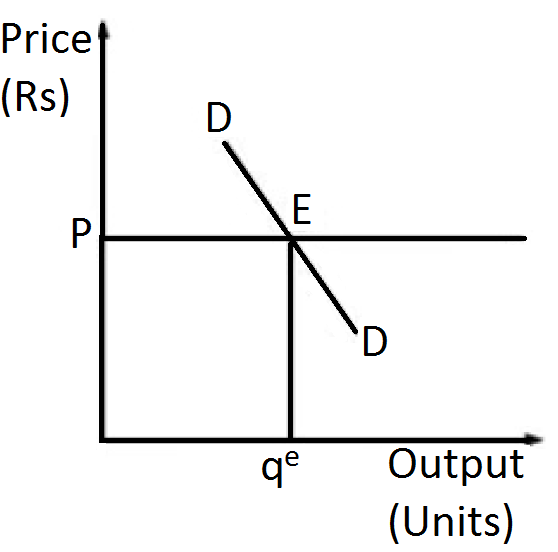
Equilibrium price will always be equal to minimum average cost in the long run as due to the free entry and exit of the firms, all the firms earn zero economic profit. The equilibrium is determined by the intersection of consumers' demand curve and the 'P = min AC' line. At equilibrium point E, quantity supplied by each firm is $q^e$ at the price (P).
View full question & answer
Question 313 Marks
A consumer consumes only two goods $X$ and $Y$. Marginal utilities of $X$ and $Y$ are $4$ and $3$ respectively. Price of $X$ and price of $Y$ is ₹ $3$ per unit. Is consumer in equilibrium? What will be further reaction of the consumer? Give reasons.
Answer
The consumer is not in equilibrium because$\frac{\text{MU}_{\text{x}}}{\text{P}_{\text{x}}}>\frac{\text{MU}_{\text{y}}}{\text{P}_{\text{y}}}\ \text{or}\ \frac{4}{3}>\frac{3}{3}$
Since per rupee $MU_x$ is greater than per rupee $MUy$, he will start buying more of $X$ and less of $Y$ till $MU_x$ falls and $MU_y$ rises enough to make $\frac{\text{MU}_{\text{x}}}{\text{P}_{\text{x}}}=\frac{\text{MU}_{\text{y}}}{\text{P}_{\text{y}}}$
View full question & answer
Question 323 Marks
How is the wage rate determined in a perfectly competitive labour market?
Answer
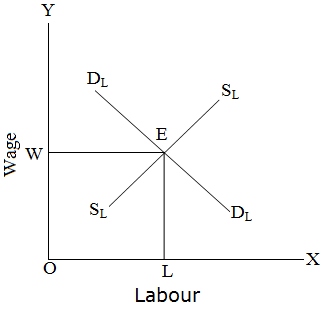
The wage rate determined in a perfectly competitive labour market by the intersection of demand and supply of labour.
$D_L = S_L$‘ it occurs equilibrium at point $E$. It define equilibrium wage and optimal amount of labour. Therefore. $OW$ is the wage rate in a perfectly competitive market.
View full question & answer
Question 333 Marks
A consumer consumes only two goods X and Y. The marginal utilities of X and of Y is 3. Prices of X and Y are ₹ 2 and ₹ 1 respectively. Is consumer in equilibrium? What will be further reaction of the consumer? Give reasons.
Answer
The consumer is not in equilibrium because$ \frac{\text{MU}_{x}}{\text{P}_{x}}< \frac{\text{MU}_{y}}{\text{P}_{y}}\ \ \text{or}\ \ \frac{3}{2}<\frac{3}{1}$
Since per rupee MUx is lower than per rupee MUy, the consumer will buy less of X and more of Y until MUx goes up and MUy goes down to reach the postion of $ \frac{\text{MU}_{x}}{\text{P}_{x}}=\frac{\text{MU}_{y}}{\text{P}_{y}}$
View full question & answer
Question 343 Marks
Show with the help of diagram the effect on equilibrium price of a commodity when demand increases and supply is perfectly elastic.
Answer
When supply curve is perfectly elastic and demand increases, there will be no change in the equilibrium price but the equilibrium quantity increases.

In the diagram, when demand increases, shown by rightward shift from $DD$ to $D_1D_1$, the equilibrium price remains unchanged at $OP$ but the equilibrium quantity increases from $OQ$ to $OQ_1​​​​​​​$​​​​​​​.
View full question & answer
Question 353 Marks
A shift in demand curve has a larger effect on price and smaller effect on quantity when the number of firms is fixed compared to the situation when free entry and exit is permitted. Explain.
Answer
Under the long run, when free entry and exit is permitted, there is total changes in quantity but no change in equilibrium price. It happens when the demand curve intersects tile supply curve at equilibrium point. Then Price = minimum Average cost. As a result demand curve shift upward,
It effect, there is no change in price but quantity rises When the number of firms is fixed, the supply curve is upward and demand curve is downward sloping. It results the demand effect more in price than quantity.
View full question & answer
Question 363 Marks
Why is the demand curve facing a monopolistically competitive firm likely to be very elastic?
Answer
The demand curve facing a monopolistically competitive firm is likely to be very elastic because the products produced by the monopolistically competitive firms are close substitutes to each other.
Consequently, Elasticity of Demand is high, i.e. presence of closely substitutable goods makes the firm's demand curve very elastic under monopolistic competition.
View full question & answer
Question 373 Marks
There are no selling costs under perfect competition. Why?
Answer
Selling costs are the costs incurred by a firm to promote its salés. A firm under perfect competition sells homogeneous products and faces a horizontal straight line demand curve. It can sell whatever amount it wishes to sell at the existing price. So, selling costs are not required.
View full question & answer
Question 383 Marks
If the prevailing market price is above the equilibrium price, explain its chain of effects.
Answer
If the prevailing market price is above the equilibrium price, there will be excess supply. Producers are not able to sell all they want to sell, resulting in competition among the sellers, Price starts falling As a result demand starts rising and supply stars falling These changes continue till the equilibrium is reached.
View full question & answer
Question 393 Marks
List the three different ways in which oligopoly firms may behave.
Answer
Following are the three different ways in which oligopoly firms may behave:
  1. Firms may collude together and decide not to compete with each other and maximise total profits, as in collusive oligopoly.
  2. Under non-collusive oligopoly, firms decide not to collude and hence decide to compete with each other through non-price competition.
  3. Firms may produce differentiated products, having their own distinguishing characteristics, as in imperfect oligopoly.
View full question & answer
Question 403 Marks
How are decisions taken by the consumer and producer in a coordinated market?
Answer
The decisions of the consumers in the market are expressed through market demand schedule and market demand curve. The decisions of the producers are expressed through market supply schedule and market supply curve. The decisions of consumers and producers are coordinated by the interaction of market demand and market supply. This is known as price mechanism, which determines equilibrium in the market.
View full question & answer
Question 413 Marks
It is generally observed that a firm under monopolistic competition, produces an excess quantity. In your view, is it a wastage of scarce resources?
Answer
It is correct that firm under monopolistic competition generates an excess quantity, however it is not a wastage of scarce resources as firms under this form of market produces differentiated goods. So, there are certain consumers who always prefer to consume goods of a particular brand or quality. Hence firm's output will be sold and there will be no wastage.
Also, it helps firms to meet with unforeseen circumstances.
View full question & answer
Question 423 Marks
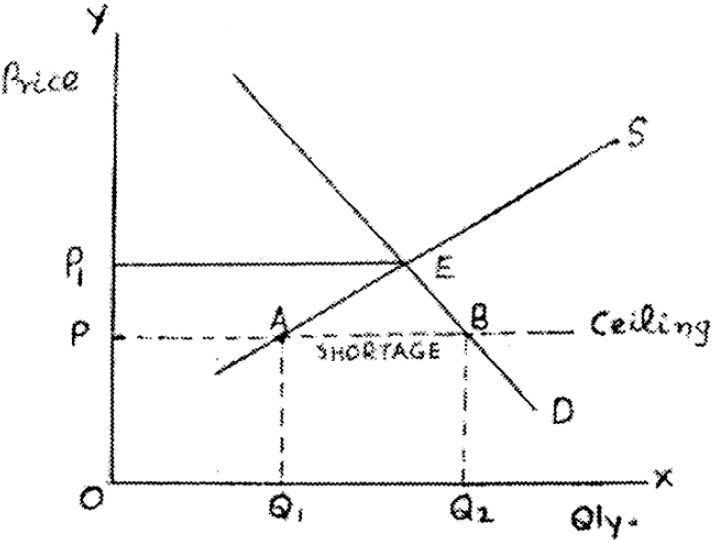
Explain the effects of 'maximum price ceiling' on the market of a good. Use diagram.
Answer
Maximum price ceiling refers to imposition of upper limit on the price of a good by the government. For example, in the diagram OP is price ceiling while equilibrium price is OP1. At this price, the producers are willing to supply only PA (Or OQ1) while consumers demand PB (Or OQ2). The effect of the ceiling is that shortage, equal to AB (O1Q2) is created, which may further lead to black marketing.
View full question & answer
Question 433 Marks
Why is the demand curve of a firm under monopolistic competition more elastic than under monopoly? Explain.
Answer
Demand curve under monopolistic competition is similar to monopoly. But the main difference between monopoly and monopolistic competition is that under monopolistic competition, demand curve is more elastic. It means that in response to change in price, change in demand is higher. It is because in a monopolistic competitive market, goods have close substitutes and in a monopoly market goods do not have close substitutes.
View full question & answer
Question 443 Marks
What is price discrimination? Give two examples of the power of a monopolist to practice price discrimination.
Answer
Sale of the same product at different prices to different buyers is known as price discrimination. For example,
  1. The only doctor in the area may charge lower fee from the poor patients as compared to the rich ones.
  2. For the same facilities, Indian railways are charging lower fare from the senior citizens than others.
View full question & answer
Question 453 Marks
State any three causes of a rightward shift of supply curve.
Answer
  1. Improvement in technology.
  2. Fall in input prices.
  3. Fall in price of related products, etc.
View full question & answer
Question 463 Marks
Why can a firm not earn abnormal profits under perfect competition in the long run? Explain.
Answer
Under perfect competition there is freedom of entry to firms into industry. When there are abnormal profits, new firms will enter. This will increase supply and price will fall. This process will continue till abnormal profits are wiped out.
View full question & answer
Question 473 Marks
Discuss the effects of simultaneous increase in demand and supply on equilibrium price.
Answer
  1. When demand increases more than supply, equilibrium price increases.
  2. When demand and supply increase equally, equilibrium price remains constant.
  3. When supply increases more than demand, equilibrium price falls.
View full question & answer
Question 483 Marks
Firms under oligopoly are involved in non-price competition. Why?
Answer
Oligopoly is a form of market in which there are only a few firms operating in the market and each firm is very large in size. This leads to huge interdependence among the firms. They generally avoid price competition as a price-cut by one firm may lead to price war, leading to loss of revenue for both firms.
View full question & answer
Question 493 Marks
How is new equilibrium struck when supply or demand curve tends to shift?
Answer
When supply or demand curve tends to shift, new equilibrium is struck through the process of extension and contraction of demand and supply. Generally, any change in demand and supply will cause a situation of either excess demand or deficient demand in relation to supply of the commodity. In a situation of excess demand (D > S), price will tend to rise causing contraction of demand and extension of supply.
This process will continue till new price is reached where demand equals to supply. Likewise in a situation of deficient demand (D < S), price will tend to fall causing extension of demand and contraction of supply. This process will continue till new price is reached where demand equals to supply.
View full question & answer
Question 503 Marks
A consumer consumes only two goods $X$ and $Y$. Marginal utility of each is $2$. The price per unit of $X$ and $Y$ is Re. $1$ and Rs. $2$ respectively. Is the consumer in equilibrium? What will be the further reaction of the consumer? Explain.
Answer
The consumer is not in equilibrium because:$\frac{\text{MUx}}{\text{Px}}>\frac{\text{MUy}}{\text{Py}}\ \text{or}\ \frac{2}{1}>\frac{2}{2}$
Since per rupee $MUx$ is higher than per rupee $MUy$, the consumer will consume more of $X$ and less of $Y$ till $MU_x$ falls and $MU_y$ rises enough to make $\frac{\text{MUx}}{\text{Px}}=\frac{\text{MUy}}{\text{Py}}.$
View full question & answer
3 Marks Question - Economics STD 11 Commerce Questions - Vidyadip