Questions · Page 1 of 2

M.C.Q (1 Marks)

🎯

Test yourself on this topic

50 questions · timed · auto-graded

MCQ 11 Mark
At a price below the equilibrium price, there is:
  • A
    Excess supply.
  • Excess demand.
  • C
    Ceiling.
  • D
    Flooring.
Answer
Correct option: B.
Excess demand.
View full question & answer
MCQ 21 Mark
The price at which quantity supplied and quantity demanded are equal is termed as:
  • Equilibrium price.
  • B
    Market price.
  • C
    Both $(a)$ and $(b).$
  • D
    None of the above.
Answer
Correct option: A.
Equilibrium price.
View full question & answer
MCQ 31 Mark
When both demand and supply decreases in the same proportion, then equilibrium price will:
  • Remain the same.
  • B
    Rise.
  • C
    Fall.
  • D
    None of the above.
Answer
Correct option: A.
Remain the same.
View full question & answer
MCQ 41 Mark
Imperfect competition is a type of market structure showing some but not all feature of competitive market. Which of the following is/ are imperfect competition?
  • A
    Perfect competition.
  • B
    Monopolistic competition.
  • C
    Oligopoly.
  • Both $(a)$ and $(b).$
Answer
Correct option: D.
Both $(a)$ and $(b).$
View full question & answer
MCQ 51 Mark
Which of the following is not an essential condition of pure competition?
  • A
    Large number of buyers and sellers.
  • B
    Homogeneous product.
  • C
    Freedom of entry and exit.
  • Absence of transport cost.
Answer
Correct option: D.
Absence of transport cost.
View full question & answer
MCQ 61 Mark
An attempt to set a minimum price for a good is called a:
  • Price floor.
  • B
    Price ceiling.
  • C
    Price subsidy.
  • D
    Both $(a)$ and $(c)$
Answer
Correct option: A.
Price floor.
View full question & answer
MCQ 71 Mark
Marginal revenue of a firm is constant throughout under:
  • Perfect competition.
  • B
    Monopolistic co.
  • C
    Oligopoly.
  • D
    All the above.
Answer
Correct option: A.
Perfect competition.
View full question & answer
MCQ 81 Mark
If price is forced to stay below equilibrium price $.........$
  • A
    excess supply exists.
  • excess demand exists.
  • C
    either $(a)$ or $(b).$
  • D
    None of these
Answer
Correct option: B.
excess demand exists.
View full question & answer
MCQ 101 Mark
Differentiated but close substitutes exist under:
  • A
    Perfect competition.
  • B
    Monopoly.
  • Monopolistic competition.
  • D
    All of the above.
Answer
Correct option: C.
Monopolistic competition.
View full question & answer
MCQ 111 Mark
$.........$ is a situation of the market in which demand for a commodity is exactly equal to its supply corresponding to a particular price.
  • A
    Consumer equilibrium.
  • B
    Producer equilibrium.
  • Market equilibrium.
  • D
    Balance of Trade.
Answer
Correct option: C.
Market equilibrium.
View full question & answer
MCQ 121 Mark
Assume that in the market for a good $Z$ there is a simultaneous increase in demand and the quantity supplied. The result will be:
  • A
    An increase in equilibrium price and quantity.
  • B
    A decrease in equilibrium price and quantity.
  • An increase in equilibrium quantity and uncertain effect on equilibrium price.
  • D
    A decrease in equilibrium price and increase in equilibrium quantity.
Answer
Correct option: C.
An increase in equilibrium quantity and uncertain effect on equilibrium price.
View full question & answer
MCQ 131 Mark
Which is the best example of monopoly market?
  • A
    Communication market.
  • Indian railway.
  • C
    Stock exchange.
  • D
    $\text{OPEC} ($Oil Producing Export Countries$).$
Answer
Correct option: B.
Indian railway.
View full question & answer
MCQ 141 Mark
Under monopoly, monopolist tries to increase his profits by restricting supply of his product and fixing:
  • A
    Low price.
  • High price.
  • C
    Market price.
  • D
    All of these.
Answer
Correct option: B.
High price.
As a price maker, a monopolist has full control over price. Thus, he charges high price to maximise the profits and can restrict supply of his product.
View full question & answer
MCQ 151 Mark
Monopolist can determine $.........$
  • A
    price.
  • B
    output.
  • both $(a)$ and $(b).$
  • D
    none of these.
Answer
Correct option: C.
both $(a)$ and $(b).$
View full question & answer
MCQ 161 Mark
Under what condition, equilibrium price will increase and equilibrium quantity will decrease?
  • A
    Increase in supply.
  • Decrease in supply.
  • C
    Increase in demand.
  • D
    Decrease in demand.
Answer
Correct option: B.
Decrease in supply.

Demand curve remain unchanged, if there is a decrease in supply, supply curve and equilibrium point will shift leftwards. As a result, equilibrium price will increase and equilibrium quantity will decrease
View full question & answer
MCQ 171 Mark
An increase in demand with unchanged supply leads to $.........$
  • A
    rise in equilibrium price and fall in equilibrium quantity.
  • B
    fall in both equilibrium price and quantity.
  • rise in both equilibrium price and quantity.
  • D
    fall in equilibrium price and rise in equilibrium quantity.
Answer
Correct option: C.
rise in both equilibrium price and quantity.
View full question & answer
MCQ 181 Mark
Rent control is an example of:
  • A
    Price floor.
  • Price ceiling.
  • C
    Equilibrium price.
  • D
    None of the above
Answer
Correct option: B.
Price ceiling.
View full question & answer
MCQ 191 Mark
If in a oligopoly, the fir1ms are selling homogeneous products, then the oligopoly firm is called:
  • A
    Pure competition.
  • Pure oligopoly.
  • C
    Monopoly.
  • D
    Duopoly.
Answer
Correct option: B.
Pure oligopoly.
View full question & answer
MCQ 201 Mark
From the following, in which market, there is a free entry and exit of firms?
  • A
    Monopoly and oligopoly.
  • B
    Monopolistic competition and monopoly.
  • C
    Perfect competition and oligopoly.
  • Perfect competition and monopolistic competition.
Answer
Correct option: D.
Perfect competition and monopolistic competition.
View full question & answer
MCQ 211 Mark
Under perfect competition, what is the relationship between Price $P$ , Average Revenue and Marginal Revenue?
  • $P = =$
  • B
    $P > >$
  • C
    $P < <$
  • D
    $P = >$
Answer
Correct option: A.
$P = =$
View full question & answer
MCQ 221 Mark
Firm in a monopolistic market has $.........$ control over price.
  • A
    no.
  • B
    full.
  • partial.
  • D
    none of these.
Answer
Correct option: C.
partial.
View full question & answer
MCQ 231 Mark
What is the impact of change in supply on market equilibrium when demand is perfectly inelastic?
  • A
    Both equilibrium price and equilibrium quantity will change.
  • B
    Both equilibrium price and equilibrium quantity will not change.
  • C
    Equilibrium price remains same and equilibrium quantity will change.
  • Equilibrium price will change and equilibrium quantity remains same.
Answer
Correct option: D.
Equilibrium price will change and equilibrium quantity remains same.
In this case, quantity will remain unchanged, only price will increase with fall in supply and vice$-$versa.
View full question & answer
MCQ 241 Mark
Under what condition, both equilibrium price and equilibrium quantity will decrease?
  • A
    Increase in demand.
  • B
    Increase in supply.
  • Decrease in demand.
  • D
    Decrease in supply.
Answer
Correct option: C.
Decrease in demand.
View full question & answer
MCQ 251 Mark
When demand decreases and there is no shift in supply, the equilibrium price $.........$ and quantity $.........$​​​​​​​
  • A
    Rises, rises.
  • B
    Rises, falls.
  • Falls, falls.
  • D
    Falls, rises.
Answer
Correct option: C.
Falls, falls.
View full question & answer
MCQ 261 Mark
A seller cannot influence the market price under:
  • Perfect Competition.
  • B
    Monopoly.
  • C
    Monopolistic competition.
  • D
    All of the above.
Answer
Correct option: A.
Perfect Competition.
View full question & answer
MCQ 271 Mark
When supply decreases and there is no change in demand, then equilibrium price $.........$ and quantity $.........$
  • A
    Falls, rises.
  • Rises, falls.
  • C
    Rises, rises.
  • D
    Falls, falls.
Answer
Correct option: B.
Rises, falls.
View full question & answer
MCQ 281 Mark
A price ceiling is:
  • A
    A minimum price that a firm may charge for a good or service.
  • B
    Usually established by the manufacturer of a product.
  • The maximum price that a firm may charge for a good or service.
  • D
    None of the above.
Answer
Correct option: C.
The maximum price that a firm may charge for a good or service.
View full question & answer
MCQ 291 Mark
Homogenous product means products are:
  • A
    Similar.
  • B
    Close substitutes.
  • Quite alike.
  • D
    None of the above.
Answer
Correct option: C.
Quite alike.
View full question & answer
MCQ 301 Mark
Market which has a few large firms is $.........$
  • oligopoly.
  • B
    perfect competition.
  • C
    monopolistic competition.
  • D
    monopsony.
Answer
Correct option: A.
oligopoly.
View full question & answer
MCQ 311 Mark
Assume that consumers' incomes and the number of sellers in the market for goods A both decrease. Based upon this information, we can conclude, with certainty, that the equilibrium $.........$
  • A
    price will increase.
  • B
    price will decrease.
  • C
    quantity will increase.
  • quantity will decrease.
Answer
Correct option: D.
quantity will decrease.
View full question & answer
MCQ 321 Mark
In which market structure, price and output solution is indeterminate?
  • Oligopoly.
  • B
    Monopolistic competition.
  • C
    Perfect competition.
  • D
    Monopoly.
Answer
Correct option: A.
Oligopoly.
View full question & answer
MCQ 331 Mark
When both demand and supply increases in the same proportion then equilibrium price will:
  • Remain the same.
  • B
    Rise.
  • C
    Fall.
  • D
    None of the above.
Answer
Correct option: A.
Remain the same.
View full question & answer
MCQ 341 Mark
When demand decreases and there is no shift in supply, the equilibrium price $.........$ and quantity $.........$
  • A
    Rises, rises.
  • B
    Rises, falls.
  • Falls, falls.
  • D
    Falls, rises.
Answer
Correct option: C.
Falls, falls.
View full question & answer
MCQ 351 Mark
When increase in demand in more than increase in supply, then equilibrium quantity will:
  • A
    Remain the same.
  • Rise.
  • C
    Fall.
  • D
    None of the above.
Answer
Correct option: B.
Rise.
View full question & answer
MCQ 361 Mark
When supply increases and there is no change in demand, then equilibrium price $.........$ and quantity $.........$​​​​​​​
  • Falls, rises.
  • B
    Rises falls.
  • C
    Rises rises.
  • D
    Falls, falls.
Answer
Correct option: A.
Falls, rises.
View full question & answer
MCQ 371 Mark
Demand curve of a firm is perfectly elastic under:
  • Perfect competition.
  • B
    Monopoly.
  • C
    Monopolistic competition.
  • D
    Oligopoly.
Answer
Correct option: A.
Perfect competition.
View full question & answer
MCQ 381 Mark
When demand increases with no change in supply, equilibrium price $.........$ and quantity $.........$
  • Rises, rises.
  • B
    Rises, falls.
  • C
    Falls, falls.
  • D
    Falls, rises.
Answer
Correct option: A.
Rises, rises.
View full question & answer
MCQ 391 Mark
With a given supply curve a decrease in demand causes $.........$
  • A
    an overall decrease in price but an increase in equilibrium quantity.
  • B
    an overall increase in price but a decrease in equilibrium quantity.
  • an overall decrease in price and a decrease in equilibrium quantity.
  • D
    no change in overall price but a reduction in equilibrium quantity.
Answer
Correct option: C.
an overall decrease in price and a decrease in equilibrium quantity.
View full question & answer
MCQ 401 Mark
There is inverse relation between price and demand for the product of a firm under:
  • A
    Monopoly only.
  • B
    Monopolistic competition only.
  • Both under monopoly and monopolistic competition.
  • D
    Perfect competition only.
Answer
Correct option: C.
Both under monopoly and monopolistic competition.
View full question & answer
MCQ 411 Mark
Few firms exist under:
  • A
    Perfect competition.
  • Oligopoly.
  • C
    Monopolistic competition.
  • D
    Both perfect and monopolistic competition.
Answer
Correct option: B.
Oligopoly.
View full question & answer
MCQ 421 Mark
A firm is able to sell any quantity of a good at a given price. The firm’s marginal revenue will be:
  • A
    Greater than Average Revenue.
  • B
    Less than Average Revenue.
  • Equal to Average Revenue.
  • D
    Zero.
Answer
Correct option: C.
Equal to Average Revenue.
View full question & answer
MCQ 431 Mark
Selling cost is insignificant under:
  • Perfect competition.
  • B
    Monopoly.
  • C
    Monopolistic competition.
  • D
    All of the above.
Answer
Correct option: A.
Perfect competition.
View full question & answer
MCQ 441 Mark
Differentiated products is a characteristic of:
  • A
    Monopolistic competition only.
  • B
    Oligopoly only.
  • Both monopolistic competition and oligopoly.
  • D
    Monopoly.
Answer
Correct option: C.
Both monopolistic competition and oligopoly.
View full question & answer
MCQ 451 Mark
If the market supply is less than the market demand of a commodity at a given price, it is called:
  • A
    Excess supply.
  • Excess demande.
  • C
    Deficit demand.
  • D
    Market supply.
Answer
Correct option: B.
Excess demande.
View full question & answer
MCQ 461 Mark
When there is increase in demand and decrease in supply, equilibrium price:
  • A
    Falls.
  • Rises.
  • C
    Constant.
  • D
    None of these.
Answer
Correct option: B.
Rises.
View full question & answer
MCQ 471 Mark
If market price is above equilibrium price, there exists a situation of:
  • Excess supply.
  • B
    Excess demand.
  • C
    Price ceiling.
  • D
    Both $(a)$ and $(c).$
Answer
Correct option: A.
Excess supply.
View full question & answer
Question 481 Mark
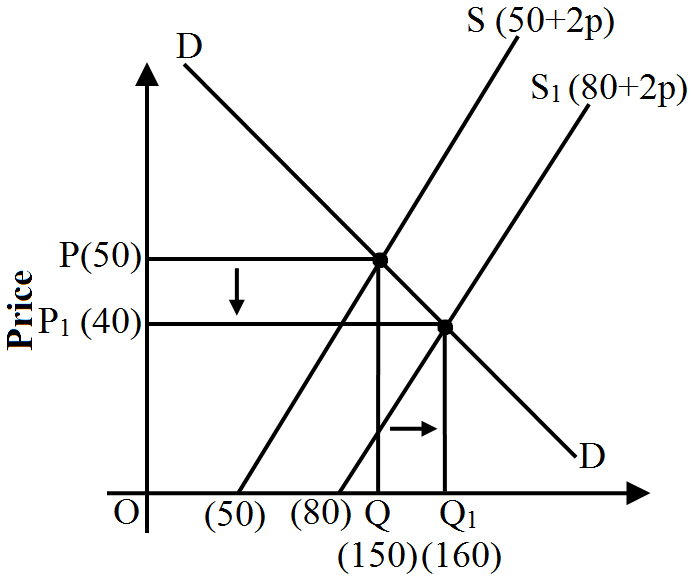
Suppose the demand and supply curve of a Commodity$-X$ is given by the following two equations simultaneously:
$Qd = 200 - p$
$Qs = 50 + 2p$
Find the equilibrium price and equilibrium quantity.
Suppose that the price of a factor of production producing the commodity has changed, resulting in the new supply curve given by the equation
$Qs' = 80 + 2p$
Analyse the new equilibrium price and new equilibrium quantity as against the original equilibrium price and equilibrium quantity.
Answer
We know that the equilibrium price and quantity are achieved at;
$Qd = Qs$
$200 - p = 50 + 2p$
$(-) 3p = (-) 150$
Therefore, Equilibrium Price
$p = 50$
And, Equilibrium Quantity
$q = 200 - 50 = 150$ units
If the price of factor of production has changed, then under the new conditions;
$Qd = Qs$
$200 - p = 80 + 2p$
$(-) 3p = (-) 120$
Therefore, Equilibrium Price
$p = 40$
And, Equilibrium Quantity
$q = 200 - 40 = 160$ units
As, Intercept on $X-$axis of Supply equation, $Qs = 50 + 2p$ is $50 [$By Putting Price $(P) = 0]$ and Intercept on $X-$axis of supply equation, $Qs' = 80 + 2p$ is $80 [$By Putting Price $(P) = 0].$
Since, Intercept of $X-$axis Increases, Supply curve shifts Rightward as shown below:


So, equilibrium price falls from $₹ 50$ to $₹ 40$ and Equilibrium Quantity rises from $150$ units to $160$ units.
View full question & answer
MCQ 491 Mark
Suppose that the supply of cameras increases due to an increase in imports. Which of the following statements will most likely occur?
  • A
    The equilibrium price of cameras will increase.
  • B
    The equilibrium quantity of cameras exchanged will decrease.
  • C
    The equilibrium price of camera film will decrease.
  • The equilibrium quantity of camera film exchanged will increase.
Answer
Correct option: D.
The equilibrium quantity of camera film exchanged will increase.
View full question & answer
MCQ 501 Mark
In monopolistic competition, which relationship is true from the following between $AR$ and $MR?$
  • A
    $AR = MR.$
  • B
    $AR < MR.$
  • $AR > MR.$
  • D
    None of these.
Answer
Correct option: C.
$AR > MR.$

Both $AR$ and $MR$ curves are downward sloping under monopolistic competition because a firm can sell more commodity by lowering the price. The $MR$ curve is half of $AR$ curve, i.e. $AR > MR.$

View full question & answer
M.C.Q (1 Marks) - Economics STD 11 Commerce Questions - Vidyadip