Question 14 Marks
A consumer's budget is ₹ 40. He is buying Good-1 and Good-2. Price of Good-1 is ₹ 8 per unit, and of Good-2 is ₹ 10 per unit. Draw a budget line on the basis of these figures.
Answer
View full question & answer→Let $X_1$ denotes quantity of Good-1 and $X_2$ denotes quantity of Good-2.
Given,
Consumer's budget, i.e ., consumer's income (Y) = ₹ 40
Price of Good-1 (P1) = ₹ 8 per unit
Price of Good-2 (P2) = ₹ 10 per unit
$\begin{array}{l}
P_1 X_1+P_2 X_2=Y \\
8 X_1+10 X_2=40
\end{array}$
When $X _2=0$
$\begin{array}{l}
8 X_1=40 \\
\Rightarrow X_1=5
\end{array}$
Thus, when the entire income of the consumer is spent on Good-1, he can buy 5 units of Good-1.
When $X _1=40$
$\Rightarrow X_2=4$
Thus, when the entire income of the consumer is spent on Good-2, he can buy 4 units of Good-2.
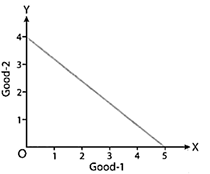
Accordingly, the budget line touches 4 units on Y-axis and 5 units on X -axis, as in figure. Since price ratio remains constant, budget line is a straight line.
Given,
Consumer's budget, i.e ., consumer's income (Y) = ₹ 40
Price of Good-1 (P1) = ₹ 8 per unit
Price of Good-2 (P2) = ₹ 10 per unit
$\begin{array}{l}
P_1 X_1+P_2 X_2=Y \\
8 X_1+10 X_2=40
\end{array}$
When $X _2=0$
$\begin{array}{l}
8 X_1=40 \\
\Rightarrow X_1=5
\end{array}$
Thus, when the entire income of the consumer is spent on Good-1, he can buy 5 units of Good-1.
When $X _1=40$
$\Rightarrow X_2=4$
Thus, when the entire income of the consumer is spent on Good-2, he can buy 4 units of Good-2.
Accordingly, the budget line touches 4 units on Y-axis and 5 units on X -axis, as in figure. Since price ratio remains constant, budget line is a straight line.