Questions

5 Marks Questions

🎯

Test yourself on this topic

12 questions · timed · auto-graded

Question 15 Marks
The following are the marks of 150 students in an examination. Calculate Karl Pearson's coefficient of skewness.

Image
Answer
First we calculate the mean and median from the given distribution. Mode is not well-defined here
Image
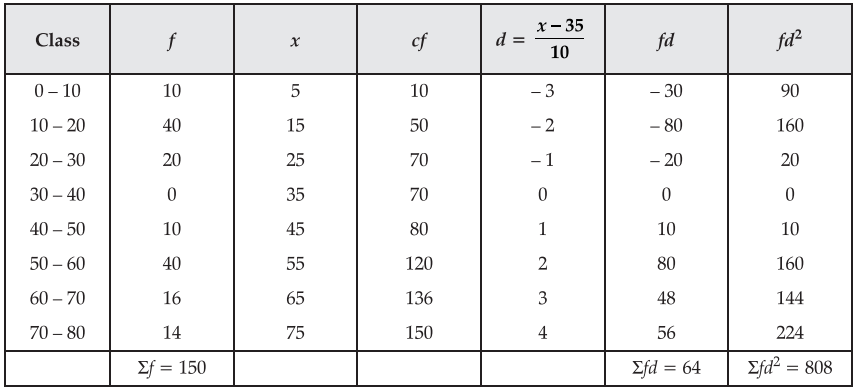
Here, $N =\Sigma f=150, h=10$. Also, $\frac{N}{2}=\frac{150}{2}=75$, therefore median class $=40-50$
$\begin{aligned} \text { Median } & =l+\frac{\left(\frac{N}{2}-c\right)}{f} \times h \\ & =40+\left(\frac{75-70}{10}\right) \times 10 \\ & =45 \\ \text { Mean }(\bar{x}) & =a+\frac{\Sigma f d}{N} \times h\end{aligned}$
$=35+\frac{64}{150} \times 10 \qquad(\because a=35)$
$=39.27$ (Approx.)
Standard Deviation $(\sigma)=h \times \sqrt{\frac{\Sigma f d^2}{N}-\left(\frac{\Sigma f d}{N}\right)^2}$
$=10 \times \sqrt{\frac{808}{150}-\left(\frac{64}{150}\right)^2}=10 \times \sqrt{5.2047}=22.8$
Therefore, coefficient of skewness :
$
\begin{aligned}
S_k & =\frac{3(\text { Mean }- \text { Median })}{\sigma} \\
& =\frac{3(39.27-45)}{22.8}=-0.754
\end{aligned}
$
View full question & answer
Question 25 Marks
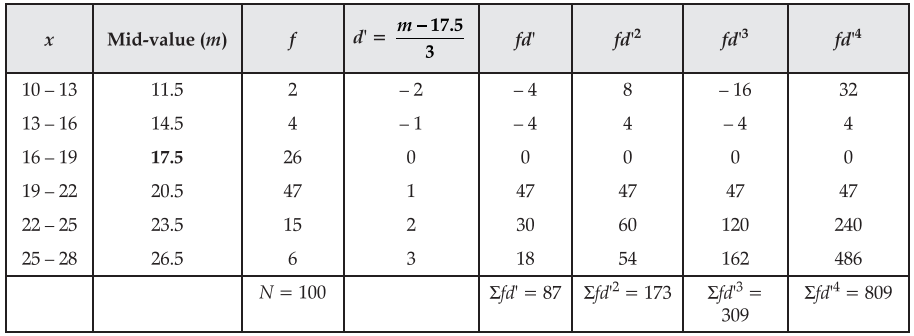
Calculate the first four moments about the arbitrary origin and then calculate the first four moments about mean.
x10-1313-1616-1919-2222-2525-28
f242647156
Answer

Image
Moments about origin :
$\begin{array}{l}\mu_1^{\prime}=\frac{\Sigma f d^{\prime}}{N} \times i=\frac{87}{100} \times 3=2.61 \\ \mu_2^{\prime}=\frac{\Sigma f d^{\prime 2}}{N} \times i^2=\frac{173}{100} \times(3)^2=15.57 \\ \mu_3^{\prime}=\frac{\Sigma f d^{\prime 3}}{N} \times i^3=\frac{309}{100} \times(3)^3=83.43 \\ \mu_4^{\prime}=\frac{\Sigma f d^{\prime 4}}{N} \times i^4=\frac{809}{100} \times(3)^4=655.29\end{array}$
Moments about mean :
$\begin{aligned} \mu_1 & =\mu_1^{\prime}-\mu_1^{\prime}=2.61-2.61=0 \\ \mu_2 & =\mu_2^{\prime}-\left(\mu_1^{\prime}\right)^2=15.57-(2.61)^2=8.76 \\ \mu_3 & =\mu_3^{\prime}-3 \mu_2^{\prime} \mu_1^{\prime}+2\left(\mu_1^{\prime}\right)^3=83.43-3(2.61)(15.57)+2(2.61)^3=-2.91 \\ \mu_4 & =\mu_4^{\prime}-4 \mu_3^{\prime} \mu_1^{\prime}+6 \mu_2^{\prime}\left(\mu_1^{\prime}\right)^2-3\left(\mu_1^{\prime}\right)^4 \\ & =665.29-4(83.43)(2.61)+6(15.57)(2.61)^2-3(2.61)^4 \\ & =291.454\end{aligned}$
View full question & answer
Question 35 Marks
For the following distribution, find central moments, $\beta_1$ and $\beta_2$.
Class1.5 - 2.52.5 - 3.53.5 - 4.54.5 - 5.55.5 - 6.5
Frequency13731
Answer

Image
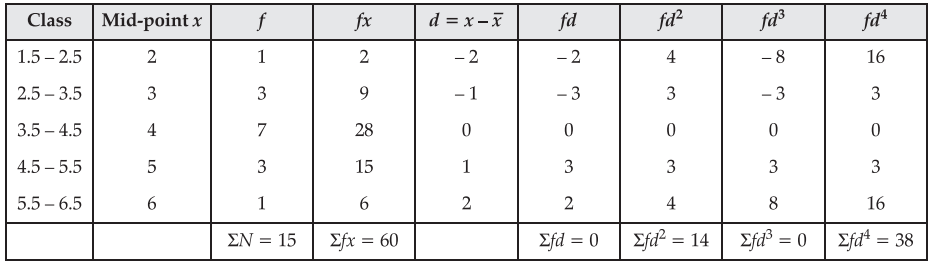
Here,
$
\text { mean, } \bar{x}=\frac{\Sigma f x}{\Sigma N}=\frac{60}{15}=4
$
We therefore have,
$\begin{array}{l}\mu_1=\frac{\Sigma f d}{N}=\frac{0}{15}=0 \\ \mu_2=\frac{\Sigma f d^2}{N}=\frac{14}{15}=0.933 \text { (Approx.) } \\ \mu_3=\frac{\Sigma f d^3}{N}=\frac{0}{15}=0 \\ \mu_4=\frac{\Sigma f d^4}{N}=\frac{38}{15}=2.533 \text { (Approx.) }\end{array}$
Thus,
$
\beta_1=\frac{\mu_3^2}{\mu_2^3}=\frac{0}{(0.933)^3}=0
$
Since, $\beta_1=0$ it means the distribution is symmetrical. and
$
\beta_2=\frac{\mu_4}{\mu_2^2}=\frac{2.53}{(0.933)^2}=2.91
$
Since, $\beta_2<3$ it means curve is platykurtic.
View full question & answer
Question 45 Marks
The mean and standard deviation of 20 observations are found to be 10 and 2 , respectively. On rechecking, it was found that an observation 8 was incorrect. Calculate the correct mean and standard deviation in each of the following cases :
(i) If wrong item is omitted.
(ii) If it is replaced by 12 .
Answer
(i)
$\begin{aligned} \text { Number of observations }(n) & =20 \\ \text { Incorrect mean } & =10 \\ \text { Incorrect standard deviation } & =2 \\ \bar{x} & =\frac{1}{n} \sum_{i=1}^{20} x_i \\ 10 & =\frac{1}{20} \sum_{i=1}^{20} x_i\end{aligned}$
$
\Rightarrow \quad \sum_{i=1}^{20} x_i=200
$
That is, incorrect sum of observations $=200$
Correct sum of observations $=200-8=192$
$\therefore \quad$ Correct mean $=\frac{\text { correct sum }}{19}=\frac{192}{19}=10.1$ (Approx.)
Standard deviation $\sigma=\sqrt{\frac{1}{n} \sum_{i=1}^n x_i^2-\frac{1}{n^2}\left(\sum_{i=1}^n x_i\right)^2}=\sqrt{\frac{1}{n} \sum_{i=1}^n x_i^2-(\bar{x})^2}$
$\begin{aligned} \Rightarrow \quad 2 & =\sqrt{\frac{1}{20} \text { Incorrect } \sum_{i=1}^n x_i^2-(10)^2} \\ \Rightarrow \quad 4 & =\frac{1}{20} \text { Incorrect } \sum_{i=1}^n x_i^2-100 \\ \Rightarrow \quad \text { Incorrect } \sum_{i=1}^{15} x_i & =2080 \\ & =2080-64 \\ & =2016\end{aligned}$
$\begin{aligned} \therefore \quad \text { Correct Standard deviation } & =\sqrt{\frac{\text { Correct } \sum x_i^2}{n}-(\text { Correct mean })^2} \\ & =\sqrt{\frac{2016}{19}-(10.1)^2} \\ & =\sqrt{1061.1-102.1} \\ & =\sqrt{4.09} \\ & =2.02\end{aligned}$
(ii) When 8 is replaced by 12
$\begin{aligned} \text { Incorrect sum of observations } & =200 \\ ∴ \text { Correct sum of observation } & =200-8+12=204 \\ ∴\text { Correct mean } & =\frac{\text { Correct sum }}{20}=\frac{204}{20}=10.2 \\ \text { Standard deviation } \sigma & =\sqrt{\frac{1}{n} \sum_{i=1}^n x_i^2-\frac{1}{n^2}\left(\sum_{i=1}^n x_i\right)^2}=\sqrt{\frac{1}{n} \sum_{i=1}^n x_i^2-(\bar{x})^2} \\⇒ 2 & =\sqrt{\frac{1}{20} \text { Incorrect } \sum_{i=1}^n x_i^2-(10)^2} \\ ⇒ 4 & =\frac{1}{20} \text { Incorrect } \sum_{i=1}^n x_i^2-100 \\⇒ \text { Incorrect } \sum_{i=1}^{15} x_i & =2080\end{aligned}$
∴ Correct $\sum x_i^2=$ Incorrect $\sum_{i=1}^{15} x_j-(8)^2+(12)^2$
$\begin{array}{l}=2080-64+144 \\ =2160\end{array}$
∴ Correct standard deviation $=\sqrt{\frac{\text { Correct } \sum x_i^2}{n}-(\text { Correct mean })^2}$
$\begin{array}{l}=\sqrt{\frac{2160}{20}-(10.2)^2} \\ =\sqrt{108-104.04} \\ =\sqrt{3.96} \\ =1.98\end{array}$
View full question & answer
Question 55 Marks
An analysis of monthly wages paid to workers in two firms A and B, belonging to the same industry, gives the following results :
ParticularFirm AFirm B
No. of wage earners586648
Mean of monthly wages₹ 5,253₹ 5,253
Variance of the distribution of wages100121
(i) Which firm A or B pays larger amounts as monthly wages ?
(ii) Which firm A or B shows greater variability in individual wages ?
Answer
For Firm A :
No. of wages earners $=586$
Mean of monthly wages, $\bar{x}=$₹ $5253$
Amount paid by firm $A=$ ₹ $(586 \times 5253)$=₹ $ 3078258$
Variance of distribution of wages, $\sigma^2=100$
Standard deviation, $\sigma=\sqrt{\sigma^2}$
$=\sqrt{100}$
$=10$
Coefficient of Variation $=\frac{\sigma}{\bar{x}} \times 100$
$=\frac{10}{5,253} \times 100$
$=0.19$
For Firm B :
No. of wage earners $=648$
Mean of monthly wages, $\bar{x}=$₹ $5253$
Amount paid by firm $B=648 \times 5253= $₹ $3403944$
Standard deviation, $\sigma=\sqrt{\sigma^2}=\sqrt{121}=11$
$
\begin{aligned}
\text { Coefficient of variation } & =\frac{\sigma}{\bar{x}} \times 100 \\
& =\frac{11}{5,253} \times 100 \\
& =0.21
\end{aligned}
$
Monthly wages paid by firm $A=$₹ $3078258$
Monthly wages paid by firm $B=$₹ $ 3403944$
$\therefore$ Firm B pays larger amount as monthly wages. Coefficient of variation of wages, of firm $A=0.19$ Coefficient of variation of wages, of firm $B=0.21$
$\therefore$ Firm B shows greater variability in individual wages.
View full question & answer
Question 65 Marks
From the data given below state which group is more variable, A or B ?
Marks10-2020-3030-4040-5050-6060-7070-80
Group A917323340109
Group B1020302543157
Answer
For Group A :
Marks$f_i$$x_i$$d_i=\frac{x_i-a}{n}$$f_i d_i$$f_i d_i^2$
10-20915-3-2781
20-301725-2-3468
30-403235-1-3232
40-503345000
50-60405514040
60-70106522040
70-8097532781
TotalN=150 -6342
$a=45$
$\begin{aligned} \text { Variance (for Group A) } & =h^2\left[\frac{\sum f_i d_i^2}{N}-\left(\frac{\sum f_i d_i}{N}\right)^2\right] \\ & =(10)^2\left[\frac{342}{150}-\left(\frac{-6}{150}\right)^2\right] \\ & =100[2.28-0.0016] \\ & =227.84\end{aligned}$
For Group B :
Marks$f_i$$x_i$$d_i=\frac{x_i-a}{n}$$f_i d_i$$f_i d_i^2$
10-201015-3-3090
20-302025-2-4080
30-403035-1-3030
40-502545000
50-60435514343
60-70156523060
70-8077532163
TotalN=150 -6366
$a=45$
$\begin{aligned} \text { Variance (for Group B) } & =h^2\left[\frac{\sum f_i d_i^2}{N}-\left(\frac{\sum f_i d_i}{N}\right)^2\right] \\ & =(10)^2\left[\frac{366}{150}-\left(\frac{-6}{150}\right)^2\right] \\ & =100[2.4384] \\ & =243.84\end{aligned}$
Since variance for Group $B$ is more than that of $A$, so $B$ is more variable than $A$.
View full question & answer
Question 75 Marks
Following are the marks obtained out of 100 , by two students Reeta and Seeta in 10 tests.
Reeta25504530704236483560
Seeta10705020955542604880
Who is more intelligent and who is more consistent ?
Answer
For Reeta :
$x_i$$x_i^2$
25625
502500
452025
30900
704900
421764
361296
482304
351225
603600
$\sum_{i=1}^{10} x_i=441$$\sum_{i=1}^{10} x_i^2=21139$
Mean, $\bar{x}=\frac{\sum x_i}{n}=\frac{441}{10}=44.1$
$\begin{aligned} \sigma & =\sqrt{\frac{\sum x_i^2}{n}-\left(\frac{\sum x_i}{n}\right)^2} \\ & =\sqrt{\frac{21139}{10}-\left(\frac{441}{10}\right)^2} \\ & =\sqrt{\frac{211390-194481}{100}}=\sqrt{169.09}=13 \text { (approx.) }\end{aligned}$
For Reeta C.V. $=\frac{13}{44.1} \times 100$
For Seeta :
$x_i$$x_i^2$
10100
704900
502500
20400
959025
553025
421764
603600
482304
806400
$\sum_{i=1}^{10} x_i=530$$\sum_{i=1}^{10} x_i^2=34018$
Mean, $\bar{x}=\frac{\sum x_i}{n}=\frac{530}{10}=53$
$and\qquad\sigma=\sqrt{\frac{\sum x_i^2}{n}-\left(\frac{\sum x_i}{n}\right)^2}$
$\sigma=\sqrt{\frac{34018}{10}-(53)^2}=\sqrt{5928}=24.35$ (Approx.)
For Reeta, C.V. $=\frac{\sigma}{\bar{x}} \times 100=\frac{13}{44.1} \times 100=29.48$ (Approx.)
and $\qquad$ for Seeta, C.V. $=\frac{\sigma}{\bar{x}} \times 100=\frac{24.35}{53} \times 100=45.94$
Since coefficient of variation for Seeta is more than that of Reeta, so Seeta is more variable and hence Reeta is more consistent. And Seeta is more intelligent.
View full question & answer
Question 85 Marks
Calculate the mean deviation about the mean of the set first $n$ natural numbers when $n$ is an even number.
Answer
Let $n=2 k \Rightarrow k=\frac{n}{2}$
$
\begin{aligned}
\bar{x} & =\frac{1+2+3+\ldots+n}{n} \\
& =\frac{n(n+1)}{2 n} \\
& =\frac{n+1}{2} \\
& =\frac{2 k+1}{2}
\end{aligned}
$
$x_i$$x_i-\bar{x}$$\left|x_i-\bar{x}\right|$
1$1-\left(\frac{2 k+1}{2}\right)=-\left(\frac{2 k-1}{2}\right)$$\frac{2 k-1}{2}$
2$-\left(\frac{2 k-3}{2}\right)$$\frac{2 k-3}{2}$
3$-\left(\frac{2 k-5}{2}\right)$$\frac{2 k-5}{2}$
,
,
,
,
,
,
,
,
,
$k-2$$-\frac{5}{2}$$\frac{5}{2}$
$k-1$$-\frac{3}{2}$$\frac{3}{2}$
$k$$-\frac{1}{2}$$\frac{1}{2}$
$k+1$$\frac{1}{2}$$\frac{1}{2}$
$k+2$$\frac{3}{2}$$\frac{3}{2}$
,
,
,
,
,
,
,
,
,
$2 k+1$$\frac{2 k-3}{2}$$\frac{2 k-3}{2}$
$2 k-1$$\frac{2 k-3}{2}$$\frac{2 k-3}{2}$
$\begin{array}{l}\therefore \Sigma|x-\bar{x}| \\ =\left\{\frac{2 k-1}{2}+\frac{2 k-3}{2}+\frac{2 k-5}{2}+\ldots+\frac{5}{2}+\frac{3}{2}+1\right\} \\ =1+3+5+\ldots+(2 k-1) \\ =\frac{k}{2}\{1+(2 k-1)\}=k^2=\left(\frac{n}{2}\right)^2=\frac{n^2}{4} .\end{array}$
View full question & answer
Question 95 Marks
Calculate the mean deviation about the mean of the set of first $n$ natural numbers when ' $n$ ' is an odd number.
Answer
Let $n=2 k+1 \Rightarrow k=\frac{n-1}{2}$
$\therefore$ $\bar{x}=\frac{1+2+3+\ldots+n}{n}$
$=\frac{n(n+1)}{2 n}=\frac{n+1}{2}$
$=\frac{2 k+1+1}{2}=k+1$.
$x_i$$x_i-\bar{x}$$\left|x_i-\bar{x}\right|$
$\begin{array}{l}1 \\ 2 \\ 3 \\ 4\end{array}$$\begin{array}{c}1-(k+1)=-k \\ -(k-1) \\ -(k-2) \\ -(k-3)\end{array}$$\begin{array}{c}k \\ k-1 \\ k-2 \\ k-3\end{array}$
,
,
,
,
,
,
,
,
,
$\begin{array}{c}k-2 \\ k-1 \\ k \\ k+1 \\ k+2 \\ k+3\end{array}$$\begin{array}{c}-3 \\ -2 \\ -1 \\ 0 \\ 1 \\ 2\end{array}$$\begin{array}{l}3 \\ 2 \\ 1 \\ 0 \\ 1 \\ 2\end{array}$
,
,
,
,
,
,
,
,
,
$\begin{array}{c}2 k \\ 2 k+1\end{array}$$\begin{array}{c}k-1 \\ k\end{array}$$\begin{array}{c}k-1 \\ k\end{array}$
$\Sigma\left|x_i-\bar{x}\right|=2(1+2+3 \ldots+k)=2\left\{\frac{k(k+1)}{2}\right\}$
$\begin{array}{l}=k(k+1) \\ =\left(\frac{n-1}{2}\right)\left(\frac{n-1}{2}+1\right)\end{array}$
$\begin{array}{l}=\frac{n-1}{2} \cdot \frac{n+1}{2} \\ =\frac{n^2-1}{4}\end{array}$
$\therefore$ mean deviation about mean i.e.,
$
\begin{aligned}
\text { M.D. }(\bar{x}) & =\frac{1}{n} \sum\left|x_1-\bar{x}\right| \\
& =\frac{1}{n} \cdot \frac{n^2-1}{4} \\
& =\frac{n^2-1}{4 n}
\end{aligned}
$
View full question & answer
Question 105 Marks
Calculate the mean deviation about mean :
Marks0-1010-2020-3030-4040-50
No. of Students5815166
Also, find coefficient of mean deviation.
Answer
Let us calculate Mean deviation.
Image
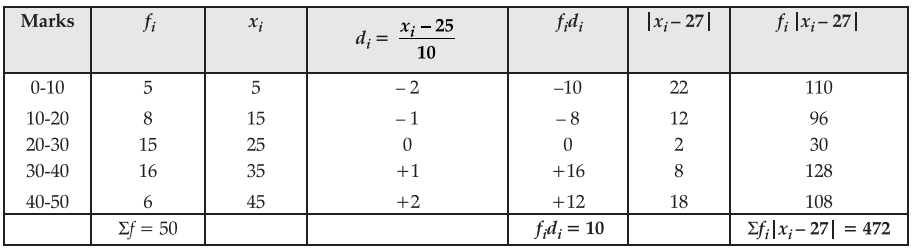
Here,
$
\begin{aligned}
\operatorname{Mean}(\bar{x}) & =\text { assumed mean }+\frac{\Sigma f_i d_i}{\Sigma f_i} \times h \\
& =25+\frac{10}{50} \times 10 \\
& =25+2 \\
& =27
\end{aligned}
$
Mean deviation about mean,
$
\begin{aligned}
\operatorname{M.D} \cdot(\bar{x}) & =\frac{\Sigma f_i\left|x_i-27\right|}{\Sigma f_i} \\
& =\frac{472}{50} \\
& =9.44
\end{aligned}
$
$
\begin{aligned}
\text { Coefficient of mean deviation } & =\frac{\text { M.D. }(\bar{x})}{\bar{x}} \times 100 \\
& =\frac{9.44}{27} \times 100 \\
& =34.96(\text { Approx. })
\end{aligned}
$
View full question & answer
Question 115 Marks
Calculate the mean deviation about median for the following data :
Class0-1010-2020-3030-4040-5050-60
Frequency67151642
Also, find coefficient of mean deviation.
Answer

Image
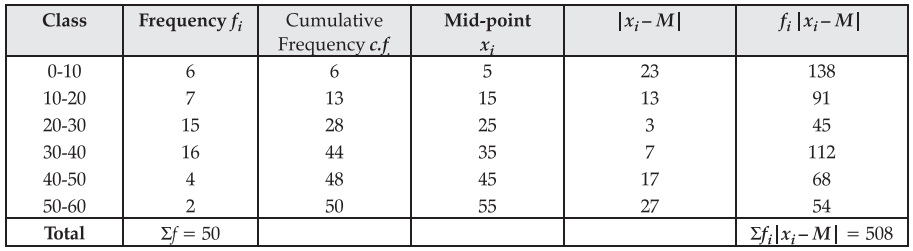
Here, The class interval containing $\left(\frac{N}{2}\right)^{\text {th }}$ or $25^{\text {th }}$ terms is $20-30$.
$\therefore 20-30$ is the median class.
$\therefore$ Median, MD $=l+\frac{\frac{N}{2}-C}{f} \times h$ where, $l=20, c=13, f=15, h=10$ and $N =50$
$
\begin{array}{l}
=20+\frac{25-13}{15} \times 10 \\
=20+8 \\
=28
\end{array}
$
Mean deviation about median,
$\begin{aligned} \text { M.D. }\left(M_d\right) & =\frac{1}{N} \Sigma f_i\left|x_i-M\right| \\ & =\frac{1}{50} \times 508 \\ & =10.16 . \\ \text { Coefficient of mean deviation about median } & =\frac{\text { M.D. }\left(M_d\right)}{\text { Median }} \times 100 \\ & =\frac{10.16}{28} \times 100 \\ & =36.28 . \text { (Approx.) }\end{aligned}$
View full question & answer
Question 125 Marks
The following table gives information regarding weekly income of labourers working at a dam site :
Image
Estimate (i) median (ii) 3rd decile (iii) $P_{95}$.
Answer
Here the classes are already continuous and of uniform width. The cumulative frequency table is
Weekly Income (in ₹)No. of employeesCumulative frequency
600- 7004040
700 -80068108
800 - 90086194
900 - 1000120314
1000 - 110090404
1100 - 120040444
1200 - 130026470

Total number, $n=470$
(i) Median is $\frac{n}{2}$ th i.e., $\frac{470}{2}$ th value i.e., 235 th value,
which lies in class $900-1000$
$\therefore \quad$ Median $\left(Q_2\right)=l+\frac{\frac{n}{2}-c}{f} \times i$
$=900+\frac{235-194}{120} \times 100$
$=900+34.17=934.17$ i.e., ₹ 934.17
(ii) Third decile $D_3$ is $\frac{3}{10}$ of 470 th value i.e., ( 0.3 ) ( 470 th) value i.e., 141 st value, which lies in class $800-900$.
$\therefore \quad D_3=l+\frac{\frac{3}{10} n-c}{f} \times i$
$=800+\frac{141-108}{86} \times 100$
$=800+38.37=838.37$ i.e., ₹ $ 838.37$
(iii) $P_{95}$ is $\frac{95}{100}$ of 470 th value i.e, 446.5 th value, which lies in class $1200-1300$.
$\therefore \quad P_{95}=l+\frac{\frac{95}{100} n-c}{f} \times i$
$=1200+\frac{446.5-444}{26} \times 100$
$=1200+9.5$
$=1209.6$ i.e., ₹ 1209.6.

View full question & answer
5 Marks Questions - Applied Maths STD 11 Science Questions - Vidyadip