Questions

Fill in the blanks.

🎯

Test yourself on this topic

14 questions · timed · auto-graded

Question 11 Mark
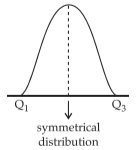
In symmetric distribution, the third quartile and first quartile of data in distribution must be at ____________ distance.
Answer
equal, because
For, symmetric distribution, $Q_1$ and $Q_2$ are at equal distance.
Image
View full question & answer
Question 21 Mark
When the frequency curve is more peaked than normal curve it is called __________
Answer
Leptokurtic, because
The curves with greater peakness than the normal curve are called leptokurtic
View full question & answer
Question 31 Mark
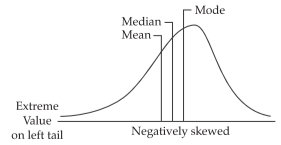
In case of negatively skewed distribution, the extreme value lies in ___________
Answer
Left tail, because
When distribution is negatively skewed, values lie on left side (or left tail).
Image
View full question & answer
Question 41 Mark
For a positively skewed distribution mean is always ___________
Answer
greater than mode, because
For positively skewed distribution mean $>$ mode, for negatively skewed distribution mean $<$ mode
View full question & answer
Question 51 Mark
The sum of square of the deviations of values of variables is ___________ , when taken about their arithmetic mean.
Answer
minimum, because
The sum of the squares of the deviations of the value of variable is minimum when taken about their arithmetic mean.
View full question & answer
Question 61 Mark
The standard deviations is ____________ to mean deviations taken from the arithmetic mean.
Answer
Greater then or equal, because
The standard deviation is greater than or equal to the mean deviations taken from the arithmetic mean.
View full question & answer
Question 71 Mark
The standard deviation of data is _____________ of any change in origin but is _____________ in change of scale.
Answer
independent; dependent, because
Since, the standard deviation of any data is independent of any change in origin but is dependent of any change of scale.
View full question & answer
Question 81 Mark
If the variance of data is 121 , then the standard deviation of data is ___________.
Answer
11, because
We know that,
$
\begin{aligned}
\text { S.D. } & =\sqrt{\text { variance }} \\
& =\sqrt{121} \\
& =11 .
\end{aligned}
$
View full question & answer
Question 91 Mark
Coefficient of variation $=\frac{\cdots \cdots \cdots \cdots}{\text { Mean }} \times 100$
Answer
S.D. (Standard Deviation), because
$
\text { C.V. }=\frac{\text { S.D. }}{\text { Mean }} \times 100
$
View full question & answer
Question 101 Mark
When tested the lines (in hours) of 5 bulbs were noted as follows : 1357, 1090, 1666, 1494, 1623; then mean deviation (in hours) from their mean is _________
Answer
178 , because
The lines of 5 bulbs are give as :
1357,1090,1666,1494,1623
$\therefore$ Mean, $\bar{x}=\frac{1357+1090+1666+1494+1623}{5}$
$=\frac{7230}{5}=1446$
$x_i$$d_i=\left|x_i-\bar{x}\right|$
1357
1090
1666
1494
1623
89
356
220
48
177
Total$\Sigma d_i=890$

Mean deviation, $MD =\frac{\Sigma d_i}{n}=\frac{890}{5}=178$.
View full question & answer
Question 111 Mark
Following are the wages of 8 workers expressed i
₹: 82,96,52,75,65,70,50,70 .
The range is _________ and coefficient of range is ________
Answer
₹ 46 and 315, because
The largest and smallest wages are L= ₹ 96 and S= ₹ 50
Thus, range = ₹ 96- ₹ 50= ₹ 46
and coefficient of range
$\begin{array}{l}=\frac{L-S}{L+S} \times 100 \\ =\frac{96-50}{96+50} \times 100 \\ =\frac{46}{146} \times 100=0.315 \times 100 \\ =31.5\end{array}$
View full question & answer
Question 121 Mark
$\left[\frac{\left(Q_3-Q_1\right)}{\left(Q_3+Q_1\right)}\right] \times 100$ is _________
Answer
Coefficient of quartile deviation, because. A relative measure of dispersion using quartiles is given by coefficient of quartile deviation which is Coefficient of quartile deviation $=\frac{Q_3-Q_1}{Q_3+Q_1} \times 100$
View full question & answer
Question 131 Mark
For the data : $5,24,36,12,20$, and 8 , value of $D_5$ is $\ldots$
Answer
16, because
Arranging the given data in ascending order, we get
$
\begin{aligned}
& 5,8,12,20,24,36 \\
D_5 & =\frac{5(6+1)}{10} \text { th value } \\
& =3.5^{th} \text { value }
\end{aligned}
$
$\begin{array}{l}=3^{\text {rd }} \text { value }+\frac{1}{2}\left(4^{\text {th }} \text { value }-3^{\text {rd }} \text { value }\right) \\ =12+\frac{1}{2}(20-12) \\ =12+4=16 .\end{array}$
View full question & answer
Question 141 Mark
The third quartile of the data set $33,25,42,25,31$, $37,46,29,38$, is .....
Answer
40 , because
On arranging the given data in ascending order, we get
$
\begin{array}{l}
25,25,29,31,33,37,38,42,46 \\
\qquad \begin{aligned}
Q_3 & =\frac{3(n+1)}{4} \text { th value } \\
& =\frac{3(9+1)}{4} \text { the value } \\
& {[\because n=9] }
\end{aligned}
\end{array}
$
$=\frac{30}{4}$ th value i.e., 7.5 value
$\begin{aligned} \therefore \quad Q_3 & =\frac{7^{\text {th }} \text { value }+8^{\text {th }} \text { value }}{2} \\ & =\frac{38+42}{2}=\frac{80}{2}=40 .\end{aligned}$
View full question & answer
Fill in the blanks. - Applied Maths STD 11 Science Questions - Vidyadip