Questions

5 Marks Questions

🎯

Test yourself on this topic

6 questions · timed · auto-graded

Question 15 Marks
Draw the graph of the function $|x-2|$.
Answer
Clearly,
$
\begin{aligned}
y & =|x-2|=\left\{\begin{array}{cc}
x-2, & x-2 \geq 0 \\
-(x-2), & x-2<0
\end{array}\right. \\
& =\left\{\begin{array}{ll}
x-2, & x \geq 2 \\
2-x, & x<2
\end{array}\right.
\end{aligned}
$
We know that, a linear equation in $x$ and $y$ represents a line for drawing a line, we need only two points for $y=x-2$.
X24
y02
So, plot the points $P(2,0), Q(4,2)$ and join $P Q$ to get the graph of $y=x-2$
for $y=2-x$;
X10
y12
Plot the points $R(1,1), S(0,2)$ and join RS to get the graph of $y=2-x$
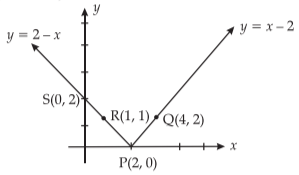
Image
View full question & answer
Question 25 Marks
Draw the graph of the function
$
f(x)=\left\{\begin{array}{ll}
1+2 x, & x<0 \\
3+5 x, & x \geq 0
\end{array}\right.
$
Also, find its range.
Answer
Given, $
f(x)=\left\{\begin{array}{ll}
1+2 x, & x<0 \\
3+5 x, & x \geq 0
\end{array}\right.
$
Here,
$
\begin{aligned}
f(x) & =1+2 x, x<0, \text { this gives } \\
f(-4) & =1+2(-4)=-7 \\
f(-3) & =1+2(-3)=-5 \\
f(-2) & =1+2(-2)=-3 \\
f(-1) & =1+2(-1)=-1
\end{aligned}
$
and
$
\begin{array}{l}
f(x)=3+5 x, x \geq 0 \\
f(0)=3+5(0)=3 \\
f(1)=3+5(1)=8 \\
f(2)=3+5(2)=13 \\
f(3)=3+5(3)=18 \\
f(4)=3+5(4)=23
\end{array}
$
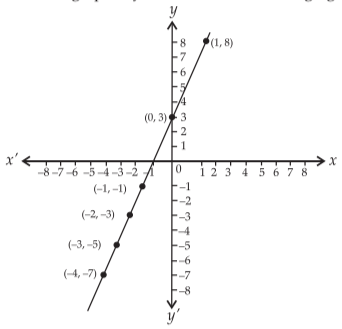
Now the graph of $f$ is as shown in following figure.
Image
$\begin{array}{ll}\text { Range }: \text { Let } & y_1=f(x), x<0 \\ \therefore & y_1=1+2 x, x<0\end{array}$
$
\begin{array}{lr}
\therefore & x=\frac{y_1-1}{2}, x<0 \\
\because & x<0 \Rightarrow y_1-1<0 \Rightarrow y_1<1 \\
\text { Let } & y_2=f(x), x \geq 0 \\
\therefore & y_2=3+5 x, x \geq 0 \\
\Rightarrow & x=\frac{y_2-3}{5}, x \geq 0 \\
\because & x \geq 0 \Rightarrow y_2-3 \geq 0 \Rightarrow y_2 \geq 3
\end{array}
$
Therefore, range of $f(-\infty, 1), \cup[3, \infty)$.
View full question & answer
Question 35 Marks
Draw the graph of following function and find range $\left(R_f\right)$ of $f(x)=|x-2|+|2-x| \forall-3 \leq x \leq 3$. U
Answer
Given, $f(x)=|x-2|+|2-x| \forall-3 \leq x \leq 3$.
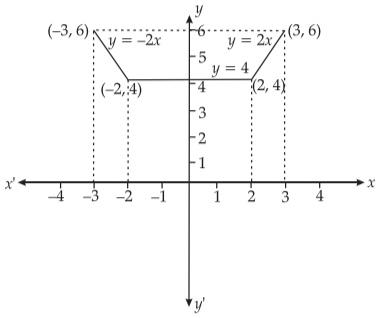
$f(x)=\left\{\begin{array}{cc}2 x, & 2 \leq x \leq 3 \\ 4, & -2 \leq x<2 \\ -2 x, & -2 \leq x \leq-3\end{array}\right.$
Image
Range of $f=[4,6]$
View full question & answer
Question 45 Marks
Find the domain and range of the following functions:
(i) $f(x)=\frac{1}{\sqrt{x-5}}$
(ii) $f(x)=\left\{\left(\frac{x^2-1}{x-1}\right): x \in R, x \neq 1\right\}$
Answer
(i) Given, $f(x)=\frac{1}{\sqrt{x-5}}$
$f(x)$ is defined, if $x-5>0 \Rightarrow x>5$ 
$\therefore$ Domain of $f=(5, \infty)$
Let $f(x)=y$
$\therefore \quad y=\frac{1}{\sqrt{x-5}}$
or, $\quad \sqrt{x-5}=\frac{1}{y}$
or, $x-5=\frac{1}{y^2}$
or, $x=\frac{1}{y^2}+5$
$\begin{array}{l}\therefore x \in(5, \infty) \in y \Rightarrow R^{+} \\ \text {Hence, range of } f=R^{+}>5 .\end{array}$
(ii) Given, $f(x)=\frac{x^2-1}{x-1}, x \neq 1$, clearly $f(x)$ is defined for all real values of $x$ except $x=1$
i.e., Domain of $f(x)=R-\{1\}$
Now, $\quad f(x)=\frac{x^2-1}{x-1}$
$=\frac{(x-1)(x+1)}{x-1}$
$\begin{aligned} \Rightarrow & f(x)  =x+1, x \neq 1 \\ \Rightarrow & \text { Range of } f(x)  = R -\{2\}\end{aligned}$
$[\therefore$ At $x=1, f(x)=1+1=2]$
View full question & answer
Question 55 Marks
Let $A=\{9,10,11,12,13\}$ and let $f: A \rightarrow N$ defined by $f(n)=$ the highest prime factor of $n$. Find the range of $f$.
Answer
Given, $A=\{9,10,11,12,13\}$ and $f: A \rightarrow N$ and
$f(n)=$ the highest prime factor of ' $n$ '
For $n=9,9=1 \times 3 \times 3$
$\Rightarrow$ Highest prime factor of $9=3$.
For $n=10,10=1 \times 2 \times 5$
$\Rightarrow$ Highest prime factor of $10=5$
For $n=11,11=1 \times 11$
$\Rightarrow$ Highest prime factor of $11=11$
For $n=12,12=1 \times 2 \times 2 \times 3$
$\Rightarrow$ Highest prime factor of $12=3$
For $n=13,13=1 \times 13$
$\Rightarrow$ Highest prime factor of $13=13$
$\therefore f(n)=\{(9,3),(10,5),(11,11),(12,3),(13,13)\}$
$\Rightarrow$ Range $=\{3,5,11,13\}$.
View full question & answer
Question 65 Marks
If $f$ and $g$ are real functions defined by $f(x)=x^2+7$ and $g(x)=3 x+5$, find each of the following :
(a) $f(3)+g(-5)$
(b) $f\left(\frac{1}{2}\right) \times g(14)$
(c) $f(-2)+g(-1)$
(d) $f(t)-f(-2)$
(e) $\frac{f(t)-f(5)}{t-5}$, if $t \neq 5$
Answer
Given, $f$ and $g$ are real functions defined by
$
f(x)=x^2+7 \text { and } g(x)=3 x+5
$
(a) $f(3)=(3)^2+7=9+7=16$
and $g(-5)=3(-5)+5$
$\quad=-15+5=-10$
$\therefore \quad f(3)+g(-5)=16-10=6$
(b) $f\left(\frac{1}{2}\right)=\left(\frac{1}{2}\right)^2+7$
$=\frac{1}{4}+7=\frac{29}{4}$
and $g(14)=3(14)+5$
$=42+5=47$
$\therefore \quad f\left(\frac{1}{2}\right) \times g(14)=\frac{29}{4} \times 47=\frac{1363}{4}$.
(c) $f(-2)=(-2)^2+7$
$=4+7=11$
and $g(-1)=3(-1)+5$
$=-3+5=2$
$\therefore \quad f(-2)+g(-1)=11+2=13$
(d) $f(t)=(t)^2+7=t^2+7$
$\begin{array}{lrl}\text { and } f(-2) =(-2)^2+7=4+7=11 \\ \therefore f(t)-f(-2)  =t^2+7-11=t^2-4 .\end{array}$
(e) $f(t)=t^2+7$
and $f(5)=(5)^2+7=25+7=32$
$\therefore \quad \frac{f(t)-f(5)}{t-5}=\frac{t^2+7-25-7}{t-5}$
$=\frac{t^2-25}{t-5}=t+5$


View full question & answer
5 Marks Questions - Applied Maths STD 11 Science Questions - Vidyadip