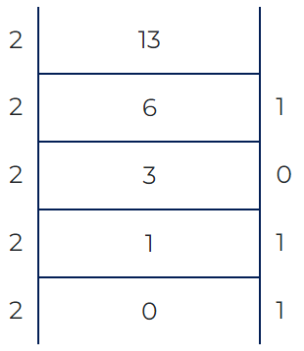
Workout for the day of week on the given date 13th August 1975.
Answer
We know that: In 1600 years, we have 0 odd days. In 300 years, we have 1 odd day. So, in 1900 years there $0+1=1$ odd day. Now from 1901 to 1974, there are 18 leap years and 56 non-leap years. So, the number of odd days is $18 \times 2+56 \times 1=92$ odd days or $13 \times 7+1$ $=1$ odd day (up to 31st Dec. 1974). Since 1975 is a non-leap year, so from 1st Jan. 1975 to 13th Aug. 1975, we have 31 (Jan.) + 28 (Feb.) +31 (Mar.) +30 (Apr.) +31 (May) +30 (Jun.) +31 (Jul.) + 13 days $=225$ days $=32 \times 7+1=1$ odd day So, the total number of odd days $=1+1+1=3$ odd days. $\therefore$ Day on 13th Aug. 1975 was Wednesday
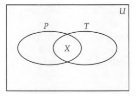
i. It is evident from the Venn diagram that the policemen $x$ is a thief also. So, the given statement is not true. Hence, its truth value is 'F'. ii. From the Venn-diagram, we find that $\mathrm{P} \cap \mathrm{T} \neq \Phi$. So, there are some thieves who are also policemen. Hence, the above statement is not true. So, its truth value is 'F'. iii. It is evident from the Venn-diagram that there are some human beings who are neither policemen nor thieves. So, the above statement is not true and its truth value is 'F'. iv. Clearly, policemen $x$ is a thief also. Therefore, the given statement is true and its truth value is 'T'.
The average monthly savings of a company was ₹ 12 lakh for the first 3 months, ₹ 12.5 lakh for the next 4 months and ₹ 31.2 lakh during the next 5 months of a year. Total expenditure during the year is 78 lakh. Find the average monthly earnings of the company.
Answer
Given, average monthly savings for the first 3 months $=₹ 12$ lakh $\Rightarrow$ total savings for the first 3 months $=₹(3 \times 12)$ lakh $=₹ 36$ lakh. Given, average monthly savings for the next 4 months $=₹ 12.5$ lakh $\Rightarrow$ total savings for the next 4 months $=₹(4 \times 12.5)$ lakh $=₹ 50$ lakh. Also, given average monthly savings for the next 5 months $=₹ 31.2$ lakh $\Rightarrow$ total savings for the next 5 months $=₹(5 \times 31.2)$ lakh $=₹ 56$ lakh $\therefore$ Total annual savings $=₹ 36$ lakh $+ ₹ 50$ lakh $+₹ 156$ lakh $=₹ 242$ lakh Given total yearly expenditure $=₹ 78$ lakh $\therefore$ Total yearly earnings $=₹ 242$ lakh $+ ₹ 78$ lakh $=₹ 320$ lakh $\therefore$ Average monthly earnings $=₹ \frac{320}{12}$ lakh $=₹ 26.67$ lakh.