Question 14 MarksThe reliability of a Covid-19 test is specified as follows:Of people having Covid-19, $90 \%$ of the test detect the disease but $10 \%$ go undetected. Of people free of Covid19, $99 \%$ of the test are judged Covid-19 negative but $1 \%$ are diagnosed as showing Covid-19 positive.From a large population of which only $0.1 \%$ have Covid-19, one person is selected at random, given the Covid19 test and Pathologist reports him/her as Covid-19 positive.(a) What is the probability of the person to be tested as Covid-19 positive given that he is actually having Covid-19?(b) What is the probability of the person to be tested as Covid-19 positive given that he is not actually having Covid-19?(c) What is the probability that the person selected will be diagnosed as Covid-19 positive?AnswerThe reliability of a Covid-19 test is specified as follows:Of people having Covid-19, $90 \%$ of the test detect the disease but $10 \%$ go undetected. Of people free of Covid-19, $99 \%$ of the test are judged Covid-19 negative but $1 \%$ are diagnosed as showing Covid-19 positive.From a large population of which only $0.1 \%$ have Covid-19, one person is selected at random, given the Covid-19 test and Pathologist reports him/her as Covid-19 positive.(i) Let E: the person selected is actually having Covid-19$\mathrm{E}^{\prime}$ : the person selected is not having Covid-19A: Person's Covid-19 test is diagnosed as +ve .$P(A \mid E)=90 \%=0.9$(ii) Let E : the person selected is actually having Covid-19$\mathrm{E}^{\prime}$ : the person selected is not having Covid-19A: Person's Covid-19 test is diagnosed as +ve .$\mathrm{P}\left(\mathrm{A} \mid \mathrm{E}^{\prime}\right)=1 \%=0.01$(iii)Let E : the person selected is actually having Covid-19$\mathrm{E}^{\prime}$ : the person selected is not having Covid-19A: Person's Covid-19 test is diagnosed as +ve.$P(E)=0.1 \%=\frac{0.1}{100}=\frac{1}{1000}=0.001$$\mathrm{P}\left(\mathrm{E}^{\prime}\right)=1-\mathrm{P}(\mathrm{E})=1-0.001=0.999$$P(A)=P(A \mid E) P(E)+P(A \mid E ') \cdot P\left(E^{\prime}\right)$$=\frac{90}{100} \times \frac{1}{1000}+\frac{1}{100} \times \frac{999}{1000}=\frac{1089}{10000}=0.01089$View full question & answer→
Question 24 MarksRahul and Saurabh are playing cards. Total number of cards are 52 in numbers. Each of them draw cards one by one(a) Rahul draw four cards, find the probability that all the four cards are from the same suit.(b) Saurabh draw four cards, find the probability that one of the four cards is an ace.(c) Rahul draw four cards, find the probability that one card is drawn from each suit.AnswerRahul and Saurabh are playing cards. Total number of cards are 52 in numbers. Each of them draw cards one by one(i) As we know there are four suits,Favourable cases are: ${ }^{13} \mathrm{C}_{4}+{ }^{13} \mathrm{C}_{4}+{ }^{13} \mathrm{C}_{4}+{ }^{13} \mathrm{C}_{4}$$=4\left({ }^{13} \mathrm{C}_{4}\right)$Required probability $=\frac{4\left({ }^{13} \mathrm{C}_{4}\right)}{{ }^{52} \mathrm{C}_{4}}$(ii) Since, there are 4 aces in the pack of 52 cards, therefore, the no. of ways of drawing 4 cards so that no card is an ace $=$ ${ }^{48} \mathrm{C}_{4}$$\therefore$ Probability of four cards so that none is an ace$=\frac{{ }^{48} C_{4}}{{ }^{52} C_{4}}$$=\frac{48 \times 47 \times 46 \times 45}{52 \times 51 \times 50 \times 49}$$=\frac{38916}{54145}$Thus, required probability $=1-\frac{38916}{54145}$$=\frac{15229}{54145}$(iii)Favourable cases to draw one card from each suit is:${ }^{13} \mathrm{C}_{1} \times{ }^{13} \mathrm{C}_{1} \times{ }^{13} \mathrm{C}_{1} \times{ }^{13} \mathrm{C}_{1}=\left({ }^{13} \mathrm{C}_{1}\right){ }^{4}$Require probability $=\frac{\left({ }^{13} C_{1}\right)^{4}}{{ }^{52} C_{4}}$$=\frac{\frac{13 \times 13 \times 13 \times 13}{52 \times 51 \times 50 \times 49}}{4 \times 3 \times 2 \times 1}$$=\frac{2197}{20825}$View full question & answer→
Question 34 MarksData of all the previous cricket matches are stored to analyze the average batting score of various batsmen. The scores of a batsman in ten innings are:38, 70, 48, 34, 42, 55, 63, 46, 54, 44(a) What is the median of the data?(b) What is the mean deviation about the median of the given scores?(c) If the scores 38 and 34 are replaced by 68 and 74 what will be the mean of the data?ORDifference between maximum value of data and minimum vale of data is called?AnswerData of all the previous cricket matches are stored to analyze the average batting score of various batsmen. The scores of a batsman in ten innings are:$38,70,48,34,42,55,63,46,54,44$(i) Arranging the data in ascending order $=34,38,42,44,46,48,54,55,63,70$Median $=$ A.M. of 5th and 6th observation$=\frac{46+48}{2}=47$$x_i$$\left| d _1\right|=\left| x _1-47\right|$389702348134134255586316461547443Total$\sum\left|d_i\right|= 8 6$Mean Deviation $=\frac{1}{n} \times \sum\left|d_i\right|=\frac{86}{10}=8.6$(iii)Sum of new scores $=564$New mean $=\frac{564}{10}=56.4$ORIt is called range of the data.View full question & answer→
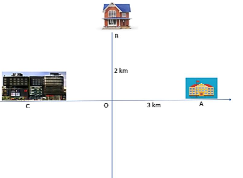
Question 44 MarksGiven the map is showing Saloni’s home and school. Her school is at the position A, home is at the position B and a shopping mall is at the position C. Assuming O is the origin, OA is along X-axis and OB is along Y-axis.(a) Find the coordinates of $A$ and $B$ also find slope of $A B$(b) What would be the equation of the line passing through $A$ and $B$.(c) A shopping mall is situated at the position C. If slope of the line BC is 1, then find equation of BC ORFind the equation of line passing through $(-2,4)$ and perpendicular to $A B$AnswerGiven the map is showing Saloni's home and school. Her school is at the position A, home is at the position B and a shopping mall is at the position C. Assuming O is the origin, OA is along X-axis and OB is along Y-axis.(i) A is on x-axis at a distance 3 km from origin. B is on y-axis at a distance of 2 km from origin.Hence coordinates of $\mathrm{A}=(3,0)$ and $\mathrm{B}=(0,2)$$A=(3,0)$ and $B=(0,2)$Slope of line $A B$ is $\frac{y_{2}-y_{1}}{x_{2}-x_{1}}=\frac{2-0}{0-3}=\frac{-2}{3}$(ii) $2 x+3 y=6$Since slope $=\frac{2}{-3} A=(3,0)$Equation of line in point slope form is$\mathrm{y}-\mathrm{y}_{1}=\mathrm{m}\left(\mathrm{x}-\mathrm{x}_{1}\right)$$\Rightarrow \mathrm{y}-0=\frac{2}{-3}(x-3)$$\Rightarrow-3 \mathrm{y}-0=2 \mathrm{x}-6$$\Rightarrow 2 \mathrm{x}+3 \mathrm{y}=6$(iii) $\mathrm{x}-\mathrm{y}+2=0$Since slope BC $=1$ and $B=(0,2)$Equation of line in point slope form is$\mathrm{y}-\mathrm{y}_{1}=\mathrm{m}\left(\mathrm{x}-\mathrm{x}_{1}\right)$$\Rightarrow \mathrm{y}-2=1(\mathrm{x}-0)$$\Rightarrow \mathrm{y}-2=\mathrm{x}-0$$\Rightarrow \mathrm{x}-\mathrm{y}+2=0$ORslop $A B=\frac{-2}{3}$ since required line is $\perp A B$slope of required line $=\mathrm{m}=\frac{3}{2}$Hence equation of line passing through $(-2,4)$ and having slope $m=\frac{3}{2}$$\Rightarrow \mathrm{y}-\mathrm{y}_{1}=\mathrm{m}\left(\mathrm{x}-\mathrm{x}_{1}\right)$$\Rightarrow \mathrm{y}-4=\frac{3}{2}(\mathrm{x}+2)$$\Rightarrow 2 y-8=3 x+6$$\Rightarrow 3 \mathrm{x}-2 \mathrm{y}+14=0$View full question & answer→