Questions

3 Marks Question

🎯

Test yourself on this topic

7 questions · timed · auto-graded

Question 13 Marks
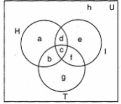
In a survey of 60 people, it was found that 25 people read Newspaper H, 26 read Newspaper T, 26 read Newspaper I, 9 read both H and I, 11 read both H and T, 8 read both T and I, 3 read all the three Newspapers. Find
i. the number of people who read at least one of the three Newspapers.
ii. the number of people who read exactly one Newspaper.
View full question & answer
Question 23 Marks
A man borrowed ₹5000 for 4 years under the following terms: $4 \%$ simple interest for the first $2 \frac{1}{2}$ years, $4 \%$ compound interest for the rest of the period on the amount due after $2 \frac{1}{2}$ years, the interest being compounded semi-annually. How much should he pay to settle the account?
Answer
For first $2 \frac{1}{2}$ year.
$\mathrm{P}=$ ₹ $5000, \mathrm{R}=4 \%, \mathrm{~T}=2 \frac{1}{2}$ year $=\frac{5}{2}$ year
$I=$ ₹ $\frac{5000 \times 4 \times 10}{2 \times 100}$
$=250 \times 4$
$=1000$
$A=5000+1000=6000$
For remaining $1 \frac{1}{2}$ year: $\mathrm{P}=6000, \mathrm{~T}=\frac{3}{2}$ year , $\mathrm{R}=4 \%$ p.a.
$A=P\left(1+\frac{R}{200}\right)^{2 n}$
$=6000\left(1+\frac{4}{200}\right)^{\frac{3}{2} \times 2}$
$=6000\left(\frac{51}{50}\right)$
$=6000 \times \frac{51}{50} \times \frac{51}{50} \times \frac{51}{50}$
$=\frac{795906}{125}=$ ₹ $6367.248$
Total amount to be paid $=$ ₹ $6367.248$
View full question & answer
Question 33 Marks
For an industrial connection monthly consumption of water is 40 Kl , calculate the Water bill. Tariff rates can be considered as the table given below:
Monthly Consumption (in Kilolitre)Service Charge (in ₹)Volumetric Charge (Per Kl in ₹)
Upto 20146.415.27
20-30219.62*26.36
> 30292.8243.93
Plus Sewer Maintenance Charges: $60\%$ of water volumetric charge
Answer
Volumetric Charge for consumption upto $20 \mathrm{kl}=₹ 20 \times 5.27=$ ₹ 105.4
Volumetric Charge for consumption between 20-30 kl = ₹ $10 \times 26.36=₹ 263.6$
Volumetric Charge for consumption between $30-40 \mathrm{kl}=₹ 10 \times 43.93=₹ 439.3$
Total volumetric Charge for consumption of $40 \mathrm{kl}=₹(105.4+263.6+439.3)=₹ 808.3$
Service Charge = ₹ 292.82
Sewage Charges $=60 \%$ of Volumetric Charges
$=808.3 \times 60 \%$ = ₹ 484.98
Amount of water bill for the given month $=₹(808.3+292.82+484.98)=₹ 1586.1$
Thus, amount of domestic water bill is ₹ 1586 .
View full question & answer
Question 43 Marks
Prove that the greatest integer function [x] is continuous at all points except at integer points.
Answer
Let $\mathrm{f}(\mathrm{x})=[\mathrm{x}]$ be the greatest integer function and let k be any integer. Then,
$\mathrm{f}(\mathrm{x})=[x]=\left\{\begin{array}{cc}k-1, & \text { if } k-1 \leq x < k \\ k, & \text { if } k \leq x < k+1\end{array}\right.$ [By definition of [x]]
Now, (LHL at $\mathrm{x}=\mathrm{k}$ ) $=\lim _{x \rightarrow k^{-}} f(x)=\lim _{h \rightarrow 0} f(k-h)=\lim _{h \rightarrow 0}[k-h]$
$=\lim _{h \rightarrow 0}(k-1)=\mathrm{k}-1[\because \mathrm{k}-1 \leq \mathrm{k}-\mathrm{h}<\mathrm{k} \therefore[\mathrm{k}-\mathrm{h}]=\mathrm{k}-1]$
and $($ RHL at $\mathrm{x}=\mathrm{k})=\lim _{x \rightarrow k^{+}} f(x)=\lim _{h \rightarrow 0} f(k+h)=\lim _{h \rightarrow 0}[k+h]$
$=\lim _{h \rightarrow 0} k=\mathrm{k}[\because \mathrm{k} \leq \mathrm{k}+\mathrm{h}<\mathrm{k}+1 \therefore[\mathrm{k}+\mathrm{h}]=\mathrm{k}]$
$\therefore \lim _{x \rightarrow k^{-}} f(x) \neq \lim _{x \rightarrow k^{+}} f(x)$.
So, $f(x)$ is not continuous at $x=k$.
Since $k$ is an arbitrary integer. Therefore, $f(x)$ is not continuous at integer points. Let a be any real number other than an integer.
Then, there exists an integer $k$ such that
$\mathrm{k}-1<\mathrm{a}<\mathrm{k}$.
Now.
$($ LHL at $\mathrm{x}=\mathrm{a})=\lim _{x \rightarrow a^{-}} f(x)=\lim _{h \rightarrow 0} f(a-h)=\lim _{h \rightarrow 0}[a-h]$
$=\lim _{h \rightarrow 0} k-1=\mathrm{k}-1[\because \mathrm{k}-1<\mathrm{a}-\mathrm{h}<\mathrm{k}[\mathrm{a}-\mathrm{h}]=\mathrm{k}-1]$
$($ RHL at $\mathrm{x}=\mathrm{a})=\lim _{x \rightarrow a^{+}} f(x)=\lim _{h \rightarrow 0} f(a+h)$
$=\lim _{h \rightarrow 0}[a+h]=\lim _{h \rightarrow 0}(k-1)=\mathrm{k}-1\left[\begin{array}{l}\because k-1 < a+h < k \\ \therefore[a+h]=k-1\end{array}\right]$
and, $\mathrm{f}(\mathrm{a})=[\mathrm{a}]=\mathrm{k}-1[\because \mathrm{k}-1<\mathrm{a}<\mathrm{k} \therefore[\mathrm{a}]=\mathrm{k}-1]$
Thus, $\lim _{x-a^{-}} f(x)=\lim _{x \rightarrow a^{+}} f(x)=f(a)$
So, $\mathrm{f}(\mathrm{x})$ is continuous at $\mathrm{x}=\mathrm{a}$. Since a is an arbitrary real number, other than an integer. Therefore, $\mathrm{f}(\mathrm{x})$ is continuous at all real points except integer points.
View full question & answer
Question 53 Marks
Find the values of the letter and give a reason for the steps involved.
$\begin{array}{r}B 345 \\ +C 9 B A \\ \hline 8 B A 2 \\ \hline\end{array}$
Answer
$\begin{array}{r}B 345 \\ +C 9 B A \\ \hline 8 B A 2 \\ \hline\end{array}$
We have to find the value of $\mathrm{A}, \mathrm{B}$, and C .
For this, $5+$ A we get 2 , a number whose unit digit is 2
Clearly $5+7=12$
So, $\mathrm{A}=7$, and Question becomes,
$\begin{array}{r}1 \\ B 345 \\ +C 9 B 7 \\ \hline 8 B 72 \\ \hline\end{array}$
Now, we have $1+4+B=7,$ A number whose unit digit is 7
So, the number should be 2, as $1+4+2=7$
$\therefore B=2$
Now, the question reduced to,
$\begin{array}{r}1~~1~~ \\ 2345 \\ +C 927 \\ \hline 8272 \\ \hline\end{array}$
Again we have $1+2+C=8$
So, the number should be 5, as $1+2+5=8$
$\therefore C=5$
So, the question reduced to,
$\begin{array}{r}1~~1~~ \\ 2345 \\ +5 927 \\ \hline 8272 \\ \hline\end{array}$
Hence, $A=7;B=2;C=5$
View full question & answer
Question 63 Marks
Five boys and 5 girls are to be seated on a bench with the boys and girls alternately. Find the number of ways of their seating.
Answer
Mark the seat numbers on the bench as $1,2,3, \ldots, 10$ as shown:
$\times$$\times$$\times$$\times$$\times$$\times$$\times$$\times$$\times$$\times$
12345678910
The boys and girls will sit alternately if ther boys sit at seat numbers 1, 3, 5, 7, and 9 or sit on the girls will sit on the remaining seats.
Now 5 boys can be arranged among themselves in $|\underline{5}$ ways and 5 girls can be arranged among themselves in $| \underline{5}$ ways.
$\therefore$ Required number of ways $=|\underline{5} \times| \underline{5} \times 2=120 \times 120 \times 2=28800$
View full question & answer
Question 73 Marks
A polygon has 35 diagonals. Find the number of its sides.
Answer
Let $n$ be the number of sides of a polygon and $D$ be the number of diagonals of that polygon.
We know that, $\mathrm{D}={ }^{n} C_{2}-n=\frac{n(n-3)}{2}$
$35=\frac{n^{2}-3 n}{2}$
$\Rightarrow \mathrm{n}^{2}-3 \mathrm{n}-70=0$
$\Rightarrow(\mathrm{n}-10)(\mathrm{n}+7)=0$
$\Rightarrow \mathrm{n}=10,-7$
Since, sides cannot be negative, therefore $\mathrm{n}=10$.
Hence, polygon is a decagon.
View full question & answer
3 Marks Question - Applied Maths STD 11 Science Questions - Vidyadip